AEO Tools: 9 Answer Engine Optimization Tools Compared by the Job They Do
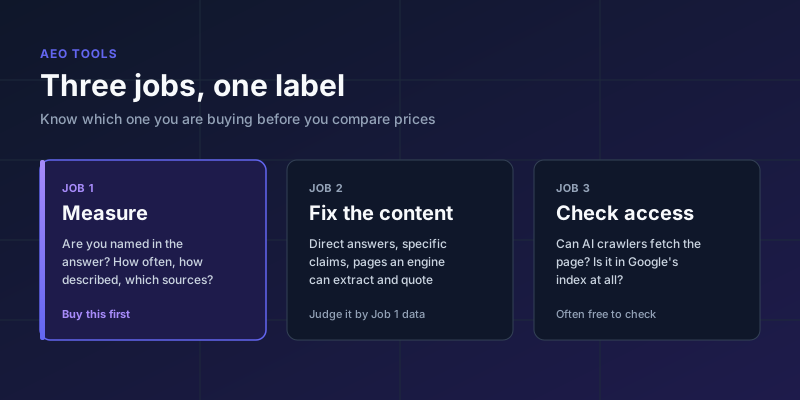
AEO tools are software for Answer Engine Optimization (AEO): they show whether AI answer engines such as ChatGPT, Google AI Overviews, Google AI Mode and Perplexity name your brand when a buyer asks a question, and they help you change the pages those engines read so that they do. In practice each product does one of three jobs. It measures your visibility in the answers, it helps you rewrite content, or it checks whether AI crawlers can reach your site. Very few do all three well, and nearly all of them call themselves AEO tools.
Below are nine answer engine optimization tools, grouped by the job they actually do, priced from each vendor's own page on 9 October 2026. We make one of them, so we have put our own product in the same format as the rest and listed where it falls short.
The Short Answer
| If you need... | Look at | Why |
|---|---|---|
| The most recorded answers per dollar | SE Visible | $99/mo for 200 prompts and about 30,000 answers a month, on five engines |
| A free start with no card | HubSpot AEO | 25 prompts on ChatGPT, Gemini and Perplexity free, then $50/mo |
| The cheapest paid tracking | Otterly.AI Lite | $29/mo for 15 prompts, Copilot included |
| Tracking plus AI-written articles in one bill | AIclicks | 30 tracked prompts and 5 "AI-optimized articles" a month from $59/mo |
| A content tool that has added tracking | Frase | AI visibility on ChatGPT and Google AI from $49/mo |
| Enterprise coverage across nine engines | Profound | Custom pricing; the only public plan is a 7-day free trial |
| Both Google AI surfaces, your own prompts, answer-level history | RankScope Professional | ChatGPT, AI Overviews, Perplexity and AI Mode, recorded in a real browser |
Three Jobs Sold Under One Label
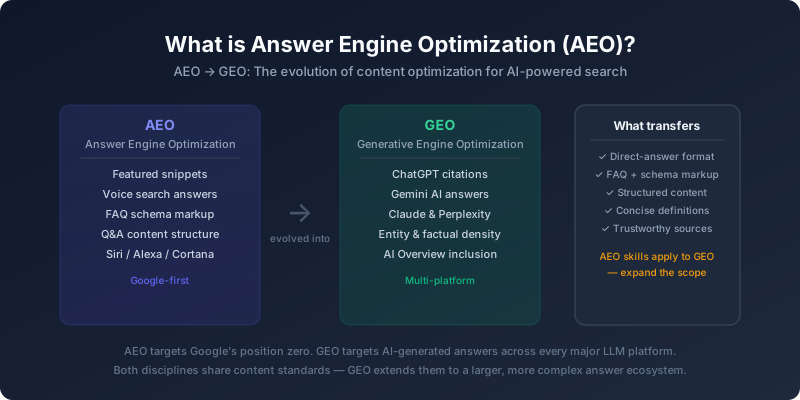
AEO and Generative Engine Optimization (GEO) describe the same practice under two names; our explainer on what AEO is covers why both terms survive. The tooling splits along a more useful line: what problem it solves for you.
Job 1: measure. The tool sends a list of questions (prompts) to each engine on a schedule, records the answers, and tells you whether you were named, how often against competitors, how you were described, and which sources the engine cited. Without this you are guessing. Every other job depends on it, because you cannot tell whether a content change worked unless you measured before and after.
Job 2: fix the content. The tool scores or rewrites pages to be easier for an engine to extract and quote: direct answers near the top, specific claims, clean structure. Some generate whole articles. This job is older than AI search and most of the products doing it began as SEO writing tools.
Job 3: check access. The tool tells you whether AI crawlers such as GPTBot and PerplexityBot are fetching your pages, and sometimes how much traffic AI engines send you. It is the least crowded job and the one most people skip.
A practical test when you read any AEO tool's home page: find the screen that shows you an actual AI answer, with your brand in it or missing from it. If there is no such screen, it is a Job 2 tool, whatever the headline says.
What Google Showed for "aeo tools" on 9 October
We pulled the live Google results for "aeo tools" on 9 October 2026, US English, desktop. Google Ads data puts the term at about 880 searches a month, at a cost per click of about $51, which tells you advertisers think the people searching it are buying.
An AI Overview sat above everything else. It loaded asynchronously, so our collection tool could not capture its text, and we are not going to describe an answer we did not read.
The ten organic results were all about software, and all aimed at marketing teams choosing a tool:
| Position | Page | Who wrote it |
|---|---|---|
| 1 | Best AEO Tools for 2026 | TechnologyAdvice, a review site |
| 2 | 10 Best Answer Engine Optimization (AEO) Tools for 2026 | Geoptie, a vendor |
| 3 | AEO tools guide 2026: 19 best answer engine optimization platforms | Profound, a vendor, which lists itself first |
| 4 | What are the best tools for Answer Engine Optimization? | Reddit, r/seogrowth |
| 5 | AEO Tools to Track & Improve Your AI Visibility | HubSpot's product page |
| 6 | 16 Best AEO Tools I've Tested in 2026 | AIclicks, a vendor, which lists itself first |
| 7 | Best Answer Engine Optimization Tools for AI Search | SE Visible, a vendor |
| 8 | 7 Best AEO Tools for Agencies in 2026 | Rankability, a vendor |
| 9 | Best AEO Tools for Getting Cited in AI Answers | Frase, a vendor, which ranks itself first |
| 10 | Best Answer Engine Optimization (AEO) Tools | G2, a review site |
Seven of the ten are written by companies that sell an AEO tool. That includes this page. Read every list here, ours included, knowing that, and weight the parts you can check: prices with a date, engine lists quoted from the vendor, and arithmetic you can redo yourself.
What Used to Be Sold as AEO, and the Mistake We Made With It
Before AI answers, "answer engine optimization" mostly meant winning Google's featured snippets and People Also Ask boxes, and FAQ schema was the headline tactic. Plenty of tools still sell that version: schema generators, snippet trackers, "AEO score" checkers that count your FAQ blocks.
Much of that stopped working for most sites in 2023. On 8 August 2023 Google announced that FAQ rich results would only be shown for "well-known, authoritative government and health websites", and began removing HowTo rich results, which went from desktop too in September (Google Search Central).
We did not check that before acting on it. By September 2026 our blog emitted 66 FAQPage schema blocks and 13 HowTo blocks, and we had a follow-up planned to look in Search Console for the FAQ rich results we expected them to produce. They could never have appeared. rankscope.ai is a software company, not a government or health site, and was never eligible. That follow-up would have been a session spent debugging a system that was working as designed. One fetch of Google's documentation would have saved it.
The same audit turned up a second defect. Across our posts, 37 of 408 FAQ questions existed only inside the schema markup, with no visible answer on the page. A reader never saw them. Google requires structured data to describe content that is on the page, so at best that markup was ignored. We fixed it by rendering every page's FAQ and its schema from one list, so the two cannot drift apart again.
We kept the markup. Structured data is still machine-readable context for any system deciding what a page says, and the visible Q&A we added stands on its own. But we changed why we keep it, and we stopped expecting a rich result from it.
Google has since been explicit about the newer version of this idea. Its guide to AI features in Search, last updated 10 July 2026, says: "Structured data isn't required for generative AI search, and there's no special schema.org markup you need to add." It also says you "don't need to create new machine readable files, AI text files, markup, or Markdown to appear in Google Search" (Google Search Central). We had pitched llms.txt as a visibility lever in our own checklist and glossary. For Google's AI Overviews and AI Mode, it is not one, and we are correcting both.
So when an AEO tool's main feature is schema generation, FAQ blocks or an llms.txt file, ask what result it expects that to produce, on which engine, and whether that engine's own documentation agrees.
What Our Own Search Console Says About AEO Tool Searches
Here is a number we did not expect.
Between 6 July and 4 October 2026, Google Search Console recorded 109 distinct queries containing "aeo" or "answer engine" together with a word like tool, platform, software or best, that showed one of our pages. Together they produced 2,745 impressions across 25 different pages. They produced zero clicks.
None of them was the head term. "aeo tools", "aeo tool", "best aeo tools", "answer engine optimization tools" and "aeo software" did not appear once.
What did appear looks like this:
- "what are the best alternatives to semrush for tracking ai search visibility? i want to know a tool that's dedicate to aeo..." (1,967 impressions on its own)
- "which platform is better for answer engine optimization, profound or semrush? provide a definitive answer, along with a list of pros and cons specific to answer engine optimization features for each."
- "which answer engine optimization tools have the best track record for data accuracy and reliable rank tracking in llms today?"
93 of the 109 queries run to ten words or more. 17 of them follow one template almost word for word: "which is better, X or Y? provide a definitive answer, along with a list of pros and cons specific to [use case] for each."
People do not type that into Google. It reads like a prompt written for a chatbot, generated from a template, with the brand names and the use case swapped in. Our best guess is that these are prompts run by AI visibility tools, which can surface in Search Console when Google's AI features search on the prompt's behalf. We have not confirmed that mechanism, and nothing in Search Console can confirm it. What we can say is that this population behaves nothing like human search: one query takes 72% of the impressions, the rest are near-uniform templates, and nobody clicks. An earlier audit of our whole site found the same pattern at larger scale, which is why we now exclude queries of ten words or more from any read of clicks or position.
There are two lessons here for anyone buying an AEO tool.
First, the prompts many tools track are generated, and generated prompts can look nothing like what your buyers ask. A tool that hands you 500 prompts it wrote is giving you a lot of data about a market of its own making.
Second, if you check your own Search Console after buying one, expect strange long queries to appear. They are not demand.
Job 1: Tools That Measure Answer Engine Visibility
Prices are from each vendor's own page on 9 October 2026, monthly billing unless marked.
1. RankScope
Pricing: Starter $49/mo, or $39/mo billed annually. Professional $149/mo, or $124/mo billed annually. Agency $399/mo, or $332/mo billed annually. Enterprise is custom pricing. Prompts: 40, 150 and 400 monitored prompts on Starter, Professional and Agency. Engines: ChatGPT and Google AI Overviews on Starter. ChatGPT, Google AI Overviews, Perplexity and Google AI Mode on Professional and Agency.
This is our product, so weigh what follows accordingly.
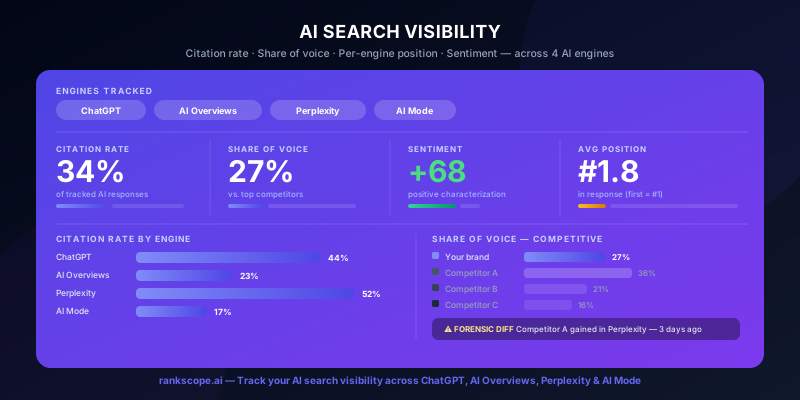
RankScope runs your prompts daily and records each answer as it appears in a real browser, rather than through an API, because an API response can differ from what a user sees. Every plan includes Share of Voice trending against the competitors you name (3 on Starter, 10 on Professional, unlimited on Agency), sentiment scoring, a diff view showing what an answer said before and after it changed, and Action Plans. Professional and Agency add competitive alerts, the GA4 and Google Search Console integration, and read access to the REST API. Seats are unlimited on every plan.
It also does a little of Job 2: GEO Audits (10 a month on Starter, 50 on Professional) score a page for how easy it is to extract and cite.
Where it falls short. We do not track Gemini, Claude, Copilot or Grok, and several tools here do. Starter's two engines leave out Perplexity and Google AI Mode. We do not offer a free trial. The free AI Visibility Checker runs a one-off check with no credit card required.
2. SE Visible (SE Ranking)
Pricing: Basic $99/mo (200 prompts, "~30,000 AI answers analyzed/month"), Core $189/mo (450 prompts, ~67,500 answers), Plus $355/mo (1,000 prompts, ~150,000 answers). A 10-day free trial. Engines: ChatGPT, Gemini, Google AI Mode, Perplexity and Google AI Overviews on every plan.
SE Visible is the volume leader by a wide margin, as the cost table below shows. It is also the only tool here that states its monthly answer count on the pricing page, which makes it the easiest to compare honestly. Both Google AI surfaces are on the cheapest plan.
3. HubSpot AEO
Pricing: Free for 25 prompts, "No credit card required". To keep tracking: "$50/month", or $45/month billed annually, for "same 25 prompts, same three engines". More prompts can be bought. Engines: ChatGPT, Gemini and Perplexity.
HubSpot's product page ranks fifth for "aeo tools", and it is the most accessible start in this list. You do not need to be a HubSpot customer: the page says it works "regardless of where your website is hosted". It produces a visibility score, prompt tracking, citation analysis and recommendations, and says it "updates your score daily".
The gap is Google. Neither AI Overviews nor AI Mode is on its engine list, so for a business whose buyers search on Google, it measures the other half of the problem. Twenty-five prompts is enough to learn whether you have a visibility problem. It is not enough to track a category.
4. Otterly.AI
Pricing: Lite $29/mo (15 prompts), Standard $189/mo (100 prompts), Premium $489/mo (400 prompts). Enterprise from 1,000 prompts, custom. Engines: ChatGPT, Google AI Overviews, Perplexity and Microsoft Copilot on every plan. Google AI Mode and Gemini are add-ons at $9/mo each on Lite, $59 on Standard and $149 on Premium; Claude is $29, $109 and $439.
The cheapest paid entry here, and the only one that includes Copilot from the bottom plan up. It also bundles a page-level GEO audit (1,000 a month on Lite), so it covers a slice of Job 2. Price the add-ons before you compare: Premium with AI Mode and Gemini is $787/mo.
5. Profound
Pricing: The pricing page shows two plans. A free trial tracks "50 unique prompts" daily for 7 days on ChatGPT, Gemini and Google AI Overviews. Enterprise is custom. Engines (Enterprise): ChatGPT, Perplexity, Google AI Mode, Gemini, Microsoft Copilot, DeepSeek, Anthropic Claude, Google AI Overviews and Exa Search.
Profound has the widest named engine list here and is the only tool whose pricing page puts AI-sourced traffic attribution, a Job 3 feature, alongside the tracking. It is built for enterprise budgets and sells that way. If you cannot get a number without a sales call, assume it will not be a small one.
Profound also publishes the third-ranked list for "aeo tools", with Profound at number one. Every vendor list does this. Discount it, as you should discount ours.
6. AIclicks
Pricing: Starter $59/mo (30 prompts, 3 LLMs, 5 AI-optimized articles a month), Pro $189/mo (150 prompts, 4 LLMs, 15 articles), Business $499/mo (300 prompts, 6 LLMs, 30 articles). Enterprise custom. A 3-day trial.
AIclicks sells Job 1 and Job 2 in one bill: tracking plus a monthly allowance of generated articles. Its pricing page counts engines ("LLMs you can track") without saying which ones each plan gets. Check which three you are getting on Starter before you pay; on 6 October its default three did not include either Google AI surface.
7. Peec AI
Pricing: Starter, Pro, Advanced and Enterprise tiers. Prices, prompt limits and engines were not readable from its pricing page on 9 October.
Peec is a well-known tracker and appears on most of the vendor lists above. We could not read its numbers, and we are not going to guess them. Check its page directly.
Job 2: Tools That Fix the Content
8. Frase
Pricing: Starter $49/mo, or $39/mo billed annually. Professional $129/mo, or $103/mo billed annually. Scale $299/mo, or $239/mo billed annually. Enterprise custom. AI visibility: Starter covers "ChatGPT and Google AI". Professional adds Perplexity, "AI crawler monitoring" and 50 tracked prompts. Scale adds Claude and Gemini and 500 prompts.
Frase began as an SEO content editor and now sells what it calls a content loop: an agent that writes and publishes, page audits (50 a month on Starter, 250 on Professional), and tracking bolted alongside. That makes it the closest thing here to all three jobs in one product, with the content job the strongest.
Its own list for "aeo tools" ranks ninth and puts Frase first.
9. AirOps
Pricing: Solo, Pro and Enterprise. No prices were shown for Solo or Pro on 9 October; Enterprise is custom. AI visibility: Solo includes "ChatGPT Insights Only". Pro includes "Insights Across 7+ Answer Engines".
AirOps is a content production platform first. Its plans are counted in tasks (35,000 on Solo, 100,000 on Pro), and visibility insights sit on top. If you produce content at volume and want the visibility data in the same place, it fits. If you mainly need measurement, you would be paying for a content engine to get it.
What to look for in any content tool
The useful ones show you the answer they are optimizing for. A content score with no link to a real AI answer is a writing grade, and you can get one of those from any SEO tool. Ask the vendor: after I make this change, where in your product do I see whether ChatGPT or Google's AI Overview now names me?
Job 3: Tools That Check Access
This is the thinnest part of the market, and the cheapest to do yourself.
Answer engines can only cite what they can retrieve. For Google's AI Overviews and AI Mode that means the page has to be in Google's index. For ChatGPT search and Perplexity it means their crawlers have to be allowed to fetch it.
Of the tools above, Frase Professional lists AI crawler monitoring and Profound Enterprise lists AI traffic attribution. You can cover the basics without either:
- Check robots.txt for rules blocking GPTBot, OAI-SearchBot, PerplexityBot or Google-Extended, and decide whether you meant them.
- Read your server logs for those user agents. If they never visit a page, no content tool will get it cited.
- Check indexing in Search Console. A page Google has not indexed cannot appear in an AI Overview, however good it is. We have had well-linked pages sit at "Discovered, currently not indexed" for weeks.
Skip llms.txt as a Google lever, per Google's own guidance quoted above. It costs little to publish, and other systems may read it, but nothing we have seen shows it moving a citation.
The Number That Separates the Trackers: Cost per Answer
A plan price tells you very little. What a tracker sells is answers: prompts, times engines, times how often each one runs. Here is that arithmetic for every plan that publishes enough to do it, assuming a 30-day month.
| Plan | Monthly price | How the answer count is reached | Answers a month | Cost per 1,000 answers |
|---|---|---|---|---|
| SE Visible Basic | $99 | Stated by the vendor | ~30,000 | $3.30 |
| RankScope Professional | $149 | 150 prompts × 4 engines × 30 daily scans | 18,000 | $8.28 |
| RankScope Agency | $399 | 400 prompts × 4 engines × 30 daily scans | 48,000 | $8.31 |
| RankScope Starter | $49 | 40 prompts × 2 engines × 30 daily scans | 2,400 | $20.42 |
| HubSpot AEO (paid) | $50 | 25 prompts × 3 engines × 30, if every prompt runs daily | 2,250 | $22.22 |
The HubSpot row rests on an assumption. Its page says the score updates daily; it does not say every prompt runs on every engine every day. If it runs less often, its cost per answer is higher than shown.
We left out Otterly.AI, AIclicks and Frase, which do not state a run frequency on their pricing pages, and Profound, Peec AI and AirOps, which do not publish a price we could read.
SE Visible wins this table comfortably, at well under half our best rate. We are leaving that row in because it is true.
Cost per answer is the right first cut and the wrong final one. A recorded answer is only worth having if the prompt is a question your buyers ask and the engine is one they use. Which brings us back to who writes the prompts.
Our View: Buy Measurement First, and Write the Prompts Yourself
Here is an opinion that could be wrong.
Most teams should buy a Job 1 tool before anything else, run it for four to six weeks on a prompt list they wrote themselves, and only then decide whether they need a content tool.
Three reasons.
You cannot judge a content change without a before and after. Answer engines are unstable: published research measured median day-over-day churn in cited sources of 82% on ChatGPT, 92% on Gemini, 78% on Google AI Mode and 43% on Perplexity (GetMentions, July 2026). One reading tells you what an engine said once. You need weeks of baseline to see whether anything you did moved it.
The prompt list is the product. Twenty to fifty unbranded questions, phrased the way a buyer who has never heard of you would ask them, will tell you more than 500 generated variations. Our Search Console shows what generated prompts look like from the outside: templated, long, and attached to nobody.
And most Job 2 tools are writing tools with a new label. The advice they give (answer the question in the first sentence, use specific numbers, cite sources) is good, and you can follow it without paying for it.
Where we might be wrong: teams with a large content backlog and no writers may get more from a content tool on day one than from any measurement, and conversational prompts typed into ChatGPT really are longer than Google searches, so long prompts are not automatically fake. If your buyers genuinely ask 40-word questions, track 40-word questions.
How to Choose an AEO Tool in Five Steps
1. Run ten prompts by hand. Type ten real buyer questions into ChatGPT, Google and Perplexity and note who is named. An hour of this tells you whether you have a visibility problem at all. HubSpot's free tier and our free AI Visibility Checker do a version of it with no card.
2. Decide which job you are buying. If you do not know whether you are named, buy measurement. If you know you are absent and you know why, a content tool may help. If your pages are not indexed, fix that first; nothing else matters until it is done.
3. Pick the engines your buyers use. Count Google AI Overviews and Google AI Mode as two surfaces, not one. HubSpot AEO covers neither. Otterly charges extra for AI Mode. SE Visible and our Professional plan include both.
4. Price the answers, not the plan. Prompts times engines times runs per month. Use the table above, and ask any vendor that does not publish its run frequency what it is.
5. Write the prompt list yourself. Unbranded, in your buyers' words. "Tell me about [your brand]" measures nothing useful.
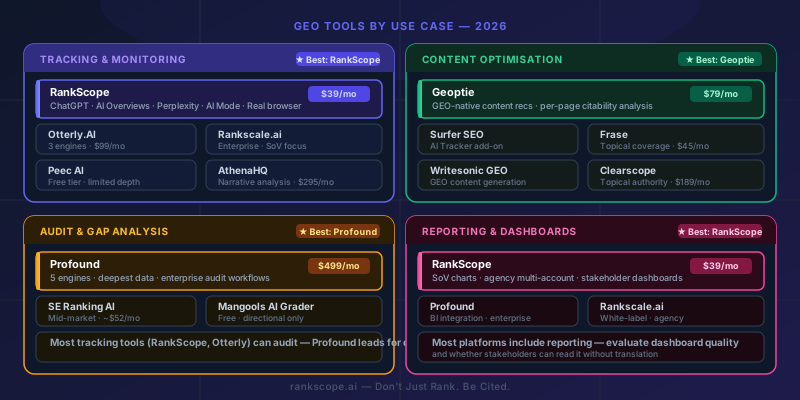
For a wider comparison that includes SEO suites with AI tracking (Semrush, Ahrefs Brand Radar, Rankscale), see our AI search visibility tools comparison. For GEO-labelled tools organized by use case, see generative engine optimization tools.
Frequently Asked Questions
What are AEO tools?
AEO tools are software for answer engine optimization. They do one of three jobs: measure whether AI answer engines such as ChatGPT, Google AI Overviews, Google AI Mode and Perplexity name your brand, help you rewrite pages so those engines can extract and cite them, or check whether AI crawlers can reach your site. Most products are strongest at one of the three.
What are the best answer engine optimization tools?
It depends on the job. As listed on the vendors' pages on 9 October 2026: SE Visible gives the most recorded answers per dollar from $99/mo; HubSpot AEO starts free for 25 prompts on ChatGPT, Gemini and Perplexity; Otterly.AI is the cheapest paid tracker at $29/mo; Frase and AirOps are content tools with tracking added; Profound sells enterprise coverage across nine engines; and RankScope tracks ChatGPT, Google AI Overviews, Perplexity and Google AI Mode in a real browser from $49/mo, or $39/mo billed annually.
How much do AEO tools cost?
On the vendors' own pages on 9 October 2026, paid tracking started at $29/mo (Otterly.AI Lite, 15 prompts) and $50/mo (HubSpot AEO, 25 prompts), with mid-tier plans from about $99 to $189/mo and enterprise plans priced by quote. Compare cost per recorded answer rather than plan price: SE Visible Basic worked out at about $3.30 per 1,000 answers and RankScope Professional at $8.28.
Is there a free AEO tool?
Yes, for a start. HubSpot AEO tracks 25 prompts on ChatGPT, Gemini and Perplexity free with no credit card before moving to $50/mo, Profound offers a 7-day free trial, and RankScope's free AI Visibility Checker runs a one-off check with no credit card required. Ongoing tracking at any real scale is paid on every tool we checked.
What is the difference between AEO tools and GEO tools?
In 2026, very little. Answer engine optimization and generative engine optimization describe the same work, and vendors pick whichever label their audience uses. The more useful split is by job: measurement, content, or crawler access.
Do AEO tools still help with featured snippets and FAQ schema?
Some still sell that, but it matters less than it did. Google has shown FAQ rich results only for well-known government and health websites since August 2023, and its guide to AI features says no special schema or AI text files are needed to appear in AI Overviews or AI Mode. Structured data still helps machines read a page, as long as every marked-up question is also visible on it.
How long before an AEO tool shows results?
Allow two weeks for a baseline and read trends over four weeks or more. Cited sources in AI answers change from one day to the next on every major engine, so a single day's reading says little about whether a change worked.
Want to see where you stand before buying anything? The free AI Visibility Checker runs a one-off check, no credit card required. When you want it tracked daily across ChatGPT, Google AI Overviews, Perplexity and Google AI Mode, start with RankScope.