8 AI Search Visibility Tools Compared (2026): What Each One Actually Measures
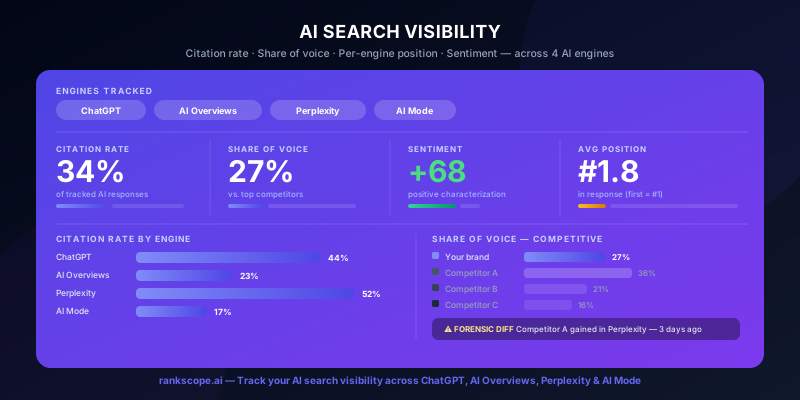
An AI search visibility tool runs the questions your buyers ask through AI engines such as ChatGPT, Google AI Overviews, Google AI Mode and Perplexity, on a schedule, and records whether your brand is named in the answer. The good ones also record how often you are named compared with competitors, which sources the engine cited, how the answer described you, and what changed since the last run. SE Ranking, AIclicks, Rankscale, Otterly.AI, Ahrefs Brand Radar, Semrush, Peec AI and RankScope all sell some version of this.
They are not interchangeable. The same $99 buys about 30,000 recorded answers a month on one of them and up to 4,800 on another. Below are all eight, priced from each vendor's own page on 6 October 2026, with the arithmetic that actually separates them.
The Short Answer
| If you need... | Look at | Why |
|---|---|---|
| The most answers per dollar on the big five engines | SE Visible (SE Ranking) | $99/mo for 200 prompts and about 30,000 answers a month |
| AI tracking inside an SEO suite you already pay for | Semrush, or SE Ranking with its AI Search add-on | No second login; Semrush includes AI visibility on paid plans |
| The cheapest way in | Otterly.AI Lite | $29/mo, though only 15 prompts |
| A wide engine list | Rankscale or AIclicks | Both list Claude, Copilot, DeepSeek and others |
| A huge prompt database you did not write | Ahrefs Brand Radar | 447M+ prompts on its $699/mo tier |
| Both Google AI surfaces, your own prompts, answer-level history | RankScope Professional | ChatGPT, AI Overviews, Perplexity and AI Mode, recorded in a real browser |
This Page Used to Be Wrong, and Google Never Showed It to Anyone
This URL went up on 15 July 2026 as a general guide to "AI search visibility". When we reopened it in October to rewrite it, three things were wrong with it.
It opened with a statistic: "More than 37% of searches now start with an AI tool, and 60% of those searches end without a traditional click." We could not find a source for either number. We deleted both rather than swap in different numbers we also could not source.
It printed a benchmark table, "citation rate above 30% = strong AI visibility; below 5% = effectively invisible", attributed to "RankScope platform data across B2B SaaS categories". We have never published a report behind those thresholds. A benchmark nobody can check is an opinion dressed as data, and this one was presented as data. It is gone.
And it said Otterly.AI's coverage "excludes Google AI Overviews and Google AI Mode". On 6 October, Otterly's pricing page lists Google AI Overviews on every plan, with AI Mode as a $9/mo add-on on Lite. That claim may have been true once. It was wrong for anyone reading it now.
The more uncomfortable finding is that it barely mattered, because almost nobody saw the page. Google Search Console recorded one impression for "ai search visibility" across our whole site in 90 days, at position 75. Google's own index status for this URL in September was "Discovered, currently not indexed": Google knew the page existed and had not crawled it. Ten other posts on our site link here, which is above our blog's median of 7, so it was not orphaned. Google simply had not decided it was worth fetching.
We are telling you this because it is the normal state of this category. Tool pages and comparison posts go stale within a quarter, and many are never seen at all. If a comparison does not say when its prices were checked, assume they were not.
What Google's AI Overview Said on 6 October
We pulled the live Google results for "ai search visibility tool" on 6 October 2026, US English, desktop.
The AI Overview defined the category in one line ("track how often and how favorably your brand appears in generative engines like ChatGPT, Perplexity, Gemini, and Google AI Overviews") and then named four tools: AIclicks, SE Ranking's SE Visible, the Ahrefs AI Visibility Checker and Rankscale. It finished with four features to look for: multi-engine tracking, citation and source detection, sentiment analysis and competitor benchmarking.
It cited 9 URLs across 8 domains. Two were YouTube videos and one was a Medium post.
None of the eight organic results on the same page were among them. The number one organic result was a Chrome extension that scores what an AI agent receives from a web page, which is a different product that happens to share the name. Below it were listicles, a Reddit thread on checking AI visibility without paying for a platform, and a Dribbble design mock-up. Two ads ran on the page: Peec AI and SE Ranking. One of SE Ranking's ad links read "Tracking 3 of 5 AI Engines?"
So the people asking this question are marketers choosing software, and Google answers them with vendor home pages rather than reviews. That is one reading on one day. Citation sets in AI answers churn fast, and the next section shows how fast.
The Mistake We Made With This Exact Search Term
In September we built a filter to decide which search terms were worth writing for. It looked at the weakest site cited in each term's AI Overview, measured by referring domains (the number of other websites linking to it), and skipped any term where that weakest site was far stronger than ours.
On 17 September it measured "ai search visibility tool". The weakest cited domain was dageno.ai, at 302 referring domains. Ours is 45 (12 of them nofollow). The filter marked the term closed, and this rewrite was cancelled.
We retired the filter the next day, after checking how stable its input was. Published research says not very. GetMentions ran 2,398 queries through four engines once a day for a week in June 2026 and found median day-over-day churn in cited sources of 82% on ChatGPT, 92% on Gemini, 78% on Google AI Mode and 43% on Perplexity (GetMentions, July 2026). We were drawing a hard line through a number that changes most days, from one observation per term.
Nineteen days later, on 6 October, we measured the same SERP again. Dageno is no longer cited. The weakest domain in the new set (setting aside YouTube and Medium, which rank on their own platform's authority) is indexly.ai, at 317 referring domains. Dageno itself now reads 389.
| Cited domain, 6 Oct 2026 | Referring domains |
|---|---|
| ahrefs.com | 100,537 |
| seranking.com | 18,067 |
| rankscale.ai | 898 |
| industry-lens.com | 626 |
| aiclicks.io | 429 |
| indexly.ai | 317 |
| rankscope.ai, not cited | 45 |
Two readings is a thin sample, and we are not going to draw a trend from it. What it does show is the problem with the filter: the floor came out at a similar number both times while the domains that set it changed. Treating that number as a property of the search term was the mistake. It cost us nearly three weeks on a 1,000-searches-a-month term, and we only found out because we came back to it.
The same thing happens inside every AI search visibility tool, and it is why you should read the tools' numbers the way the rest of this page suggests.
What an AI Search Visibility Tool Measures
Every tool here starts from the same object: a prompt, meaning one question a buyer might type, such as "what's the best tool for tracking brand mentions in ChatGPT?" The tool sends that prompt to each engine it covers, records the answer, and extracts a handful of measurements. The names vary by vendor. The measurements do not.
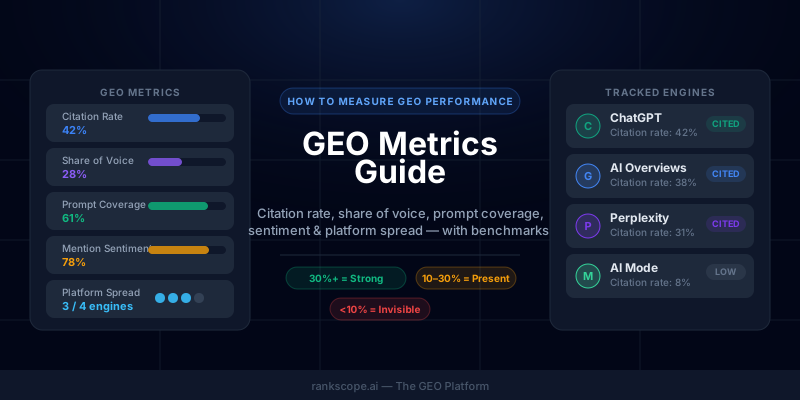
Mention rate (or citation rate)
The share of recorded answers that name your brand.
Formula: answers naming you ÷ answers recorded × 100
Some tools split "mentioned" (your brand name appears in the text) from "cited" (your URL appears as a source). They are different outcomes. Perplexity shows numbered sources on every answer, so a citation there is visible; ChatGPT can name a brand with no link at all. Ask any vendor which of the two its headline number counts.
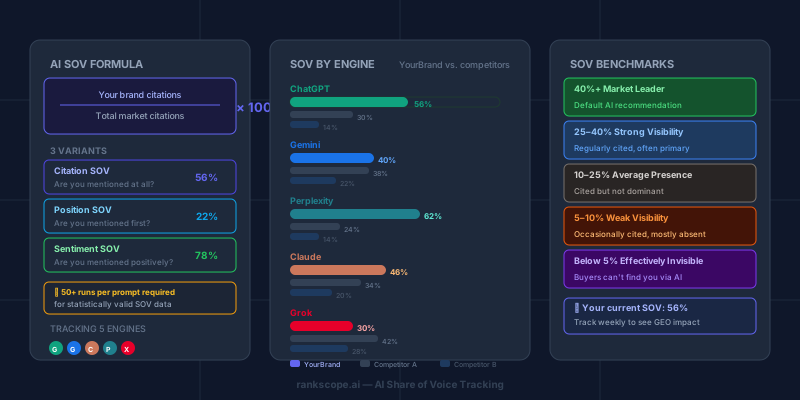
Share of voice
Your mentions as a share of all mentions of the brands you track.
Formula: your mentions ÷ (your mentions + every tracked competitor's mentions) × 100
To illustrate with made-up numbers: across 100 recorded answers you are named 22 times and three competitors are named 31, 18 and 11 times. Total mentions are 82, so your share of voice is 26.8%. Notice that the result depends on which competitors you entered. Add a fourth and your share falls without anything changing in the answers. Our share of voice guide walks through the calculation in more detail.
Position
Where in the answer you appear. "The top tools are A and B; you might also consider C" names all three, but it ranks them. Most tools report an average position. A few show the answer text so you can see the ranking for yourself.
Sentiment
How the engine describes you: recommended, merely listed, or framed as the budget or limited option. Two answers can both mention you and send opposite signals to a buyer.
Sources
Which URLs the engine drew on. This is often the most useful field in practice, because it tells you which third-party pages are shaping answers about your category, and some of those you can do something about.
For how these metrics combine into reporting, see our GEO metrics guide.
The 8 Tools
Prices are from each vendor's own pricing page on 6 October 2026, on monthly billing unless marked.
1. RankScope
Pricing: Starter $49/mo, or $39/mo billed annually. Professional $149/mo, or $124/mo billed annually. Agency $399/mo, or $332/mo billed annually. Enterprise is custom. Prompts: 40, 150 and 400 monitored prompts on Starter, Professional and Agency. Engines: ChatGPT and Google AI Overviews on Starter. ChatGPT, Google AI Overviews, Perplexity and Google AI Mode on Professional and Agency.
This is our product, so weigh what follows accordingly.
RankScope runs your prompts daily and records each answer as it appears in a real browser, not through an API, because API responses can differ from what a user actually sees. Every plan includes share of voice trending against the competitors you name (3 on Starter, 10 on Professional, unlimited on Agency), sentiment scoring, and a diff view that shows what an answer said before and after it changed. Seats are unlimited on every plan.
Where it falls short: we do not track Gemini, Claude, Copilot or Grok, and several tools below do. Starter's two engines leave out Perplexity and Google AI Mode. There is no free trial. The free AI Visibility Checker runs a one-off check with no credit card required.
2. SE Ranking and SE Visible
Pricing, SE Visible (standalone): Basic $99/mo (200 prompts, about 30,000 answers a month), Core $189/mo (450 prompts, about 67,500), Plus $355/mo (1,000 prompts, about 150,000). Pricing, inside SE Ranking: Core $129/mo, or $103.20/mo billed annually, plus the AI Search add-on at $89/mo, or $71.20/mo billed annually. Engines: SE Visible covers ChatGPT, Gemini, Google AI Mode, Perplexity and Google AI Overviews on every plan. The add-on's AI Results Tracker lists AI Overviews, AI Mode, Perplexity and ChatGPT.
SE Visible is the volume leader in this comparison by a wide margin, as the cost table below shows. Of the four tools Google's AI Overview named, it is the only one whose cheapest paid plan clearly lists both Google AI surfaces.
A small warning about reading vendor pages: on the same day, SE Ranking's AI tracker page offered a two-week free trial and the SE Visible page offered a 10-day one. Neither is wrong on purpose. They are two pages that drifted apart.
3. AIclicks
Pricing: Starter $59/mo (30 prompts, 3 engines), Pro $189/mo (150 prompts, 4 engines), Business $499/mo (300 prompts, 6 engines). Enterprise custom. Yearly billing takes "up to 29%" off. Engines: ChatGPT, Gemini and Perplexity by default. Google AI Overviews, Google AI Mode, Claude, Copilot, Grok, Meta, DeepSeek and Mistral are available on higher plans. Trial: 3 days, no credit card, on Starter and Pro.
AIclicks was the first tool named in Google's AI Overview, and its home page was cited for the definition at the top. Its pitch is tying AI visibility to Google Analytics traffic. Check the engine list against your plan: Starter's three defaults do not include either Google AI surface.
4. Rankscale
Pricing: Essentials from $17/mo (yearly only), Pro $99/mo (1,200 credits, up to 4,800 answers), Pro+ $229/mo (up to 12,000 answers), Growth $385/mo (up to 22,000 answers), Enterprise $780/mo (up to 48,000 answers). Yearly billing saves 15%. A 7-day free trial of Pro. Engines: The pricing page names ChatGPT, Gemini, Perplexity, Claude, DeepSeek, Mistral, Grok and Copilot "and more"; its home page says 17+.
Rankscale meters in credits, and one engine query typically costs 0.25 of a credit. That is what turns 1,200 credits into 4,800 answers. It states the conversion on its pricing page, which makes it easy to compare with tools that count prompts.
5. Otterly.AI
Pricing: Lite $29/mo (15 prompts), Standard $189/mo (100 prompts), Premium $489/mo (400 prompts). Annual billing takes 15% off. Free trial. Engines: ChatGPT, Google AI Overviews, Perplexity and Microsoft Copilot on every plan. Google AI Mode, Gemini and Claude are add-ons, priced by plan: on Lite, AI Mode and Gemini are $9/mo each and Claude is $29/mo.
The cheapest entry in this comparison, and Copilot is included from the bottom plan up. Fifteen prompts is enough to learn whether you have a visibility problem, not enough to track a category. On Premium the AI Mode add-on is $149/mo, so price it in if Google matters to you.
6. Ahrefs Brand Radar
Pricing: Brand Radar AI is $199/mo for selected platforms, or $699/mo for all platforms, which includes "447M+ organic prompts" plus 2,500 custom prompt checks a month. Free tool: the Ahrefs AI Visibility Checker covers ChatGPT, Gemini, Perplexity, Copilot, Google AI Overviews and Google AI Mode, with no signup, but shows only the top 5 results per section.
Brand Radar works the other way round from most tools here. Instead of you writing prompts, Ahrefs has collected an enormous set of them and shows you where your brand appears across it. That is useful for discovery. The risk is the reverse of the usual one: you may get confident numbers about questions your buyers never ask.
7. Semrush
Pricing: SEO $139/mo, Starter $199/mo, Pro+ $299/mo, Advanced $549/mo. Billed annually: $117.33, $165.17, $248.17 and $455.67. AI visibility: "Google Search, ChatGPT, Perplexity, Gemini & more". The SEO plan includes AI search performance tracking and sentiment; Starter tracks 50 prompts daily, Pro+ 100 and Advanced 200.
If you already pay for Semrush, use this before buying anything else. AI visibility is included, not an add-on, and it sits next to the keyword and backlink data you already use. Our Semrush alternative post covers when a dedicated tracker is still worth adding.
8. Peec AI
Pricing: Starter, Pro, Advanced and Enterprise tiers. We could not read prices or limits from its pricing page on 6 October.
Peec ran a paid ad on this exact search the day we checked, so it is clearly competing for the term. We are not going to guess its numbers. Check its page directly.
The Number That Actually Separates Them: Cost per Answer
A plan price tells you very little. What you are buying is a number of answers: prompts, times engines, times how often each one runs. Here is that arithmetic for every tool that publishes enough to do it, assuming a 30-day month.
| Plan | Monthly price | How the answer count is reached | Answers a month | Cost per 1,000 answers |
|---|---|---|---|---|
| SE Visible Basic | $99 | Stated by the vendor | ~30,000 | $3.30 |
| RankScope Professional | $149 | 150 prompts × 4 engines × 30 daily scans | 18,000 | $8.28 |
| RankScope Agency | $399 | 400 prompts × 4 engines × 30 daily scans | 48,000 | $8.31 |
| RankScope Starter | $49 | 40 prompts × 2 engines × 30 daily scans | 2,400 | $20.42 |
| Rankscale Pro | $99 | Stated by the vendor ("up to") | 4,800 | $20.63 |
We left out Otterly.AI, AIclicks, Semrush and Ahrefs. None of them states a run frequency or answer count on its pricing page, so we would have been guessing.
SE Visible wins this table comfortably, at well under half our best rate. Rankscale's Pro plan and our Starter plan cost about the same per answer.
Cost per answer is the right first cut. It is the wrong final one, because an answer is only worth recording if the prompt is a question your buyers ask and the engine is one they use. A thousand answers from engines your market never opens are worth nothing. A tracked prompt list you did not write may be worth less than nothing, because it produces a chart that looks like evidence.
Which Engines Should the Tool Cover?
| Tool | Engines named on the vendor's page, 6 Oct 2026 | Both Google AI surfaces? |
|---|---|---|
| RankScope | ChatGPT, AI Overviews, Perplexity, AI Mode | Professional and up |
| SE Visible | ChatGPT, Gemini, AI Mode, Perplexity, AI Overviews | Yes, every plan |
| AIclicks | ChatGPT, Gemini, Perplexity by default; 8 more on higher plans | Higher plans |
| Rankscale | 8 named "and more"; home page says 17+ | Unclear ("Google AI") |
| Otterly.AI | ChatGPT, AI Overviews, Perplexity, Copilot; AI Mode, Gemini, Claude as add-ons | With add-on |
| Ahrefs Brand Radar | Free checker: 6 incl. both Google surfaces | Yes, in the free checker |
| Semrush | Google Search, ChatGPT, Perplexity, Gemini "& more" | Not stated |
| Peec AI | Not readable on 6 Oct | Unclear |
Treat Google AI Overviews and Google AI Mode as two surfaces, not one. They are separate products, and a tool that reports "Google AI" as a single number cannot tell you which of them names you. The GetMentions study above measured 78% day-over-day source churn on AI Mode alone.
The engines also differ in how stable they are. In that same study, Perplexity's cited sources changed 43% from one day to the next and Gemini's 92%. A tool reading Gemini once a day is sampling something that turns over most of its sources overnight. That is not a reason to ignore Gemini. It is a reason to read its numbers as a trend over weeks.
Our view: engine count is the most oversold spec here
Here is an opinion that could be wrong.
Most teams should pick the three or four engines their buyers actually use and stop there. A tool listing 17 engines is not measuring your market 17 times better. Each extra engine dilutes your prompt budget, adds a column of numbers you will not act on, and on credit-based plans directly cuts how many prompts you can afford.
Ask your sales team which assistant prospects mention, look at which AI referrers show up in your analytics, and buy coverage for those. If you sell into Microsoft-heavy enterprises, Copilot may matter more than Perplexity, and Otterly or AIclicks covers it where we do not.
Where we might be wrong: buyer behaviour is moving quickly, and an engine nobody in your market used in spring can matter by autumn. If you cannot tell which engines your buyers use, broad coverage for a quarter is a reasonable way to find out.
How to Read What the Tool Tells You
Every tool here gives you a number on day one. Most of that number is noise.
With source churn of 43% to 92% a day depending on the engine, one day's reading of one prompt tells you what the engine said once. It does not tell you what it usually says. The useful signal is the direction across weeks, on the same prompts and the same engines.
Three rules that follow from that:
- Change nothing for the first two weeks. Let the tool build a baseline. A dip on day four is usually the engine, not you.
- Compare four-week windows, not days. If your share of voice on ChatGPT averages 19% one month and 27% the next, something moved. A single day at 40% is not news.
- Read the answers, not only the score. A falling mention rate with the same competitors named usually means a new source entered the answer. The sources field tells you which one, and that is where the work is.
The same caution applies to search data. When we checked our own Search Console in September, one query reported an average position of 2.8 while the live Google results had us outside the top 10. A tool's number is a reading of a system that changes faster than the reading. Check it against the live answer before acting on it.
How to Choose in Five Steps
1. Run ten prompts by hand. Before paying for anything, type ten real buyer questions into ChatGPT, Google and Perplexity, and note who is named. An hour of this tells you whether you have a visibility problem at all. Ahrefs' free checker, SE Ranking's 5 free daily checks and our free AI Visibility Checker all do a version of it without an account.
2. Write the prompt list yourself. Twenty to fifty unbranded questions, the way a buyer who has never heard of you would ask them. "Tell me about [your brand]" measures nothing useful.
3. Pick the engines your buyers use. See the opinion above. If Google is where your buyers search, count AI Overviews and AI Mode as two.
4. Price the answers, not the plan. Prompts times engines times runs per month. Compare that across two or three tools using the table above.
5. Check what you already pay for. Semrush includes AI visibility. SE Ranking sells it as an $89/mo add-on. If you already have either, start there and move to a dedicated tool only when you need your own prompts on engines the suite does not cover, answer-level history, or share of voice against specific named competitors.
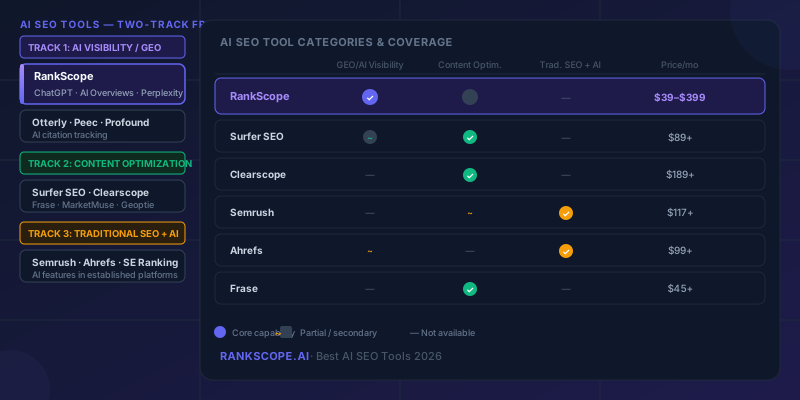
For a broader comparison that includes content tools and SEO suites, see our 13 AI SEO tools compared. For tracking-only tools at more length, see best AI visibility tools.
Frequently Asked Questions
What is an AI search visibility tool?
An AI search visibility tool runs the questions your buyers ask through AI engines such as ChatGPT, Google AI Overviews, Google AI Mode and Perplexity on a schedule, and records whether your brand is named in each answer. Most also record share of voice against competitors, your position in the answer, how you were described, and which sources the engine cited.
What are the best AI search visibility tools?
It depends on the engines you need and how many prompts you track. As listed on 6 October 2026: SE Visible gives the most answers per dollar on five engines from $99/mo; Otterly.AI is the cheapest entry at $29/mo; Rankscale and AIclicks list the widest engine sets; Semrush includes AI visibility on its paid SEO plans; and RankScope tracks ChatGPT, Google AI Overviews, Perplexity and Google AI Mode in a real browser from $49/mo, or $39/mo billed annually.
How much does an AI search visibility tool cost?
On the vendors' own pages on 6 October 2026, paid plans started at $29/mo (Otterly.AI Lite, 15 prompts) and ran to $699/mo for Ahrefs Brand Radar on all platforms, with enterprise plans priced by quote. Compare cost per answer rather than plan price: SE Visible Basic worked out at about $3.30 per 1,000 answers, RankScope Professional at $8.28 and Rankscale Pro at about $20.63.
How do AI search visibility tools measure visibility?
They send each tracked prompt to each engine, record the answer, and calculate mention or citation rate (the share of answers that name you), share of voice (your mentions against tracked competitors), position in the answer, sentiment, and the sources cited. Because AI answers change daily, the trend over several weeks is more meaningful than any single reading.
Is there a free AI search visibility tool?
Yes, for one-off checks. The Ahrefs AI Visibility Checker is free with no signup but shows only the top 5 results per section, SE Ranking offers 5 free checks a day on its tracker page, and RankScope's free AI Visibility Checker needs no credit card. Ongoing daily tracking is a paid feature on every tool we compared.
Which AI engines should an AI search visibility tool track?
The ones your buyers use. For most teams that means ChatGPT plus Google AI Overviews and Google AI Mode, counted as two separate surfaces, with Perplexity, Gemini or Copilot added depending on the market. A longer engine list is not better by itself: each extra engine spreads your prompt budget thinner.
How often should AI search visibility be checked?
Daily data, read as a trend over at least four weeks. Published research measured day-over-day churn in cited sources of 43% on Perplexity to 92% on Gemini, so a single day's result says little. Wait about two weeks for a baseline before reacting to a change.
Want to see where you stand before buying anything? The free AI Visibility Checker runs a one-off check, no credit card required. When you want it tracked daily across ChatGPT, Google AI Overviews, Perplexity and Google AI Mode, start with RankScope.