AI Citation Tracking: The Complete Guide (2026)
AI citation tracking is the practice of monitoring which specific URLs and content pieces AI search engines reference when generating answers — across ChatGPT, Perplexity, Google AI Overviews, and AI Mode.
It's different from brand monitoring (which tracks whether your name appears) and different from traditional backlink tracking (which tracks who links to you). AI citation tracking answers a more specific question: when AI engines answer questions relevant to your business, are they using your content as a source?
That question matters because AI-generated answers increasingly drive how buyers discover, evaluate, and shortlist products and services. Being cited as a source is worth more than a brand mention — it means your content is the authoritative foundation for the answer, your URL is visible, and users who want more detail click through to you.
This guide covers exactly what AI citation tracking is, why it's different from everything you've used before, the four citation types you need to track, how to set it up, and how to improve your citation rate.
Citation vs. Mention: The Critical Distinction
Most people conflate AI citations and AI mentions. They're not the same, and treating them as the same leads to bad strategy.
A mention is when an AI engine names your brand in its answer. Example: "Tools like RankScope, Otterly, and Profound track AI visibility." Your brand appears. No URL is provided. No content is cited.
A citation is when an AI engine references a specific URL or content piece as the source for information. Example: Perplexity's answer includes a footnoted link to your blog post. ChatGPT's web browsing result cites your guide. The AI used your actual content to construct the answer.
| Mention | Citation | |
|---|---|---|
| What it is | Brand name appears in answer | Specific URL appears as source |
| Visibility to user | Brand name in text | URL with link (Perplexity) or attribution text |
| Traffic potential | Low — no direct path to click | High — user can click through to your page |
| Authority signal | Brand awareness | Content is trusted as source material |
| What drives it | Training data + brand authority | Content structure + retrieval quality |
| How to improve | Third-party mentions, PR, reviews | Content optimization, structured data, extraction-readiness |
The most valuable position: your brand is mentioned and your content is cited as the source. You get the brand impression and the click.
The most dangerous gap: competitors are being cited as sources in the queries your buyers ask, while you're absent from the answer entirely. That's not a mention problem or a citation problem — it's an invisibility problem. Citation tracking is what reveals it.
The Four Types of AI Citations
Not all citations are equal. Understanding the types helps you track accurately and prioritize correctly.
Type 1: Direct URL Citations (highest value)
The AI engine explicitly links to or attributes your specific URL. Most common in Perplexity (which shows numbered source citations with links) and ChatGPT's web browsing mode (which shows cited sources). This is the most valuable citation type — visible, clickable, and a strong authority signal.
Example: Perplexity's answer includes "[1] rankscope.ai/blog/what-is-geo" as a numbered source.
Type 2: Unlinked Content Citations
The AI uses your content as source material to construct its answer but doesn't provide a link or URL attribution. Common in ChatGPT answers that paraphrase content from web browsing without naming the source. Valuable for authority building but doesn't generate direct traffic.
Example: ChatGPT gives an answer that closely matches your guide but doesn't credit your site.
Type 3: Brand Mentions Without Citation
Your brand name appears in the answer but no content is cited. Common for well-known brands in training data. Builds awareness but doesn't confirm your content is being used as an authoritative source.
Example: "Popular GEO tools include RankScope, Otterly, and Profound" — with no URLs.
Type 4: Implicit Citations
The AI's answer matches your content, data, or unique framing closely enough to suggest your content influenced the answer, but there's no attribution. Difficult to track systematically but worth noting when content has distinctive phrasing or proprietary data.
For most tracking purposes: focus on Type 1 (direct URL citations) as your primary metric. It's the most trackable, most valuable, and most directly actionable.
Why AI Citation Tracking Matters Now
The case for citation tracking comes down to one structural fact: AI answers don't work like search results.
A Google results page shows 10 links. An AI answer synthesizes 2–5 sources and presents a unified response. The user often doesn't see the underlying sources unless they click "show sources" in Perplexity or check the browsed links in ChatGPT. The answer looks authoritative and complete — so most users don't dig further.
This creates a winner-takes-most dynamic at the source level. The content pieces that get cited are the ones shaping what buyers believe about a topic. The ones that don't get cited are invisible — not just to the user, but to the AI's reasoning for that answer.
Three practical consequences:
Your traffic picture is incomplete without it. Traditional analytics shows you clicks from Google organic. It doesn't show you when Perplexity cited your guide and 500 people read the AI answer that was based on your content — but never clicked through. Citation tracking reveals influence that doesn't show up in referral traffic.
Your content strategy is flying blind. If you don't know which of your pages are being cited and which aren't, you can't make intelligent decisions about which content to update, expand, or create. Citation data is the feedback loop that tells you what's actually working in AI search.
Competitor citation share is a leading indicator. If a competitor is being cited in 30% of the prompts in your category while you're at 5%, that gap will eventually show up in their brand awareness, pipeline, and revenue. Citation share is a leading indicator of AI-era market share.
How AI Citation Tracking Works Technically
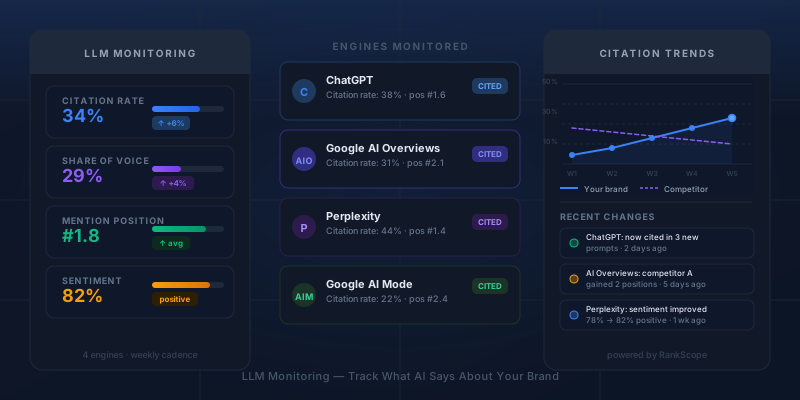
AI citation tracking works by running controlled prompt sets across each AI engine, then capturing when your domain, brand, or specific URLs appear in the generated responses.
The process:
-
Prompt library: A defined set of queries relevant to your category — buyer questions, comparison queries, use-case queries. These are the prompts your potential customers are actually asking.
-
Engine execution: The prompts are run across ChatGPT, Perplexity, Google AI Overviews, and AI Mode. Each engine has different retrieval behavior and different citation presentation formats.
-
Citation extraction: For each response, extract: (a) which URLs are explicitly cited, (b) whether the brand name appears, (c) the position/prominence of the citation.
-
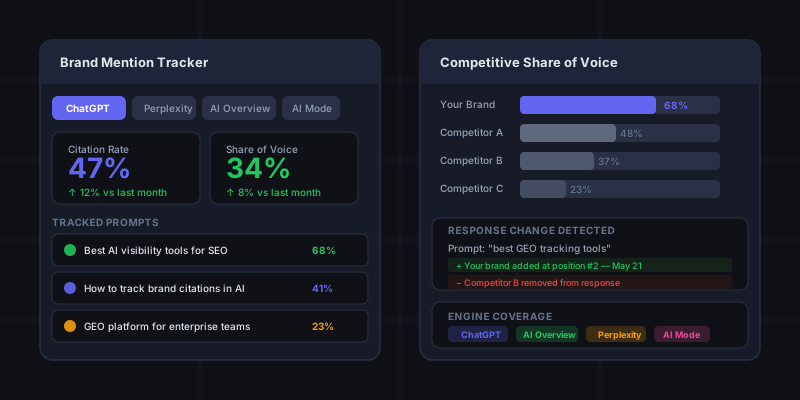
Aggregation: Combine results into metrics — citation share (what % of responses cite your domain), citations per engine, most-cited pages, competitor comparison.
-
Trend tracking: Run the same prompt set on a repeating schedule (weekly) to detect changes over time.
Why engine-specific tracking matters: Each AI engine has different citation behavior.
| Engine | Citation Format | Primary Source Pool | Citation Frequency |
|---|---|---|---|
| Perplexity | Numbered footnotes, visible links | Live web crawl | Very high — almost always cited |
| ChatGPT (browsing) | "Searched: [query]" + source list | Bing index | High when browsing fires |
| ChatGPT (no browsing) | Rarely explicit | Training data | Low — mostly unlinked |
| Google AI Overviews | Attributed source chips | Google organic index | Moderate — 3–5 sources typical |
| Google AI Mode | Multiple sourced paragraphs | Google organic index | High — more sources than AIO |
A brand visible as a citation in Perplexity may be absent in Google AI Overviews and vice versa — they draw from different source pools. Accurate citation tracking requires running across all engines, not just one.
AI Citation Tracking vs. Traditional Backlink Monitoring
People often ask whether existing tools (Ahrefs, Semrush, Moz) can do AI citation tracking. They can't — and the reason is fundamental, not a feature gap.
Traditional backlink monitoring scans the published web for hyperlinks pointing to your domain. A link exists in someone's published HTML. It's indexable, crawlable, permanent (until removed).
AI citation tracking monitors model behavior — what an AI generates in response to a specific query at a specific moment. That response:
- Is not published anywhere
- Changes every time the query runs (AI is non-deterministic)
- Depends on what the model retrieved from the web for that session
- Varies by engine, by model version, by whether browsing was used
| Traditional Backlinks | AI Citations | |
|---|---|---|
| Source | Published HTML on the web | AI-generated response |
| Permanence | Stable (until deleted) | Dynamic — changes every query |
| Discoverability | Crawlable | Only visible when you run the query |
| Tracking method | Web crawling | Controlled prompt execution |
| Tools that work | Ahrefs, Semrush, Moz | RankScope, Siftly, Omniseo, Perplexity itself |
| What it signals | Another site trusts your content | AI engine uses your content as a source |
The fundamental difference: backlinks are about who links to you. AI citations are about what content AI uses to answer questions. They're related but not the same — a highly-linked page might not get AI citations if it's not structured for extraction, and a page with few backlinks might earn strong AI citations if it directly and specifically answers a high-frequency query.
What Content Earns AI Citations
This is the part that turns citation tracking from a measurement exercise into a strategy. Once you know which of your pages are and aren't being cited, the next question is: what's different about the pages that are?
Research and practitioner observation consistently point to the same content patterns:
Original data and proprietary research
Content containing unique data — your own survey results, platform benchmark data, analysis of a dataset only you have — earns disproportionately high citation rates. AI engines prefer novel, specific information they can't find replicated elsewhere. A post titled "We analyzed 10,000 prompts: here's what gets cited in ChatGPT" will earn citations that a generic tips post cannot.
Comparison tables
Structured comparisons — tools vs tools, approaches vs approaches, options A/B/C — are highly extraction-friendly. AI engines synthesizing an answer about "best X for Y" heavily rely on comparison content because it packages the information they need to assemble a useful answer.
How-to guides with numbered steps
Step-by-step guides match the structure of how-to queries, which are among the most common prompts AI engines receive. Numbered, sequential structure makes extraction easy. Each step is a citable unit.
FAQ sections
Question-answer pairs are the format that most directly maps to how AI engines construct responses — a user asks a question and the engine provides an answer. FAQs that directly answer the exact query terms users ask are particularly strong citation candidates.
Definition sections with direct answers
"What is X" sections that open with a clean, complete definition in 1–2 sentences. These are pulled directly into AI answers for definitional queries. The key is the opening sentence — it needs to be extractable as a standalone definition.
What doesn't earn citations
- Long-form prose that buries the key point after several paragraphs of context
- Marketing copy focused on product benefits rather than educational information
- Content without specific data (vague claims like "many companies" or "significant growth")
- Thin pages with few specific facts to extract
- Paywalled or subscription-gated content AI crawlers can't access
How to Set Up AI Citation Tracking
Step 1: Build your prompt library
Start with 30–50 prompts organized into three tiers:
Tier 1 — Category definition queries (what is X, how does X work) These define the topic space. High AI Overview prevalence. Useful for establishing whether you're being cited as a source authority on core concepts.
Tier 2 — Comparison and evaluation queries (best X tools, X vs Y, alternatives to X) These are the highest-intent queries from a buyer perspective. Being cited here means you're part of the consideration set AI presents to active evaluators.
Tier 3 — Use-case queries (how to do X with Y, X for Z use case) Specific enough to match your product's functional value proposition. Citation here signals strong match between your content and what buyers actually do with products in your category.
Step 2: Run across all four engines
Don't track just one engine. Your citation profile varies significantly across ChatGPT, Perplexity, AI Overviews, and AI Mode. Missing one means missing a meaningful slice of your AI visibility picture.
The minimum viable setup: ChatGPT (both with and without browsing enabled) + Perplexity + Google AI Overviews.
Step 3: Record citations systematically
For each prompt run, record:
- Engine (ChatGPT / Perplexity / AI Overviews / AI Mode)
- Cited URLs (every domain/URL that appeared as a source)
- Your domain present? (yes/no)
- Citation type (direct URL / brand mention / neither)
- Competitor domains present
- Date
This raw data is the foundation for all your metrics.
Step 4: Calculate your citation share
Citation share = (number of prompt runs where your domain was cited) ÷ (total prompt runs) × 100
Run this overall and per engine. A site with 20% overall citation share but 40% in Perplexity and 5% in AI Overviews has very different optimization priorities than one with consistent 20% across all engines.
Step 5: Identify citation gaps by page
Which of your pages are being cited? Which aren't? Compare:
- Pages that rank well in Google but never get cited in AI → likely a content structure problem
- Pages that get cited but have no brand mention → content is trusted but brand is not being named
- Competitor pages that get cited in your category queries → examine their structure and what you're missing
Step 6: Act on the gaps
The data tells you what to fix:
- No citations in Perplexity: Content may not be reaching Perplexity's crawlers. Verify robots.txt allows Perplexity's bots. Improve page structure.
- No citations in AI Overviews: Likely a Google organic ranking gap. The page needs to rank on page 1 before AI Overviews will cite it.
- Citations but no brand mention: Improve brand signal in the content — include your brand name in the opening sections, data labels, and conclusion.
- Competitor being cited for your core query: Study the cited page's structure. What format, data, and directness of answer does it have that you don't?
The Best AI Citation Tracking Tools in 2026
| Tool | Engines Tracked | Citation Type | Best For | Pricing |
|---|---|---|---|---|
| RankScope | ChatGPT, Perplexity, AI Overviews, AI Mode | Direct URL + brand | Before/after measurement; citation share over time | From $49/mo |
| Siftly | ChatGPT, Perplexity, AI Overviews | Direct URL + type classification | Deep citation analytics; owned vs earned breakdown | Custom |
| Omniseo | ChatGPT, Perplexity, AI Overviews, AI Mode, Copilot | Direct URL | Cross-platform citation scale | Custom |
| Otterly.AI | ChatGPT, Perplexity, AI Overviews, Gemini, Copilot | Brand + source | Citation drift tracking; publisher-focused | Free / paid |
| Indexly | Multiple | Direct URL | Agency teams; bulk tracking | Custom |
| Profound | ChatGPT, Perplexity, AI Overviews | Direct URL + sentiment | Enterprise; deep competitive benchmarking | $499+/mo |
| Manual (spreadsheet) | Any | Direct URL | 0–30 prompts; getting started | Free |
Choosing a tool: If you're just getting started, manual tracking across 20–30 prompts is completely viable. Build a spreadsheet, run prompts weekly, record what you find. It takes 30–60 minutes per week and gives you a real citation baseline without any tool spend.
Once you're tracking 50+ prompts across multiple engines, the manual approach breaks down. A dedicated tool pays for itself in time saved and data quality.
Frequently Asked Questions
What is AI citation tracking?
AI citation tracking is the practice of monitoring which specific URLs and content pieces AI search engines reference when generating answers to user queries. It tracks whether AI engines like ChatGPT, Perplexity, Google AI Overviews, and AI Mode are using your content as a source — not just whether your brand name appears in answers.
How is AI citation tracking different from brand monitoring?
Brand monitoring tracks whether your brand name appears anywhere in AI-generated answers. Citation tracking is more specific: it tracks whether your actual content (specific URLs and pages) is being used as a source. Your brand can be mentioned without your content being cited, and your content can be cited without your brand being named. Both metrics matter, but they require different optimization strategies.
Which AI engines should I track citations in?
At minimum: ChatGPT (browsing enabled) and Perplexity, since both show explicit source citations. Add Google AI Overviews and AI Mode for a complete picture. Each engine draws from different source pools — Bing for ChatGPT, live crawl for Perplexity, Google's index for AI Overviews — so your citation profile varies significantly across engines.
What is a good AI citation share rate?
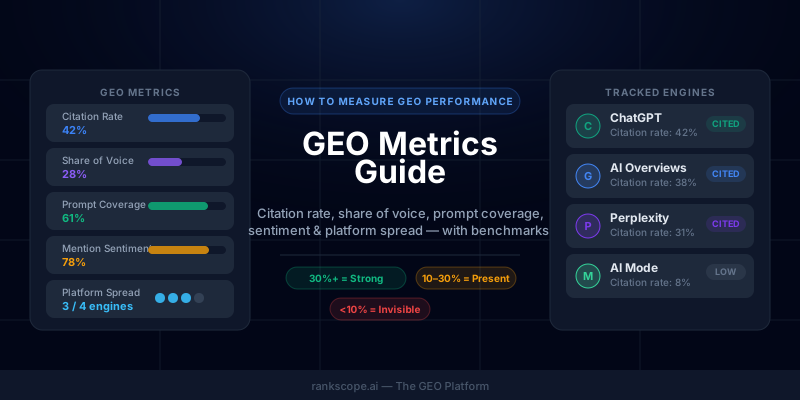
It varies by category competitiveness. For most B2B SaaS brands starting out, 5–15% citation share (meaning your domain appears in 5–15% of tracked prompt runs) is a realistic starting baseline. Established brands in their category can reach 25–40%+ citation share for core queries. If you're under 10% for your most central category queries, that's a meaningful optimization gap.
How often should I run citation tracking prompts?
Weekly is the minimum for meaningful trend data. AI answers are non-deterministic — they change with every query run — so you need repeated sampling to see stable patterns. A single snapshot is anecdotal. Weekly data over 4–6 weeks gives you a reliable citation baseline and lets you see whether content changes are working.
Why isn't my content being cited even though I rank on page 1 of Google?
Google organic rankings and AI citations draw from the same index but prioritize different signals. A page that ranks #1 for SEO reasons (strong backlink profile, domain authority) may still not get cited in AI Overviews if: (1) the content doesn't open with a direct extractable answer, (2) there are no structured data signals (FAQPage/HowTo schema), (3) the content is vague rather than factually dense, or (4) Googlebot-Extended is being blocked. For Perplexity and ChatGPT, check if Perplexity's bots and GPTBot have access in your robots.txt.
Can I track AI citations for free?
Yes, manually. Run your top 20–30 prompts through ChatGPT and Perplexity manually, note which sources they cite, and record whether your domain appears. It's time-consuming but gives you a real citation baseline at no cost. For systematic tracking at scale, dedicated tools like RankScope automate the prompt execution, citation extraction, and trend tracking.
Getting Started
The fastest way to understand your current citation position: open ChatGPT and Perplexity, run your 10 most important category queries, and record whether any of your URLs appear as sources. That's your manual baseline.
If you find you're being cited in 0 of 10 queries, the priority is content structure — specifically adding direct-answer openings, comparison tables, and FAQ sections to your most relevant pages. If you're being cited in 4–6 of 10 but competitors are in 8–9, the gap is content authority and coverage breadth.
RankScope automates this across ChatGPT, Perplexity, Google AI Overviews, and AI Mode — tracking your citation share, your competitor citation share, and which specific pages are earning or losing citations over time. Start your first citation report →