AI Brand Monitoring: The Complete Guide (2026)
AI brand monitoring is the practice of tracking how AI search engines mention, recommend, and characterize your brand when someone asks a question in your category. It runs your buyers' real questions through ChatGPT, Google AI Overviews, Perplexity, and Google AI Mode, records whether you appear, and reports what the engine said about you and which sources it used.
It is not social listening. Social listening reads what people publish about you. AI brand monitoring reads what models say about you, which is a synthesis of sources you often do not control and cannot see.
What AI brand monitoring tracks
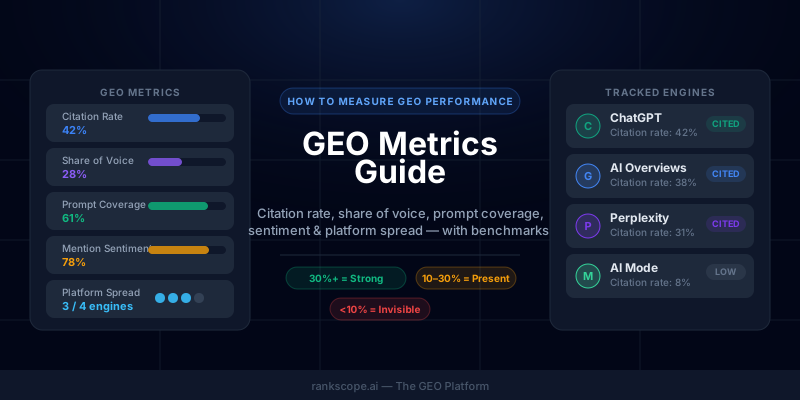
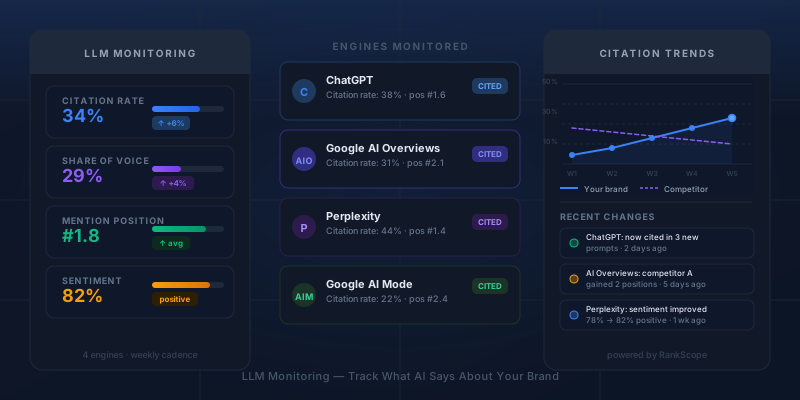
- Visibility rate: the share of your tracked category prompts where your brand appears in the answer at all.
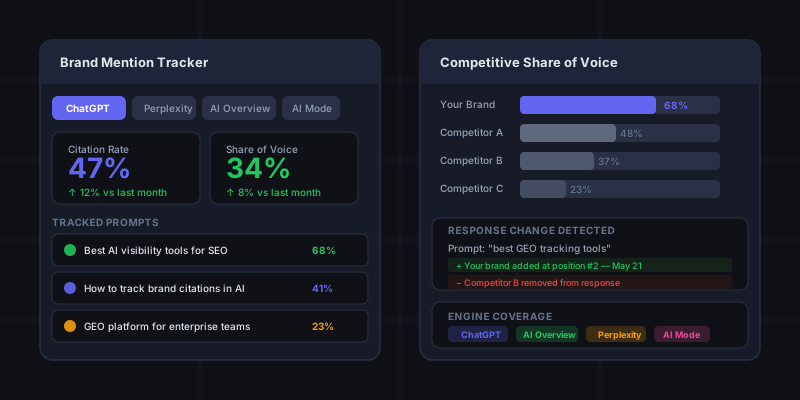
- Share of Voice: how often you are recommended compared with named competitors across the same prompt set.
- Citation sources: which third-party pages, forums, and review sites the engine referenced when it described you — the most actionable of the four, because those sources are what you can go and change.
- Sentiment and framing: whether the description is positive, neutral, or negative, and whether the pricing and features it states are even correct.
Why brands run it
- Close the AI visibility gap. Ranking well on Google says nothing about whether a model recommends you; the two are measured separately and frequently disagree.
- Catch inaccurate claims. Models state prices, features, and positioning confidently, and they go stale. Monitoring is how you find out you are being described with last year's pricing.
- Find the sources that move the needle. Citation data shows which external pages influence answers in your category, which turns digital PR from guesswork into a target list.
RankScope tracks all four metrics across four engines — ChatGPT, Google AI Overviews, Perplexity, and Google AI Mode, covering both of Google's AI surfaces. Share of Voice trending and sentiment scoring are on every plan, from $49/mo, or $39/mo billed annually.
The rest of this guide covers how engines pick which brands to name, the differences between them, and how to set monitoring up manually or with a platform.
What Is AI Brand Monitoring?
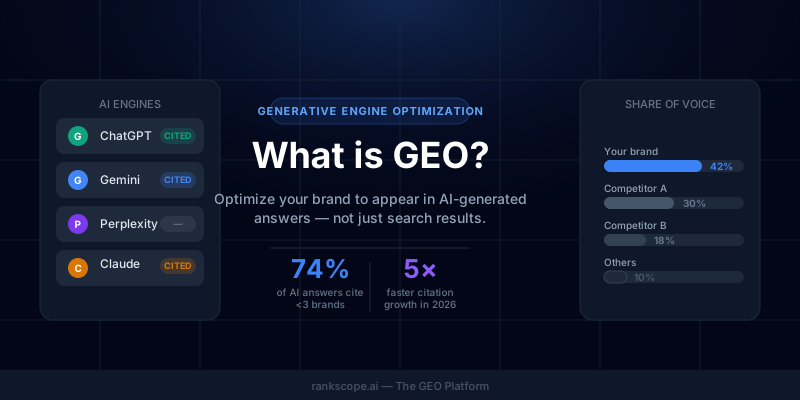
AI brand monitoring is the practice of systematically tracking how AI search engines mention, describe, and recommend your brand when users ask questions relevant to your category.
Specifically, it means:
- Running the questions your buyers ask across AI engines (ChatGPT, Perplexity, Google AI Overviews, AI Mode)
- Recording whether your brand appears in the answers
- Tracking what the AI says about you — the characterization, not just the mention
- Identifying which sources the AI cited to form its answer
- Measuring how all of this changes over time and against competitors
This is different from traditional brand monitoring (which scans public web content for your name) and different from social listening (which tracks what people say about you on social platforms). AI brand monitoring probes the models themselves — because the "mention" that now drives purchasing decisions happens inside a generated answer, not on a public feed.
Why AI Brand Monitoring Matters Now
AI search has a structural property that makes brand monitoring more important than it's ever been: AI answers are winner-take-most.
A Google results page shows 10 blue links. An AI answer names 2–3 brands and moves on. There is no page two. Being one of the named options is worth far more than ranking 7th on Google — and being left out is complete invisibility.
The scale is there. ChatGPT has more than 500 million weekly active users as of 2026. Google AI Overviews now appear in the majority of searches in the US. Perplexity crossed 100 million monthly visits. A growing share of product research, software evaluation, and service decisions begins with an AI conversation, not a search query.
Three things follow from this:
Discovery has moved upstream. Buyers build their shortlist inside AI before they ever visit a website. If you're not in the AI answer, you don't make the shortlist — and you never get the chance to convince them on your site.
Your brand is being narrated by a model. AI doesn't just list you — it characterizes you. "Good for enterprise." "Affordable for startups." "Better than [competitor] for X use case." A wrong characterization — or no characterization at all — costs deals you'll never know you lost.
You can't manage what you can't see. Most brands have never run their top 20 category queries through ChatGPT and recorded what comes back. They have zero citation baseline. AI brand monitoring starts with establishing that baseline.
How AI Search Engines Decide Which Brands to Mention
Understanding this changes your whole monitoring strategy.
AI engines construct answers from two sources: training data (what the model learned during training) and live retrieval (web pages fetched at query time via Bing, Google, or native crawlers).
A brand gets named when:
-
It appears in trusted sources at retrieval time — authoritative comparison pages, "best of" lists, review aggregators (G2, Capterra, Reddit), and industry publications. These are the sources AI engines actively retrieve and cite.
-
Its information is structured for extraction — clear product descriptions, comparison tables, FAQs, and schema markup make it easy for models to pull specific claims about your brand.
-
It has corroborated mentions across multiple independent sources — a brand that appears on G2 AND Reddit AND three industry blogs AND a Gartner report is far more likely to be cited than a brand only on its own website.
-
It has training data presence — for models like ChatGPT's GPT-4o (October 2023 cutoff), brands that had strong web presence before that date have a structural citation advantage baked into the model's weights. Newer brands rely entirely on live retrieval.
The engine-specific variation matters: Each AI engine has different source preferences and citation behavior. What gets you cited in ChatGPT is not identical to what gets you cited in Perplexity or AI Overviews. This is why monitoring all four engines — not just one — gives you an accurate picture of your actual AI visibility.
AI Brand Monitoring vs. Traditional Brand Monitoring
This is the most common source of confusion. Here's how they differ:
| Dimension | Traditional Brand Monitoring | AI Brand Monitoring |
|---|---|---|
| What's monitored | Public web, news, social media | AI-generated answers |
| How mentions surface | Your name appears in published content | AI names you in a response |
| When it happens | After someone writes about you | When a user asks a question |
| Source of the mention | A human writer or publisher | A model constructing an answer |
| What you can influence | PR, social, SEO | Content structure, citations, third-party authority |
| Discovery timing | After mention is published | At query time, every time |
| Examples of tools | Brandwatch, Mention, Meltwater | RankScope, Siftly, Otterly |
The key distinction: traditional monitoring is reactive (you find out what people already said). AI brand monitoring is predictive and operational — you're running the queries proactively, on a schedule, before your buyers do.
The Four Metrics That Actually Matter
1. Mention Rate (AI Visibility)
The percentage of your tracked prompts where your brand appears in the AI answer. If you track 100 relevant prompts and appear in 23 of them, your mention rate is 23%.
This is your baseline. Most brands, on first audit, find they're appearing in fewer than 20% of the queries their buyers ask. The benchmark varies by category — more competitive categories have lower per-brand rates.
2. Share of Voice
What percentage of all brand mentions in your tracked queries go to your brand versus competitors? If 10 competitor brands get mentioned across your prompt set and RankScope appears in 30% of the total mentions, your AI Share of Voice is 30%.
This is the competitive metric. It tells you your relative position in AI-generated answers, not just absolute presence. A brand with 10% mention rate in a two-player market is doing fine; 10% in a 20-player market signals a problem.
3. Sentiment and Characterization
It's not enough to be mentioned — you need to be described accurately and favorably. AI models build characterizations from what they've retrieved. Common issues:
- Wrong pricing or feature information
- Described as "good for beginners" when you're enterprise-grade
- Listed as an "alternative to" a competitor when you're actually category-leading
- Missing from answers for your core use case while appearing in peripheral ones
Sentiment tracking means reading what the AI actually says about you, not just whether you appear. A mention that says "RankScope is an expensive option better suited to large teams" is worse than no mention for a startup prospect.
4. Citation Sources
Which URLs is the AI using to justify naming you? This is the most actionable metric. If ChatGPT consistently cites a specific G2 page, a particular blog comparison, and a Reddit thread when it mentions your brand — those three sources are your highest-leverage content targets.
Fixing or improving those sources (updating your G2 listing, contributing to the Reddit thread, reaching out to the blog author) directly impacts your citation rate. Citation sources give you a map of the external content that controls your AI visibility.
Engine-by-Engine Monitoring: What's Different
ChatGPT (GPT-4o / GPT-5.5)
- Source preference: Bing-indexed pages, Reddit, G2, Capterra, established tech publications
- Retrieval behavior: Browses via Bing on paid plans; free tier leans more on training data (Oct 2023 cutoff)
- What moves the needle: Bing indexing, third-party review presence, being on "best of" lists that Bing ranks highly
- Monitoring note: Answers vary significantly between the free tier (GPT-4o) and Plus (GPT-5.5) — monitor both
Perplexity
- Source preference: Native real-time web crawl; strong preference for structured, citable content
- Retrieval behavior: Nearly always retrieves before answering; citations are explicit and visible
- What moves the needle: Clean, extraction-friendly page structure; being on pages Perplexity has indexed; high-authority domains
- Monitoring note: Perplexity shows source URLs in its answers — make your citation tracking here easy by noting which pages get cited
Google AI Overviews
- Source preference: Google's live index — pages already ranking on page 1 of Google for related queries
- Retrieval behavior: Gemini with Google Search grounding; no training cutoff constraint
- What moves the needle: Google organic rankings, E-E-A-T signals, structured data, Core Web Vitals
- Monitoring note: If you're on page 1 of Google for a query, you have a strong chance of appearing in AI Overviews for it. If you're not on page 1, you're likely not in AI Overviews either.
Google AI Mode
- Source preference: Similar to AI Overviews but used for more complex, multi-step queries
- Retrieval behavior: Gemini with deeper reasoning; tends to synthesize across more sources
- What moves the needle: Same as AI Overviews, but content depth matters more — AI Mode handles longer, more specific queries
- Monitoring note: AI Mode and AI Overviews have separate citation behavior — they play by different rules, so track them separately
How to Set Up AI Brand Monitoring
Step 1: Build your prompt library
Start with 30–50 prompts covering three types of buyer intent:
Discovery queries ("what is the best X tool?", "what's a good platform for Y?")
- These are where new buyers form their shortlist. Being absent here is the highest-cost gap.
Comparison queries ("[your brand] vs [competitor]", "alternatives to [competitor]")
- These capture buyers who are already evaluating. Showing up here with accurate characterization matters.
Use-case queries ("best tool for [specific use case]", "how do I track [specific thing]?")
- These are the queries closest to a buying decision. High-intent, narrow, often overlooked.
Aim for 10–15 prompts per category. Use actual language your buyers use, not marketing speak.
Step 2: Pick your engines
At minimum: ChatGPT and Google AI Overviews. These two cover the majority of AI search interactions for most B2B and B2C categories.
Add Perplexity if you're in a research-heavy category (tech, finance, healthcare) where users ask detailed questions expecting citations.
Add AI Mode if your category has complex, multi-step buying decisions where buyers ask detailed comparative questions.
Step 3: Run prompts on a schedule
One-time checks are useless — AI answers change. Models get updated, sources get re-indexed, competitor content shifts.
For early-stage monitoring: run your full prompt set weekly and record results in a spreadsheet. For each prompt, log: engine, date, mentioned (yes/no), characterization summary, cited URLs.
At scale, manual tracking breaks down fast. At 50 prompts × 4 engines × weekly cadence, you're looking at 800+ data points per month before you've done anything with the data.
Step 4: Establish your baseline
After your first 2–3 weeks of data, you have a baseline:
- Overall mention rate across all prompts and engines
- Per-engine breakdown (where are you strongest / weakest?)
- Share of voice vs top 3 competitors
- Top citation sources driving your mentions
This baseline is the starting point for everything. Without it, you can't measure whether your GEO efforts are working.
Step 5: Act on what you find
The data tells you where to invest:
- Low mention rate on specific query type → create content that directly addresses those queries
- Good mention rate but poor characterization → update your G2/Capterra listings, improve how your product is described on the pages AI cites
- High citation of one specific third-party page → reach out to that publisher about keeping the content accurate
- Visible in ChatGPT but invisible in AI Overviews → Google SEO gap; improve organic rankings for those queries
The Best AI Brand Monitoring Tools in 2026
The tools in this category divide into two types: GEO-native AI monitoring platforms (built specifically to track LLM citations) and traditional monitoring platforms (social listening tools that have added an AI monitoring feature).
For tracking what AI search engines say about your brand, GEO-native tools are meaningfully better — they're built for the problem, not retrofitted.
GEO-Native AI Brand Monitoring Tools
RankScope — Tracks brand citations across ChatGPT, Perplexity, Google AI Overviews, and AI Mode. Built specifically for AI search visibility, with share of voice tracking, citation source identification, prompt libraries, and before/after comparison to measure what content changes actually move your citation rate. Starter plan from $49/mo.
Siftly — AI-native monitoring with strong metrics coverage (mention rate, SoV, sentiment, citation sources). Good depth on the process side. Primarily targets B2B SaaS.
Otterly.AI — Covers ChatGPT, Perplexity, AI Overviews, Copilot, Gemini. Strong on tracking citation drift over time. Has a free tier. More monitoring-focused, lighter on the optimization guidance.
Peec AI — AI search analytics with competitive benchmarking. Clean UI, good for teams new to AI monitoring. Fewer engines than some competitors.
Profound — Enterprise-grade AI visibility platform. Expensive ($499+/mo) but deep feature set for large brand teams. Overkill for most SMBs.
Rankscale — AI rank tracking with share-of-mind metrics. Strong on competitive positioning data.
Traditional Tools With AI Monitoring Add-ons
Brandwatch — Market-leading social listening platform with an AI visibility module added. Best if you already use Brandwatch for social and want AI monitoring in the same platform. Not purpose-built for LLM citation tracking.
Meltwater — Media monitoring + AI search visibility. Similar story to Brandwatch — strong core platform with AI as an add-on, not a core capability.
Sprinklr — Enterprise social/PR platform with AI visibility features. Best for large teams already on Sprinklr.
SE Ranking — Traditional SEO platform with an AI Visibility Tracker feature. Affordable, good for teams already using SE Ranking who want basic AI monitoring added.
At-a-Glance Comparison
| Tool | Engines Covered | Best For | Starting Price |
|---|---|---|---|
| RankScope | ChatGPT, Perplexity, AI Overviews, AI Mode | GEO-focused teams; before/after measurement | $49/mo |
| Siftly | ChatGPT, Perplexity, AI Overviews | B2B SaaS brands; metrics depth | Custom |
| Otterly.AI | ChatGPT, Perplexity, AI Overviews, Copilot, Gemini | Tracking + drift monitoring; free tier | Free / paid |
| Peec AI | ChatGPT, Perplexity, Gemini | Teams new to AI monitoring | Custom |
| Profound | ChatGPT, Perplexity, AI Overviews | Enterprise brands | $499+/mo |
| Brandwatch | Limited AI coverage | Teams already on Brandwatch | Enterprise |
| SE Ranking | AI Overviews, limited LLMs | Budget-conscious SEO teams | $65+/mo |
AI Brand Monitoring vs. Social Listening: The Key Difference
People often ask whether they can use existing social listening tools for AI brand monitoring. The short answer: no, not really.
Social listening scans published, public content — tweets, news articles, forum posts. It finds mentions after they've been written.
AI brand monitoring probes model behavior — it asks the AI a question and records what the model says. The model's answer may not exist anywhere as a published document. It's synthesized on the fly.
The distinction matters because:
- Social listening can't tell you what ChatGPT says about your brand — ChatGPT's answers aren't published anywhere for social tools to find
- AI brand monitoring is proactive — you run the queries before buyers do, rather than reacting to what's already been written
- The influence levers are different — you improve AI citations by improving the sources AI retrieves and cites, not by publishing more content on your own channels
If you're using a social listening tool and calling it AI brand monitoring, you're missing the actual problem.
Frequently Asked Questions
What is AI brand monitoring?
AI brand monitoring tracks how AI search engines (ChatGPT, Perplexity, Google AI Overviews, AI Mode) mention, describe, and recommend your brand when users ask questions relevant to your category. It runs prompts systematically, records brand appearances and characterizations, and tracks how visibility changes over time and against competitors.
How is AI brand monitoring different from traditional brand monitoring?
Traditional brand monitoring scans published web content, news, and social media for your brand name. AI brand monitoring probes the models themselves — asking AI engines the questions your buyers ask and recording what the model says. The mentions that now influence purchasing decisions happen inside AI-generated answers, not on public feeds, so traditional tools miss them entirely.
Which AI engines should I monitor?
At minimum: ChatGPT and Google AI Overviews — these two account for the majority of AI search interactions. Add Perplexity if you're in a research-heavy category. Add AI Mode for complex B2B buying journeys. Each engine has different source preferences and citation behavior, so you need to monitor them separately.
How many prompts should I track?
Start with 30–50 prompts covering discovery queries, comparison queries, and use-case queries. This is enough to establish a meaningful baseline. At scale (100+ prompts across 4 engines), manual tracking becomes impractical and a dedicated tool pays for itself quickly.
How often should I run prompts?
Weekly is the minimum for meaningful trend data. AI answers change as models update, sources get re-indexed, and competitors publish new content. A single snapshot tells you where you are; weekly data tells you if your GEO efforts are actually moving the needle.
Can I improve my AI brand monitoring results?
Yes — this is the whole point of GEO (Generative Engine Optimization). Once monitoring shows you where you're absent or poorly characterized, you can act on it: improve the sources AI cites, fix inaccurate listings, create content targeting the specific prompts where you're invisible, and build third-party authority on the platforms AI trusts.
How long does it take to see results after making changes?
For Perplexity (real-time crawl), as little as 1–2 weeks after a page gets re-indexed. For Google AI Overviews (live Google index), 2–4 weeks after improved pages rank. For ChatGPT (Bing-grounded retrieval), 2–6 weeks. For training data impact, 6–18 months until the next model refresh. Focus your near-term efforts on retrieval-based engines.
Getting Started
The fastest way to know where you stand is to run your top 20 category queries through ChatGPT, Perplexity, and a Google AI search right now and count how many times your brand gets mentioned. That's your manual baseline.
If you want to do this properly — tracking 50+ prompts across 4 engines on a weekly schedule, with competitor benchmarking and citation source identification — that's what RankScope is built for. You get your first citation report in minutes, no setup required. For a closer look at how a dedicated AI brand tracker structures this process, see AI brand tracker: how to monitor your brand across AI search engines.