What Are Google AI Overviews? The Complete Guide (2026)
Google AI Overviews are the AI-generated summaries sitting at the very top of Google Search — above every organic link, above every ad — for hundreds of millions of searches every day. If you've Googled anything moderately complex in the past two years, you've seen them: a paragraph or two that synthesizes the answer, with small citation links you can expand to see which pages contributed.
For anyone who cares about search visibility — whether you're a content marketer, SEO, product team, or brand manager — AI Overviews are now one of the most important SERP features you need to understand. They change what "ranking" means, they affect click-through rates, and they create a new category of visibility that doesn't show up cleanly in Google Search Console.
This guide covers everything: what AI Overviews actually are, the full history, how Google decides what to put in them, every optimization tactic with the evidence behind each one, how to measure your citation rate, and what tools make this tractable at scale.
What Are Google AI Overviews?
Google AI Overviews are AI-generated summaries that Google displays at the top of search results for certain queries. They're powered by Google's Gemini large language models, synthesized from multiple web pages already in Google's organic index, and they include expandable citation links showing which pages contributed to the answer.
A few things that often get misunderstood:
They pull from Google's existing index. There's no special "AI overview index" or separate submission process. If Google already crawls and ranks your page, it's a candidate for AI Overview inclusion. Pages that aren't indexed at all — or that block Googlebot — can't be cited, but there's no additional opt-in step.
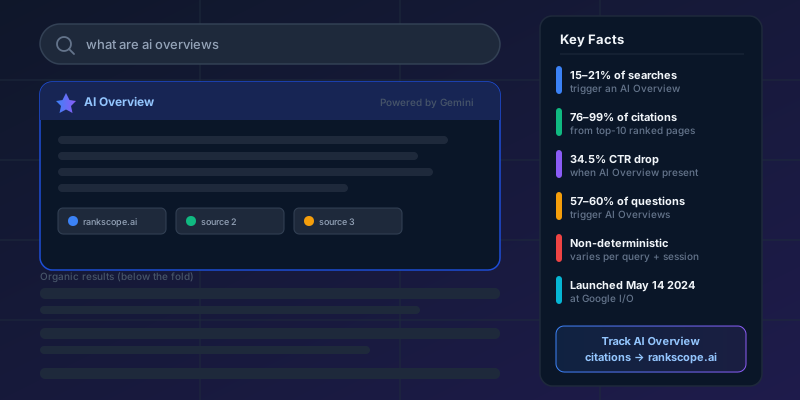
They're not shown for every query. Based on Ahrefs' analysis of 146 million SERPs, AI Overviews appear on approximately 21% of all searches. Semrush's data shows a similar range. They appear most commonly for informational, multi-step, and comparison queries. Most transactional and navigational queries don't trigger them.
They're different from Google AI Mode. AI Mode, launched in 2025, is a fully conversational interface that replaces the standard Google results page. AI Overviews appear within the standard Google Search layout — the familiar blue links and ads are still there, the AI Overview is a collapsible box at the top. Different product, different optimization considerations, though the content signals overlap significantly.
They're non-deterministic. Run the same search twice in quick succession and you may get different AI Overviews — or none at all the second time. The format, length, cited sources, and even whether an overview appears at all can vary based on query phrasing, personalization factors, Google's confidence in available sources, and ongoing A/B testing. For measurement, this has a direct practical consequence: a single manual check of whether your page is cited in an AI Overview is essentially meaningless data. You need repeated sampling across time and query variations to understand your actual citation rate — which is exactly why manual spot-checking doesn't scale as a monitoring strategy.
A Brief History: From SGE to AI Overviews
Understanding the timeline helps explain where the product is today and where it's likely to go.
May 2023 — Search Generative Experience (SGE) launches in Search Labs. Google opens its experimental AI search interface to US users who opt in through Search Labs. The interface puts a prominent AI-generated answer at the top of results. Initial coverage is inconsistent and the quality is frequently criticized, including some notable accuracy failures.
May 2024 — AI Overviews launch publicly at Google I/O. On May 14, 2024, Google announces AI Overviews for all US users without an opt-in requirement. This is the moment most of the industry starts paying serious attention to the feature. The launch also brings the now-famous early stumbles — the AI recommending putting glue on pizza and eating rocks — which led Google to pull back AI Overviews on certain query types in the weeks following.
Late 2024 — Quality improvements and global expansion. Google refines the system substantially. Accuracy problems become less frequent. Coverage expands to over 200 countries and 40+ languages. The feature becomes a fixture rather than an experiment.
2025 — AI Mode and continued evolution. Google launches AI Mode in the US as a more expansive, conversational experience. AI Overviews continue to expand in query coverage, particularly in commercial and transactional query types that were initially excluded. According to Semrush data, the share of AI Overview results that are purely informational dropped from 89% in October 2024 to 57% in October 2025. This is a significant strategic shift: Google is no longer using AI Overviews only to answer definitional or how-to questions. It's increasingly generating AI summaries for product research, comparison, and category queries — the exact searches where buyers are evaluating vendors. If you're in a competitive B2B or SaaS category, AI Overviews are no longer just a "content SEO" problem. They're a brand visibility problem for every stage of the funnel.
2026 — Current state. AI Overviews are embedded in the standard Google Search experience globally. For brands and publishers, they've shifted from "interesting to watch" to "part of the core visibility picture." The optimization discipline around them is now well-established enough that the patterns are reliably documented.
How AI Overviews Work: The Technical Foundation
To optimize for AI Overviews, you need to understand the system that generates them — not at a machine learning depth, but at a practical "what does this mean for my content" level.
Gemini Does the Synthesis
Google's Gemini models generate AI Overview responses. The process isn't simply retrieving the top organic result and summarizing it — it's more like running multiple searches simultaneously (Google calls this "query fan-out"), gathering relevant passages from multiple sources, and synthesizing a response.
The practical consequence: a single excellent page doesn't dominate AI Overviews the way a #1 ranking dominates organic clicks. Google's AI synthesizes across multiple sources, which means even a #4 or #6 ranked page can contribute content to the overview. For optimization, this means you should think less about "is my page the best" and more about "does my page have a clearly extractable passage that directly answers a sub-question Google's AI is trying to answer." The fan-out process creates multiple insertion points — even if you don't rank #1.
The Index Is the Source
AI Overviews draw from Google's organic search index — the same billions of pages that power standard Google Search. Google uses its existing evaluation infrastructure (PageRank, quality scores, spam detection, E-E-A-T assessment) to determine which pages are trustworthy enough to synthesize from.
This means standard technical SEO hygiene is load-bearing: pages that return errors, block Googlebot, have no external links, or are otherwise seen as low-quality by Google's ranking systems won't be cited even if the content quality is high.
The Grounding Process
When generating an AI Overview, Google's system uses a process called grounding — anchoring the AI's output to specific passages from real web pages rather than generating from internal model knowledge alone. This is what produces the citation links you see in AI Overviews.
Research by Dan Petrovic found that Google's content grounding plateaus around 540 words. In practice, this means that once a page crosses roughly 540 words of relevant, on-topic content, adding more words doesn't increase your AI Overview citation probability. The implication for content strategy: you don't need 3,000-word pages to earn AI Overview citations. A focused, well-structured 600-word page covering one query intent precisely will outperform a 2,500-word page covering five loosely related topics. Depth and directness beat volume.
What Percentage of Searches Trigger AI Overviews?
This question matters because it determines the scope of the opportunity and where AI Overview optimization effort is worth concentrating.
Overall rate: approximately 15–21% of all Google searches, based on Ahrefs' analysis of 146 million SERPs and Semrush's ongoing SERP tracking research.
Broken down by query type:
| Query Type | AI Overview Frequency |
|---|---|
| Question-based queries ("how," "what," "why") | 57–60% |
| "Why" queries specifically | ~59.8% |
| Yes/no queries | ~57.4% |
| Informational queries (broad) | ~57% (down from 89% in late 2024) |
| Commercial intent queries | Increasing through 2025–2026 |
| Transactional queries ("buy," "price") | <5% |
| Navigational queries (brand names, URLs) | <5% |
The trend in 2025 and into 2026 is meaningful: AI Overviews are expanding into commercial and even transactional territory. A feature that started as "informational summaries" is increasingly appearing on competitive research and product comparison queries. That's a significant shift for brands in competitive categories.
How AI Overviews Affect Traffic and Visibility
The honest answer is that it depends on the query type and whether you're cited.
If you're cited in the AI Overview: Your page gets a direct link at the top of the Google results page, above every organic result. Users who want to explore further click your link. For complex queries where users want depth, citation CTR can be meaningful.
If you're not cited and there's an AI Overview: You're competing for whatever is left below the fold. Ahrefs research found an average 34.5% CTR drop across all organic results when an AI Overview is present. For simple definitional queries that the overview fully answers, zero-click rates are high.
The strategic implication: Being cited is better than not being cited. But the real benchmark isn't "did I get cited vs. zero" — it's "did I get cited while my competitors didn't, or vice versa?" That competitive picture is what actually determines whether AI Overviews are helping or hurting your brand's relative visibility.
One more nuance worth understanding: brand mentions in AI Overviews without a direct citation link still have brand awareness value. If Google's AI names your product as an example while summarizing a category, users see it even without clicking. This is a form of visibility that doesn't register in traffic analytics at all — which is part of why dedicated AI visibility tracking matters.
How Google Selects Sources for AI Overviews
This is the core question for optimization. Google doesn't publish a detailed algorithmic spec for AI Overview source selection, but the combination of Google's own documentation, third-party research, and practitioner testing has produced a reasonably clear picture.
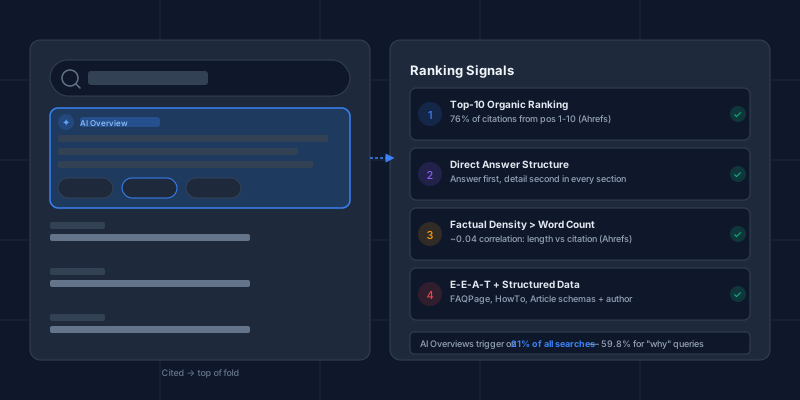
Signal 1: Organic Ranking Position
The most important signal isn't content structure or schema markup — it's whether your page already ranks in Google's top 10 for the target query.
Ahrefs' analysis of 1.9 million AI Overview citations found that 76% of citations come from pages ranking in the top 10 organic results, with the median cited position being #2. Semrush's earlier research found over 99% of citations from top-10 pages in their dataset. The exact numbers vary by study, but the direction is unambiguous.
What this means practically: AI Overview optimization is a layer on top of traditional SEO, not an alternative to it. If your page isn't ranking on page one for the target query, getting into the AI Overview for that query isn't possible through content tweaks alone. Earn the ranking first.
Signal 2: Direct-Answer Content Structure
Google's AI is built to extract self-contained, directly answerable passages. The content that gets cited is typically content that opens a section with a direct answer before providing supporting context — not content that builds to an answer through multiple paragraphs.
The extractability principle: the first complete, declarative sentence of a section is the most consistently cited unit. A section that opens with "The three main causes of X are A, B, and C" will be grounded far more reliably than a section that spends two paragraphs contextualizing before naming A, B, and C.
This is the same principle that underpins optimizing content for AI search across all platforms — Perplexity, ChatGPT, and Google AI Overviews all extract using some form of passage retrieval, and they all favor directly answerable passages.
Signal 3: E-E-A-T (Experience, Expertise, Authoritativeness, Trustworthiness)
Google has consistently emphasized E-E-A-T signals for AI Overview source selection — more heavily than for standard organic rankings. The practical components:
- Named authors with verifiable credentials — not "Staff Writer" or anonymous authorship
- Cited primary sources — specific studies, data points with attribution, official documentation
- Original data and research — content that contains something not available elsewhere
- First-hand experience — demonstrated use of the thing being described, not just description of it
- Accurate, up-to-date information — especially for queries where freshness matters
E-E-A-T is harder to game than structured markup because it requires substantive content investment. That's also why it's a meaningful quality signal.
Signal 4: Technical Accessibility
The basics have to work:
- Googlebot must not be blocked in robots.txt — critically,
Googlebot-Extended(which powers AI Overviews) must specifically be allowed - Pages must be indexed — not blocked via noindex tags or excluded from the sitemap
- Pages must return 200 status codes — 4xx errors prevent inclusion entirely
- Core Web Vitals shouldn't be severely degraded — while not a confirmed AI Overview signal, pages Google considers poor quality experiences are less likely to be trusted sources
If you're checking your AI Overviews SEO setup, robots.txt is one of the first technical checks to run. A surprising number of sites accidentally block Googlebot-Extended while allowing standard Googlebot.
Signal 5: Factual Density
Research on AI Overview citations consistently shows that specific, verifiable information outperforms vague generalities. Pages that state "AI Overviews appear on roughly 21% of all searches based on Ahrefs' analysis of 146 million SERPs" are more extractable than pages that say "AI Overviews appear on a significant portion of searches."
Numbers, percentages, dates, named entities, and specific claims are the currency of AI Overview citation. Dense factual content gives the AI a passage it can lift and verify against other sources. Vague content gives it nothing to work with.
AI Overviews vs. Other AI Search Surfaces
Understanding where AI Overviews sit relative to other AI search products matters for resource allocation. They're related but distinct, and the optimization overlap is partial rather than complete.
Google AI Overviews vs. Google AI Mode
AI Overviews appear within the standard Google Search interface. AI Mode replaces the standard interface with a conversational experience. The underlying Gemini models are related, and strong E-E-A-T content that wins AI Overview citations tends to perform well in AI Mode too — but they're different products with different UX and different citation mechanics.
Google AI Overviews vs. Perplexity
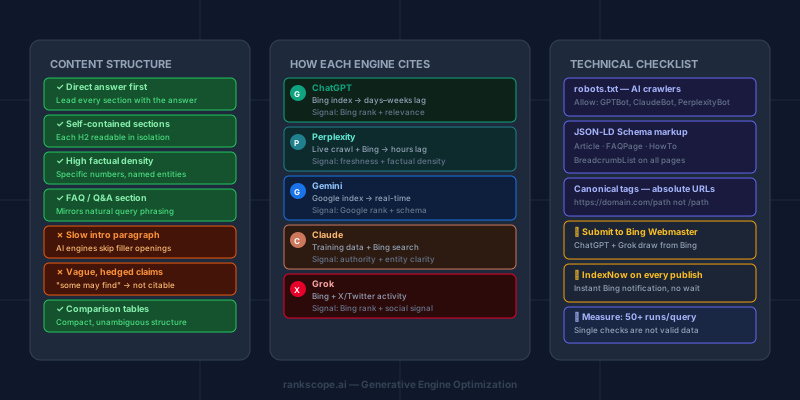
Perplexity is a standalone AI search engine built around RAG (Retrieval Augmented Generation). It crawls the web aggressively and freshness-weights its sources more heavily than Google does. Google AI Overviews rely on Google's existing index and ranking infrastructure. Perplexity will cite recent content from lower-authority domains if the content is highly relevant and freshly indexed; Google AI Overviews require the ranking prerequisite first. The Perplexity SEO guide covers Perplexity-specific optimization in detail.
Google AI Overviews vs. ChatGPT
ChatGPT (with Browse mode enabled) uses Bing's index for real-time retrieval. ChatGPT citations don't require Google ranking at all — a page can appear in ChatGPT answers without ranking anywhere in Google Search. The E-E-A-T weighting is also different; ChatGPT's model has its own trustworthiness assessments that aren't identical to Google's.
The broader framework: All of these are AI search surfaces that require AI-specific optimization on top of traditional SEO. The discipline that covers all of them together is Generative Engine Optimization (GEO). AI Overviews are the Google-specific piece. For the complete multi-platform strategy, the complete guide to GEO covers the full picture.
How to Optimize for Google AI Overviews
Everything above was context. This section is what you do about it. The following tactics are ranked roughly by impact, based on available research and practitioner evidence.
1. Earn the Organic Ranking First
AI Overview optimization is a top-10 game. Before any of the tactics below are worth your time, the question is: does this page already rank in positions 1–10 for the target query?
If not, the path to AI Overview inclusion runs through traditional SEO: keyword targeting, backlink building, E-E-A-T strengthening, and technical optimization. These aren't separate problems — they're sequential steps. See our complete GEO checklist for the full audit framework.
2. Structure Every Section for Extractability
This is the highest-leverage content change you can make once you're in the top 10.
The pattern to follow:
- H2 or H3 heading — describes the section topic precisely
- Opening sentence — directly answers the question the heading implies
- Supporting paragraph(s) — evidence, context, nuance
Here's a concrete before/after:
Before (buried answer):
There are many factors that influence how Google generates its AI Overviews. The system uses Gemini models and draws from a variety of signals. Organic ranking position is one of the most important signals, and researchers have found that it correlates strongly with AI Overview citation rates.
After (direct-answer structure):
AI Overview citations come predominantly from top-10 ranking pages — Ahrefs found 76% of citations come from pages ranking positions 1–10. The AI synthesizes content from these pages using Gemini models and multiple quality signals, with ranking position as the strongest predictor of inclusion.
The after version is extractable. The before version forces the AI to infer the key claim from surrounding context.
3. Maximize Factual Density
Specificity is what makes a passage quotable. Every vague claim has a more specific equivalent — find it and use it.
Replace this pattern: "AI Overviews appear frequently for informational searches" with this pattern: "AI Overviews appear on 57.9% of question-based queries and 59.8% of 'why' queries, according to Ahrefs' analysis of 146 million SERPs."
Named sources, specific percentages, dates, and comparative data points all increase the passage's extractability. Research on AI citation consistently shows that factually dense content correlates with AI Overview inclusion independent of word count or page authority.
4. Add FAQPage and HowTo Schema
JSON-LD schema markup doesn't directly determine AI Overview inclusion, but it does two useful things:
- Makes content structure machine-readable — Google's AI can identify question-answer pairs programmatically without needing to interpret prose
- Increases the probability your content appears in Google's featured snippet and People Also Ask features — which strongly correlates with AI Overview citation
The implementation is straightforward. FAQPage schema for any page with a Q&A section, HowTo schema for any instructional content with discrete steps. Our GEO checklist has the full implementation reference.
5. Strengthen E-E-A-T Signals
The minimum E-E-A-T bar for AI Overview citation is higher than for standard organic rankings. Practical implementation:
- Named author with a real byline page — author name, credentials, and ideally a profile that links out to verifiable professional presence
- Cited primary sources — link to the original study, the official documentation, the primary data source. Not a roundup of roundups.
- Original data — even small-scale original data (your own survey, your own analysis of publicly available data) is stronger than citing others' research
- Content freshness — update dates that actually correspond to content updates, not cosmetic refreshes
- Clear organizational identity — Organization schema with a consistent company name, location, contact information
6. Keep Content Tightly Intent-Focused
One counter-intuitive finding from AI Overview research: adding more content to a page doesn't always help, and can sometimes hurt. Ahrefs documented a case where adding tangentially related sections to a page caused its AI Overview visibility to drop — the additional content diluted the page's intent focus.
The lesson: one page, one clear intent. A guide about AI Overview optimization should not double as a general SEO primer. A page targeting "what are AI Overviews" should answer that question comprehensively, not pivot to five loosely related topics after the core answer.
7. Ensure Technical Accessibility
The checklist:
GooglebotandGooglebot-Extendedboth allowed in robots.txt- Page returns 200 status code
- No
noindexmeta tag - No
X-Robots-Tag: noindexHTTP header - Page included in XML sitemap
- Canonical URL correctly set — no unintentional self-canonicalization to a different page
- No
disallowrules blocking page in robots.txt
How to Measure AI Overview Visibility
Measurement is where most AI Overview strategy breaks down. The tools practitioners already know don't solve this problem cleanly.
What Google Search Console Tells You (and Doesn't)
Google Search Console shows impressions, clicks, position, and CTR for organic results. It does not report AI Overview citations separately. A click on a citation link within an AI Overview may appear in GSC data, but Google doesn't attribute it as an AI Overview click versus a standard organic click.
GSC is still useful for AI Overview work — it tells you which queries your pages rank for (which is the prerequisite for any AI Overview inclusion) — but it can't answer "am I being cited in AI Overviews for this query?"
Manual SERP Checks
You can manually search your target queries in Google and observe whether an AI Overview appears and whether your page is cited. This works for spot checks but fails at scale because:
- Volatility — AI Overviews change across query variations and refresh cycles. A single check is a snapshot that doesn't represent typical visibility
- Personalization — your Google Search results may differ from your users' results
- Scale — checking 50+ queries manually is not sustainable as a weekly practice
Systematic Monitoring
The practical solution is automated monitoring that:
- Runs your target query list regularly from a neutral, non-personalized environment
- Detects when an AI Overview appears for each query
- Records whether your domain is cited in the AI Overview
- Tracks your citation rate over time, so you can see whether optimization work is producing results — start with the free AI Overviews Tracker
- Shows competitor citation data for queries where you're not cited — which is often the fastest way to diagnose what's missing
RankScope's AI Overviews Tracker does exactly this. It monitors your target query set on a schedule, logs citation presence for your domain and your competitors, and surfaces the citation rate trends that tell you whether your optimization is working. Getting a clear answer to "is my content being cited in AI Overviews for the queries that matter to my business?" requires this kind of systematic data — not a one-off manual check.
The Right Metrics
Once you have monitoring in place, the metrics to track are:
| Metric | What It Tells You |
|---|---|
| Citation rate | % of target queries where your domain is cited in the AI Overview |
| AI Overview frequency | % of target queries where an AI Overview appears at all |
| Competitor citation rate | How often competitors are cited in the same queries |
| Citation share | Your citations ÷ total citations across your query set |
| Trend over time | Whether optimization work is moving the numbers |
Citation rate and competitor citation rate together give you the picture you actually need: not just "are we in AI Overviews" but "are we winning or losing the AI Overview share for our target queries?"
AI Overviews and the Broader GEO Picture
It's worth stepping back to frame AI Overviews in the larger context of where search is going.
AI Overviews are Google's version of a shift that's happening across the entire search landscape. ChatGPT, Perplexity, Google AI Mode, Grok, and Claude are all generating answers and citing sources. Google AI Overviews are the piece that happens inside the product your users probably still use most — standard Google Search — which makes them the highest-volume AI citation surface for most businesses.
But optimizing for Google AI Overviews while ignoring ChatGPT and Perplexity is leaving a large part of the AI visibility picture unaddressed. The users who ask ChatGPT "what's the best tool for [your category]" are often high-intent buyers. If ChatGPT names three competitors and not you, that's a brand visibility gap that doesn't show up in any traditional SEO metric.
Generative Engine Optimization (GEO) is the discipline that addresses all of this together: getting your brand cited in AI-generated answers across every platform where your buyers are searching. AI Overviews are the Google-specific piece of a multi-platform optimization problem.
The tactics overlap substantially: direct-answer content structure, factual density, E-E-A-T signals, and schema markup all help across Google AI Overviews, ChatGPT, and Perplexity simultaneously. The platform-specific differences are in the retrieval mechanics — what indexes they draw from, how heavily they weight freshness, whether organic ranking is a prerequisite.
For the complete cross-platform strategy, the full GEO guide covers the framework, platform-specific guidance, and measurement approach in detail.
Frequently Asked Questions
What are Google AI Overviews?
Google AI Overviews are AI-generated summaries that appear at the top of Google Search results for certain queries. Powered by Google's Gemini models, they synthesize content from multiple web pages already in Google's index and include citation links so users can explore sources in more depth.
When did AI Overviews launch?
AI Overviews launched publicly in the United States on May 14, 2024, at Google I/O. They were available earlier as Search Generative Experience (SGE) through Search Labs beginning in May 2023. Global expansion followed through 2024 and 2025, reaching 40+ languages and 200+ countries.
Do AI Overviews hurt organic traffic?
AI Overviews can reduce clicks for simple queries where the summary fully answers the question. Ahrefs research found an average 34.5% CTR drop when AI Overviews are present. However, pages cited in the AI Overview partially offset this — they receive a prominent link above the organic results. Complex queries with genuine research depth retain healthier CTR even with AI Overviews present.
How do I optimize for AI Overviews?
Start by ranking in the top 10 for the target query — that's the prerequisite. Then: structure content with direct answers at the start of each section, maximize factual density with specific numbers and named sources, add FAQPage and HowTo schema, strengthen E-E-A-T signals with author credentials and cited primary sources, and ensure Googlebot-Extended is not blocked in robots.txt.
How are AI Overviews different from regular featured snippets?
Featured snippets pull a single passage from a single page. AI Overviews synthesize content from multiple sources and generate a new response — they're not lifting a passage verbatim but creating a summary based on multiple inputs. AI Overviews are also more complex, often longer, structured with multiple paragraphs and lists, and include multiple citation links rather than one.
How do I track AI Overview citations?
Google Search Console doesn't report AI Overview citations separately. Manual checking is not scalable and misses volatility. The practical solution is systematic monitoring through a tool that runs your target queries, detects AI Overview appearances, and records your citation rate over time. RankScope's AI Overviews Tracker handles this automatically.
What's the difference between AI Overviews and AI Mode?
AI Overviews appear within the standard Google Search interface as a collapsible summary box. AI Mode is a fully conversational interface that replaces the standard Google Search page. Different products, different interfaces, partially overlapping optimization signals.
Summary: The Key Things to Know About AI Overviews
AI Overviews are now a permanent fixture of Google Search. For brands and publishers, understanding them isn't optional — they affect visibility, click-through rates, and brand perception for roughly one in five Google searches.
The key takeaways in plain terms:
- They're powered by Gemini and draw from Google's existing index — not a separate crawler or index
- Ranking top 10 is the prerequisite — no amount of AI-specific optimization helps if you're not on page one first
- Content structure matters a lot — direct answers first, details second, every time
- Factual density beats word count — specific, verifiable claims get cited; vague generalizations don't
- Schema markup helps — FAQPage and HowTo schema make your content machine-readable for Google's AI
- Measurement requires dedicated monitoring — GSC doesn't report it, manual checks don't scale
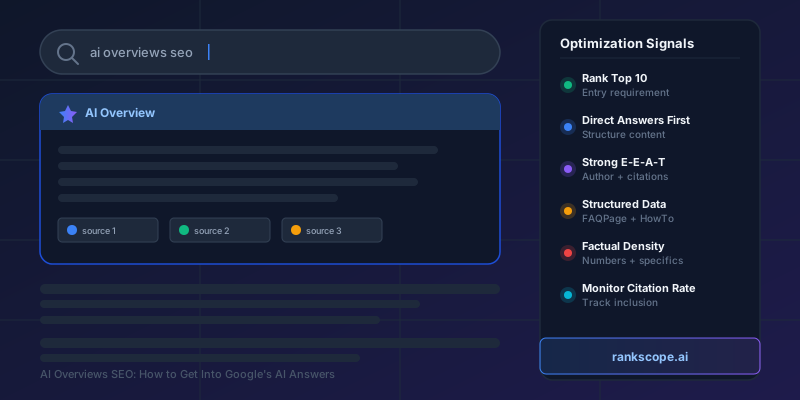
For the detailed step-by-step optimization process, see the companion guide: How to Rank in Google AI Overviews: Complete Guide. For the signals and content optimization deep-dive, see AI Overviews SEO: How to Get Into Google's AI Answers. And for tracking your citation rate automatically, RankScope's AI Overviews Tracker is built for exactly this.