How to Rank in Google AI Overviews in 2026: The Complete Data-Backed Guide
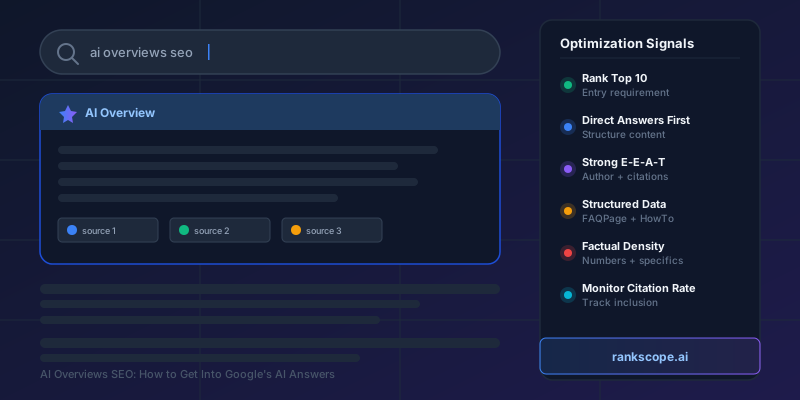
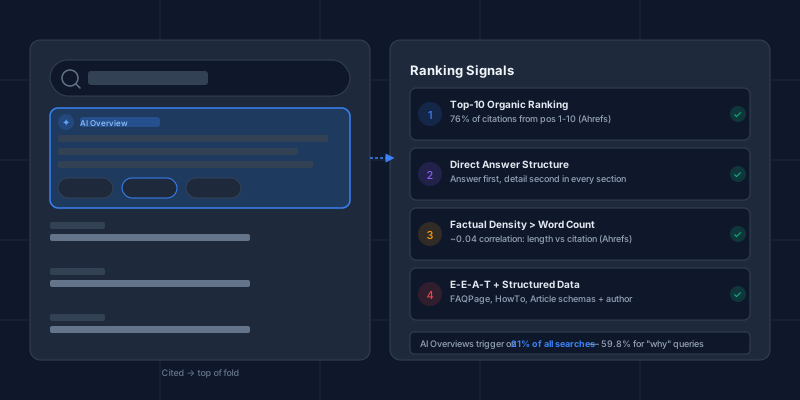
To rank in Google AI Overviews, you need to: (1) already rank in Google's top 10 for the query, (2) structure content with direct answers at the start of each section, (3) maximize factual density over word count, and (4) pass Googlebot-Extended access. That's the core. Everything below is how to execute it.
Last updated: August 10, 2026.
For roughly 1 in 5 queries, Google now generates an AI-written summary that sits above every organic link — the AI Overview. Brands cited inside get a trust signal and a click. Everyone below the fold competes for what's left.
The good news: ranking in AI Overviews is learnable. Google has published guidance, researchers have run large-scale studies of what actually correlates with inclusion, and the signals are increasingly clear. This guide covers what's confirmed to work — and why some of the most commonly repeated advice is wrong.
If you're also optimizing for ChatGPT, Perplexity, and other AI engines, the broader discipline is Generative Engine Optimization (GEO). For the complete cross-engine playbook, see the complete GEO guide. This post focuses specifically on Google AI Overviews — how to get cited, not just indexed.
What Changed in AI Overviews in 2026
Before the data, a quick state-of-play. AI Overviews have evolved significantly since the May 2024 US launch. Here's what's materially different as of mid-2026:
- AI Mode is now live and distinct. Google launched AI Mode as a separate conversational interface in 2025. AI Overviews and AI Mode are now clearly separate products — see the comparison table later in this guide. Many 2024-era articles conflate them.
- Trigger rate has stabilized. After early volatility (AI Overviews disappeared from many queries in late 2024 after backlash), they've stabilized at roughly 21% of all queries — up from ~15% in late 2024.
- International rollout is complete. AI Overviews are now live in 200+ countries and 40+ languages. The optimization principles are consistent across markets.
- GSC still doesn't break out AI Overview impressions. This remains the biggest measurement gap. Google has acknowledged it; no timeline for a fix as of June 2026.
- Googlebot-Extended is the critical crawler. Confirmed since 2024 but worth repeating: blocking this variant blocks AI Overview access entirely.
- Fan-out queries are more important. Google's "fan-out" query behavior (breaking one complex query into multiple sub-queries) has become more prominent with AI Mode. Content that answers a topic cluster — not just one keyword — is better positioned for both AI Overviews and AI Mode.
August 2026 Update: AI Mode Expansion
Google has significantly expanded AI Mode availability through mid-2026. Key developments as of August 2026:
- AI Mode is now default for a larger share of queries — Google has been progressively routing more informational and transactional queries through AI Mode rather than standard AI Overviews
- AI Overviews citation patterns are stabilizing — early 2026 saw significant fluctuation; as of August 2026, citation patterns are more consistent for informational queries but remain volatile for commercial intent
- Multi-step reasoning queries now routinely trigger AI Overviews where they previously didn't — "how to" and "why does" query formats see the highest coverage
- RankScope data shows citation rates improving for pages that added structured FAQ sections and explicit numbered step formats in H2/H3 headings in Q2 2026
The core optimization framework in this guide remains valid. The prerequisite — ranking in the top 10 organically — has not changed.
What the Data Actually Says About AI Overview Rankings
A lot of AI Overview advice is speculative. Let's start with what the numbers show.
Ahrefs analyzed 146 million SERPs and 1.9 million AI Overview citations. The findings:
- AI Overviews appear on 21% of all Google searches — far more concentrated than most estimates
- 57.9% of question-based queries trigger AI Overviews — compared to 21% overall
- 59.8% of "why" queries trigger AI Overviews — the highest rate of any query type studied
- 76% of AI Overview citations come from top-10 ranking pages — with the median cited position being #2
- Word count has near-zero correlation with citations — Spearman coefficient of approximately 0.04
That last finding surprises people. More words do not equal more citations. The quality and structure of the answer matters, not its length.
Separately, researcher Dan Petrovic analyzed over 7,000 queries and found that Google's "grounding" — the content it uses as source material when generating AI Overviews — plateaus at around 540 words. Pages over 2,000 words see diminishing returns. "Adding more content dilutes your coverage percentage without increasing what gets selected," Petrovic found. "Density beats length."
The picture this paints: Google is looking for pages that directly and specifically answer the query, already hold a top-10 ranking, and carry strong authority signals. Length is not a proxy for any of those things.
Step 1: Target the Right Query Types
Before any content optimization, you need to confirm you're targeting queries where AI Overviews actually appear.
Query types with high AI Overview rates:
| Query Type | AI Overview Rate |
|---|---|
| "Why" questions | 59.8% |
| "Yes/No" (bool) questions | 57.4% |
| Question-based queries (any) | 57.9% |
| Definition queries | 47.3% |
| Queries with 7+ words | 46.4% |
| All queries (baseline) | 21.0% |
Source: Ahrefs analysis of 146 million SERPs
Query types that rarely trigger AI Overviews:
- Transactional queries — "buy," "price," "shop," "discount" — Google won't replace the purchase journey with a summary
- Navigational queries — searching for a specific brand or site name
- Breaking news — too dynamic for synthesized answers
- Sensitive YMYL topics — Google is cautious about AI-generated medical and legal guidance
- Simple one-word or two-word queries — often lack enough context to warrant synthesis
Practically: if you're creating content targeting informational "how to," "what is," "why does," and comparison queries, you're in the right zone. If you're targeting product landing pages or news articles, AI Overview optimization is less relevant.
Before you start optimizing: search your target query in Google and verify an AI Overview actually appears for it. Not every informational query triggers one consistently. Prioritize queries that already show AI Overviews — they're your highest-leverage targets.
Step 2: Get on Page One First
This is the most important section in this guide, and the one most people skip over because it feels obvious.
You cannot rank in a Google AI Overview if you're not in the top 10 organic results for that query.
This isn't a soft guideline — it's a structural constraint. Ahrefs' research found that 76% of AI Overview citations come from pages ranking in the top 10. Semrush's earlier studies found over 99% of citations from top-10 pages for their dataset. The number varies by study, but the conclusion is consistent: page two pages are almost never cited.
Why? Because Google AI Overviews use Retrieval-Augmented Generation (RAG) — they query Google's own index, retrieve the highest-quality pages, and synthesize. If Google doesn't surface your page in its organic results, its AI system doesn't have it in the retrieval pool.
What this means in practice:
- If you're at position 11–20 for a target query, your first priority is improving that ranking — not restructuring your AI Overview content
- If you're at positions 2–10 for an informational query that triggers AI Overviews, you're a strong candidate — now content optimization is your lever
- If you're at position 30 or below (which is where many sites start for competitive terms), traditional SEO fundamentals come first: backlinks, page authority, topical depth
The AI Overview optimization checklist below assumes you've cleared this hurdle. If you haven't, the most impactful action is standard SEO work.
Step 3: Match Searcher Intent Precisely
Once you're ranking on page one, the next question Google's AI asks is: does this page actually answer this specific query? This is where many pages fail even after achieving strong rankings.
Intent precision matters more than topic coverage. A page that broadly covers "AI Overviews" is different from a page specifically written to answer "how to rank in AI overviews." Google's AI Overview generator distinguishes between them — and will cite the more specific answer.
Ahrefs documented a concrete failure mode here: a piece of content that was updated by adding more sections on tangentially related topics saw AI Overview visibility drop despite the update being a legitimate quality improvement. The additional content diluted the page's intent focus and pushed important answers further down.
How to audit intent alignment:
- Search your target query in Google. Read the first 3–5 organic results and identify what they're actually answering. That's the intent baseline.
- Check whether your page answers the same question from its opening sections — or whether it builds context for several paragraphs before getting to the answer.
- If your page covers significantly more territory than the top results, consider whether that extra coverage is diluting your focus for this specific query.
A 1,000-word page that precisely and completely answers the query will frequently outperform a 3,000-word page that also covers related topics in Google's AI extraction — even if the longer page is technically more comprehensive.
Step 4: Structure Content So Google Can Extract It
This is the content optimization step that most directly influences whether your page gets cited. Google's AI doesn't read your page the way a human does — it extracts specific passages that answer the query. Everything in your content structure should make extraction easier.
Lead With the Answer, Follow With the Detail
Every H2 and H3 section should open with a direct, complete answer in the first sentence. Then support it with context, caveats, and data.
Wrong:
Google introduced AI Overviews in May 2024 as the successor to SGE. The feature went through extensive testing before launching publicly. It draws from Google's index and synthesizes information from multiple sources. To understand whether your content might qualify, you first need to understand...
Right:
To rank in Google AI Overviews, your page must already appear in Google's top 10 for the target query — AI Overviews pull from pages Google already considers authoritative, not from a separate submission system.
The second version is extractable. The first requires reading four sentences before hitting anything citable.
This pattern applies to every section, not just your introduction. Google's extraction works at the section level — the opening sentence of an H2 section is the most frequently extracted unit of content.
Use Lists and Tables for Structured Information
When content naturally fits a list or table format, format it that way. AI Overviews frequently pull bulleted lists and comparison tables directly into their summaries because the structure maps naturally to synthesis.
- Steps → numbered lists
- Options or factors → bulleted lists
- Comparisons → two-column tables
- Stats → grouped data with clear labels
Unstructured prose makes the AI's extraction job harder. Lists and tables make it easier.
Keep Paragraphs Short and Self-Contained
Paragraphs of 3–4 sentences, each covering a single idea, are more extractable than dense multi-idea paragraphs. Each paragraph should stand alone — if you lifted it out of the page context, it should still be meaningful.
Dense paragraphs that weave several related points together are harder for AI systems to extract without pulling in surrounding context. Clean, self-contained paragraphs give the extraction system more options.
Write an FAQ Section
A Q&A section with FAQPage schema is one of the clearest extraction signals you can add. Google's AI Overviews are triggered by questions — and question-answer pairs are the format that maps most directly to how the AI Overview is presented to users.
Write questions the way real users ask them. Open each answer with one declarative sentence that directly answers the question. Then elaborate.
FAQ sections also tend to capture People Also Ask (PAA) boxes, which is a related ranking signal that correlates with AI Overview candidacy.
Step 5: Maximize Factual Density
When your page competes with five others for inclusion in an AI Overview, factual density is the primary differentiator. The page with the most specific, verifiable, citable information wins.
Vague content doesn't get cited. Specific content does.
| Vague (skip) | Specific (cite) |
|---|---|
| AI Overviews appear on many searches | AI Overviews appear on 21% of all Google searches |
| Most cited pages rank highly | 76% of AI Overview citations come from top-10 results |
| Content should be comprehensive | Google's grounding plateaus at ~540 words |
| CTR drops when AI Overviews appear | Ahrefs found an average 34.5% CTR drop when AI Overviews appear |
Every vague claim is a missed citation opportunity. Go back through your top target pages and replace approximations with numbers. If you don't have specific data, find the primary source and link to it.
Original data is the highest form of factual density. If your product generates data — usage patterns, benchmark numbers, survey results — publish it as citable content. A post titled "We Analyzed 10,000 Queries: What Percentage Triggered AI Overviews?" will earn citations that a generic tips post cannot. AI systems prefer novel, specific information that they can't find reproduced elsewhere.
For a broader look at how factual density works across all AI search engines — not just Google — see our guide on how to optimize content for AI search.
Step 6: Strengthen E-E-A-T Signals
Google's AI Overviews are held to a higher quality bar than standard organic results. Google has stated this explicitly — it's willing to rank a page in position 7 that it won't cite in an AI Overview. The difference is often E-E-A-T: Experience, Expertise, Authoritativeness, and Trustworthiness.
Author credentials matter. An anonymous page with no author attribution is at a disadvantage for AI Overview inclusion even when it ranks well. A named author with verifiable credentials in the subject — a byline that links to a professional bio — adds a meaningful E-E-A-T signal.
Source citation strengthens authority. Link to primary sources for your factual claims: original studies, official documentation, government data, peer-reviewed research. Linking to other blog posts doesn't carry the same weight. When you cite a Pew Research study or a Google engineering blog directly, you're connecting your content to established authoritative sources.
Original data and first-hand experience signals E. The "Experience" component of E-E-A-T is newer and often overlooked. Content that describes what you actually measured, tested, or observed — "in our analysis of X accounts," "when we ran this test," "across RankScope's dataset" — demonstrates direct experience. Generic explainer content that doesn't draw on any first-hand knowledge has no Experience signal.
Publication dates and update signals. Fresh, recently updated content signals that the information is current. For rapidly-evolving topics like AI Overviews (which have changed considerably since launching in 2024), a visible publication date and documented update history tells Google's AI that this content reflects the current state.
Step 7: Get Your Technical Signals Right
Content and ranking strategy are the big levers. Technical issues are blockers — they override everything else.
Googlebot-Extended Access
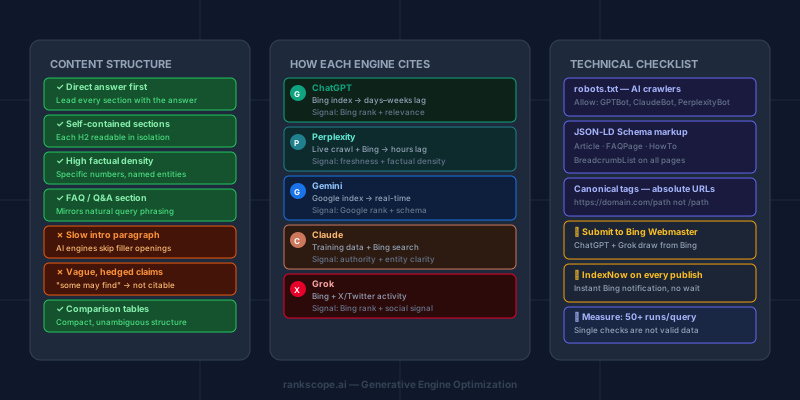
This is the single most common technical mistake: blocking Googlebot-Extended in robots.txt. This variant is the crawler responsible for content used in Google's AI features, including AI Overviews. Block it and your pages cannot appear in AI Overviews regardless of how well they rank or how well they're structured.
Check your robots.txt file right now. Confirm Googlebot-Extended is either explicitly allowed or not mentioned (which defaults to allowed). Once crawling is clear, check your AI visibility to see whether AI Overviews is citing you yet. Any blocking rule that covers it — including broad * blocks with no exceptions — will prevent AI Overview inclusion.
If you're using a CDN or WAF that manages bot rules, verify the AI crawler access at the CDN level too, not just at the domain level.
Indexing Basics
Confirm the page is indexed in Google Search Console and returns HTTP 200. Check that the page is not marked noindex, and that the canonical URL matches the actual URL. These are the same checks that matter for standard SEO, but for AI Overviews there's less tolerance for ambiguity — Google's AI extraction prioritizes clean, unambiguous pages.
Core Web Vitals
Page speed and Core Web Vitals affect your overall ranking quality, which is the foundation for AI Overview candidacy. They're not a direct AI Overview signal, but a page with poor LCP or high CLS scores will struggle to rank in positions 1–10 where AI Overview citations come from.
Structured Data Implementation
Add JSON-LD structured data appropriate to your page type:
- Article/BlogPosting — on all blog posts (publication date, author, description)
- FAQPage — on any page with a Q&A section
- HowTo — on any step-by-step how-to content
These schemas help Google's AI extraction layer classify and extract your content correctly. They don't override ranking or E-E-A-T, but they're a clear positive signal for AI Overview inclusion.
Our GEO checklist has the full structured data implementation reference.
How AI Overviews Differ From AI Mode
This is the terminology confusion that trips up most people. Google AI Overviews and Google AI Mode are different products with different triggers, different audiences, and different optimization targets.
| Google AI Overviews | Google AI Mode | |
|---|---|---|
| Where it appears | Within standard Google Search results | Separate AI Mode tab / interface |
| Trigger rate | ~21% of all queries | Complex, multi-step queries |
| Format | Paragraph or list summary with 3–5 citations | Full conversational response, multiple sources |
| Index source | Google's organic index | Google's organic index (same) |
| Ranking prerequisite | Top-10 organic rank strongly required | Top-10 helps, but AI Mode synthesizes more broadly |
| Launched | May 2024 (US full rollout) | 2025 |
| Optimization maturity | Well-documented signals | Still evolving |
| Closest analogy | Featured snippet but AI-generated | Perplexity inside Google |
The practical implication: The content structure and E-E-A-T optimizations in this guide apply to both. But AI Overviews have a much tighter dependency on traditional organic rankings — if you're not in the top 10, you're almost certainly not getting cited. AI Mode pulls from a broader pool and appears to be somewhat more forgiving on ranking position for complex queries.
Which one you're seeing matters. When you test a query and see an AI response, check whether you're in standard Search results (AI Overviews) or in the AI Mode tab (AI Mode). The content signals overlap, but the ranking dynamics don't map 1:1.
This guide covers AI Overviews specifically. For AI Mode optimization, the core principles from Steps 1–7 above apply — but expect the playbook to evolve as Google publishes more data.
AI Overviews vs ChatGPT and Perplexity: Where They Differ
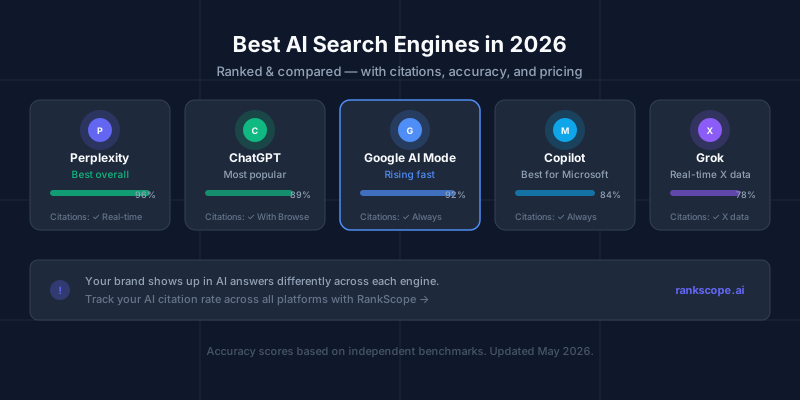
AI Overviews and ChatGPT/Perplexity are all AI search surfaces, but they have meaningfully different optimization requirements. Understanding the differences helps you allocate effort correctly. For a full breakdown of how each major AI search engine works — including Perplexity, ChatGPT, Copilot, and Grok — see our comparison of the best AI search engines in 2026.
| Signal | Google AI Overviews | ChatGPT Search | Perplexity |
|---|---|---|---|
| Index source | Google's organic index | Bing's organic index | Live web crawl |
| Ranking prerequisite | Top-10 Google rank required | Bing top-10 helps significantly | Less dependent on ranking |
| E-E-A-T weight | Very high | Moderate | Moderate |
| Structured data impact | Direct signal | Indirect | Indirect |
| Freshness weighting | Moderate | Moderate | Very high (near real-time) |
| Citation visibility | Attributed sources in overview | Inline citations with links | Inline citations with links |
The shared fundamentals across all three: direct-answer content structure, high factual density, and AI crawler access.
The AI Overview-specific requirement: a top-10 Google ranking. This is the one signal that doesn't transfer directly to ChatGPT (which uses Bing) or Perplexity (which crawls live). It's the hardest prerequisite to meet but also the most durable competitive moat once you do.
For the complete framework covering every major AI surface — including ChatGPT, Perplexity, and both of Google’s AI surfaces — the complete GEO guide covers the full picture. For Perplexity specifically, which has a distinct RAG-first architecture and freshness-weighted citation model, see the Perplexity SEO guide.
How to Track AI Overview Rankings
Tracking AI Overview visibility is fundamentally different from tracking traditional keyword rankings. Here's why:
AI Overviews are query-session dependent — the same query run twice can produce different AI Overviews (or no AI Overview at all). Position tracking tools that scrape SERPs once per day miss this entirely.
What you need to track:
- Trigger rate — what % of your target queries produce an AI Overview at all
- Citation rate — when an AI Overview appears, what % of the time does it cite your page
- Citation position — are you the primary source, secondary source, or buried in "show more"
- Change detection — when a competitor enters or exits an AI Overview you were previously cited in
Manual tracking method (free):
- Open an incognito Chrome window (logged out of Google)
- Search your 10–20 most important target queries
- Screenshot AI Overviews that appear
- Note which pages are cited (check the source links)
- Repeat weekly — single checks are meaningless due to non-determinism
Automated tracking: RankScope runs real browser sessions against your target query set, detects AI Overview appearances, tracks your citation rate over time, and alerts you when your citation status changes. Unlike API-based tools, it captures the actual browser-rendered AI Overview — the same response your users see.
Measuring AI Overview Visibility
Optimization without measurement is guessing. But AI Overview measurement has a real problem: Google Search Console doesn't report AI Overview citations separately from organic impressions.
What you actually need to track:
- Trigger rate — For your 20–50 target queries, what percentage currently show an AI Overview? This tells you where your optimization effort is relevant.
- Citation rate — When an AI Overview appears for one of your target queries, does it cite your domain? This is the core metric.
- Position within the overview — Are you the first cited source, or buried in the expanded list? Top-cited positions are worth more.
- Competitor citation rate — For the queries where you're not cited, who is? What are they doing differently?
- Trend over time — Is your citation rate improving after you make content changes?
The volatility problem. AI Overviews are non-deterministic — they change with every refresh. A query that shows your domain cited in the morning may not show it that afternoon. This is intentional: Google's confidence threshold is dynamic.
This means a single manual check is statistically meaningless. One search showing an AI Overview is anecdotal. You need systematic data across multiple sessions and multiple days to see signal above the noise.
Manual monitoring works at small scale, and our free AI Overviews Tracker covers the rest: set a weekly reminder to check your 10 most important queries in a fresh browser session. Record what you see. The limitation is consistency and scale — it's hard to do well across 50+ queries, and easy to miss trends.
Automated monitoring is the practical solution at meaningful scale. RankScope's AI Overviews Tracker runs your target queries systematically, detects when AI Overviews appear, records whether your domain is cited, and tracks your citation rate over time. It also shows you which competitors are being cited in the queries where you're not — which is often the fastest way to identify what you're missing. For a broader look at monitoring your brand across all AI engines (not just AI Overviews), see our AI brand monitoring guide.
The AI Overview Optimization Checklist
Use this as a pre-publish check for any page you're targeting for AI Overview inclusion.
Foundation (must complete first)
- Confirm the target query triggers AI Overviews in Google Search
- Verify the page ranks in positions 1–10 for the target query in Google Search Console
- Confirm
Googlebot-Extendedis not blocked in robots.txt
Content Structure
- Every H2 and H3 section opens with a direct answer in the first sentence
- No sections that build context for 2+ paragraphs before reaching the answer
- Comparison or multi-option content is formatted as tables or lists
- FAQ section with direct Q&A pairs present (if appropriate for the topic)
- Paragraphs are 3–4 sentences, each covering a single idea
Factual Density
- All major claims include specific numbers, percentages, or named sources
- Vague language ("many," "often," "significant") replaced with specifics where possible
- At least one piece of original data or first-hand observation included
- Primary sources cited with outbound links (studies, official docs, data)
E-E-A-T
- Named author with professional credentials and a bio or linked profile
- Publication date visible and accurate
- At least two outbound links to primary sources (not other blog posts)
- Content reflects direct experience or first-hand knowledge where relevant
Technical
- Page indexed in Google Search Console (HTTP 200, not noindex)
- Canonical URL matches actual URL
- Article/BlogPosting JSON-LD schema present with accurate date and author
- FAQPage JSON-LD schema if FAQ section exists
- HowTo JSON-LD schema if step-by-step content exists
- Core Web Vitals passing for the page
Common Mistakes That Kill Your Chances
Burying the answer. Starting every section with three sentences of background before the actual answer is the single most common structural mistake. It's the easiest fix and the one most likely to move your citation rate.
Adding more words instead of better answers. If a page isn't appearing in AI Overviews, the instinct is often to make it longer. The data says this often makes things worse. Add specificity, not length.
Treating AI Overviews like featured snippets. Featured snippets and AI Overviews share some optimization principles (direct answers, structured content) but aren't the same. Featured snippets pull a single passage; AI Overviews synthesize multiple sources and multiple passages. You're not optimizing for one extraction — you're making your content consistently citable across many extractions.
Optimizing without checking trigger rate first. Spending time on a query where AI Overviews rarely or never appear is wasted effort. Check trigger rate before you optimize.
Single spot-checks instead of systematic measurement. See the measurement section above. One good result in one manual check does not mean your citation rate has improved. Measure systematically.
Blocking Googlebot-Extended. Check this right now if you haven't. It's a five-second check with major consequences if you've got it wrong.
What Happens to Your Traffic
The honest answer: AI Overviews can reduce click-through rates on the queries they appear for. Ahrefs' research shows an average 34.5% CTR drop when AI Overviews appear, with some studies from Seer Interactive reporting drops as high as 61% for specific query types. Pew Research found users click a traditional result in only 8% of AI Overview visits, versus 15% without one.
This is real. For simple definitional queries — "what is X" — the AI Overview often fully answers the question and users don't click through. Zero-click risk is highest here.
The counterintuitive reality: not being cited is worse than being cited.
When a competitor is inside the AI Overview and you're not, they get the trust signal, the brand impression, and the clicks from users who want more. You get nothing. The alternative to being cited is not "user sees your organic result instead" — it's "user never sees you at all" for queries where the AI Overview dominates the fold.
For complex research queries, comparisons, and multi-step how-tos, cited pages still generate meaningful click-through because users seeking depth click through to sources. The zero-click risk is concentrated in simple queries.
The strategic takeaway: optimize for citation inclusion because being inside the overview is categorically better than being outside it, even for queries where some zero-click risk exists.
Understanding the full zero-click picture — including what brand visibility means in a world where 68% of searches don't produce a click — is covered in our dedicated zero-click search guide for 2026.
Google AI Overviews are now a permanent part of search — not a test, not a rollout, a fixture. The optimization path is learnable and the signals are clear. Rank in the top 10, answer the specific query directly from the first sentence of each section, add factual density and structured data, and measure your citation rate over time.
If you're building an AI-visible content strategy across all of Google's AI surfaces — including AI Overviews and the newer AI Mode — our detailed AI Overviews SEO guide goes deeper on the signal-level optimization. And for visibility across Perplexity, ChatGPT, Google AI Overviews and Google AI Mode simultaneously, RankScope tracks your citation rate across all four engines from a single dashboard.
Frequently Asked Questions
What percentage of Google searches show an AI Overview?
Google AI Overviews appear on approximately 21% of all searches, based on Ahrefs' analysis of 146 million SERPs (2025). The rate is significantly higher for specific query types — 57.9% for question-based queries and 59.8% for "why" queries specifically.
Do you need to rank #1 to appear in Google AI Overviews?
No, but you need to rank in the top 10. Ahrefs' analysis of 1.9 million AI Overview citations found that 76% come from top-10 ranking pages, with the median cited position being #2. Pages outside the top 10 are almost never cited.
Does word count affect AI Overview rankings?
No — Ahrefs research found near-zero correlation (Spearman ~0.04) between word count and AI Overview citations. Research by Dan Petrovic found Google's content grounding plateaus around 540 words, with longer pages seeing diminishing citation returns. Intent focus and direct-answer structure matter far more than length.
What structured data helps rank in Google AI Overviews?
FAQPage, HowTo, and Article/BlogPosting JSON-LD schemas correlate most strongly with AI Overview inclusion. FAQPage is particularly effective for question-type queries; HowTo helps for multi-step queries that commonly trigger AI Overviews.
How do I track if my site appears in Google AI Overviews?
Google Search Console does not separate AI Overview citations from standard organic data. Tracking requires systematic monitoring across your target queries — either manual weekly checks (workable at small scale) or an automated tool like RankScope's AI Overviews Tracker that monitors citation rate over time across your full query set.
How is ranking in AI Overviews different from regular SEO?
Regular SEO optimizes for position in a ranked list. AI Overview SEO requires three additional layers: direct-answer content structure, strong E-E-A-T signals, and structured data markup — all layered on top of a top-10 organic ranking. The ranking foundation is necessary but not sufficient.
Does being in an AI Overview hurt my organic traffic?
Being cited can reduce CTR for simple definitional queries (Ahrefs found an average 34.5% drop when AI Overviews appear). But not being cited when a competitor is cited is categorically worse — they get the brand impression and the clicks; you get neither.