AI Overviews SEO: How to Get Into Google's AI Answers
Google AI Overviews now appear on hundreds of millions of searches every day. They sit at the top of the results page, above every organic link, and they change the game in a specific way: the pages inside the overview get a citation badge and a traffic bump, while everyone below the fold is competing for whatever clicks remain.
The good news is that AI Overview SEO is learnable. Google has published guidance, researchers have run inclusion studies, and the signals are clearer than they were when AI Overviews launched in May 2024. This post covers what triggers them, what Google actually pulls from, how to structure your content for inclusion, and how to measure whether it's working.
If you're new to the broader world of AI citation optimization, start with what generative engine optimization is — AI Overviews are Google's version of a problem that also plays out in ChatGPT, Perplexity, Claude, and Grok.
What Google AI Overviews Actually Are
Google AI Overviews are AI-generated summaries that appear at the top of Google Search results for certain queries. They're powered by Google's Gemini models and built by synthesizing information from multiple web pages already in Google's index.
A few things to get straight before the optimization tactics:
- They're not a separate index. Google AI Overviews pull from the same pages Google already ranks. There's no special submission process or AI-specific crawl required.
- They're not shown for every query. They concentrate on informational and complex queries, though Semrush found the informational share of AI Overview queries fell from 91.3% in January 2025 to 57.1% by October 2025 as commercial queries grew. (Semrush)
- They launched publicly in the US in May 2024 (formerly called Search Generative Experience, or SGE) and have expanded globally since.
- They're different from AI Mode. AI Mode is a newer, more expansive conversational interface Google introduced in 2025. AI Overviews appear within standard Google Search. Different product, different optimization target.
The practical consequence: if your page appears in an AI Overview, users see your content summarized before they ever scroll to the organic results. Google's own data shows AI Overview citations generate meaningful clicks despite the summary — because users who want depth still click through.
What Triggers an AI Overview
Understanding when AI Overviews appear is step one, because optimizing for queries that never trigger them wastes effort.
Query types that consistently trigger AI Overviews:
- Informational queries — "what is," "how does," "why does" questions
- Multi-step how-to queries — "how to set up," "how to fix," "how to calculate"
- Comparison queries — "X vs Y," "what's the difference between"
- Definition queries — especially technical or emerging concepts
- Research queries — questions that typically require synthesizing multiple sources
Query types that rarely trigger AI Overviews:
- Transactional queries — "buy," "price," "shop for" — Google doesn't want to replace the purchase journey
- Navigational queries — "Facebook login," "YouTube" — the user knows where they're going
- Breaking news queries — too dynamic for a synthesized answer
- YMYL queries where mistakes matter — Google is cautious about AI-generated health and legal guidance
- Brand-specific queries — searching for a specific company name usually returns the site directly
The trigger condition at Google's level is this: Google asks whether a synthesized answer is more useful to the user than a list of links. Complex questions where the answer requires pulling information together say yes. Simple navigational or transactional intent says no.
One key observation from practitioners: AI Overviews are volatile. A query that triggers one today may not trigger one tomorrow, and vice versa. Google adjusts based on query phrasing, freshness needs, and its own confidence in the available source material. This is why monitoring matters (more on that below).
The Foundation: You Need to Rank First
This is the most important thing to understand about AI Overview SEO, and the one that surprises most people:
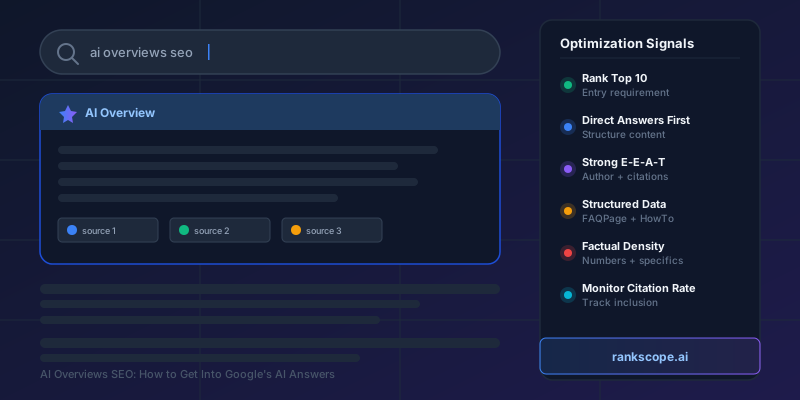
Google AI Overviews almost exclusively cite pages that already rank in the top 10 organic results for that query.
Multiple studies have confirmed this. Semrush's analysis found that over 99% of AI Overview citations come from top-10 ranking pages. Google's own documentation confirms that AI Overviews draw from content its systems already consider high-quality and authoritative.
What this means practically:
- AI Overview optimization is a layer on top of traditional SEO, not a replacement for it
- If you're not ranking on page one for a target query, no amount of AI-specific optimization will get you into the AI Overview
- The first question to ask for any target keyword is: "Do I already rank top 10?" If the answer is no, traditional SEO comes first
- For the complete guide to GEO, this is one of the key distinctions between optimizing for Google AI Overviews versus optimizing for ChatGPT or Perplexity — the others don't have the same hard ranking prerequisite
The flip side: if you're already ranking #3 or #5 for a query, you're a strong candidate for AI Overview inclusion and the incremental optimization is tractable.
What Google Pulls: The Source Signals
Google's Gemini doesn't pull arbitrary text from your page. It looks for specific content characteristics. Understanding what it extracts helps you write content that gets cited rather than skipped.
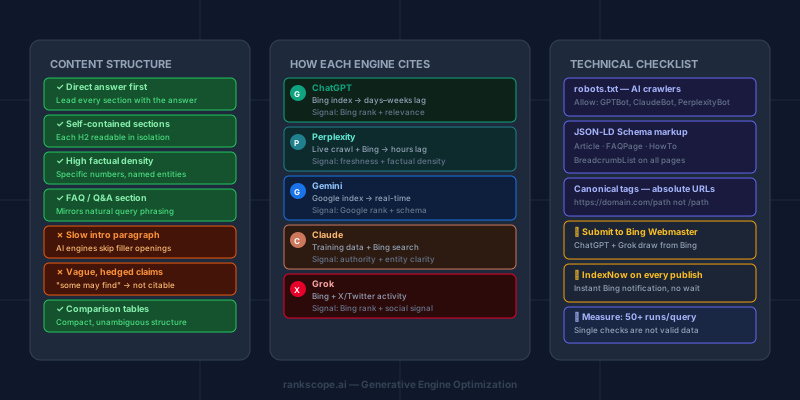
Direct, Self-Contained Answers
Google's AI Overview generator looks for passages it can lift and present clearly without needing surrounding context. A section that opens with "To do X, you need to Y and Z" is far more extractable than one that builds to an answer over several paragraphs.
The practical rule: lead each section with your answer, then support it. Don't bury your key claim in paragraph three after two paragraphs of setup. The first complete, declarative sentence in a section is the most frequently extracted unit.
This is the same principle underlying optimizing content for AI search broadly — AI systems are efficient extractors, not patient readers.
E-E-A-T Signals
Experience, Expertise, Authoritativeness, and Trustworthiness (E-E-A-T) were always part of Google's ranking quality signals. For AI Overview inclusion, they carry even more weight. Google has stated that AI Overviews are held to a higher quality bar than standard organic results — it's willing to rank something in position 7 that it won't cite in an AI Overview.
E-E-A-T signals that improve AI Overview candidacy:
- Author credentials — named authors with bios, professional background, and demonstrable expertise in the subject
- Original research and data — numbers, studies, first-party data that can only come from direct experience
- Cited primary sources — links to original studies, official documentation, government data
- Demonstrated experience — content that describes process from experience ("when we tested this," "in our analysis") rather than generic claims
- Publication date and freshness — updated content signals that information is current
Structured Data
Structured data doesn't directly "get you into" AI Overviews, but it does help Google understand the type and structure of your content. Three schemas correlate most strongly with AI Overview inclusion:
- FAQPage — question-and-answer pairs are a natural format for AI Overview extraction
- HowTo — step-by-step content maps well to multi-step query types that trigger AI Overviews
- Article/BlogPosting — gives Google publication metadata (date, author, subject) that supports E-E-A-T signals
Our GEO checklist covers the full structured data implementation workflow if you're starting from scratch.
Factual Density
Vague content doesn't get cited. Specific content does. The difference between "AI Overviews reduce clicks" and "when an AI summary appeared, users clicked a traditional result in 8% of visits against 15% without one (Pew Research Center, 2025)" is the difference between text Google skips and text it extracts.
Every claim should be as specific as the source data allows:
- Numbers over approximations
- Named entities over vague categories
- Dates over "recently" or "soon"
- Percentages over "most" or "many"
For a comprehensive picture of the AI search landscape — including citation concentration data, platform growth stats, and zero-click trends — see our GEO statistics compilation for 2026.
The Optimization Checklist
Based on Google's documentation and practitioner testing, here's what to check when targeting AI Overview inclusion for a specific query.
Page-Level Fundamentals
1. Confirm you rank top 10. Use Google Search Console or a rank tracker for the exact target query. If you're not there, fix that first.
2. Check whether the query currently triggers an AI Overview. Search the query in Google, see whether an AI Overview appears. If it doesn't trigger consistently, it may not be worth targeting specifically for AI Overview inclusion — optimize for the organic result instead.
3. Verify your content directly answers the query. This sounds obvious, but many pages rank for queries they don't directly answer — they rank because they're tangentially related to the topic. AI Overviews need a direct, unambiguous answer.
Content Structure
4. Open each section with a direct answer. Review your H2 and H3 sections. The first sentence under each heading should stand alone as a complete answer to the implicit question that heading poses.
5. Use lists and tables where appropriate. AI Overviews frequently pull bulleted lists and comparison tables. When the content naturally calls for a list (steps, options, factors), format it as one.
6. Keep paragraphs short and self-contained. Paragraphs of 3–5 sentences, each covering a single point, are more extractable than dense, multi-idea paragraphs.
7. Add a dedicated FAQ section. A Q&A section with FAQPage schema is one of the clearest signals you can send. Write the questions as the user would ask them, and open each answer with a one-sentence direct response.
E-E-A-T Enhancement
8. Add a named author with credentials. A byline from someone with demonstrable expertise in the subject matters. This is one of the E-E-A-T signals Google is most explicit about for AI-generated content specifically.
9. Cite your sources. Link to primary sources — original studies, official documentation, government data — for factual claims. Don't just link to other blog posts.
10. Add original data or first-hand experience. Even one section where you describe what you actually observed or measured in your own work lifts the E-E-A-T signal significantly.
Technical
11. Ensure Google can crawl and index the page. Check robots.txt, verify the page is not noindexed, and confirm it appears in Google Search Console as indexed.
12. Add Article, FAQPage, and HowTo JSON-LD schemas. Implement structured data appropriate to the page's content type.
13. Check page speed. Core Web Vitals affect overall ranking quality, which is the foundation for AI Overview candidacy.
How AI Overview SEO Differs from ChatGPT/Perplexity SEO
AI Overviews and ChatGPT are often lumped together, but the optimization levers are meaningfully different. Understanding the distinction helps you allocate effort correctly.
| Factor | Google AI Overviews | ChatGPT / Perplexity |
|---|---|---|
| Source | Google's existing index | Bing index (ChatGPT), live crawl (Perplexity) |
| Ranking prerequisite | Top-10 Google rank required | No hard rank prerequisite |
| E-E-A-T weight | Very high — same standard as core ranking | Lower — more weight on factual density and recency |
| Structured data impact | Direct signal | Indirect |
| Freshness | Moderate — updates within days of indexing | High for Perplexity (near real-time) |
| User context | Appears within Google Search | Standalone AI assistant |
| Trigger mechanism | Query-type detection in Google | User-initiated question |
The shared fundamentals: direct-answer structure, factual density, and AI crawler access (make sure GoogleBot-Extended is allowed in your robots.txt).
The AI Overview-specific layer: traditional Google SEO fundamentals. You cannot skip ranking.
For GEO vs SEO vs AEO, the key distinction is that AI Overview optimization sits at the intersection of all three — it requires traditional SEO authority plus GEO-style content structure plus AEO-style direct answers.
Measuring AI Overview Visibility
This is where most teams fall short. They optimize content and then have no way to tell if it's working.
The challenge: Google Search Console does not break out AI Overview impressions and clicks separately from standard organic results. You can see that a query drove impressions and clicks, but not whether those came from an AI Overview citation or a standard organic result.
What you need to measure:
- AI Overview trigger rate — for your target queries, what percentage currently show an AI Overview?
- Citation rate — when an AI Overview appears for your target query, does it cite your domain?
- Position within the overview — are you the first source cited, or buried in a secondary list?
- Trend over time — is your citation rate improving as you optimize?
Manual monitoring is possible for a small set of queries (our free AI Overviews Tracker automates the same check across a full query set): open Google Search in a fresh browser session, search your target queries, note whether an AI Overview appears and whether you're cited. Do this weekly. The problem: it doesn't scale, it's inconsistent (AI Overviews are personalized and volatile), and it gives you no historical trend data.
Automated monitoring through a tool that regularly checks your target queries, detects AI Overview presence, and logs citation data is the practical solution at any meaningful scale. RankScope's AI Overviews Tracker does this — it monitors your target query set, tracks when AI Overviews appear, and shows you exactly which queries cite your domain versus your competitors.
The measurement gap is real. Teams that optimize without measurement often can't tell whether changes are working or whether their citation rate has moved at all.
The AI Overview Volatility Problem
One thing practitioners don't discuss enough: AI Overviews change constantly.
A query that shows an AI Overview today may not show one tomorrow. Your content may be cited in one session and not another, even for the same query. Google has acknowledged this is intentional — its confidence threshold for showing an AI Overview is dynamic, and it adjusts based on query context, freshness signals, and available source quality.
What this means for strategy:
Don't make decisions from single data points. A single search showing an AI Overview (or not showing one) tells you almost nothing. You need data across multiple sessions and multiple days.
Monitor trends, not snapshots. A 30-day trend in citation rate is meaningful. A single observation is noise.
Some queries are more stable than others. Evergreen informational queries ("what is X," "how does Y work") tend to show more consistent AI Overviews than news-adjacent or rapidly-evolving topics.
Track competitors in the same queries. Understanding whether your competitor's content is getting cited in the same queries you're optimizing for helps you calibrate expectations and identify what they're doing differently.
Common Mistakes That Kill AI Overview Candidacy
A few patterns show up repeatedly in content that doesn't get cited:
Burying the answer. Starting with three paragraphs of background before getting to the actual answer is the most common structural mistake. Google's extraction needs the answer upfront.
Vague, hedged prose. "This can sometimes be a factor in some cases" is unextractable. Be specific and direct.
No author or institutional credibility signal. Anonymous content with no E-E-A-T markers is at a disadvantage for AI Overview inclusion even if it ranks well.
Blocking Googlebot-Extended in robots.txt. This variant of Googlebot is responsible for crawling content specifically used in AI features. Block it and you will not appear in AI Overviews, regardless of your ranking.
Duplicate or thin content. If your page covers a topic shallowly or duplicates what other sources say without adding new information, Google has no reason to cite you over those original sources.
Not targeting the actual trigger query. AI Overviews appear for specific query phrasings, not for topics in general. The page optimized for the exact user question performs better than a broadly topical page.
What Happens to Your Traffic
The honest answer: AI Overviews can reduce click-through rates for cited pages because some users get their answer from the overview and don't click through. This is real.
The counterintuitive finding: being cited in an AI Overview still generates positive traffic for many content types. Users who want depth, who are evaluating options, or who are in research mode still click through to cited sources. The citation badge creates a trust signal that drives clicks even when the summary partially answers the question.
What the data shows:
- Zero-click risk is highest for simple definitional queries and short how-to answers
- Click-through is healthier for complex comparison queries, multi-step how-tos, and research-heavy content
- Not being cited is worse than being cited — when your competitor is in the AI Overview and you're not, they get the trust signal and you don't
The practical takeaway: optimize for AI Overview inclusion because cited pages outperform uncited pages in the same query, even accounting for zero-click risk.
For a deeper look at how AI Overviews fit into the broader zero-click search trend — and what brand visibility means when most searches don't produce a click — see our guide to zero-click search in 2026.
Putting It Together: A Practical Starting Point
If you're starting AI Overview optimization today, here's the sequence that makes the most sense:
Step 1: Audit your current rankings. Pull your Google Search Console data and identify queries where you're ranking positions 2–10 with informational intent. These are your best AI Overview candidates — you already have the ranking foundation, now you optimize the content.
Step 2: Check trigger rate. For those queries, manually verify which ones currently show AI Overviews. Prioritize the ones that already trigger them.
Step 3: Review content structure. For each target page, check whether the H2 and H3 openings lead with direct answers. Restructure sections where you're burying the lead.
Step 4: Add or improve structured data. Implement FAQPage schema on pages with Q&A sections. Add Article schema with proper author and date metadata.
Step 5: Strengthen E-E-A-T. Add a named author, cite primary sources, and add at least one section with original data or first-hand observations.
Step 6: Monitor. Set up tracking so you know when your citation rate improves. Without measurement, you're optimizing blind.
Understanding how Google selects what to include in AI Overviews is the same framework as understanding what it means to optimize content for AI search broadly — factual density, direct-answer structure, and technical accessibility are the foundations across every AI search surface.
If you're ready to go beyond the signal breakdown and into the full step-by-step ranking strategy — including the data-backed query targeting, content checklist, and measurement framework — see the companion guide: How to Rank in Google AI Overviews: Complete Guide.
For the deeper strategy around AI search visibility across all platforms (not just Google), the complete guide to generative engine optimization covers the full framework.
Frequently Asked Questions
What are Google AI Overviews?
Google AI Overviews are AI-generated summaries powered by Google's Gemini model that appear at the top of Google Search results for certain queries, primarily informational and complex questions. They synthesize information from multiple top-ranking web pages and link back to source pages.
What triggers Google AI Overviews?
AI Overviews are triggered by informational, multi-step, and comparison queries where Google judges a synthesized answer more useful than a list of links. Common triggers: "how to," "what is," "why does," and "X vs Y" queries. Transactional, navigational, and breaking news queries rarely trigger them.
Do you need to rank #1 to appear in Google AI Overviews?
No, but you need to rank in the top 10. Research shows over 99% of AI Overview citations come from pages in the top 10 organic results for that query. Being #5 or #8 is sufficient — pages on page 2 or lower are almost never cited.
How is AI Overview SEO different from regular SEO?
Regular SEO optimizes for ranking position in a results list. AI Overview SEO adds three layers on top: direct-answer content structure, strong E-E-A-T signals, and structured data markup. Traditional ranking signals remain the foundation — AI Overview optimization doesn't work without them.
Can I track if my content appears in Google AI Overviews?
Google Search Console doesn't report AI Overview citations separately. Tracking requires either manual SERP checks (not scalable) or a dedicated monitoring tool. RankScope's AI Overviews Tracker automates this — it monitors your target queries, detects AI Overview appearances, and tracks your citation rate over time.
Does being in an AI Overview hurt my traffic?
Being cited in an AI Overview generates mixed results by query type: simple definitional queries have higher zero-click risk, while complex research and comparison queries see healthier click-through rates. Not being cited when a competitor is cited is categorically worse for your traffic than being cited.