GEO Statistics 2026: 20 Sourced Data Points on AI Search and Citations
These are 20 statistics on generative engine optimization (GEO) and AI search, each linked to the primary source that published it or drawn from our own documented measurements, with the date it applies to. They cover AI search adoption, how Google's AI Overviews choose citations, what AI answers do to clicks, and how stable AI citations are.
Before you use any of them, one disclosure.
The earlier version of this page, published in April, listed 47 statistics and described them as "all sourced." In September 2026 we checked every one against its source. 34 did not survive. Fourteen were numbers with no source at all, labelled "industry aggregate" or "industry snapshot." Two linked to pages that did not contain the number we quoted. Two sources could not be reached to verify. Fourteen were not statistics, just claims with a number in front of them, and some of those were contradicted by our own data. One cited "RankScope platform benchmarks" that do not exist as a published report, and one came from a roundup page that names no primary source. Of the 13 that survived, four needed rewording because the source said something narrower than we had.
| What we found when we checked | Count | What we did |
|---|---|---|
| Number with no source ("industry aggregate") | 14 | Removed |
| Not a statistic (a claim with a number in front) | 14 | Removed |
| Linked page did not contain the number | 2 | Removed |
| Source could not be reached to verify | 2 | Removed |
| Cited a RankScope report that does not exist | 1 | Removed |
| Roundup page naming no primary source | 1 | Removed |
| Source said something narrower than we quoted | 4 | Reworded to match the source |
| Confirmed as quoted | 9 | Kept, with the date added |
We removed all of them rather than swapping in replacements, because replacing an unsourced number with a different unsourced number looks like a fix and is the same defect. What follows is shorter and every figure can be checked.
1. AI Search Adoption
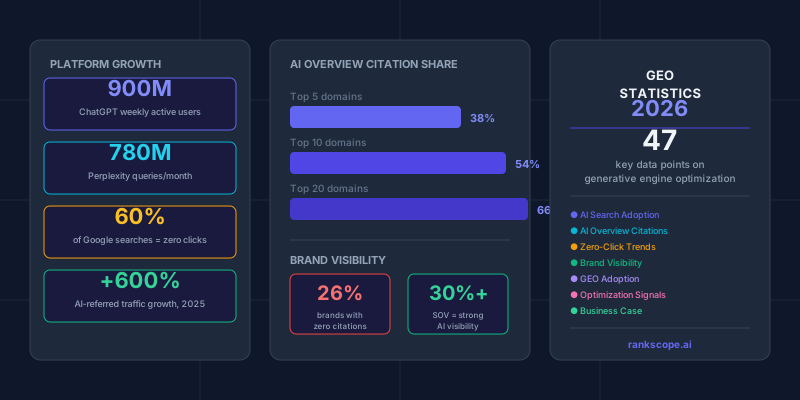
1. ChatGPT reached 900 million weekly active users in February 2026. OpenAI announced the figure on February 27, 2026, along with 50 million paying subscribers (TechCrunch).
2. ChatGPT prompt volume grew nearly 70% in the first half of 2025. From a Sensor Tower sample, reported by Bain on August 8, 2025 (Bain).
3. Perplexity served 780 million search queries in May 2025, up from roughly 230 million a month in August 2024, with the CEO citing 20% month-over-month growth (AdWeek).
4. 31% of Gen Z turn to AI platforms or chatbots to start a search. GWI data, cited in a September 2024 Marketing Dive piece (Marketing Dive). This is about where a search begins, not a replacement for search engines.
5. 39% of consumers, and over half of Gen Z, use AI for product discovery. From Salesforce's Connected Shoppers Report (Salesforce, 2025).
6. For digital marketing and SEO topics, Semrush projects AI search visitors could overtake traditional search visitors by early 2028. A forecast, not a measurement, and scoped to those topics (Semrush, June 2025).
The adoption numbers are real and large. None of them tells you how often your buyers use AI tools for your category, which is the number that should set your priorities, and the only way to get it is to ask them or measure it.
2. How Google's AI Overviews Cite Sources
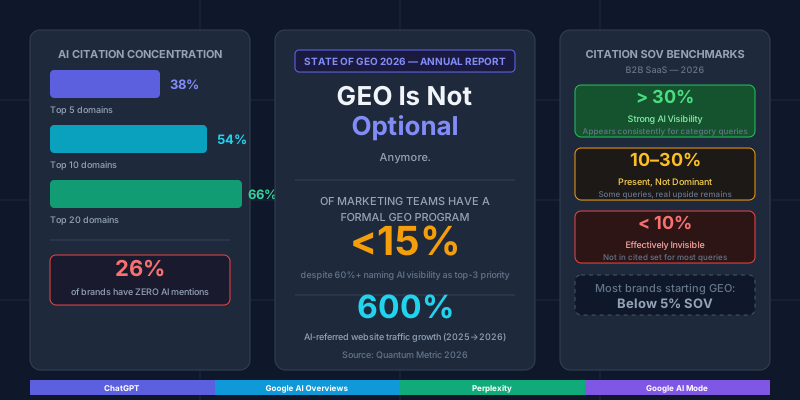
7. AI Overview citations are concentrated in a few domains. In The Digital Bloom's 2025 analysis, the top 5 cited domains took 38.13% of citations, the top 10 took 53.87% and the top 20 took 66.18% (The Digital Bloom).
8. Reddit's AI Overview citation rate rose from 1.30% to 7.15% between March and June 2025, a 450% increase in three months, in the same analysis (The Digital Bloom).
9. AI Overviews moved beyond informational queries during 2025. In January 2025, 91.3% of queries triggering an AI Overview were informational; by October 2025 that share was 57.1%, with commercial and transactional queries making up more of the rest (Semrush AI Overviews study, updated December 2025).
Point 9 matters most for anyone selling something. AI Overviews started on "what is" questions. They now appear on the queries buyers use when choosing a product.
3. Clicks and Traffic
10. When a Google AI summary appeared, users clicked a traditional result in 8% of visits; without one, 15%. Users clicked a link inside the summary itself in just 1% of visits. From browsing data shared by 900 US adults (Pew Research Center, July 2025).
11. 58% of that Pew panel ran at least one Google search in March 2025 that produced an AI summary (Pew Research Center).
12. About 80% of consumers rely on zero-click results in at least 40% of their searches, according to Bain in February 2025 (Bain).
13. Quantum Metric reported AI-referred traffic rates up 600% since January 2025, in its 2025 peak-season benchmark, which combined a survey of 1,600 US and UK consumers with Quantum Metric's aggregated customer data (Quantum Metric). Growth from a small base, measured on one vendor's data.
Read 10 and 13 together. Fewer clicks reach you from Google when an AI answer sits above the results, while traffic arriving from AI tools grows quickly from a low starting point. Whether that nets out positive for you depends on whether the AI answers name you.
4. What Predicts AI Citation, and How Stable It Is
14. Brand web mentions correlated with AI Overview brand visibility at 0.664; backlinks at 0.218. Domain Rating came in at 0.326 and referring domains at 0.295. Across 75,000 brands (Ahrefs, published May 2025, updated April 2026). Correlation, not cause.
15. Median day-over-day churn in cited sources was 82% on ChatGPT, 92% on Gemini, 78% on Google AI Mode and 43% on Perplexity. From 2,398 queries run through four engines once a day for seven days in June 2026, 530,875 citations in all (GetMentions, July 2026).
16. Only 0.4% to 11.1% of cited sources, depending on the engine, were still cited on all seven days of that study (GetMentions).
17. Google has shown FAQ rich results only for "well-known, authoritative government and health websites" since August 2023 (Google Search Central, August 8, 2023). The earlier version of this page counted FAQ schema as a GEO lever. For most sites it does not produce a rich result.
Points 15 and 16 are the most important on this page for anyone measuring AI visibility. A single check of whether an AI engine cites you is a snapshot of something that will probably have changed by tomorrow. Only repeated measurement on a fixed set of questions tells you where you stand.
5. Our Own Measurements
These come from our own work on rankscope.ai's category in September 2026. They are small samples from one category, and we say so, but the method is described and nobody else has them.
18. The weakest source cited in an AI Overview ranged from 1 to 857 referring domains across 19 AI Overviews we measured in the AI visibility tools category. We used that number to pick targets for a day, then stopped, because the minimum of a set this volatile is mostly noise. The full account is in what actually moves AI citation rate.
19. For "answer engine optimization," 7 of the 9 organic page-one results were also cited in the AI Overview. The #2 organic result, a Reddit thread, was not cited. CXL was cited without ranking on page one. One query on one day (September 25, 2026); the comparison is in GEO vs SEO vs AEO.
20. 37 of the 408 FAQ questions in our own site's structured data had no matching question visible on the page. Google ignores FAQ markup that does not match visible content. The wording had usually drifted by a word or two, because the schema and the page were maintained as separate copies.
What the Numbers Mean
Adoption is not the question any more. Hundreds of millions of people use AI tools weekly, and AI Overviews now reach commercial queries. The open question is whether those answers name you.
Citation is concentrated and volatile at the same time. A handful of domains take most AI Overview citations (point 7), and yet, on the four engines GetMentions measured, the specific sources behind any one answer change most days (point 15). Both can be true because the big domains keep reappearing while the long tail rotates.
Off-site presence correlates with visibility more strongly than links do (point 14). If you are choosing between another link campaign and getting your product discussed in reviews, forums, videos and comparison articles, the evidence leans toward the second.
Measure repeatedly or not at all. Given point 15, a one-off manual check of ChatGPT tells you very little. Run a fixed set of buyer questions on a schedule and compare runs.
Track Your Own Numbers
RankScope tracks citation rate, share of voice and sentiment across ChatGPT, Google AI Overviews, Perplexity and Google AI Mode, with daily scans so you see how your visibility moves, not a single snapshot. Plans start at $49/mo, or $39/mo billed annually, for 40 monitored prompts on ChatGPT and Google AI Overviews. To see where you stand first, the free AI Visibility Checker runs real prompts with no credit card required.
For how to act on these numbers, see our complete guide to GEO and the GEO checklist.
Frequently Asked Questions
How many people use AI search in 2026?
ChatGPT reached 900 million weekly active users in February 2026, according to OpenAI as reported by TechCrunch. Perplexity served 780 million search queries in May 2025, up from about 230 million a month in August 2024 (AdWeek). In a Pew Research Center panel of 900 US adults, 58% ran at least one Google search in March 2025 that produced an AI summary.
Do AI Overviews reduce clicks to websites?
Pew Research Center found that when a Google AI summary appeared, users clicked a traditional search result in 8% of visits, against 15% when no summary appeared, and clicked a link inside the summary itself in only 1% of visits. Bain reported in February 2025 that about 80% of consumers rely on zero-click results in at least 40% of their searches.
How concentrated are AI Overview citations?
In The Digital Bloom's 2025 analysis of Google AI Overview citations, the top 5 domains took 38.13% of citations, the top 10 took 53.87% and the top 20 took 66.18%.
How stable are AI citations?
Not very. GetMentions ran 2,398 queries through four AI engines daily for seven days in June 2026. Median day-over-day churn in cited sources was 82% on ChatGPT, 92% on Gemini, 78% on Google AI Mode and 43% on Perplexity, and only 0.4% to 11.1% of sources were cited on all seven days.
Do backlinks drive AI citations?
Less than brand mentions do, on the best available evidence. Ahrefs' study of 75,000 brands found brand web mentions correlated with AI Overview visibility at 0.664, against 0.326 for Domain Rating, 0.295 for referring domains and 0.218 for backlinks. These are correlations, not proof of cause.
Sources
- OpenAI via TechCrunch: ChatGPT reaches 900M weekly active users, February 27, 2026
- Bain (Sensor Tower data): How customers are using AI search, August 8, 2025
- Bain: Goodbye clicks, hello AI: zero-click search redefines marketing, February 19, 2025
- AdWeek: Perplexity monthly query growth, 2025
- Marketing Dive (GWI data): How brands maximize search with generative AI, September 5, 2024
- Salesforce: Consumer shopping AI trends, 2025
- Semrush: AI search SEO traffic study, June 9, 2025
- Semrush: AI Overviews study, updated December 15, 2025
- The Digital Bloom: Google AI Overviews top cited domains, 2025
- Pew Research Center: Google users are less likely to click on links when an AI summary appears, July 22, 2025
- Quantum Metric: 2025 Peak Season Benchmark
- Ahrefs: An analysis of AI Overview brand visibility factors, May 26, 2025, updated April 27, 2026
- GetMentions: AI citation volatility: a 530,875-citation study, July 9, 2026
- Google Search Central: Changes to HowTo and FAQ rich results, August 8, 2023
Every link above was checked against the figure quoted on September 26, 2026.