How to Calculate Share of Voice in AI Search (All 5 Engines)
Most marketers know how to calculate share of voice. You count your brand mentions, divide by total market mentions, multiply by 100. Done.
The problem is that formula was built for a world where "mentions" meant press coverage, social posts, or ad impressions. If you need a refresher on how share of voice works across paid, organic, social, and AI channels, that guide covers the full framework. This one goes deep on the AI-specific calculation. That world still exists — but a new one has appeared alongside it. When someone asks ChatGPT "what's the best tool for X," AI search engines generate a synthesized answer that names specific brands. The brands it names get a shot at a new kind of buyer. The ones it doesn't name effectively don't exist.
That's the new measurement problem. And the formula for solving it is both similar to what you already know and meaningfully different in ways that matter.
This guide covers everything: the exact AI share of voice formula, how each of the five major AI engines calculates citations differently, what benchmarks actually mean, and how to track it without going insane.
What Is Share of Voice in AI Search?
AI share of voice (SOV) is the percentage of AI-generated responses that include your brand when users ask questions in your product category.
The core formula is:
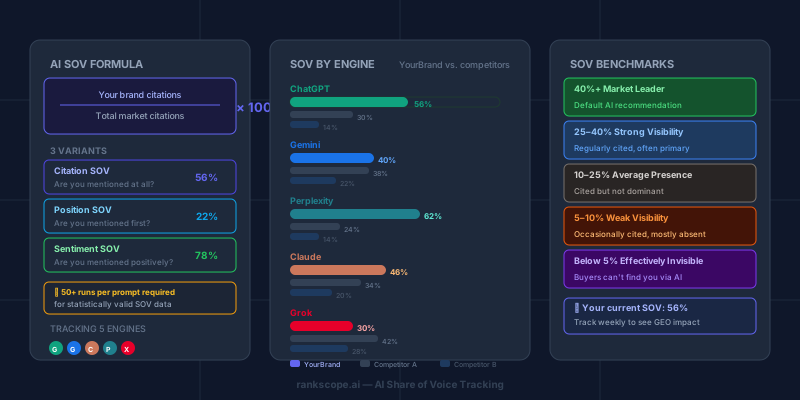
AI SOV% = (Your brand citations ÷ Total citations across all tracked brands) × 100
If you run 100 relevant prompts through ChatGPT and your brand appears in 35 of those responses, while your top three competitors appear in 30, 25, and 15 responses respectively (total: 105 citations), your ChatGPT SOV is roughly 33%.
This is not a Google ranking metric. It's not about page one or featured snippets. It's about how often AI engines choose to mention your brand when synthesizing answers to queries a buyer would actually ask.
Why This Metric Is New (and Why It Matters)
Traditional AI visibility metrics like impressions, clicks, and rankings don't exist inside AI-generated responses. When ChatGPT or Perplexity answers a question, it doesn't give every brand equal "impressions." It names some brands, ignores others, and occasionally paraphrases without attribution.
For brands operating in Generative Engine Optimization (GEO), SOV is the single number that captures whether your GEO work is translating into actual visibility. You can have perfectly structured content, great schema markup, and strong backlinks — but if your AI SOV is 4%, buyers asking AI engines about your category are finding your competitors.
SOV also gives you a competitive benchmark that traffic numbers can't. If your site gets 1,000 organic visitors a month and a competitor gets 5,000, that says something about Google performance. It says nothing about what happens when their customers ask ChatGPT for a recommendation — which is where an increasing share of research conversations are starting.
The Three SOV Variants That Matter
One number doesn't capture the full picture. There are three distinct ways to measure AI SOV, and each tells you something different.
1. Citation SOV (Are You Mentioned?)
This is the base metric. Out of all AI responses to your tracked prompts, what percentage include your brand's name?
Formula: (Responses mentioning your brand ÷ Total responses tracked) × 100
This tells you reach — how present you are in AI-generated conversations about your category. A brand with 40% citation SOV appears in nearly half of all relevant AI responses. A brand at 5% is almost entirely absent.
2. Position SOV (Are You Mentioned First?)
Citation presence and citation position are different things. AI engines often list multiple brands in a single response, but the first brand named tends to carry significantly more weight — it's the default recommendation, the brand the user is most likely to explore.
Formula: (Responses where your brand is cited first ÷ Total responses tracked) × 100
You can have a 35% citation SOV and a 10% position SOV, which means you're being cited regularly but rarely as the primary recommendation. That gap is a signal to work on. (For a full framework on what drives AI citations, see our complete GEO guide.)
3. Sentiment SOV (Are You Mentioned Positively?)
The most nuanced variant. AI engines don't just cite brands — they frame them. "Brand A is great for enterprises but expensive" is a citation with qualified sentiment. "Brand B is a popular choice for small teams" is a citation with positive framing. "Brand C is often criticized for reliability issues" is a negative citation that could actively hurt conversion.
Formula: (Positive-framing citations ÷ Total citations) × 100
Sentiment SOV matters because AI search functions partly as a recommendation engine. A high citation SOV with poor sentiment can be actively damaging — you're being mentioned, but in a context that steers buyers away.
How Each AI Engine Calculates Citations Differently
Here's what most guides miss: you don't have one AI SOV. You have five, and they can vary dramatically from each other. Each AI engine retrieves and weighs content through a different mechanism, which means the same brand can have 40% SOV on Perplexity and 8% on Gemini.
Understanding why they differ is the key to improving each one.
ChatGPT (OpenAI)
Retrieval mechanism: Bing search index (when web search is enabled) + training data
ChatGPT's web search feature draws from Microsoft's Bing index. Pages that rank well in Bing, are well-structured with clear entity signals, and have recent fresh content get prioritized. Without web search, ChatGPT relies entirely on training data — meaning brands that were well-documented online before the training cutoff have a structural advantage.
What moves ChatGPT SOV: Strong Bing search presence, freshly published content that Bingbot has indexed, third-party coverage (reviews, roundups, comparisons) that ChatGPT can synthesize.
ChatGPT SOV calculation: Run your prompt set with web search enabled. Record brand citations across 50+ runs per prompt. Aggregate.
For more on ChatGPT's retrieval behavior, see our guide on how to get cited by ChatGPT.
Perplexity AI
Retrieval mechanism: Perplexity's own crawler (PerplexityBot) + Bing
Perplexity is arguably the most citation-heavy of the five engines — it typically names more sources per response than any other platform, and it aggressively favors recently-updated, well-structured pages. It also shows inline citations, which means you can directly observe which URLs it's pulling from.
What moves Perplexity SOV: Recently published or updated content (Perplexity's freshness weighting is aggressive), structured content with clear direct answers, pages that PerplexityBot can crawl freely (check your robots.txt).
Perplexity SOV calculation: Run prompts and record both brand citations and the source URLs Perplexity shows inline. The URL data tells you which of your pages are being cited, not just whether you appear.
Google Gemini
Retrieval mechanism: Google's search index + Google's knowledge graph
Gemini has the deepest possible integration with web content through Google's own index. If you rank well in Google Search, Gemini is more likely to cite you. But it's not a 1:1 relationship — Gemini applies its own synthesis layer on top of search results, and it tends to favor authoritative sources with strong entity signals.
What moves Gemini SOV: Traditional SEO authority (Google rankings, backlinks, E-E-A-T signals), Schema.org structured data, entity consistency across your brand's web presence.
Note: Gemini SOV and Google AI Overviews SOV are different metrics. AI Overviews appear in Google Search results; Gemini responses appear in the Gemini interface. Both matter but measure different things.
Claude (Anthropic)
Retrieval mechanism: Anthropic's index + claude.ai search (where available) + training data
Claude is the most training-data-dependent of the five major engines in day-to-day use. Its web search capabilities are more limited than Perplexity's aggressive crawling, and its retrieval is less tied to Bing than ChatGPT. This means Claude's citations often reflect historical web presence more than real-time freshness.
What moves Claude SOV: Long-form, well-cited content (Claude favors authoritative sources), consistent brand mentions across multiple contexts in its training corpus, third-party editorial coverage that predates Claude's training cutoff.
Claude SOV consideration: Claude tends to be more conservative with brand recommendations in some categories, preferring to describe categories before naming specific tools. Prompt construction matters more here than with other engines.
Grok (xAI)
Retrieval mechanism: X (Twitter) activity + real-time web search
Grok is unique among the five engines because it layers in X (Twitter) data as a first-class signal. Brands actively discussed on X — in posts, threads, and replies — have a structural advantage in Grok's retrieval over brands with minimal social presence but strong web content.
What moves Grok SOV: Active X presence, mentions and discussions in X threads about your category, recent web content that Grok's web search picks up, brand advocates who discuss your product on X.
Grok SOV calculation: Run prompts with Grok's web search enabled. Note that Grok's responses can be stylistically different — more conversational and opinionated — which affects how it frames brand citations.
The Complete AI SOV Calculation Process (Step by Step)
Here's exactly how to run a manual AI SOV audit. This works if you're doing occasional spot checks; for continuous tracking, you'll want automated tooling.
Step 1: Define Your Competitive Set
Choose 4–8 brands you want to measure against. These should be the brands AI engines naturally compare you with in your category. If you're a B2B SaaS tool, this is your direct competitors — not adjacent market players.
Getting this right matters because SOV is a relative metric. If you benchmark against only weak competitors, your SOV looks artificially high. If you exclude a dominant competitor, you're measuring the wrong race.
Step 2: Build a Prompt Library
Write 15–25 prompts that reflect how real buyers discover tools in your space. The most useful prompts are:
- "Best [category] tools" — e.g., "What are the best AI citation tracking tools?"
- "How to [solve problem]" — e.g., "How do I track my brand's visibility in AI search?"
- "Compare [competitor A] vs [competitor B]" — puts you directly in competitive comparison context
- "[Job title] needs [tool type]" — e.g., "A marketing manager needs a GEO platform — what should they use?"
Avoid prompts that are too branded or too narrow — you want queries that represent real organic demand, not setups designed to make your brand appear.
Step 3: Run Each Prompt 50+ Times Per Engine
This is where most manual audits fail. Running a prompt once or five times gives you anecdote. You need sample size.
AI responses vary significantly across runs, sessions, and time. A 2024 study found ChatGPT gives consistent brand citations only about 73% of the time across identical prompts — meaning nearly 1 in 3 runs will differ even for the same user asking the same question.
For statistically meaningful AI SOV data, run each prompt a minimum of 50 times. This sounds like a lot because it is — which is exactly why automated tracking tools exist.
Step 4: Record Citations and Position
For each response, record:
- Which brands were cited (yes/no per brand)
- Position order (first, second, third, etc.)
- Sentiment framing (positive, neutral, qualified, negative)
- Source URLs (for Perplexity and ChatGPT with citations)
A simple spreadsheet works: rows = prompt runs, columns = brands, cells = citation (1/0) + position.
Step 5: Apply the Formula
Per engine, per prompt cluster:
Citation SOV% = (Runs mentioning your brand ÷ Total runs) × 100
Position SOV% = (Runs where your brand cited first ÷ Total runs) × 100
Sentiment SOV% = (Runs with positive framing ÷ Runs mentioning your brand) × 100
Aggregate AI SOV (across all engines):
Sum all citations for your brand across all engines and all prompt runs. Divide by sum of all citations across all brands. Multiply by 100.
Step 6: Benchmark and Track Over Time
One measurement is a baseline, and an AI visibility checker is the fastest way to take it. The value comes from tracking weekly or biweekly and watching the trend. When you publish new content, build new backlinks, or get mentioned in a roundup, you want to see if SOV moves within 2–4 weeks.
AI SOV Benchmarks by Category
These benchmarks come from platforms tracking GEO metrics across multiple verticals. Use them directionally, not as precise targets — competitive dynamics vary significantly by category.
| AI SOV Range | Interpretation |
|---|---|
| 40%+ | Market leader presence — you're the default recommendation for many queries |
| 25–40% | Strong AI visibility — regularly cited, often as a primary option |
| 10–25% | Average presence — cited but not dominant, significant room to improve |
| 5–10% | Weak visibility — occasionally cited, mostly absent from AI answers |
| <5% | Effectively invisible — buyers asking AI engines about your category aren't finding you |
Context that shifts these benchmarks:
- Category size: In a 20-brand market, 30% SOV is extraordinary. In a 4-brand market, 30% is below average.
- Category maturity: In emerging categories where AI engines haven't established strong brand preferences, SOV numbers are more volatile and harder to sustain.
- Engine-specific: Perplexity tends to distribute citations more broadly (more brands mentioned per response), so aggregate SOV numbers look lower compared to ChatGPT which often focuses on 2–3 brands per response.
Why Manual Tracking Falls Apart at Scale
The manual process above works for a one-time audit. It breaks down quickly when you need:
- Coverage across all 5 engines — that's 5× the prompt volume
- Weekly cadence — multiplied again
- Multiple prompt clusters — multiplied again
- Sentiment analysis — manual scoring is subjective and slow
- Historical trending — requires consistent methodology over time
A 20-prompt library, run 50 times each, across 5 engines = 5,000 responses to process. Weekly. That's a full-time job before you've done anything with the data.
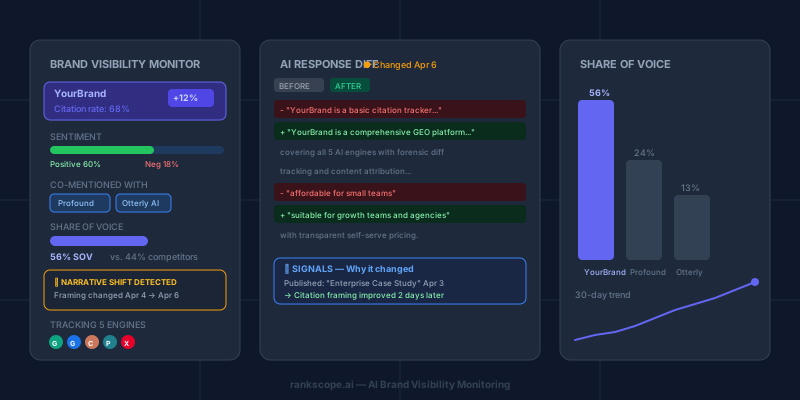
This is the core problem AI visibility tools solve. RankScope automates the full cycle — running your tracked prompts across the four engines it covers (ChatGPT, Google AI Overviews, Perplexity and Google AI Mode), extracting brand citations and positions, calculating SOV per engine and in aggregate, and tracking sentiment shifts over time. The dashboard shows you what's changed week over week, which competitors are gaining, and which of your pages are being cited as sources. For teams that want this running continuously without manual intervention, RankScope's Agents feature lets you configure automated tracking workflows that surface action plans when your share of voice shifts.
You still need to understand the methodology to interpret the data correctly. But the data collection and aggregation — the part that makes manual tracking infeasible — is handled automatically.
Common Mistakes in AI SOV Calculation
Mistake 1: Measuring One Engine and Calling It Done
Brands that only measure ChatGPT SOV often have a distorted picture. Perplexity users tend to be highly research-oriented buyers. Gemini is deeply integrated into Google Workspace and captures enormous enterprise usage. Claude is gaining fast with technical and professional audiences. Missing any of these isn't just an incomplete picture — it's a blind spot in a high-value buyer segment.
Mistake 2: Running Too Few Prompt Iterations
Five runs isn't a number. It's an anecdote. The AI response variability problem is real: even for factual queries, citation patterns shift based on current retrieval state, session context, and stochastic sampling. You need 50+ runs per prompt to get signal you can act on.
Mistake 3: Using Only Branded Queries
"Tell me about [Your Brand]" will tell you how AI engines describe you. It won't tell you whether buyers find you when they're asking category-level discovery questions — which is where SOV actually matters for new customer acquisition. Your prompt library should be dominated by unbranded queries that represent real purchase research journeys.
Mistake 4: Ignoring Citation Sentiment
Being cited as "the affordable option that lacks enterprise features" is different from being cited as "the leading platform." Both show up as a citation in raw SOV calculations. If you're not tracking sentiment alongside volume, you might be celebrating a high SOV number that's actually doing damage.
Mistake 5: Not Comparing to the Same Competitor Set Over Time
SOV is a relative metric. If you expand your competitive set between measurement periods, your SOV will mathematically change even if nothing has actually shifted in AI citations. Keep the competitor set consistent across measurement periods, then update it deliberately when new competitors emerge.
How AI SOV Relates to Other GEO Metrics
Share of voice doesn't live in isolation. It's one number in a broader AI brand visibility measurement system. Share of voice is one of five core GEO metrics — alongside citation rate, prompt coverage, mention sentiment, and platform spread. For a complete breakdown of all five, how to calculate each, and the benchmarks to use, see the full GEO metrics guide. Here's how the key metrics relate to SOV specifically:
| Metric | What It Measures | How It Relates to SOV |
|---|---|---|
| Citation rate | % of runs where your brand appears (any context) | The numerator in your SOV calculation |
| Share of voice | Your citations as % of total market citations | The core competitive benchmark |
| Position rate | % of citations where you're mentioned first | Qualifies SOV — high SOV + low position = present but not preferred |
| Sentiment score | % of citations with positive framing | Qualifies SOV — high SOV + low sentiment = present but in wrong light |
| Source diversity | How many unique sources drive your citations | Contextualizes SOV stability — diversified sources are more durable |
| Platform coverage | SOV split across each AI engine | Shows where you're strong and where you have gaps |
A complete LLM SEO measurement stack tracks all of these — not just raw citation counts.
Setting AI SOV Targets That Are Actually Achievable
Random SOV targets ("we want 50%!") don't translate into actionable strategy. Here's a more useful framework.
Start with category ceiling analysis. Run your prompt library once and count the maximum number of brands cited per response (the most any single response ever names). Multiply by your prompt volume. That's the theoretical upper bound of citations in your category. Your target SOV should be benchmarked against what's realistically achievable in that citation pool.
Set 90-day targets, not annual ones. AI engine citation patterns update with training cycles and retrieval improvements. A 12-month SOV target is too abstract to drive weekly decisions. Set a 90-day SOV target, identify the 3–5 specific actions (content publishing, backlink acquisition, crawler access fixes) that have historically moved SOV, execute, and measure.
Track leading indicators separately. SOV is a lagging indicator — it reflects work you've already done. The leading indicators that predict future SOV improvement are: pages published, third-party citations acquired, crawler access improvements made, and structured data added. Track both.
Getting Started with AI SOV Tracking
If you haven't measured your AI SOV before, here's the minimum viable approach:
-
Identify your top 3 competitors by asking ChatGPT: "What are the leading tools for [your category]?" — the brands it names most consistently are your baseline competitive set.
-
Write 10 unbranded discovery prompts covering the main use cases buyers would query in your space.
-
Run each prompt 20 times in each engine (lower bar for a first baseline — increase to 50+ for ongoing tracking).
-
Record citations in a spreadsheet — brand name, appeared (Y/N), position, rough sentiment.
-
Calculate your baseline SOV using the formula above. This is your starting point.
-
Set a 90-day target — typically a 10–15 percentage point improvement is achievable through focused GEO content work.
-
Run the audit again in 30 days to see whether recent content and technical work is moving the needle.
Once you've done this manually twice, the pain of the process will tell you everything about why automated tracking is worth it. RankScope handles the entire data collection and calculation layer, leaving you to focus on the strategic questions: why is your SOV low on Google AI Mode? Which competitor is pulling citations away from you on Perplexity? What content is actually being cited as a source?
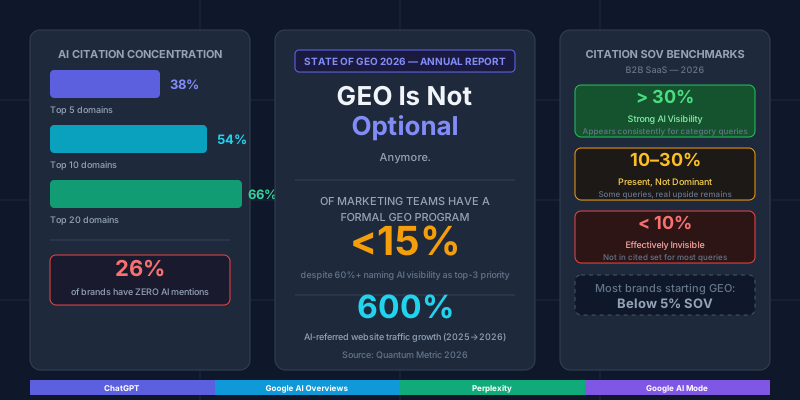
For a complete walkthrough of manual tracking methods, prompt library construction, and the step-by-step process for establishing your first baseline, see the guide on how to track brand mentions in AI search. For a broader look at where the market stands — including citation concentration patterns, GEO adoption benchmarks, and what separates cited brands from invisible ones — see the State of GEO 2026 report.
Frequently Asked Questions
What's the difference between AI SOV and traditional share of voice?
Traditional SOV measures brand presence in paid ads, earned media, or social conversations. AI SOV measures citation frequency inside AI-generated responses. The formula is identical; the data source is fundamentally different. Traditional SOV is backward-looking (what coverage did we get last month?). AI SOV is buyer-journey-relevant (when prospects ask AI engines what to buy, do we appear?).
How often should I recalculate AI SOV?
Weekly is ideal for brands actively running GEO campaigns. Biweekly is a reasonable minimum. Monthly gives you trend data but misses fast-moving shifts — some AI engines update their citation patterns within days of new content being indexed.
Does paid advertising affect AI SOV?
No — not directly. AI engines currently don't incorporate paid ad signals into their organic citation decisions. However, brands that invest heavily in paid distribution often generate the third-party coverage, reviews, and editorial mentions that AI engines do cite. The downstream content effect of paid amplification can indirectly improve SOV.
Can a new brand build meaningful AI SOV quickly?
Yes, but the path is different from traditional SEO. New brands can move AI SOV quickly by getting cited in high-authority roundup articles that AI engines already draw from, publishing high-factual-density content that AI engines extract immediately, and building a presence on platforms Grok and Perplexity actively index. The GEO checklist covers the specific technical and content actions that accelerate this.
What tools exist to track AI share of voice automatically?
Several AI visibility tools now track AI SOV automatically, including RankScope (covers ChatGPT, Google AI Overviews, Perplexity, and Google AI Mode), Profound (enterprise-focused, $499/mo+), Otterly (good for ChatGPT and Perplexity, lighter on Claude and Grok coverage), and Peec AI (analytics-focused with SOV tracking). RankScope's free AI visibility checker lets you run a baseline check before committing — no account, no credit card.
AI share of voice is the metric that will define AI search success for the next decade. The brands with high AI SOV today built it through content strategy, technical access, and consistent measurement — not because they got lucky with training data.
The formula hasn't changed. What's changed is where you measure it.