How to Get Your Brand Cited by ChatGPT
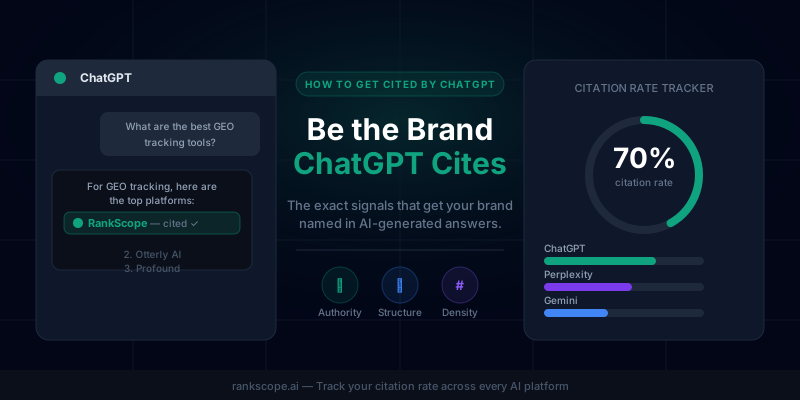
When someone asks ChatGPT "what tools do you recommend for [your category]," your brand either gets named or it doesn't. There's no page two. No second chance to catch someone's eye. The brands in the answer get the consideration. Everyone else is invisible.
This is the new search reality — and the good news is that ChatGPT's citation behavior is learnable and optimizable. It doesn't pick sources randomly. It has clear, identifiable preferences, and brands that understand them can systematically improve how often they appear. If you're new to this space, start with what generative engine optimization actually is before diving into the tactics below. For a full step-by-step ranking playbook — covering ChatGPT Search mode, Bing SEO, and entity signals — see how to rank in ChatGPT: complete guide. Running a SaaS product? We have a dedicated guide to GEO for SaaS companies covering the specific strategies and metrics that matter for B2B software.
(Note: this post is about getting your brand cited in ChatGPT answers — a GEO strategy. If you're looking for how to use ChatGPT as a productivity tool to speed up keyword research, schema generation, and content workflows, that's a different topic covered in ChatGPT for SEO: using ChatGPT to improve search rankings.)
Here's how it works, and what to do about it.
How ChatGPT Decides What to Cite
ChatGPT's citations come from two distinct mechanisms:
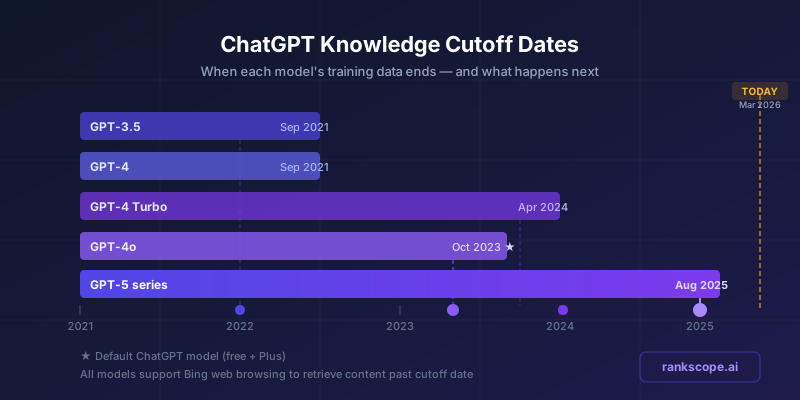
Training data — GPT-4 and its successors were trained on vast datasets of web content. Brands that were well-represented in that data — through blog posts, news coverage, product reviews, community mentions, documentation — are embedded in the model's understanding of their category. When ChatGPT recommends project management tools from memory, it's drawing on what it learned during training. GPT-4o's training data ends at October 2023; GPT-5 series models cut off at August 2025 — see our full breakdown of ChatGPT knowledge cutoff dates to understand exactly which model knows what.
Real-time retrieval (Browse mode) — When ChatGPT has web access enabled (which is increasingly the default), it fetches current web pages before answering. The content it finds and retrieves for a given query heavily shapes its response. This is the mechanism you can most directly influence right now.
Both matter. But retrieval is where short-term GEO work pays off fastest.
What ChatGPT Retrieves
ChatGPT with Browse uses Bing's index to retrieve results. This means:
- Your Bing SEO matters. If Bing can't find you for relevant queries, ChatGPT may not either.
- Submit your sitemap to Bing Webmaster Tools. Use IndexNow to push new URLs immediately.
- Pages that rank in Bing's top 10 for a query are far more likely to be retrieved when ChatGPT answers that query.
What ChatGPT Cites from What It Retrieves
Retrieval is necessary but not sufficient. ChatGPT retrieves multiple pages and then synthesizes. The pages that get cited in the final answer are the ones that:
- Provide a direct, specific answer near the top of the page
- Are factually dense — numbers, specifics, comparisons, not generalities
- Have clear entity associations — the content unambiguously connects your brand to the relevant category
- Are self-contained — each section makes sense without context from the rest of the document
- Come from a trusted source — domain authority, consistent publishing history, clear authorship
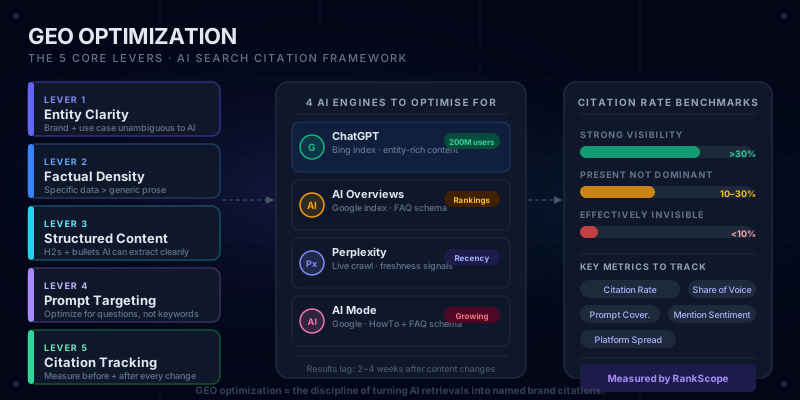
A page that spends three paragraphs on background before getting to the point rarely gets cited. A page that leads with "RankScope is a GEO platform that tracks brand citations across all four engines: ChatGPT, Perplexity, Google AI Overviews and Google AI Mode" and backs it up with specifics almost always does.
The Five Things That Most Affect Your ChatGPT Citation Rate
1. Content Structure — Format for Extraction
ChatGPT doesn't read your whole page. It extracts the most relevant paragraph or section for the query it's answering. That means your content needs to be structured so any single section is independently meaningful and citable.
The format that works best:
- Heading as a clear statement or question (not clever, just clear)
- Direct answer in the first sentence of the section
- Specific supporting data in the second or third sentence
- Brief elaboration below
Avoid: long preambles, buried leads, "In this section, we'll explore..." openers. ChatGPT doesn't care about your narrative setup. It wants the answer.
Also useful: FAQ sections with direct Q&A format. ChatGPT specifically retrieves content that answers questions, and FAQ schema makes the Q&A relationship explicit to retrieval systems.
2. Entity Clarity — Be Unambiguous About What You Are
AI models think in entities. An entity is a named thing with attributes and relationships. "RankScope" is an entity. "Generative Engine Optimization platform" is a category entity. Your goal is for ChatGPT to clearly associate your brand entity with the right category entities.
This means:
- Your homepage, about page, and key landing pages should explicitly state what category you're in, what problem you solve, and who you serve — in plain language, not marketing speak
- Your brand name should appear alongside your category keywords naturally and consistently across your site
- Your structured data (Organization, SoftwareApplication schemas) should reinforce these associations
- Third-party sources mentioning your brand should also make the category connection clear
Ambiguity is the enemy. If ChatGPT isn't sure whether you're a GEO tool or a traditional SEO tool, it'll default to the clearer option.
3. Factual Density — Give ChatGPT Something Citable
The single most reliable way to get cited is to have specific, verifiable facts that directly answer common questions.
Compare:
- Weak: "RankScope helps you understand your AI visibility across multiple platforms."
- Strong: "RankScope tracks citation rate, share of voice, and sentiment on ChatGPT, Perplexity, Google AI Overviews and Google AI Mode — updated daily on Professional plans."
The second version is citable. It has specifics that complete a sentence, answer a question, and can be lifted into a response without needing additional context.
Original data is the highest form of this. If your product generates data, publish it. Benchmarks, averages, rates — numbers that don't exist anywhere else. ChatGPT is trained to favor original research because its users find it credible. A post titled "We Analyzed 10,000 ChatGPT Responses: Here's What Gets Cited" will outperform "Tips for Getting Cited by ChatGPT" every time.
4. Web Presence Breadth — Appear in Multiple Contexts
ChatGPT's training data favored brands that appear in multiple independent contexts. A brand mentioned only on its own website looks different to a model than a brand mentioned in third-party reviews, community discussions, comparison posts, and news coverage.
Practically, this means:
- Product directories: G2, Capterra, Product Hunt, GetApp — get your product listed and keep it updated
- Community mentions: Reddit threads about your category (r/SEO, r/marketing, etc.), Hacker News discussions, relevant Slack/Discord communities where your brand gets mentioned organically
- Comparison posts: When other sites write "best [category] tools" roundups, being included reinforces your entity associations across independent sources. Our roundup of the best AI visibility tools is a good example of the format that earns citations.
- Press and media: Even small coverage in industry newsletters matters — it's independent signal that you exist and are relevant
You can't fake this. But you can be systematically present in the places where your category gets discussed.
5. Technical Accessibility — Let the Bots In
This one is surprisingly often missed. ChatGPT's crawler (GPTBot) needs to be able to access your content. Check your robots.txt right now:
User-agent: GPTBot
Allow: /
If GPTBot is blocked or not explicitly allowed, your content may not make it into OpenAI's training data refreshes or retrieval pool. Same applies to ChatGPT-User, OAI-SearchBot, and anthropic-ai if you want Claude coverage too.
Beyond robots.txt: your pages need to load fast and render properly. ChatGPT's crawler doesn't execute JavaScript the same way a browser does. Server-side rendered pages (like Next.js with SSR or static generation) fare better than fully client-side rendered pages.
What Content to Create First
Given limited bandwidth, prioritize content in this order for ChatGPT citation impact:
1. Category definition pages — "What is [your category]?" pages rank for definition queries, get retrieved constantly, and establish your brand as a category authority. If you don't own your category's definition page, someone else does.
2. Comparison and alternative pages — "RankScope vs [competitor]" and "[competitor] alternative" pages capture high-intent query patterns. ChatGPT frequently retrieves these when answering buying questions.
3. How-to guides with specific steps — Numbered, specific step-by-step content is structurally perfect for ChatGPT extraction. "How to track brand mentions in AI search: 5 steps" is far more citable than "Best practices for AI visibility."
4. Original data posts — If you can publish data from your own platform or original research, do it. This is the highest-leverage content format for both citation rate and SEO.
5. FAQ pages — Comprehensive FAQ pages with direct answers to every common question in your category. Build these with FAQ schema.
How to Know If It's Working
The frustrating thing about ChatGPT citations is that they don't show up in standard analytics. Google Analytics won't tell you how many times ChatGPT cited your content today. GA4 will show chatgpt.com as a referral source when users click links in ChatGPT responses — but most citations don't generate clicks at all. The brand just gets named. The full set of metrics you need — citation rate, share of voice, mention prominence, and engine coverage — is what's collectively called LLM visibility. Here's how to measure it.
To actually measure citation rate you need to:
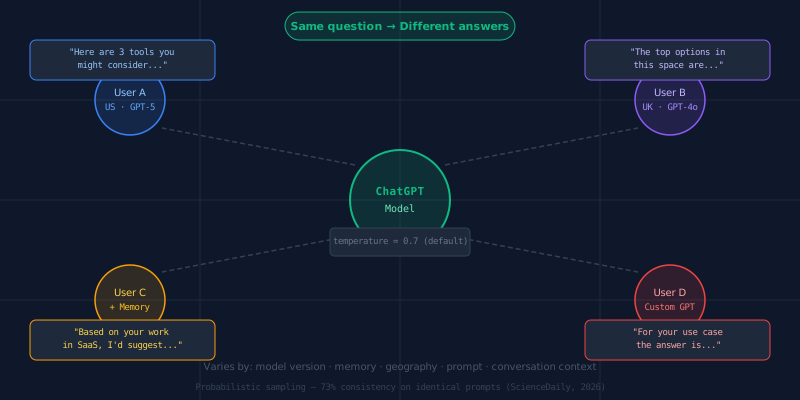
One important caveat: ChatGPT doesn't give the same answer to everyone — responses vary by model version, conversation context, geography, and built-in randomness. A single spot-check isn't representative. Measure across multiple queries and sessions.
-
Define your query set — The 20-50 queries most relevant to your business where you want to appear. "Best GEO tools," "how to track AI citations," "generative engine optimization platform," etc.
-
Run those queries regularly — Manually at first; automated with a tool like RankScope if you want consistent tracking at scale.
-
Record your citation rate — Out of 50 queries, how many name your brand? That's your baseline. Track it week over week. (A free AI visibility checker will do a 5-prompt version of this across four engines in under a minute.)
-
Track per-platform — ChatGPT Browse, ChatGPT without Browse, and ChatGPT's different modes can behave differently. Your Perplexity citation rate may differ significantly from your ChatGPT rate.
-
Monitor competitor citations — Are you losing ground to a competitor? Which of their pages is ChatGPT citing when it mentions them? That's content gap analysis.
A Practical 30-Day Plan
Week 1: Audit and fix the basics
- Check robots.txt — allow GPTBot, ChatGPT-User, OAI-SearchBot
- Submit sitemap to Bing Webmaster Tools
- Enable IndexNow for your domain
- Audit your 5 most important pages for entity clarity and factual density
Week 2: Content structure improvements
- Rewrite page intros to lead with direct answers
- Add FAQ sections to your homepage and key landing pages
- Add FAQ schema markup to those pages
Week 3: Create one high-value new piece
- Write a category definition page if you don't have one
- Or write a comparison page against your top competitor
Week 4: Establish a citation baseline
- Run your 20 most important queries through ChatGPT
- Record which get cited, which don't
- Note what content ChatGPT is pulling when it cites competitors
From that baseline, every month you can measure whether your citation rate is moving.
Getting cited by ChatGPT isn't magic. It's the result of clear entity associations, direct content structure, factual density, and consistent presence across the web. The brands doing this systematically are pulling ahead in AI search right now — while most of their competitors haven't started. Use our AI citation tracker to measure exactly where you stand. For a full breakdown of the tools available for tracking and optimizing your LLM visibility, see our LLM SEO tools guide.
RankScope tracks your citation rate across ChatGPT, Google AI Overviews, Perplexity, and Google AI Mode automatically — so you always know where you stand. Get started and get your citation baseline in minutes.
If you are deciding which queries to chase in the first place, our write-up on AI visibility optimization covers what we measured and the prediction method that did not hold up.