Does ChatGPT Give the Same Answer to Everyone?
The short answer: no. ChatGPT does not give the same answer to everyone, and it doesn't give identical answers even to the same person asking the same question twice.
This isn't a bug. It's a fundamental feature of how large language models work — and understanding it matters for anyone who uses ChatGPT for research, business decisions, or just curious questions.
The One-Sentence Explanation
ChatGPT generates each response from scratch using probabilistic sampling — it predicts the next word based on probability distributions, not a fixed script, so every generation is slightly different.
What Is Probabilistic Sampling?
When ChatGPT writes a response, it doesn't look up an answer from a database. Instead, it generates text one token at a time. At each step, the model calculates the probability of every possible next word, then picks one — not always the most likely one.
This is the core of why responses vary. The model is designed to sample from these probabilities rather than always choose the top result. The technical term for how much randomness is introduced at this step is temperature.
Temperature: The Randomness Dial
Temperature is a number, typically between 0 and 2, that controls how adventurous ChatGPT is when picking the next token:
| Temperature Value | Behavior | Typical Use Case |
|---|---|---|
| 0.0 | Always picks the most probable next token — nearly deterministic | Legal documents, code, factual Q&A |
| 0.3–0.5 | Slight variation; similar phrasing across attempts | Business writing, customer support |
| 0.7–1.0 (default) | Noticeable variation in wording and structure | General conversation, creative tasks |
| 1.5–2.0 | High creativity; responses can drift significantly | Brainstorming, fiction |
The standard ChatGPT web interface uses a default temperature setting that OpenAI doesn't publicly disclose. Via the OpenAI API, developers can set temperature explicitly. For modern GPT-5 reasoning models, temperature controls have been removed entirely — the internal reasoning chain introduces its own variance.
The practical upshot: Even if you send the exact same message twice, ChatGPT will almost certainly produce different sentences. The meaning may be similar, but the phrasing, examples, structure, and depth will shift.
Seven Reasons ChatGPT's Answers Vary by User
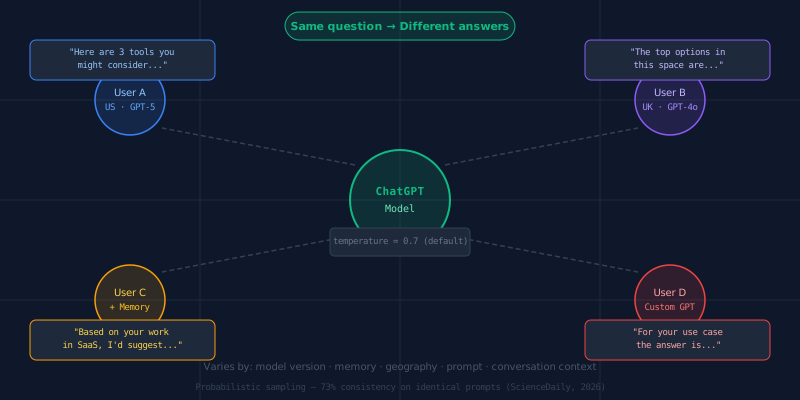
Temperature explains within-session variability. The reasons two different users get different responses are more numerous.
1. Conversation Context
ChatGPT reads the entire conversation history when generating each reply. If User A has been discussing marketing strategy for the last five messages, and User B asks "how does ChatGPT work" as their very first message, those two users get different answers — the model's framing and assumed audience differ based on what came before.
This also means a question asked early in a conversation gets a different treatment than the same question asked after twenty exchanges.
2. Saved Memory and Custom Instructions
Since April 2025, ChatGPT's Memory feature automatically references information across all of a user's past conversations. If you've told ChatGPT you're a software engineer, or that you prefer bullet points, or that you work in healthcare — those facts get baked into future responses without you re-stating them.
Custom instructions (available to Plus and above subscribers) also shape behavior: users can set preferences like "always respond in UK English" or "don't use metaphors" that apply to every session.
Both features are private — ChatGPT does not share memory between different users' accounts. But they mean two users can ask the identical question and get substantially different outputs based on their accumulated conversation histories.
3. Model Version
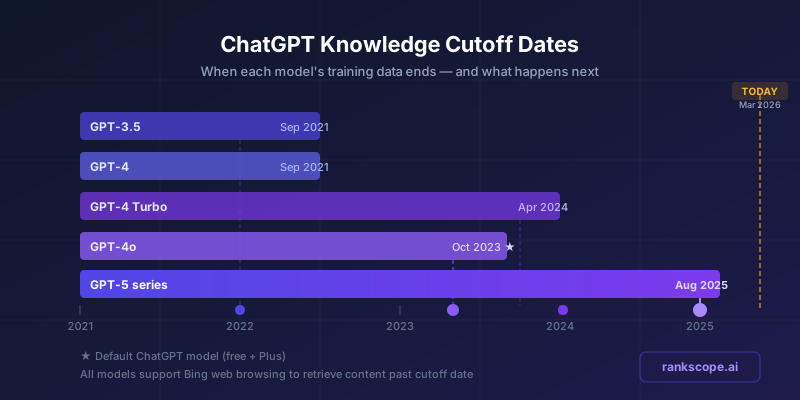
Not everyone runs on the same model. The ChatGPT interface offers access to multiple models, and OpenAI updates the default model periodically without always announcing it. As of early 2026, users might be on:
- GPT-4o — knowledge cutoff October 2023; fast, multimodal
- GPT-5 — knowledge cutoff August 2025; significantly more capable
- GPT-5.2 Thinking — reasoning model; 38% fewer errors than GPT-5.1 according to OpenAI's December 2025 release notes
- o4-mini — efficient reasoning variant; different capability profile
Different models produce different outputs even for identical prompts — they have different training data, different instruction tuning, different knowledge cutoffs, and different capability profiles. A question about a recent event will get completely different answers from GPT-4o (which doesn't know about it) versus GPT-5 (which might).
For more on how knowledge cutoffs affect what ChatGPT knows, see our ChatGPT Knowledge Cutoff guide.
4. Geographic Location
ChatGPT detects a user's approximate location and can adapt responses accordingly. A question about "the best approach to X" might get a US-centric answer for a user in San Francisco and a UK-centric answer for a user in London.
This is more pronounced for topics with genuine regional variation — law, business practice, health guidance, current events — but has been observed even in creative and general knowledge tasks.
5. System Prompts (for Custom GPTs and API Users)
When developers build custom GPTs or access the API directly, they can inject system prompts — hidden instructions that shape the model's persona, response style, topic restrictions, and formatting preferences. A custom GPT built for customer service at a software company will answer "how do I set up a subscription?" very differently from a general-purpose ChatGPT session.
The ChatGPT web interface itself has a system prompt from OpenAI that shapes baseline behavior — this prompt has changed over time as OpenAI updates its policies.
6. Prompt Phrasing
Minor variations in how a question is asked can meaningfully change the output. Compare:
- "What is SEO?" → Likely a broad, definitional answer
- "What is SEO and how is it different from GEO?" → A comparative answer that covers generative engine optimization
- "Explain SEO to me like I'm 12" → A simplified analogy-heavy response
This isn't just about tone. The same underlying question framed differently activates different patterns in the model's training, leading to responses that cover different facets of the topic.
7. Real-Time Web Retrieval
ChatGPT can use Bing to search the web in real time (Browse mode). When it does, the answer is partially determined by which web pages Bing surfaces — and that varies based on user location, query phrasing, and the current state of Bing's index.
Two users asking about a recent news event may get responses grounded in different source articles, leading to different nuances even if the core facts are the same.
How Consistent Is ChatGPT, Really?
Research gives a mixed picture.
A 2026 study covered by ScienceDaily found that when given the exact same prompt 10 times, ChatGPT produced consistent answers only about 73% of the time. That 27% inconsistency rate isn't random noise — it shows up even on factual questions, not just subjective or creative tasks.
A peer-reviewed study published in PLOS ONE noted: "The responses generated by ChatGPT are subject to variation depending on the question and may also differ over time." The authors flagged this as a reproducibility concern for research contexts.
For factual, closed-ended questions ("What is the capital of France?"), consistency is much higher — close to 100% for well-established facts. The variability ramps up with:
- Subjective or interpretive questions — opinions, advice, recommendations
- Questions with multiple valid answers — "what's the best approach to..."
- Long-form outputs — essays, summaries, explanations where structure can vary dramatically
- Questions at the edge of the model's knowledge — recent events, niche topics, contested facts
Does ChatGPT Remember What It Told Someone Else?
No. ChatGPT memory is strictly per-user. There is no shared knowledge pool where ChatGPT accumulates what it told previous users and applies that to new ones.
Each user's Memory is stored in their own account. What you've told ChatGPT — your job, your preferences, your projects — is never visible to or used in conversations with other users.
This is worth stating plainly because the question comes up often: asking ChatGPT the same question as a colleague doesn't mean you'll get the same answer. You won't.
What This Means If You're Trying to Appear in ChatGPT Answers
This variability has a specific implication for businesses: whether your brand or product appears in ChatGPT's answer isn't a binary yes/no.
Because ChatGPT's outputs vary by user, model version, conversation context, and real-time retrieval, a brand might appear in responses for some users in some contexts but not others. Unlike a Google ranking — where position 1 means position 1 for most searchers — AI citation is probabilistic and context-dependent.
That's why tracking AI brand visibility requires sampling many different query variations, models, and user contexts — not a single spot-check. Tools built for AI citation tracking approach this by running queries systematically and measuring citation rate across a representative sample.
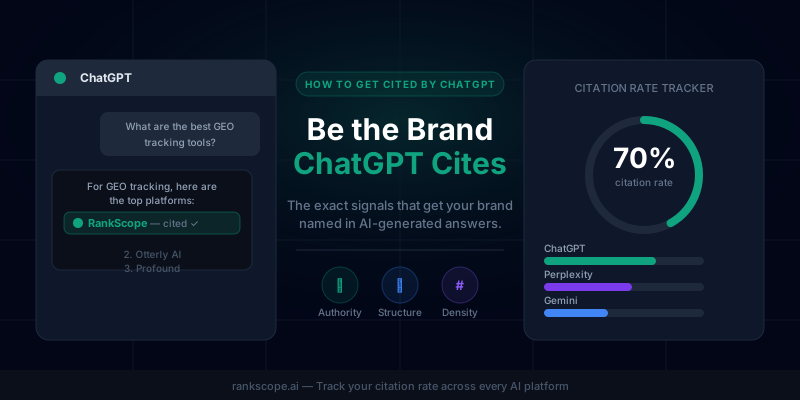
The underlying factors that influence whether a brand appears are: content quality and structure, factual density, web presence breadth (G2, Reddit, press mentions), and whether GPTBot can crawl your site. These are covered in detail in our guide to getting cited by ChatGPT.
Can You Force ChatGPT to Give Consistent Answers?
Via the API
Setting temperature: 0 in an API call pushes the model toward near-deterministic outputs — it picks the most probable token at each step. This is widely used for applications like code generation, legal drafting, and structured data extraction where consistency matters.
{
  "model": "gpt-4o",
  "messages": [{"role": "user", "content": "What is the capital of Australia?"}],
  "temperature": 0
}
With temperature at 0, responses to simple factual questions become very consistent — often word-for-word identical across runs. Complex or longer outputs will still show some structural variation even at temperature 0.
Note: For GPT-5 reasoning models (o3, o4-mini, GPT-5 Thinking), OpenAI has removed the temperature parameter. The internal chain-of-thought reasoning introduces its own variance that can't be turned off.
In the Web Interface
The standard ChatGPT web interface doesn't expose temperature controls to users. You can improve consistency by:
- Adding explicit constraints to your prompt: "Use exactly 5 bullet points", "Give a one-sentence answer", "Only cite peer-reviewed sources"
- Using a custom GPT with defined system instructions that pin format and style
- Asking ChatGPT to commit to an answer: "Give me your single best recommendation, not a list of options"
These techniques reduce variability but don't eliminate it. If your use case requires truly reproducible outputs, the API with low temperature is the correct tool.
Summary
ChatGPT does not give the same answer to everyone. The variation comes from multiple layers:
- Probabilistic sampling — built-in randomness at the token level (temperature)
- Conversation history — what came before in the chat shapes the answer
- User memory and custom instructions — accumulated preferences from past sessions
- Model version — GPT-4o, GPT-5, o4-mini, and GPT-5.2 Thinking behave differently
- Geographic location — regional context influences responses
- Prompt phrasing — small wording changes activate different response patterns
- Real-time retrieval — Browse mode sources from Bing, which returns different results by user
Studies put factual consistency at around 73% even when the same prompt is sent 10 times. For subjective, interpretive, or long-form questions, variation is significantly higher.
If you're using ChatGPT for research, keep this in mind: a single response is a sample from a probability distribution, not a lookup from a database. For important questions, run the prompt multiple times and look for consistency in the substance across responses.
And if you're thinking about this from a business perspective — what it means for whether ChatGPT mentions your brand, and how to measure it — the ChatGPT citation tracking guide covers that side in depth.
Want to know how often ChatGPT recommends your brand right now? RankScope tracks your citation rate across ChatGPT and 3 other AI engines automatically. Start tracking from $49/mo →
Related reading: ChatGPT Knowledge Cutoff Explained · ChatGPT for SEO: What It Can and Can't Do · How to Get Your Brand Cited by ChatGPT