ChatGPT Knowledge Cutoff Date: February 16, 2026 (Plus Claude, Gemini, Grok and Every Major LLM)
The question comes up constantly: "Does ChatGPT know about [thing that happened recently]?" Or more specifically these days: "What is GPT-5's knowledge cutoff?"
The answer depends on which model you're using, whether web browsing is enabled, and what "knows" actually means for an LLM. The concept at the center of all of this is the knowledge cutoff — and it has real implications for anyone trying to appear in AI-generated answers.
Here's every major model's current cutoff date, what it means in practice, and what it means for your AI search visibility.
Last verified: August 10, 2026. We update this table when new models ship.
GPT-5 Knowledge Cutoff
GPT-5's training data cuts off at September 30, 2024. Despite shipping in mid-2026, the base GPT-5 model knows nothing about events after that date unless web browsing retrieves it.
This surprises a lot of people. GPT-5 launched roughly 18 months after its training cutoff — longer than the typical 6–12 month gap. The training dataset was frozen in late 2024 while OpenAI spent months on post-training alignment, safety evaluation, and staged rollout.
A few things worth knowing about GPT-5 specifically:
- Web browsing is enabled on paid plans, so real-time queries can supplement the training gap
- The model sometimes surfaces information from its training with high confidence that was actually accurate as of Sep 2024 but has since changed — pricing, product features, company details
- GPT-5.5, the current ChatGPT Plus default, is a later model with a more recent December 2025 cutoff — GPT-5 and GPT-5.5 are distinct models with different cutoffs
- GPT-5.6 (Sol/Terra/Luna) is the newest GPT-5 family, released in 2026 with a February 16, 2026 cutoff — currently available via API and to ChatGPT Plus/Pro users
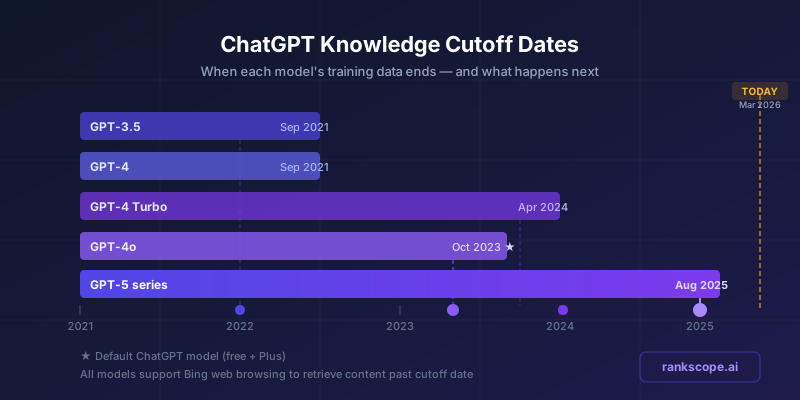
ChatGPT Knowledge Cutoff Dates (OpenAI Models)
| Model | Knowledge Cutoff | Web Browsing | Notes |
|---|---|---|---|
| GPT-5.6 Sol | February 16, 2026 | Yes (Bing) | Frontier model; complex reasoning and coding |
| GPT-5.6 Terra | February 16, 2026 | Yes (Bing) | Balanced intelligence and cost |
| GPT-5.6 Luna | February 16, 2026 | Yes (Bing) | High-volume, cost-sensitive workloads |
| GPT-5.5 | December 1, 2025 | Yes (Bing) | Current ChatGPT Plus default |
| GPT-4o | October 2023 | Yes (Bing) | Default on ChatGPT free tier |
| GPT-4o mini | October 2023 | Yes (Bing) | Lightweight free-tier variant |
| GPT-4 Turbo | April 2024 | Yes (Bing) | Available via API |
| GPT-4 (original) | September 2021 | Yes (Bing) | Largely superseded |
| GPT-3.5 Turbo | September 2021 | No | Legacy fallback |
| o1 | October 2023 | Yes (Bing) | Reasoning model |
| o1 Pro | October 2023 | Yes (Bing) | Extended reasoning |
| o3 | August 2025 | Yes (Bing) | Latest reasoning model |
| o4-mini | August 2025 | Yes (Bing) | Efficient reasoning |
The default model matters: When someone opens ChatGPT free today, they get GPT-4o (October 2023 cutoff). ChatGPT Plus subscribers default to GPT-5.5 (December 2025 cutoff). GPT-5.6 Sol/Terra/Luna are available via API and to Plus/Pro users, all with a February 16, 2026 cutoff. Most citation data and AI search behavior studies are based on GPT-4o since it's the most widely used model globally.
Common confusion: GPT-4o's cutoff is frequently misquoted as September 2021 — that's the old GPT-3.5/GPT-4 cutoff. When GPT-4o launched in May 2024, the cutoff moved to October 2023. Outdated documentation and some of the model's own training data (which included older help articles) perpetuate the error.
All Major LLM Knowledge Cutoffs (August 2026)
| Model | Provider | Knowledge Cutoff | Real-Time Search | Notes |
|---|---|---|---|---|
| GPT-5.6 Sol | OpenAI | Feb 2026 | Yes (Bing) | Frontier; complex reasoning + coding |
| GPT-5.6 Terra | OpenAI | Feb 2026 | Yes (Bing) | Balanced intelligence/cost |
| GPT-5.6 Luna | OpenAI | Feb 2026 | Yes (Bing) | High-volume, cost-optimized |
| GPT-5.5 | OpenAI | Dec 2025 | Yes (Bing) | Current Plus default |
| GPT-4o | OpenAI | Oct 2023 | Yes (Bing) | Free tier default |
| o3 | OpenAI | Aug 2025 | Yes (Bing) | |
| Claude Fable 5 | Anthropic | Jan 2026 | Yes (tool use) | Most capable; GA Jun 2026 |
| Claude Mythos 5 | Anthropic | Jan 2026 | Yes (tool use) | Limited availability |
| Claude Opus 4.8 | Anthropic | Jan 2026 | Yes (tool use) | |
| Claude Opus 4.7 | Anthropic | Jan 2026 | Yes (tool use) | |
| Claude Sonnet 4.6 | Anthropic | May 2025 | Yes (tool use) | |
| Claude Opus 4.6 | Anthropic | May 2025 | Yes (tool use) | Hybrid reasoning |
| Claude Haiku 4.5 | Anthropic | Feb 2025 | Yes (tool use) | Fastest/cheapest |
| Claude Sonnet 4.5 | Anthropic | Jan 2025 | Yes (tool use) | |
| Claude Opus 4 / Sonnet 4 | Anthropic | Mar 2025 (training) / Jan 2025 (reliable) | Yes (tool use) | |
| Claude 3.7 Sonnet | Anthropic | Oct 2024 | Yes (tool use) | |
| Gemini 3.6 Flash | Real-time | Yes (Google Search) | Latest stable; no fixed cutoff | |
| Gemini 3.5 Flash | Real-time | Yes (Google Search) | No fixed cutoff | |
| Gemini 3.5 Flash-Lite | Real-time | Yes (Google Search) | No fixed cutoff | |
| Gemini 3.1 Pro | Real-time | Yes (Google Search) | Preview | |
| Grok 4.5 | xAI | Feb 1, 2026 | Yes (X/web search) | Real-time when search enabled; cutoff applies without it |
| Perplexity Sonar | Perplexity | Real-time | Yes (native crawl) | No training cutoff limit |
| Llama 4 Maverick | Meta | Not published | No (base model) | 17B active params, 128 experts |
| Llama 4 Scout | Meta | Not published | No (base model) | 17B active params, 16 experts; 10M context |
| DeepSeek-V4-Pro | DeepSeek | Not published | Optional | Replaces DeepSeek-V3/R1 |
| DeepSeek-V4-Flash | DeepSeek | Not published | Optional | Replaces deepseek-chat/reasoner |
| Mistral Medium 3 | Mistral | Not published | No | Current featured model |
| Mistral Small 4 | Mistral | Not published | No | Hybrid instruct/reasoning/coding |
| Mistral Large 3 | Mistral | Not published | No | Open-weight |
| Qwen 2.5 Max | Alibaba | Sep 2024 | Optional | |
| Microsoft Copilot | Microsoft | Oct 2023 | Yes (Bing) | Powered by GPT-4o |
| Amazon Nova Pro | AWS | Feb 2024 | No | Base model |
| Command R+ | Cohere | Mar 2024 | Yes (RAG) |
Key pattern: Google's Gemini family uses live Google Search grounding at inference time — there is no meaningful training cutoff constraint for users. Perplexity is built search-first. xAI's Grok 4.5 has a training cutoff (Feb 2026) but effectively operates in real-time when web/X search tools are enabled. OpenAI, Anthropic, Meta, Mistral, and DeepSeek models all operate on discrete training cutoffs supplemented by optional retrieval. Note that Meta, DeepSeek, and Mistral do not publish formal cutoff dates in their public documentation.
What Is a Knowledge Cutoff?
A knowledge cutoff (also called a training cutoff or data cutoff) is the specific date after which an LLM has no training data. The model was trained on text scraped from the internet, books, research papers, and other sources — but that collection stopped at a specific point in time.
After the cutoff:
- The model has no awareness of events, publications, or changes that occurred after that date
- Its factual claims about the world are frozen at that point
- New products, companies, and research published after the cutoff simply don't exist in trained knowledge
Think of it as a library that was sealed on a specific date. Everything on the shelves at sealing is accessible. Everything published afterward doesn't exist to the model — unless it goes out and retrieves it via web search.
Why cutoffs exist
Training a frontier LLM takes months and hundreds of millions of dollars in compute. The training dataset has to be frozen at some point so training can actually happen. After data collection closes, the model goes through weeks or months of pre-training, then safety tuning, then internal evaluation, then staged public rollout. By the time you open a "new" model, you're working with knowledge that's already 6–12 months out of date.
How Web Browsing Changes the Picture
The knowledge cutoff story has a major asterisk: web retrieval.
ChatGPT, Claude, Copilot, and most commercial AI assistants now support real-time web access. When you ask ChatGPT a question and it searches, it's fetching live Bing results and using that content to build its answer.
This means:
- For users: You can get answers about recent events even past the training cutoff
- For brands: Content published after the training cutoff can still surface in answers — but only if it's indexed by Bing (for ChatGPT/Copilot) or Google (for Gemini)
Trained knowledge vs. retrieved knowledge — they behave differently
This is the part most people miss. When ChatGPT retrieves a web page, it reads and synthesizes that page's content for the current session. But:
- Retrieved facts are more prone to hallucination if sources are contradictory or low-quality
- Browsed content doesn't persist — the same question without browsing falls back to training data only
- LLMs tend to be more confident citing things from training data than from retrieved pages
Training data is deep, embedded knowledge. Retrieved data is working memory for one conversation. Both matter for your AI visibility strategy, but through different mechanisms.
How Knowledge Cutoffs Affect AI Search Visibility (GEO)
This is where cutoff dates stop being trivia and start being strategy. If you're trying to get your brand cited in ChatGPT, Perplexity, or AI Overviews — the core discipline of Generative Engine Optimization — the cutoff timeline directly shapes what's possible.
Training data visibility: the legacy advantage
If your brand had meaningful web presence before GPT-4o's October 2023 cutoff, you may already have training-level citations baked in. The model "knows" your brand from its training data. It will mention you in relevant answers even without browsing.
Brands that established authority before the cutoff — content, backlinks, third-party mentions, Reddit discussions, G2 reviews — have a structural citation advantage that's very hard for newer entrants to overcome in the short term.
Retrieval is the near-term lever for newer brands
If your brand launched or significantly updated after October 2023, your path to ChatGPT visibility runs through Bing retrieval until the next major training refresh. That means:
- Allow GPTBot in robots.txt — if you're blocking OpenAI's crawler, you're blocking yourself from both training refreshes and real-time retrieval
- Submit to Bing Webmaster Tools — ChatGPT browses via Bing. No Bing index, no ChatGPT retrieval.
- Rank in Bing for your target queries — retrieval pulls from Bing's organic results, so SEO fundamentals apply (for Bing specifically)
- Structure content for extraction — ChatGPT doesn't read whole pages when browsing. It extracts the most relevant passage. Lead with direct answers, use clear H2/H3 headers, keep factual claims tight and specific.
For a complete playbook on appearing in ChatGPT answers, see how to get cited by ChatGPT.
Different engines, different cutoff rules
One thing brands consistently get wrong: assuming that AI citation visibility is one unified thing. It's not.
| Engine | Cutoff Relevance | What to Optimize For |
|---|---|---|
| ChatGPT | High — Oct 2023 default (GPT-4o) | Bing indexing + GPTBot access |
| Google AI Overviews | Low — Gemini 3.x has live Google access | Google indexing + E-E-A-T signals |
| Perplexity | Near zero — native real-time crawl | Crawlability + citation-worthy structure |
| Google AI Mode | Low — live Gemini 3.x grounding | Google indexing + schema clarity |
| Microsoft Copilot | High — GPT-4o based, Bing grounding | Same as ChatGPT |
| Claude | Low-Medium — Fable 5/Opus 4.8 cut off Jan 2026; retrieval via tool use | Anthropic training data + retrieval tools |
| Grok | Low — Feb 2026 cutoff, real-time with search | X/web presence + crawlability |
A brand that's optimized for Google and has strong AI Overview presence can still be invisible in ChatGPT because Bing has never crawled them. These are different visibility problems requiring different fixes.
To understand how to track your citation rates across all of these engines, see our guide to GEO metrics.
The Cutoff Gap: Why AI Is Always Behind
There's a structural quirk in LLM development that creates what's called the "cutoff gap" — the time between when training data ends and when the model ships to users.
The gap has multiple components:
- Data collection closes — the training dataset is frozen
- Pre-training runs — weeks to months depending on model size
- Post-training alignment — RLHF, safety tuning, Constitutional AI, etc.
- Internal red-teaming and evaluation — security and safety review
- Staged rollout — gradual release to avoid infrastructure overload
Add it up and a model released in June 2026 might have training data only through late 2025. GPT-5.5's December 2025 cutoff with its mid-2026 release is a textbook example — roughly a 6-month gap.
The practical implication: the AI answering your customers' questions is always working from a worldview that's at least several months stale, regardless of how recently it launched.
How to Check a Model's Actual Cutoff
Stated cutoffs and practical knowledge sometimes diverge. Training data is uneven — there's far more data from 2020 than from the final weeks before cutoff. Events close to the cutoff date may be sparsely represented even if technically within the training window.
Ask the model directly:
"What is your knowledge cutoff date?"
Most models state their cutoff accurately, but some pull from stale internal documentation and get it wrong. If GPT-4o tells you its cutoff is September 2021, it's citing outdated help content from the GPT-3.5 era.
Test with specific dated events: Ask about specific things you know happened in the 1–3 months before the stated cutoff. If the model is vague or wrong about events it should know, the practical knowledge boundary may be earlier than the stated cutoff.
Check official documentation:
- OpenAI: help.openai.com/en/articles/9624314-model-release-notes
- Anthropic: model cards at docs.anthropic.com
- Google: Gemini technical reports at deepmind.google
Cutoff Dates by Use Case
For users asking factual questions
If you're asking about recent events, always check whether web browsing is enabled and which model is active. The free tier defaults to GPT-4o (October 2023 cutoff, browsing enabled). If you need the most current training knowledge, use GPT-5.6 Sol (February 2026 cutoff) on ChatGPT Plus or via API, or GPT-5.5 (December 2025 cutoff) as the ChatGPT Plus default.
For SEOs and content strategists
Content published after a model's training cutoff only reaches AI-generated answers via retrieval until the next training refresh. Prioritize Bing indexing and GPTBot access alongside Google. Use extraction-ready formatting so retrieval can find your key claims quickly.
For brand managers
Check your brand's citation rates across engines — especially ChatGPT. A brand with strong Google organic rankings can still be invisible in ChatGPT if it launched after October 2023 and hasn't built Bing presence. That citation gap is a real business risk. Tools like RankScope track your citation rate across ChatGPT, Perplexity, AI Overviews, and AI Mode so you can measure it rather than guess. For a full breakdown of what's available in this category, see our LLM SEO tools comparison.
Cutoff Dates and Google AI Overviews
While this post focuses on ChatGPT, it's worth noting that Google AI Overviews operate on a fundamentally different model.
AI Overviews are powered by Gemini, which has native Google Search integration and is continuously updated. There's no training cutoff constraint in the way there is for ChatGPT — Gemini can ground answers in Google's live index at query time. This means:
- AI Overview visibility is driven by Google organic ranking, not Bing or training data
- Standard Google SEO signals apply (E-E-A-T, structured data, Core Web Vitals)
- Content freshness matters because Google's live index reflects recent updates immediately
If AI Overviews are your primary target, the ChatGPT cutoff playbook is irrelevant. Focus on Google indexing and content that Google's systems trust.
Frequently Asked Questions
What is GPT-5's knowledge cutoff?
GPT-5's training data cuts off at September 30, 2024. Despite launching in mid-2026, the base model has no training knowledge of events after that date. Web browsing on paid plans supplements this gap with real-time Bing retrieval. Note that GPT-5.5 — the current default on ChatGPT Plus — is a separate, later model with a December 2025 cutoff.
What is ChatGPT's knowledge cutoff in 2026?
As of August 2026: GPT-5.6 Sol, Terra, and Luna all cut off at February 16, 2026. GPT-5.5 (ChatGPT Plus default) cuts off at December 1, 2025. GPT-4o (free tier) cuts off at October 2023. Check the model selector in ChatGPT to see which model is active.
Does ChatGPT know about things that happened after its cutoff date?
Only if web browsing is active. ChatGPT Plus, Team, and Enterprise plans have Bing-grounded browsing enabled by default. When browsing fires, ChatGPT retrieves current web pages and uses them to answer. The free tier (GPT-4o without browsing) is limited to training data through October 2023.
Why does ChatGPT say its cutoff is 2021 when I ask it?
The September 2021 date was GPT-3.5 and early GPT-4's cutoff. That date is documented in thousands of help articles and forum posts that made it into the training data. When GPT-4o launched (October 2023 cutoff), the model's training data still contained all those old "GPT's cutoff is September 2021" articles. So the model sometimes repeats the outdated date. Check OpenAI's official release notes for the authoritative number.
How often does OpenAI update training cutoffs?
No fixed schedule — it happens with major model releases. GPT-3.5 had September 2021. GPT-4 Turbo moved it to April 2024. GPT-5.5 pushed it to December 2025. GPT-5.6 Sol/Terra/Luna advanced it to February 16, 2026. Realistically, expect training cutoffs to advance every 6–12 months with each new model generation. You can't request an updated cutoff between releases.
What's the difference between knowledge cutoff and model release date?
The knowledge cutoff is when training data collection stopped. The release date is when the model became publicly available. The gap is typically 6–12 months. GPT-5.5's December 2025 cutoff with its mid-2026 release illustrates this — about 6 months of events the model knew nothing about on launch day. By the time you're using the model, it's already months behind the present day.
Which AI model has the most current knowledge?
For trained knowledge without retrieval, Grok 4.5 technically has the most recent training cutoff at February 1, 2026. GPT-5.6 Sol/Terra/Luna follow at February 16, 2026. Claude Fable 5 and Claude Opus 4.8 both cut off at January 2026. For effectively real-time knowledge, Gemini 3.6 Flash, Grok 4.5 with search enabled, and Perplexity Sonar have live search integration with no meaningful training cutoff constraint.
Will LLMs eventually have no training cutoff?
The trajectory is toward continuous retrieval reducing the impact of cutoffs, not toward eliminating them entirely. Gemini and Grok effectively demonstrate this already. But the architectural distinction between pre-trained weights (deep stable knowledge) and retrieved context (ephemeral working memory) will likely persist — the tradeoffs are fundamental to how LLMs work.
What This Means for Your AI Search Visibility
Knowledge cutoffs are one of the most underappreciated factors in AI citation strategy. If your brand was well-documented on the web before October 2023, you have a trained-in citation advantage in the world's most-used AI assistant. If you're newer, you're working against the clock until the next GPT training refresh.
Either way, the starting point is knowing where you actually stand. Running your top 20–30 category queries through ChatGPT and recording when your brand gets mentioned is the fastest way to establish a citation baseline. At scale — tracking 100+ prompts across ChatGPT, Perplexity, AI Overviews, and AI Mode — manual tracking breaks down fast.
That's what RankScope is built for: automated citation tracking across every major AI engine, so you know your citation rate, how it moves over time, and which content changes actually shift your visibility. Start tracking your brand and find out where you stand today.