The AI Visibility Platform for Generative Engine Optimization
An AI visibility platform tracks, analyzes, and improves how your brand appears in AI-generated answers. RankScope does it across four engines (ChatGPT, Google AI Overviews, Perplexity, and Google AI Mode), which covers both of Google's AI surfaces, with forensic detail on every citation, mention, and shift.
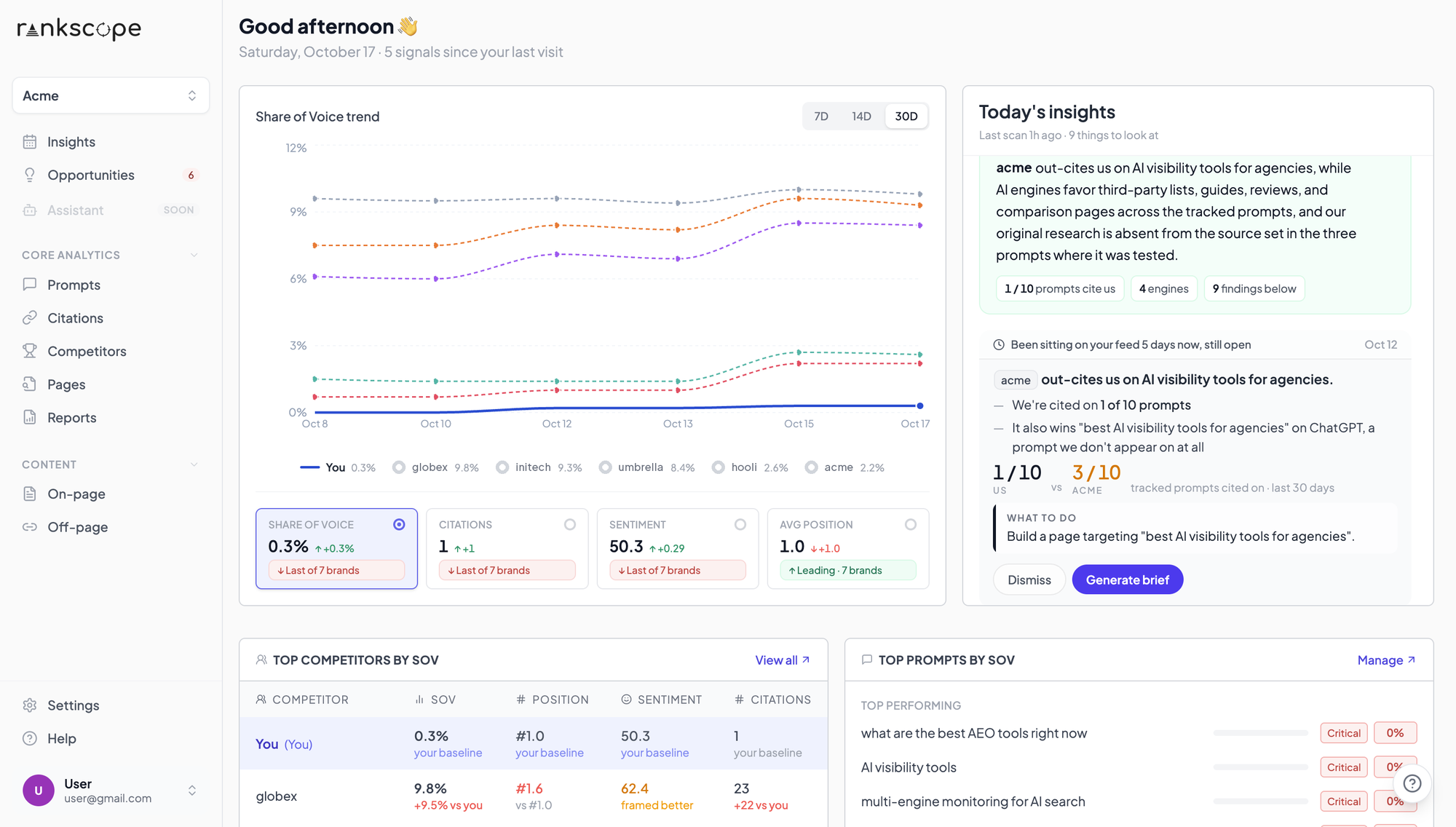
Your AI visibility, in one place
Share of Voice, Citations, Sentiment and Position for you and every tracked competitor, across ChatGPT, Google AI Overviews, Perplexity and Google AI Mode. Each metric shows its change and where you rank among the brands you track.
Today's insights
Last scan 11h ago · 9 things to look at
Globex out-cites us on searches for top tools managing shared work across teams, while initech.com leads on remote-team software searches, our homepage is losing citations in recent scans, and Google AI Overviews favor comparison-style pages over our /pricing page across the 8 tracked prompts.
1d ago
Globex out-cites us on "top tools for managing shared work across teams" searches.
- —We're cited on 8 of 10 prompts, only on ChatGPT
- —Our only cited page is homepage
- —On "what are the top tools for managing shared work across teams?" it was cited 5 times to our 2
- —It also wins "need ideas for team project trackers" on ChatGPT and Google AI Overviews, a prompt we don't appear on at all
2
Us
vs
5
globex.com
citations on that head-to-head prompt
What to do
Add a comparison section to the homepage positioning our team project tracker against alternatives.
11h ago
initech.com leads us on remote-team software searches.
- —We're cited on 8 of 10 prompts, only on ChatGPT
- —Our only cited page is homepage
- —On "best task management software" it was cited 6 times to our 1
- —It also wins "what's the best software for coordinating a remote team?" on ChatGPT, a prompt we don't appear on at all
- —globex.com is ahead of us too
1
Us
vs
6
initech.com
citations on that head-to-head prompt
What to do
Add a remote-team coordination section to the homepage.
1d ago
Across the 8 tracked prompts, Google AI Overviews favors comparison-style pages over our /pricing page for searches like these.
- —8 prompts you track, including "best project tracking software", "best task management software", "best work management software" and 5 more
- —Umbrella.com, Initech, Globex and 6 others are cited on these, we're not
- —Your closest pages, homepage and /pricing, aren't cited on these
- —Why it wins: The cited pages explain how software fits different needs and support comparative decisions, while our /pricing page lacks the same depth and comparison context.
What to do
Expand our /pricing page with a detailed comparison section covering different use cases and software options.
1d ago
The untracked prompt "For software teams, Globex vs Initech: which one is the better fit?" pulls about 140 searches a month.
Track "For software teams, Globex vs Initech: which one is the better fit?"
11h ago
Across the tracked prompts, our homepage is being passed over for project-tracking citations.
- —1 prompt you track, "best project tracking software"
- —Umbrella.com, Initech, Globex and 2 others are cited on these, we're not
- —Your closest pages, homepage and /blog/globex-vs-initech-vs-hooli, aren't cited on these
- —Why it wins: The cited pages give teams concrete guidance on tasks, timelines, dependencies, portfolios, reporting, and cross-functional collaboration, which our page does not.
What to do
Add a dedicated project-tracking section to our homepage covering tasks, timelines, dependencies, project portfolios, reporting, and cross-functional collaboration.
1d ago
The untracked prompt "Should I use Hooli vs Vandelay for a flexible work management system?" pulls about 110 searches a month.
Track "Should I use Hooli vs Vandelay for a flexible work management system?"
1d ago
Umbrella.com, Hooli and Vandelay are cited in your scans but remain untracked, so their mentions do not count toward Share of Voice. Umbrella.com stands out across 3 engines and 5 tracked prompts.
What to do
Track Umbrella.com first.


Track allDismiss all
1d ago
The untracked prompt "Between Globex vs Vandelay, which is better for organizing team tasks?" pulls about 110 searches a month.
Track "Between Globex vs Vandelay, which is better for organizing team tasks?"
Agents that tell you what changed, and why
After every daily scan, RankScope's autonomous agents work out who out-cites you, why their pages win, and what to do next. You read it in Insights as a plain-English briefing, every finding with its evidence and one next step.
- Daily briefing after every scan
- Evidence and one next step on every finding
- Open findings stay flagged until handled
- Agents on Professional and Agency; Starter gets the top 10 findings per scan
Suggested 3
Off-site opportunity for "best project tracking software"
WHY THIS MATTERS95% of citations for "best project tracking software" go to third-party sites, mostly earned media. Pitch the cited publications directly.
New content · All engines · 80% confidence
3 signals · 0 pages · 3 prompts
Off-site opportunity for "best work management software"
WHY THIS MATTERS84% of citations for "best work management software" go to third-party sites. Pitch the cited publications directly.
New content · All engines · 63% confidence
2 signals · 0 pages · 2 prompts
In progress 2
Off-site opportunity for "need ideas for team project trackers"
WHY THIS MATTERS100% of citations for "need ideas for team project trackers" go to third-party sites. Pitch the cited publications directly.
Single-page · All engines · 84% confidence
20 signals · 1 page · 10 prompts
Off-site opportunity for "project management software for small business"
WHY THIS MATTERS87% of citations for "project management software for small business" go to third-party sites. Pitch the cited publications directly.
Single-page · All engines · 68% confidence
9 signals · 1 page · 9 prompts
Every gap, already diagnosed
Opportunities show which competitor pages AI engines cite instead of yours, why those pages win, and whether the fix lives on your own site or on a third-party site AI engines already trust.
- Root causes ranked with a match score
- Confidence score on every opportunity
- On-page and off-page fixes, kept separate
- Suggested, In progress and Done in one board
Create similar page for ‘best task management software’
WHAT TO DOEngines in scope
Why this is happening
The cited page is a pricing page, but engines prefer comparison-style content for this query, so the page lacks the depth needed to be cited.
Signals (8)
- globex.com now cited across 3 of your topics — you're not
- initech.com now cited across 2 of your topics — you're not
- umbrella.com now cited for "best task management software" on Google AI Overviews — you're not
Show 5 more
Affected pages
https://acme.com/serves 3 prompts
What to do
Add a concise definition of task management software, how it differs from project tracking tools, and the criteria used to evaluate them.
Add a comparison table covering each tool's best use case, free plan, starting price, collaboration features and a notable limitation.
Stop staring at data. Start knowing what to write.
Open any opportunity and the brief is waiting: which engines cite you and which don't, the root cause, the signals behind it, and a numbered list of exactly what to change on the affected page.
- One-click brief from any insight or opportunity
- Engines in scope, cited or not, at a glance
- Root cause with a confidence score
- Step-by-step changes for the affected page
Create similar page for ‘best task management software’
GENERATING 02
Comparison Table
Writing this section first so the page has something real to assemble.
Write for AI citation, not just for clicks
Generate the page section by section against the brief's GEO target, check any draft or live page against a live GEO score, then send it to your CMS as a draft or copy it in. Uses Studio credits: 10, 30 or 200 a month.
- Pages generated section by section
- Live GEO score on drafts and live pages
- Publish to WordPress, Webflow, Wix, Shopify, Drupal or Contentful as a draft
- Generate an llms.txt file for your site
In progress 1
Create similar page for 'best task management software'
WHY THIS MATTERSglobex.com started appearing in citations for best task management software on Google AI Mode and Google AI Overviews, where you have no citations. Study what makes it citable and build a stronger alternative.
Single-page · Google AI Mode, Google AI Overviews · 84% confidence
1 signal · 1 page · 3 prompts
In progress 1
Off-site opportunity for "best project management software for agencies"
WHY THIS MATTERS87% of citations for "best project management software for agencies" go to third-party sites, mostly earned media. Pitch the cited publications directly.
Single-page · All engines · 68% confidence
9 signals · 1 page · 9 prompts
Prove what every fix did
Accepted fixes live on your On-page and Off-page boards. Once a fix is live, the On-page board shows its impact on your AI visibility, and reports roll the results up for your leadership, on demand or on a schedule.
- Impact tracked on every fix you ship (Professional and Agency)
- On-page and off-page work kept separate
- In progress and Done at a glance
- Reports on demand or weekly, monthly or quarterly
Something changed. Here's exactly what.
Your AI citation metrics don't just change, they change for a reason. Answer Diff shows how an engine's answer to a prompt changed, before and after, side by side: what appeared, what was dropped, which competitors entered responses that used to mention only you.
Performance Comparison Table
Showing 1 to 10 of 22 prompts
| Prompt | Mentions | Position | Share of Voice |
|---|---|---|---|
| Provide an overview of recent breakthroughs in AI-assisted medical diagnostics, focusing on radiology and pathology... | 00/00→ | 10/10→ | 00/00→ |
| What are the latest developments in AI-powered customer service chatbots for e-commerce platforms?... | 00/00→ | 10/10→ | 00/00→ |
| Analyze how Sitebot's AI chatbot features and customer feedback compare to its main competitors... | 20%/20%→ | 1.5/7↓ | 50%/22.2%↓ |
Built for teams that take GEO seriously
Multi-engine tracking across ChatGPT, Google AI Overviews, Perplexity, and Google AI Mode. Automated daily scans. Citation analysis on every scan. Historical trend tracking. Everything a GEO team needs to move fast and measure what matters.
Multi-Engine Tracking
Monitor your brand across ChatGPT, Google AI Overviews, Perplexity, and Google AI Mode with automated query execution.
Automatic Data Collection
Every plan scans daily, with no manual runs needed. Manual scans are there on top when you want a fresh read.
Citation Analysis
Track which domains AI engines cite most, identify new authoritative sources, and monitor competitor citations.
Historical Trend Tracking
Compare any two points in your history (30 days on Starter, 90 on Professional and Agency) to measure optimization impact and spot market shifts.