How to Improve Your AI Brand Visibility in 2026
Every day, millions of people ask ChatGPT, Perplexity, and Google AI Overviews questions like "what's the best [tool in your category]?" or "how does [your brand] compare to [competitor]?" The answers those engines give shape buying decisions — sometimes before a prospect ever visits your website.
Here's the problem: most brands have no idea what those answers say. And a lot of them are wrong. Outdated. Missing key features. Framing the brand as something it no longer is. AI engines formed an opinion about your brand based on training data from 12 or 24 months ago, and that opinion has been shared in millions of conversations since.
This guide is about changing that. Not monitoring it — changing it. If you want a tool comparison for brand monitoring, see our guide to AI brand monitoring tools. This page is about the strategy and process for actually improving how AI engines characterize your brand.
What AI Brand Visibility Actually Means
Before you can improve something, you need to know what you're measuring. AI brand visibility has four distinct dimensions:
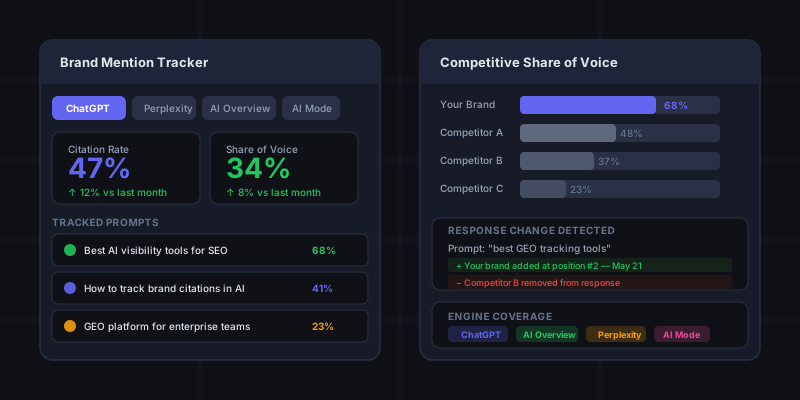
Citation rate is the baseline: how often your brand appears in AI responses to queries relevant to your category. A brand with a 30% citation rate is mentioned in roughly 3 out of every 10 relevant queries. This number alone doesn't tell you much — a brand being cited as "a basic option for small teams" with 50% citation rate is losing ground to a competitor with 20% citation rate but premium positioning.
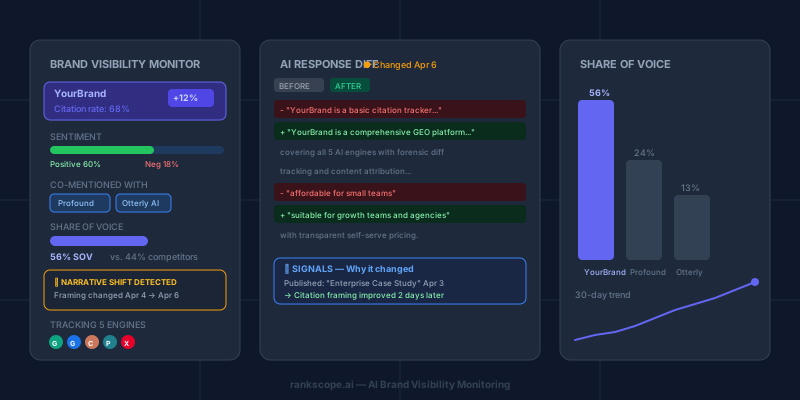
Framing and sentiment is where the real brand impact lives. "RankScope is a comprehensive GEO monitoring platform" and "RankScope is a basic citation tracker" are both citations. They are not equivalent. The language AI uses around your brand — the adjectives, the qualifiers, the use cases it associates with you — is your effective brand positioning in AI-generated responses.
Competitive co-mention reveals how AI has categorized you relative to the market. When AI mentions you, who else appears in the same response? If you're consistently co-cited with budget alternatives, AI has filed you in that tier. If you're mentioned alongside the category leaders, your positioning is better than you might think.
Share of voice is the competitive metric: of all brand mentions in your category across AI responses, what percentage belong to you versus competitors? Track this as a trend, not a snapshot — the direction matters more than the current number. For the full calculation methodology, see our guide on share of voice in AI search.
Step 1: Audit Your Current AI Brand Presence
You can't fix what you can't see. The first step is running a systematic audit of how AI engines currently characterize your brand. Do this before any content work — the audit tells you what to fix.
How to run a manual AI brand audit
Hit all three major engines: ChatGPT, Perplexity, and Google AI Overviews. For each engine, run queries across these four types:
| Query type | Example | What to look for |
|---|---|---|
| Best-in-category | "Best [your category] tool" | Are you cited? Where in the list? What language introduces you? |
| Direct comparison | "How does [your brand] compare to [key competitor]?" | Who's framed as the leader? What weaknesses are attributed to you? |
| Brand review | "[Your brand] review" or "Is [your brand] good?" | What's the overall sentiment? What objections does AI raise? |
| Use-case fit | "[Specific use case] tool" or "[Your ICP] using [your category]" | Do you appear for your target use cases? Or only general/adjacent ones? |
Take notes on the specific language used. Don't just record "yes, mentioned" — write down the exact framing. The words matter. "Affordable" and "cost-effective" read differently. "Good for small teams" and "scalable for growing businesses" are night-and-day for enterprise positioning.
Run each query 2–3 times, since AI responses vary. Note patterns, not just individual outputs.
Using SEO Review Tools for a quick baseline
The SEO Review Tools AI Brand Visibility Report runs automated queries across multiple engines and returns a snapshot report. It's free and takes about five minutes. Run it before your manual audit — it'll surface the most obvious characterization issues and help you focus your manual queries on the areas that need the most attention.
Why manual audits don't scale
Running 20 queries across three engines, twice a week, is roughly 120 manual checks per week. Multiply that across a competitive query set and you're looking at hours of work for a single data point — with no ability to track changes over time, no alerts when something shifts, and no way to attribute changes to specific content actions.
If you'd rather skip the manual work, an AI visibility checker runs the same prompts across four engines and returns the breakdown in about a minute. For ongoing improvement work, you need automated tracking. We'll get to that in Step 5. For now, the manual audit gives you the starting baseline.
Step 2: Identify Where Your Brand Narrative Is Broken
Most brands that run their first audit find at least one — usually several — broken narrative patterns. Here are the most common, what they look like in AI responses, and how to spot each:
| Broken narrative type | What it looks like | Why it happens | Fix |
|---|---|---|---|
| Outdated positioning | AI describes features or pricing from 12–24 months ago. Calls you an "early-stage tool" when you've scaled. | Training data lag. Your old content still dominates the training corpus. | Publish updated positioning content — feature pages, updated comparisons, current case studies — with explicit "as of [year]" framing. |
| Wrong tier positioning | Called "affordable alternative" or "entry-level option" when you're mid-market or enterprise. | Early-stage content, early pricing, early customer stories still dominant in training data. | Publish enterprise case studies, enterprise feature documentation, and comparison content that explicitly positions against premium tools. |
| Missing feature associations | AI doesn't mention your strongest differentiators when describing your brand. | Those features weren't prominent in early content, or the content about them lacks structure. | Publish dedicated feature pages and use-case content with the feature name prominent in H1s and early body copy. |
| Absent from high-intent queries | You appear in general category queries but not in specific "best for [use case]" queries your ICP is asking. | No use-case-specific content mapping your brand to those queries explicitly. | Build use-case content that names the query pattern directly: "RankScope for Enterprise Brand Teams," "RankScope for SEO Agencies." |
| Wrong competitor grouping | Consistently co-cited with tools you don't actually compete with, or lower-tier alternatives. | Co-citation patterns in training data established early, before you moved upmarket. | Publish comparison content that explicitly mentions premium competitors alongside your brand, rather than only budget tools. |
Identify which of these apply to your brand from your Step 1 audit. You probably have 2–3 of these patterns operating simultaneously. Prioritize by which one most directly undercuts your sales motion.
Step 3: Publish Content That Shapes the Narrative
AI engines respond to structured, authoritative, entity-rich content. The goal is to publish content that contains your intended brand positioning clearly enough, and from credible enough sources, that AI engines update their characterization of your brand over time.
This is the core of generative engine optimization applied to brand strategy.
The content types that move the needle
Comparison pages are the single highest-leverage format for AI brand positioning. When you publish "[Your Brand] vs. [Premium Competitor]" and frame yourself as the better choice for a specific use case or buyer type, AI engines pick up that framing — especially on RAG-based engines that retrieve live web content. These pages also do double duty: they serve both organic search and AI retrieval.
Write them with specificity. Not "RankScope is better than Profound." Instead: "For growth-stage SaaS teams that need AI citation monitoring without enterprise pricing, RankScope covers ChatGPT, Google AI Overviews, Perplexity, and Google AI Mode — at $49/mo versus Profound's $499/mo minimum." That sentence contains positioning, a specific use case, the competitor's name, and both price points. AI engines can pull that directly into a comparison response.
Use-case guides close the gap between your brand and specific high-intent queries. If your brand isn't appearing when someone asks "best AI brand visibility tool for agencies," the fix is a dedicated page — "AI Brand Visibility Monitoring for Agencies" — that contains that exact framing, names specific agency pain points, and makes your solution's fit for that context explicit.
Category explainers with explicit brand positioning establish your brand within the conceptual framework AI uses to categorize your space. A page that explains what AI brand visibility is, what the key dimensions are, and then positions your brand within that framework gives AI engines a well-structured reference to pull from when answering category questions.
Response-formatted FAQs are among the most direct ways to influence AI outputs. Write FAQ sections where the question exactly matches what someone might type into ChatGPT or Perplexity, and the answer contains your brand positioning naturally. "What's the best tool for tracking AI brand visibility?" as a question, followed by a substantive answer that includes your brand in context, is a retrievable unit that AI can surface.
Consistent positioning language across all content
Consistency matters as much as volume. If your homepage says "comprehensive GEO platform," your blog says "AI visibility tool," and your case studies say "brand monitoring software," AI engines get mixed signals about what you actually are. Pick your positioning language deliberately and use it consistently across every page on your site.
The terms AI uses to describe your brand are largely drawn from the most repeated and authoritative language in your content. Repetition is a signal. Use it intentionally.
What to avoid
Don't keyword-stuff or write for AI extraction in a way that reads as artificial — AI engines are trained on human-written text, and responses that feel like they were written to game the system often get lower retrieval weight. Write like you're explaining your positioning to a smart prospect, not writing a schema block.
Step 4: Build the Right Co-Citation Signals
How AI groups brands together matters as much as how it describes individual brands. Co-citation — the pattern of which brands appear together in AI responses — is a signal that shapes your category positioning.
How AI forms brand groupings
AI engines see patterns across enormous amounts of text. When a review site compares Tool A, Tool B, and Tool C together repeatedly, when analysts write about "the leading AI visibility platforms" and name the same three brands, when comparison articles cluster certain tools together — those patterns create a mental model of which brands belong in the same tier.
If most of the early content about your brand compared you to budget-tier tools, that co-citation pattern got baked into training data. Even if you've moved upmarket, AI may still be pulling from those older associations.
How to shift co-citation patterns
The most direct approach: publish comparison and competitive content that puts your brand next to the premium tools you want to be associated with. Not in a negative way — in a substantive "here's how these tools compare and where each fits" way. This content creates new co-citation signals.
When you publish "[Your Brand] vs. [Premium Competitor]" pages, write "[Your Brand] alternative to [Premium Competitor]" content, or include premium competitors in your own category explainers, you're creating text where your brand appears alongside those names in a relevant, authoritative context.
This works best when it's honest. If you're genuinely a strong alternative to a premium tool for a specific use case, write that case clearly. AI engines are good at synthesizing comparative language, and a well-written honest comparison carries more weight than an obviously promotional piece.
The co-mention tier test
Run this manually: ask ChatGPT "what are the leading tools for [your category]?" and see which brands appear in a typical response. Now ask "what are the enterprise options for [your category]?" and "what are the more accessible options for [your category]?" Check which list your brand appears on. That tells you exactly which tier AI has you in — and whether that matches your positioning intent.
If there's a gap, your comparison content should explicitly address it: "RankScope is designed for [target customer type] — here's how it compares to both enterprise options like Profound and entry-level alternatives."
Step 5: Track the Feedback Loop
Content without measurement is guesswork. After publishing positioning content, you need to track whether AI responses are actually shifting — and what's driving those shifts.
Why manual tracking doesn't work at scale
Say you're tracking 30 queries across 3 AI engines. That's 90 data points per check. Run that weekly and you have 360 data points per month — before any analysis of what changed, when, and why. Most teams run this check once a month if they're lucky, which means they're catching changes 3–4 weeks after they happen.
The practical problem: you need a large enough query set to get statistically meaningful signals, but running large query sets manually is unsustainable. And the most valuable insight — "the narrative shifted on this date, here's what changed" — requires a baseline to compare against, which manual checking rarely preserves properly.
What systematic AI brand tracking looks like
Good tracking answers three questions:
- What is the current characterization? — What language does each engine use to describe your brand in response to target queries?
- What changed? — Did the characterization shift since last check? In what direction?
- What triggered it? — Can the change be attributed to specific content you published, competitor activity, or external events?
The third question is where most manual approaches fall apart. Without automated diff tracking that timestamps changes and correlates them with your content calendar, attribution is guesswork.
Tools for systematic AI brand monitoring
RankScope automates citation monitoring across ChatGPT, Perplexity, and both of Google's AI surfaces, AI Overviews and AI Mode. The forensic diff tracking feature is specifically designed for the "what changed and when" question — it timestamps characterization shifts automatically so you can correlate them with content actions. Signals connects content publication events to visibility changes. Pricing starts at $49/mo, with no setup fee and cancel anytime. For a full breakdown of what it does and how to set up tracking, see track brand mentions in AI search.
Profound ($499/mo+) handles enterprise-scale query volumes with deeper sentiment NLP. If you're running thousands of queries per month across a large competitor set, Profound's data depth is worth the price. For most teams, the cost is hard to justify when RankScope covers the core use cases at a fraction of the price.
Otterly covers ChatGPT, Perplexity, and Google AI Overviews and has a clean dashboard that works well for stakeholder reporting. Lighter on sentiment analysis than RankScope but good for teams that primarily need citation trend data. For a comparison, see our Otterly alternative breakdown.
Evertune is purpose-built for AI sentiment monitoring — it's particularly strong at detecting subtle narrative drift over time. Enterprise pricing, no self-serve. Best for large consumer brands where AI reputation monitoring is a board-level concern.
For a full comparison of available tools, see the best GEO tools roundup.
How Long Does It Take?
This is the question every brand team asks, and the honest answer is: it depends on the engine type and what you're trying to change.
RAG-based engines: 2–4 weeks
Perplexity, and increasingly Google AI Overviews and AI Mode, use retrieval-augmented generation — they pull live web content to supplement their responses. This means content you publish today can start influencing responses within 2–4 weeks, once it's indexed and being retrieved.
Comparison pages and FAQ content tend to move fastest in RAG-based systems because they're structured to answer specific questions — exactly what the retrieval layer is looking for.
Training-data-based characterizations: 1–3 months
ChatGPT's core characterizations of brands are shaped more by training data than real-time retrieval, which means changes take longer. When OpenAI updates its models with fresh training data, your newer content gets absorbed — but that process plays out over months, not weeks.
Publishing high-quality, authoritative content consistently still matters here. Models prioritize well-structured, entity-rich content that appears across multiple credible sources. A single blog post won't move a training-data characterization; a coordinated content push across your site, with third-party coverage reinforcing the same positioning, moves faster.
A realistic 90-day improvement arc
Weeks 1–2: Audit your AI brand presence across engines. Identify the 2–3 broken narrative patterns causing the most positioning damage. Build a content list: which comparison pages, use-case guides, and FAQ content to publish.
Weeks 3–6: Publish the first wave of positioning content. Start tracking with a monitoring tool so you have a baseline. Expect to see early movement in Perplexity and Google AI Overviews as RAG-based retrieval picks up the new content.
Weeks 6–12: Continue publishing. Track changes systematically. By week 8–10, most RAG-based characterization improvements should be visible. ChatGPT and training-data-heavy characterizations start shifting in this window if content volume and quality are high.
Month 4+: At this point, the feedback loop is visible. You can see which content types moved which engines, which query types responded fastest, and where the remaining gaps are. Ongoing work becomes more targeted — specific queries, specific engines, specific competitor comparisons that still need addressing.
The brands that see the fastest improvement are those publishing consistently across the full 90 days while tracking changes in parallel — not waiting for "the content" to work before they check whether it did.
AI Brand Visibility Tools
If you're building the infrastructure to track and improve AI brand visibility, here are the four tools worth knowing about. (For the full deep-dive on monitoring tools specifically, see our AI brand monitoring tools guide.)
RankScope
RankScope is built specifically for teams that want to monitor and improve AI brand visibility — not just observe. It covers ChatGPT, Google AI Overviews, Perplexity, and Google AI Mode, with forensic diff tracking that flags characterization changes automatically. The Signals feature connects content publication events to visibility shifts, giving you attribution data you can actually act on.
Pricing: Starter $49/mo, Pro $149/mo, Agency $399/mo. No free trial, no setup fee, cancel anytime.
Otterly
Otterly covers ChatGPT, Perplexity, and Google AI Overviews with a clean dashboard designed for reporting citation trends to stakeholders. Good for teams that primarily need to track and report AI citation performance. Lighter on sentiment and narrative analysis. Starts around $99/mo.
Profound
Profound is the enterprise-grade option for high-volume brand intelligence. It handles large competitor sets with deep sentiment NLP and advanced reporting infrastructure. Pricing starts at $499/mo and scales. Sales demo required. Best suited for Fortune 500 brands with dedicated brand intelligence teams.
Evertune
Evertune is purpose-built for AI sentiment and narrative monitoring — specifically designed to detect subtle tone and characterization shifts over time that citation trackers miss. Custom pricing, enterprise tier, sales process required. Strong fit for consumer brands and public companies where AI reputation is a board-level concern.
FAQ
How do I audit my current AI brand visibility for free?
Run manual queries across ChatGPT, Perplexity, and Google AI Overviews using the four query types described in Step 1: best-in-category queries, direct comparisons, brand review queries, and use-case fit queries. The SEO Review Tools AI Brand Visibility Report automates a basic version of this for free. Manual audits give you a starting point but don't scale — for ongoing tracking, a monitoring tool is necessary.
How is improving AI brand visibility different from regular SEO?
Traditional SEO optimizes for Google's ranking algorithm — keyword relevance, backlink authority, page experience signals. AI brand visibility improvement targets how AI language models characterize your brand in synthesized responses. The content tactics overlap (structured content, entity-rich language, topical authority), but the objectives are different: you're not trying to rank for a keyword, you're trying to ensure that when an AI generates an answer about your category, it describes your brand accurately and favorably. See our guide on generative engine optimization for the full framework.
Why does AI describe my brand differently across different engines?
Each engine has different training data, different retrieval mechanisms, and different response generation approaches. ChatGPT, Perplexity, and Google AI Overviews have pulled from different content corpora at different points in time — and they weight sources differently. It's common for a brand to be well-positioned in Perplexity (which leans heavily on current web retrieval) while still being described with outdated positioning in ChatGPT. That's why monitoring across all engines matters: each engine is a separate data point, and improving one doesn't automatically improve the others.
What if AI keeps describing my brand incorrectly even after I've published new content?
Check whether the new content is being indexed and retrieved. For RAG-based engines like Perplexity, you can often verify this by seeing whether a direct query surfaces your new page. For training-data-based characterizations, persistence suggests the old content still dominates — which usually means either the volume of new content is insufficient, or the new content isn't structured in a way that AI retrieval weights highly. Revisit the content format: response-formatted FAQs, comparison pages, and use-case guides tend to outperform long-form narrative content for AI retrieval purposes. Also check whether the old characterization is being reinforced by third-party sources (review sites, analyst posts) that you haven't addressed.
How much does improving AI brand visibility cost?
The content work costs time — typically 2–4 pieces per month for a focused improvement campaign, handled by an in-house content team or an agency. Monitoring tools run from $49/mo (RankScope Starter) to $499/mo+ (Profound) depending on the scale and depth you need. Most growth-stage teams start with RankScope's Starter plan and expand based on what the data shows. No setup fee · Cancel anytime.
The Bottom Line on AI Brand Visibility Improvement
AI engines have already formed opinions about your brand. Some of those opinions are accurate and favorable. Some are outdated. Some are subtly wrong in ways that are quietly undermining your positioning with every buyer who asks an AI question about your category.
The process to fix this is straightforward, even if the execution takes time: audit where you are now, identify what's broken, publish content that corrects the narrative, and track the feedback loop systematically.
What separates brands that improve their AI characterization from those that don't isn't access to secret tactics — it's consistency. Publishing the right content types regularly, monitoring changes as they happen, and adjusting based on what the data shows.
Start with the audit. Run your brand through ChatGPT and Perplexity today, use the query types in Step 1, and read what comes back. Most teams are surprised. What you find will tell you exactly where to start.
Get started with RankScope →
No setup fee · Cancel anytime · From $49/mo