Best GEO Tools in 2026: Ranked & Compared
The GEO tools category didn't really exist three years ago. Now there are a dozen platforms competing for the same buyer — and the quality gap between them is significant.
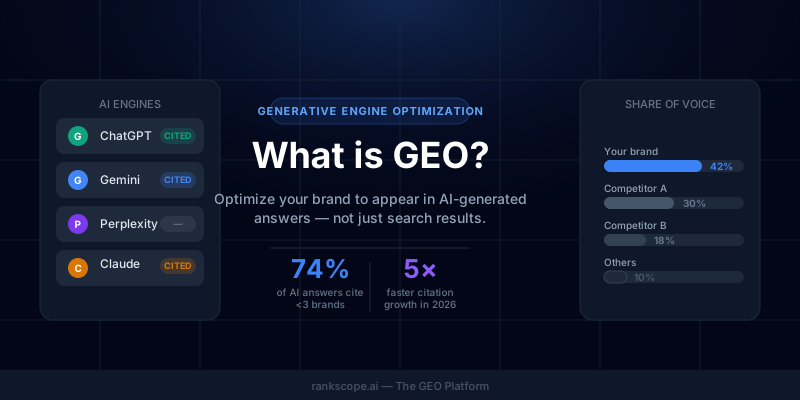
Generative Engine Optimization is the practice of getting your brand cited in AI-generated answers, not just ranked in Google. As ChatGPT, Google AI Overviews, Perplexity, and Google AI Mode handle more and more of the queries your buyers are asking, showing up in those answers matters more than it used to. And you can't optimize for something you're not measuring.
That's what this category is for. This guide covers 9 of the best GEO tools in 2026 — with real pricing, honest pros and cons, and a comparison table you can actually use. No affiliate fluff, no vague summaries. If a tool has meaningful limitations, we'll tell you.
What Makes a Good GEO Tool?
Before the list, here's what separates the tools worth paying for from the ones that aren't.
Engine coverage
There are five AI engines that collectively handle the vast majority of AI search queries: ChatGPT, Google Gemini, Anthropic Claude, Perplexity, and Grok. Citation patterns differ across them — a brand that gets recommended consistently in ChatGPT responses can be entirely absent from Google AI Overviews. RankScope specifically tracks the 4 engines most important for brand visibility: ChatGPT, Google AI Overviews, Perplexity, and Google AI Mode. A GEO tool that only tracks one or two engines is giving you a partial picture.
Check coverage before anything else. "AI visibility tracking" that only covers ChatGPT is like an SEO rank tracker that only shows mobile rankings.
Forensic diff detection
This is the feature that separates serious GEO platforms from lightweight monitors. AI responses change — a competitor gets added, your brand gets dropped, the sentiment shifts. Knowing that something changed isn't enough. Forensic diff detection shows you what changed and when, so you can correlate response shifts with your content activity and understand what's actually working.
Content optimization vs. monitoring only
Some GEO tools stop at measurement: here's your citation rate, here's your share of voice, here's a chart. Others go further — they analyze why you're not being cited and give recommendations for what to fix. If you're actively doing GEO work (not just reporting on it), tools with optimization guidance save a lot of guesswork.
Pricing transparency
A frustrating number of GEO tools require a sales demo before they'll tell you what they charge. That's a legitimate business model, but know what it means: you're buying enterprise software with a sales team involved, and the price will reflect it. For most growth-stage teams, self-serve tools with transparent pricing are the right fit.
GEO Tools Comparison Table
| Tool | Best For | Pricing | Engine Coverage | Free Trial |
|---|---|---|---|---|
| RankScope | Most teams — best multi-engine coverage | $49–$399/mo | ChatGPT, Google AI Overviews, Perplexity, Google AI Mode | No setup fee |
| Geoptie | Content teams wanting optimization + tracking | ~$79/mo | ChatGPT, Perplexity | Yes |
| Otterly.AI | Mid-market teams, clean reporting | ~$99/mo | ChatGPT, Perplexity, Gemini | Yes (limited) |
| Rankscale.ai | Enterprise share-of-voice benchmarking | Custom | ChatGPT, Perplexity, Gemini | Demo only |
| Profound | Large enterprises needing maximum data depth | $499/mo+ | ChatGPT, Google AI Overviews, Perplexity, and Google AI Mode | Demo only |
| Peec AI | Budget-conscious teams and solo operators | Free; paid from ~$29/mo | ChatGPT, Perplexity | Free tier |
| AthenaHQ | AI citation intelligence + content strategy | Custom | ChatGPT, Perplexity, Gemini | Demo only |
| Writesonic GEO | Teams creating GEO-optimized content at scale | Bundled with Writesonic | ChatGPT, Perplexity, Gemini | Free tier |
| SE Ranking AI | Agencies wanting SEO + AI in one platform | From $65/mo | ChatGPT, Perplexity | 14 days |
The 9 Best GEO Tools in 2026
1. RankScope
RankScope is a purpose-built GEO platform that covers ChatGPT, Google AI Overviews, Perplexity, and Google AI Mode. It's the best self-serve tool at this price point with that breadth of coverage.
The forensic diff tracking is the feature worth highlighting: it stores full AI response text and flags changes with timestamps, so when an AI shifts its recommendation (or drops your brand from an answer it used to include you in), you see exactly what changed. Most competitors show you aggregated metrics; RankScope shows you the actual text.
The Signals feature takes it a step further — it correlates your content publishing and optimization activity with shifts in citation rates, giving you a basic attribution model for GEO work. That's something most teams have had to cobble together in spreadsheets before.
Key features:
- ChatGPT, Google AI Overviews, Perplexity, and Google AI Mode tracked in one dashboard
- Forensic diff tracking with full response history
- Signals: correlate content changes with citation rate shifts
- Citation rate, share of voice, and sentiment metrics
Pricing: $49/mo (Starter), $149/mo (Pro), $399/mo (Agency). Annual discounts available.
Get started: No setup fee · cancel anytime.
Pros:
- Broadest engine coverage of any self-serve tool in the category
- Forensic diffs make real GEO optimization work possible — not just monitoring
- Transparent pricing; no sales call required
- Accessible entry price for what you get
Cons:
- Newer platform — some enterprise features (white-label reports, SSO, API access) are still in development
- Signals feature takes a few weeks of data to become meaningful
- Smaller team than some established competitors
Best for: Growth teams, SEO and GEO practitioners, and any brand that wants serious AI visibility tracking across the 4 major AI search surfaces without enterprise pricing.
2. Geoptie
Geoptie is the most content-focused GEO tool on this list. Where most platforms are primarily monitoring tools with some optimization guidance bolted on, Geoptie inverts that — content optimization is central, with tracking built around it.
The pitch: Geoptie scores your pages for GEO readiness, shows you exactly why certain pages aren't getting cited, and gives you structured recommendations for how to fix them. Templates help content teams act on the feedback without needing to deeply understand GEO mechanics. For teams that need to improve citation rates across a lot of pages quickly, that's genuinely useful.
Tracking coverage is narrower — primarily ChatGPT and Perplexity — and the monitoring depth isn't as sophisticated as RankScope or Profound. Geoptie is the right choice if your main bottleneck is content quality rather than measurement.
Key features:
- GEO content scoring and readiness analysis
- Specific, structured optimization recommendations per page
- Citation tracking across ChatGPT and Perplexity
- Content templates optimized for AI citation formats
Pricing: Around $79/mo for entry-level plans.
Free trial: Yes.
Pros:
- Best-in-class content optimization guidance in the GEO tools category
- Helps content teams translate GEO theory into specific page improvements
- More affordable than enterprise options
- Good for teams new to GEO who need actionable guidance, not just data
Cons:
- Engine coverage is limited (primarily ChatGPT and Perplexity)
- Tracking depth is thinner than dedicated monitoring tools
- Smaller product team; feature velocity slower than well-funded competitors
Best for: Content-heavy teams and SEOs who want to actively improve GEO-readiness at the page level, not just track citation rates.
3. Otterly.AI
Otterly.AI is one of the better-known names in the GEO tools space, and for good reason — the UX is genuinely clean and the dashboard is easy to present to stakeholders who aren't deep in GEO. Coverage spans ChatGPT, Perplexity, and Gemini.
Where Otterly falls short relative to RankScope is depth. There's no forensic diff tracking, Google AI Overviews and Google AI Mode aren't covered, and the data you get is more surface-level than you'd need for serious optimization work. For teams where the primary use case is reporting AI visibility to leadership — rather than actively moving the numbers — those limitations matter less.
Key features:
- AI citation monitoring across ChatGPT, Perplexity, and Gemini
- Clean, presentation-ready dashboard
- Keyword-level citation tracking with trend views
- Brand monitoring and mention alerts
Pricing: Around $99/mo for small teams; scales with keyword volume.
Free trial: Yes (limited).
Pros:
- Best-in-class UX — genuinely the easiest to use in the category
- Good for sharing AI visibility data with non-technical stakeholders
- Solid trend views and citation change tracking
Cons:
- No Google AI Overviews or Google AI Mode coverage
- No forensic diff detection — you see that something changed, not what
- Per-keyword pricing can scale up quickly for larger keyword sets
- Optimization guidance is limited
Best for: Mid-market marketing teams that prioritize clean reporting and don't need forensic-level analysis. If you're comparing Otterly specifically against RankScope, our Otterly AI alternative breakdown covers the full head-to-head.
4. Rankscale.ai
Rankscale.ai is built around competitive share of voice in AI search — specifically, how often your brand appears relative to competitors across a defined set of queries. It's enterprise-oriented, with a sales process, custom contracts, and pricing that reflects that structure.
The share-of-voice focus makes it genuinely well-suited to competitive intelligence work. If your main question is "how does our AI visibility compare to [competitor X] across these 500 queries?" — Rankscale handles that better than most tools. The API access also appeals to enterprise teams that want to pull AI visibility data into custom dashboards or BI tooling.
Key features:
- Competitive share of voice tracking across ChatGPT, Perplexity, and Gemini
- Side-by-side brand comparison and competitive benchmarking
- Enterprise reporting and API access
- Custom keyword set management at scale
Pricing: Custom; demo required. Enterprise-tier pricing.
Free trial: Demo only.
Pros:
- Best competitive share-of-voice analysis in the GEO tools category
- API access for custom integrations and dashboards
- Enterprise-grade support and SLAs
Cons:
- No self-serve option — requires a sales conversation before you can see pricing
- Narrower engine coverage than RankScope
- Expensive and overkill for most growth-stage teams
- Features beyond benchmarking are less developed than dedicated monitoring tools
Best for: Enterprise teams doing competitive AI visibility benchmarking across large keyword sets, where a sales process and custom contracts are normal.
5. Profound
Profound is the enterprise anchor in this category — $499/mo minimum, demo required, and genuinely impressive data quality to justify it. Coverage includes ChatGPT, Google AI Overviews, Perplexity, and Google AI Mode. The query volumes Profound runs are significantly higher than what mid-market tools do, which surfaces patterns in AI response behavior that lower-frequency tools miss.
For a Fortune 500 brand or large agency where AI search visibility shifts can have material revenue impact, the investment is defensible. For most companies, it isn't — you're paying for infrastructure and query depth you don't need.
Key features:
- High-volume query tracking across ChatGPT, Google AI Overviews, Perplexity, and Google AI Mode
- Sentiment analysis and contextual citation tracking in AI responses
- Enterprise reporting infrastructure, SSO, and team management
- Deep competitive benchmarking at scale
Pricing: $499/mo minimum; most enterprise contracts are significantly higher.
Free trial: Demo only.
Pros:
- Among the deepest data in the GEO tools category
- Strong on sentiment and contextual analysis
- Enterprise-grade infrastructure, security, and support
- Good for large brands where response quality data (not just citation rate) matters
Cons:
- Starting price ($499/mo) is out of reach for most teams
- Requires a sales demo before seeing the product
- Overkill for any team without a dedicated GEO function and high query volumes
- No self-serve; procurement process required
Best for: Large enterprise brands with meaningful budget, a dedicated GEO or SEO team, and a use case that justifies the data depth Profound provides.
6. Peec AI
Peec AI is the most accessible entry point in the GEO tools space. A real free tier — not a time-limited trial, actually free — with citation monitoring for ChatGPT and Perplexity. Paid plans start around $29/mo.
The trade-off is depth. Peec AI does citation tracking competently, but it doesn't have forensic diff detection, the engine coverage is limited to two platforms, and the reporting interface isn't suitable for client-facing or executive presentations. For a small team getting started with AI visibility tracking, it's a legitimate option. For serious GEO optimization work, you'll outgrow it quickly.
Key features:
- Permanent free tier with citation monitoring
- Citation tracking for ChatGPT and Perplexity
- Keyword-level AI mention alerts and trend views
- Simple, low-learning-curve setup
Pricing: Free tier (permanent, limited); paid plans from approximately $29/mo.
Free trial: Free tier available with no time limit.
Pros:
- Most accessible option in the category — free tier is genuinely usable
- Very fast setup; good starting point for teams new to GEO
- Low cost makes it reasonable for budget-constrained teams
- Useful for testing whether AI visibility tracking matters for your keywords before committing budget
Cons:
- Limited to ChatGPT and Perplexity — misses Gemini, Claude, and Grok
- No forensic diff tracking
- Basic reporting; not suitable for stakeholder presentations or agency reporting
- Feature development slower than well-funded competitors
Best for: Small teams, solopreneurs, and early-stage companies testing the waters with GEO before committing to a paid tool. Our Peec AI alternative comparison covers the head-to-head against RankScope in detail.
7. AthenaHQ
AthenaHQ sits between pure monitoring and content intelligence — the platform combines citation tracking with AI-native content strategy recommendations. It covers 8+ AI engines including ChatGPT, Perplexity, Google AI Overviews, Google AI Mode, Gemini, Claude, Copilot, and Grok. The content analysis goes deeper than most tools: AthenaHQ analyzes why specific content is being cited and generates structured guidance for how to build topical authority in AI search.
Self-serve access starts at $295/month (first-month promotional discount available). The product is genuinely strong — rated 4.9/5 on G2 in Spring 2026 — but that price point puts it out of reach for startups and growth teams. For teams evaluating AthenaHQ against more accessible alternatives, see our full AthenaHQ alternative breakdown.
Key features:
- Citation tracking across ChatGPT, Perplexity, and Gemini
- AI content intelligence — analysis of why specific content earns citations
- Topical authority mapping and content strategy recommendations
- Competitive citation analysis
Pricing: Custom; demo required.
Free trial: Demo only.
Pros:
- Unique angle: content intelligence, not just monitoring
- Useful for teams building long-term topical authority in AI search
- Solid competitive citation analysis
Cons:
- No Grok or Claude coverage
- No self-serve; pricing hidden behind sales process
- Newer platform with less established track record than Profound or RankScope
- KD for "athenahq alternative" is near zero — meaning not many people are shopping it yet
Best for: Teams that want a deeper content strategy layer alongside their citation tracking, and are comfortable with a sales-led evaluation process.
8. Writesonic GEO
Writesonic is primarily a content creation platform — GEO is its extension into the optimization and measurement space. The core value proposition is create-and-measure: write AI-optimized content in Writesonic, then track whether it's getting cited.
For pure GEO monitoring, Writesonic isn't the right tool. The tracking is a secondary feature and the depth shows it. But if your bottleneck is producing GEO-optimized content at scale and you're already using Writesonic for writing, the bundled tracking reduces the number of tools you need to manage.
Key features:
- GEO-optimized content generation with built-in citation tracking
- Coverage of ChatGPT, Perplexity, and Gemini
- Content scoring for GEO citation potential
- Integrated workflow from content creation to performance tracking
Pricing: Bundled with Writesonic plans; free tier available. Check current pricing as it changes frequently.
Free trial: Free tier available.
Pros:
- Tight integration between content creation and GEO tracking
- Useful for teams producing high volumes of AI-optimized content
- Writesonic's content generation tools are genuinely strong
- Free tier available
Cons:
- GEO tracking is clearly a secondary feature — dedicated tools do it better
- Limited value if you're not using Writesonic for content creation
- Tracking depth is shallower than purpose-built GEO tools
- Feature development driven by content priorities, not GEO monitoring needs
Best for: Content teams using Writesonic for writing who want basic GEO tracking built into their existing workflow without adding another tool.
9. SE Ranking AI Toolkit
SE Ranking is a full-service SEO platform that added AI visibility monitoring as a module. Like Ahrefs Brand Radar, the value is consolidation — traditional SEO rank tracking, backlink monitoring, and basic AI citation tracking in a single platform.
The AI tracking covers ChatGPT and Perplexity and works reasonably well for keyword-level citation monitoring. SE Ranking's white-label reporting is genuinely useful for agencies. The limitation is the same as most hybrid tools: AI visibility is a secondary feature, and when you compare it to dedicated GEO tools on depth of diff tracking and engine coverage, it falls short.
Key features:
- AI citation tracking (ChatGPT, Perplexity) alongside full traditional SEO toolset
- Keyword rank tracking, backlink analysis, site audit, and AI visibility in one platform
- White-label reporting for agencies
- No credit card required
Pricing: Plans from approximately $65/mo; AI features included on mid-tier and above plans.
Free trial: 14 days.
Pros:
- Good value if you're paying for SEO tools anyway — no extra budget line
- White-label reports are useful for agency use cases
- Solid traditional SEO tools surrounding the AI module
- Self-serve with transparent pricing
Cons:
- AI visibility module is noticeably thinner than dedicated GEO tools
- No Gemini, Claude, or Grok coverage
- Not ideal when AI visibility is the primary focus
- GEO features get less investment than the core SEO product
Best for: Agencies and growth teams that want traditional SEO plus basic AI visibility monitoring in a single tool — particularly if white-label reporting matters. For a full breakdown of SE Ranking's AI module limitations and the best dedicated alternatives, see Best SE Ranking Alternative for AI Visibility.
How to Choose the Right GEO Tool
You're just getting started with GEO
Start with Peec AI's free tier or RankScope (no setup fee). Run your most important queries across ChatGPT and Perplexity, see what citation rate you actually have, and decide whether investing in monitoring makes sense for your business. If it does, RankScope at $49/mo covers ChatGPT, Google AI Overviews, Perplexity, and Google AI Mode and gives you real data to optimize from.
Read what is generative engine optimization first if you need to build the business case internally — it explains the discipline clearly without the jargon.
You need to actively improve citation rates, not just monitor
RankScope for the tracking and diff detection, paired with Geoptie if your bottleneck is actually producing GEO-optimized content. The combination of forensic monitoring (RankScope) and content optimization guidance (Geoptie) covers both sides of the work. See what GEO vs SEO vs AEO covers to understand how GEO optimization differs from what you're probably already doing.
You're running an agency managing multiple client brands
RankScope Agency ($399/mo) for the citation tracking depth, or SE Ranking if white-label reporting and consolidated SEO + AI in one platform is the priority. Multi-client management is an important factor at agency scale — tools designed for single brands become unwieldy fast. The RankScope for agencies page covers the multi-client workspace and white-label features specifically. See the complete GEO for agencies guide for the full playbook on packaging AI citation tracking as a client service, including pricing structures and reporting templates.
You're at an enterprise with a dedicated GEO team
Profound for maximum data depth on citation tracking and sentiment. Rankscale.ai if competitive share-of-voice benchmarking across large keyword sets is the primary use case. For enterprise teams that want depth without full enterprise pricing, RankScope Pro still performs well up to significant keyword volumes.
If your priority is not just citation tracking but understanding how AI characterizes your brand — sentiment, framing, narrative shifts — see our dedicated guide to AI brand visibility tools which goes deeper on that dimension.
FAQ
What are GEO tools?
GEO tools (Generative Engine Optimization tools) are platforms built to track, measure, and improve brand visibility in AI-generated answers. They send automated queries to AI engines like ChatGPT, Google AI Overviews, Perplexity, and Google AI Mode, parse the responses, and tell you whether your brand was cited — and in what context.
Unlike traditional SEO tools that measure keyword rankings on Google, GEO tools measure citation rate (what percentage of relevant queries include your brand), share of voice (your mentions as a percentage of all citations in your category), and sentiment (whether citations characterize your brand positively, negatively, or neutrally). For a full breakdown of GEO terminology, the RankScope GEO glossary covers every relevant term.
How much do GEO tools cost?
The range is wide. Peec AI has a permanent free tier. RankScope starts at $49/mo (Starter) and goes to $399/mo (Agency). Mid-market tools like Otterly.AI ($99/mo) and Geoptie ($79/mo) fall in between. Enterprise platforms like Profound ($499/mo+), Rankscale.ai, and AthenaHQ require a sales demo and custom contracts.
For most growth-stage companies, $49–$99/mo covers everything you need. Enterprise pricing is only justified when you're running high query volumes, need advanced competitive benchmarking, or require enterprise-grade SLAs and support.
Do I need a GEO tool if I already have an SEO tool?
If AI search visibility matters for your business — yes. Traditional SEO tools track Google rankings and backlinks. They don't capture whether ChatGPT is recommending your product this week, whether your Perplexity citation rate has dropped, or how your share of voice in AI-generated answers compares to competitors. Some platforms (Ahrefs Brand Radar, SE Ranking AI Toolkit) have added basic AI tracking modules, but these are secondary features with less depth than dedicated GEO tools. If AI visibility is a real priority, a dedicated tool is worth the additional cost. For a breakdown of what Ahrefs Brand Radar covers and where it falls short specifically, see Best Ahrefs Alternative for AI Brand Visibility. For Semrush specifically, see Best Semrush Alternative for AI Search Visibility.
Which GEO tool tracks the most AI engines?
RankScope tracks the 4 major AI engines it supports — ChatGPT, Google AI Overviews, Perplexity, and Google AI Mode. Profound covers all five engines comprehensively. Most other tools cover two or three — typically ChatGPT and Perplexity, sometimes Gemini. Engine coverage matters: citation patterns vary significantly across AI platforms, and a brand that dominates ChatGPT responses can be entirely absent from Google AI Overviews.
Bottom Line
GEO tools are no longer optional for brands that compete in spaces where buyers ask AI for recommendations — which, at this point, includes nearly every B2B software category, professional services, and a growing number of consumer verticals.
The right tool depends on what you're trying to do:
- Best overall: RankScope — widest engine coverage, forensic diffs, most actionable for real GEO work
- Best for content teams: Geoptie — optimization guidance that helps you actually fix what's wrong
- Best for budget: Peec AI (free) or RankScope Starter ($49/mo)
- Best for enterprise: Profound (data depth) or Rankscale.ai (competitive benchmarking)
- Best for SEO + AI in one tool: SE Ranking AI Toolkit
If you're not sure where to start, RankScope's $49/mo Starter, or $39/mo billed annually, plan covers ChatGPT and Google AI Overviews (all four engines on Pro). Run it for two weeks across your core queries and you'll have real citation data to work from, and a clear picture of whether AI visibility is a gap worth closing for your brand.
Note: GEO tools (covered on this page) focus specifically on AI search citation tracking. If you also need traditional social media and web listening, see our complete comparison of AI brand monitoring tools which covers both categories.
If you'd prefer a breakdown of GEO tools organized by use case — tracking, content optimization, audit, and reporting — rather than a ranked list, see our complete GEO tools comparison by use case.
If you're also evaluating GEO agencies and consultants alongside tools, see our full roundup of generative engine optimization companies — it covers who's operating in the GEO space and how to decide between tools, agencies, and consultants.