Best Ahrefs Alternative for AI Brand Visibility in 2026
Let's get one thing out of the way: Ahrefs is genuinely excellent. If you're doing serious backlink analysis, keyword research, technical audits, or tracking keyword rankings at scale, Ahrefs has earned its reputation. The link index is one of the most comprehensive available, the keyword data is solid, and the platform's depth is hard to match in traditional SEO.
This post isn't about replacing Ahrefs.
It's about something Ahrefs' Brand Radar — their AI visibility feature — doesn't fully cover, and why that gap matters more in 2026 than it did even a year ago. AI search engines now handle a meaningful share of informational and commercial queries. ChatGPT, Google AI Overviews, Perplexity, and Google AI Mode are generating brand mentions, making product recommendations, and shaping buying decisions — all outside the traditional search results that Ahrefs was built to track.
Brand Radar is Ahrefs' answer to this. It's a real feature with real utility — particularly for existing Ahrefs users who want a quick read on AI visibility without signing up for a new platform. But it's a feature, not a platform. And the gaps between "bundled feature" and "dedicated AI visibility layer" are what this post is about.
What Is Ahrefs AI Visibility? (Brand Radar, Explained)
If you've landed here wondering what Ahrefs actually offers for AI search visibility — here's the short version before we get into alternatives.
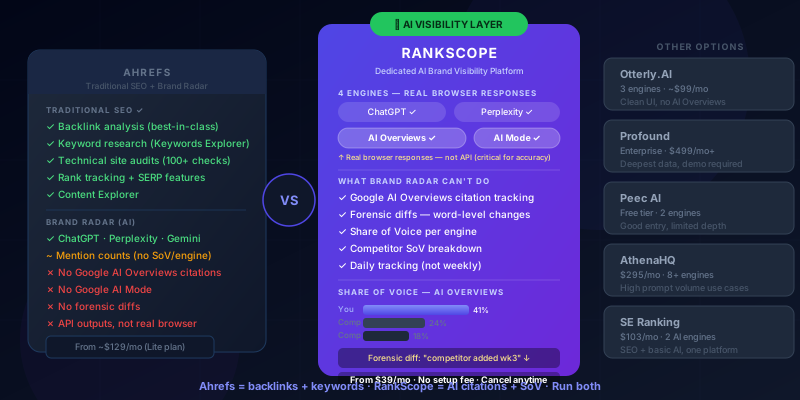
Ahrefs' AI visibility product is called Brand Radar. It's not a standalone tool — it's a feature bundled into existing Ahrefs plans (Lite and above, starting at ~$129/month). Brand Radar tracks how often your brand is mentioned in AI-generated responses across ChatGPT, Perplexity, and Gemini.
What it shows you:
- Brand mention counts over time across the three covered engines
- Which prompts and query types trigger mentions
- Basic trend data for citation rate
- How your mention frequency compares to a set of competitors
What it doesn't cover:
- Google AI Overviews — the AI surface with the highest search volume impact, because AI Overviews appear on ~15–20% of all US Google queries
- Google AI Mode — the full AI-first search interface expanding across Google
- Real browser responses — Brand Radar queries via API, not live browser sessions; for Google AI surfaces especially, API outputs and real browser responses diverge
- Forensic diffs — no before/after comparison of the actual AI response text when your citation rate changes
- Engine-level Share of Voice — blended metrics rather than per-engine competitive SoV
The bottom line on Ahrefs AI visibility: Brand Radar is a solid starting point for an Ahrefs subscriber who wants a quick read on AI citation presence without adding a new tool. It's not a dedicated AI visibility platform and isn't designed to be. If your team treats AI search visibility as a primary objective rather than an occasional check, you'll outgrow Brand Radar quickly — and the alternatives below are where teams typically land when that happens.
What Ahrefs Does Well (The Honest Version)
Before the alternatives, here's what Ahrefs actually does well — because knowing its strengths clarifies what you're actually shopping for when you look at the AI visibility gaps.
Backlink analysis. Ahrefs' link index is arguably the best in the business for crawl frequency and accuracy. The domain rating metric, broken link discovery, link velocity tracking, and backlink gap analysis are genuinely class-leading. Teams that invest in link building need Ahrefs or something that can go toe-to-toe with it.
Keyword research. The Keywords Explorer database is comprehensive, with solid volume estimates, keyword difficulty scores, and traffic potential calculations. The "Traffic Potential" metric — which estimates how much traffic the top-ranking page gets across all related keywords, not just the exact match — is a particularly useful planning tool.
Content Explorer. Ahrefs' Content Explorer lets you find the best-performing content for any topic or keyword, filtered by links, traffic, domain rating, and more. For content gap research and spotting what's earning citations in traditional search, it's hard to beat.
Technical site audits. The Ahrefs Site Audit tool covers over 100 technical issues, crawl budget problems, and performance bottlenecks. It's thorough and fast for most site sizes.
Rank tracking. Keyword Rank Tracker handles large keyword sets with regular updates and clean reporting. Position history, SERP feature tracking, and share-of-voice metrics (for traditional search) are all well-implemented.
Brand Radar. The AI visibility layer Ahrefs added. Brand Radar monitors brand mentions across ChatGPT, Perplexity, and Gemini. For an Ahrefs subscriber who hasn't added a dedicated AI visibility tool yet, this is genuinely useful as a starting point.
Where it stops: Brand Radar doesn't cover Google AI Overviews at the brand citation level, doesn't include Google AI Mode, doesn't use real browser responses for accuracy, and doesn't offer forensic diffs or engine-level Share of Voice analysis. More on exactly what those gaps cost you below.
What Ahrefs Brand Radar Misses
Brand Radar is a better starting point than most Ahrefs users realize — but it has real limits that matter once you're actively managing AI visibility rather than just checking it occasionally.
1. Google AI Overviews — the most important channel it skips
Google AI Overviews appear at the top of Google results for roughly 15-20% of all US searches, according to multiple 2025-2026 industry studies. They're not a fringe feature — they're a mainstream search surface that's reshaping what gets traffic and what doesn't.
Brand Radar does not track your brand's presence in Google AI Overviews at the citation level. It covers ChatGPT, Perplexity, and Gemini. For brands where Google search is still the dominant inbound channel, leaving Google AI Overviews untracked means you're missing your most important AI visibility surface entirely.
2. Google AI Mode — the full AI-first search interface
Google AI Mode is the complete AI-first search experience, available to an expanding segment of Google users. It blends conversational AI responses with traditional organic results. Brand Radar doesn't cover it. If your ICP skews toward tech-forward users who've adopted AI Mode, this is a meaningful blind spot.
3. API outputs versus real browser responses
This one is technical but consequential. Brand Radar — like most AI visibility tools that aren't purpose-built for accuracy — pulls data via API. Google's AI Overviews especially don't behave consistently through API calls the way they do in a real browser session. Google personalizes, tests, and continuously updates AI Overviews in ways API queries don't capture.
Real browser responses — pulling what an actual Chrome user sees in an actual search — give you an accurate picture of what your customers actually encounter. Tools that use API outputs can show your brand as cited when a real user search returns a completely different response. For AI rank tracking to be meaningful, the data has to reflect reality.
4. Forensic diffs — the diagnostic layer that's missing
If your Brand Radar numbers drop — fewer brand mentions this week than last — what happened? Did an AI engine restructure how it answers questions in your category? Did a competitor get added to a response that previously cited you? Did the entire response format change?
Brand Radar can tell you citation counts changed. It can't show you what specifically changed in the AI responses — the exact text, word-level differences between any two dates, filterable by engine and date range. Without that diagnostic layer, you know something changed but you don't know what, which means you can't do anything targeted about it.
Forensic diff tracking is what turns AI visibility data from a monitoring dashboard into an optimization tool.
5. Share of Voice per engine
Share of Voice in AI search — what percentage of AI-generated answers in your product category mention your brand versus each competitor — varies significantly across engines. Your brand might appear in 40% of ChatGPT responses about your category but only 12% of Google AI Overviews. Those are different problems requiring different optimization approaches.
Brand Radar doesn't calculate SoV at the engine level. It gives you brand mentions. Mentions without competitive context, without engine breakdown, and without trend lines calibrated against competitors is harder to act on.
The 6 Best Ahrefs Alternatives for AI Brand Visibility
1. RankScope — Best Dedicated AI Visibility Layer
RankScope was purpose-built for generative engine optimization — tracking and optimizing how AI search engines represent your brand. It covers all four major AI engines that matter in 2026: ChatGPT, Google AI Overviews, Perplexity, and Google AI Mode.
The core positioning difference from Ahrefs Brand Radar isn't just engine coverage — it's depth. RankScope is an AI visibility platform, not a feature bundled into a traditional SEO tool. That distinction plays out in three ways that matter to anyone running a real GEO program.
Real browser responses, not API outputs. For Google AI Overviews especially, this is the difference between tracking what AI APIs return and tracking what your customers actually see. RankScope pulls real browser sessions — the full rendered response in Chrome — for every tracked query. This is why the citation data is reliable enough to make optimization decisions on. It's also why the forensic diffs are meaningful: you're diffing the real response, not a synthetic approximation.
Forensic diffs. When citation metrics shift, RankScope shows you the word-level changes in AI responses between any two dates. If your brand dropped from a ChatGPT response in week three, you can see exactly what changed — whether a competitor was added, the response was restructured, or the AI changed how it frames your product category entirely. This is the diagnostic layer that makes AI citation tracking actionable rather than just observable.
Share of Voice per engine. For any set of tracked queries, RankScope calculates what percentage of AI-generated answers include your brand versus each specified competitor, broken out by engine. You can see whether you're gaining or losing ground in ChatGPT specifically, in AI Overviews specifically, in Perplexity specifically. Engine-level SoV is the competitive metric that lets you prioritize optimization effort correctly.
Engine coverage:
- ChatGPT ✓ (real browser, including GPT-4o)
- Google AI Overviews ✓ (real browser — this is the critical differentiator)
- Perplexity ✓
- Google AI Mode ✓
Pricing:
- Starter: $49/mo — 2 engines (ChatGPT + AI Overviews), 40 prompts, 3 competitors, 5 manual scans
- Pro: $149/mo — all 4 engines, 150 prompts, 10 competitors, 30 manual scans, GA4/GSC/Looker integration, API access, agents
- Agency: $399/mo — all 4 engines, 400 prompts, unlimited competitors, 25 client workspaces, white-label
No setup fee. No demo required. Cancel anytime.
What Ahrefs still wins on: Everything RankScope doesn't do. Backlink analysis, keyword research, content gap identification, rank tracking, technical site audits, link building workflow. These tools are not competitors — they're two different measurement layers. Most teams running serious AI brand visibility programs alongside traditional SEO use Ahrefs for one and RankScope for the other.
Get started with RankScope → — No setup fee · Cancel anytime
2. Otterly.AI — Best for Stakeholder-Friendly Reporting
Otterly built a genuinely well-designed AI citation tracking product. The interface is clean — cleaner than most tools in this space — and the dashboards are easy enough for non-technical stakeholders to read without needing interpretation. Citation trend charts, engine breakdowns, and brand mention tracking are all presented in a way that translates cleanly into executive reports.
Otterly covers ChatGPT, Perplexity, and Gemini — the same three engines as Ahrefs Brand Radar, minus Google AI Overviews and AI Mode. For teams where the primary need is stakeholder visibility and Google's AI surfaces aren't critical tracking requirements, Otterly's UI advantage is real.
For teams actively diagnosing and optimizing — where the missing forensic diff layer and limited engine coverage create gaps in analytical depth — the constraints become meaningful faster.
Where it fits: Teams where stakeholder-friendly AI visibility reporting is the primary goal and Google's AI search surfaces aren't the core focus.
Pricing: Starts at approximately $99/month. No free tier.
3. Profound — Best for Enterprise Depth
Profound is the market-leading AI visibility platform at the enterprise end of the market. If you're running AI visibility programs for large brands — hundreds of custom tracking prompts, deep competitive intelligence across dozens of competitors, advanced API exports, enterprise data governance — Profound has the most mature infrastructure in this space.
The barrier is pricing and access. Profound starts at $499/month and requires a sales demo and procurement process before you can evaluate it properly. There's no self-serve option. For teams at that stage where enterprise procurement is a normal part of vendor selection, the depth often justifies the process.
Where it fits: Enterprise marketing and communications teams with significant AI visibility budgets and complex data requirements.
Pricing: $499/month+, demo required.
4. Peec AI — Best Low-Friction Starting Point
Peec AI is built for teams at the beginning of their AI visibility journey. It has a free tier, covers ChatGPT and Perplexity, and requires minimal configuration to get started. For a brand that's just beginning to track AI citations and wants basic data before committing budget, Peec AI is a reasonable first step.
The practical limits are what you'd expect at the entry tier: no Google AI Overviews, no forensic diffs, shallow competitive tracking, and less data depth overall. These constraints don't matter if you're answering the question "are we ever cited in AI answers?" They start to matter once you're trying to optimize, benchmark competitively, or report with any rigor.
Where it fits: Early-stage exploration, small brands, or teams evaluating the AI visibility space before committing to a paid plan.
Pricing: Free tier available. Paid plans for higher prompt volumes.
5. AthenaHQ — Best for High-Volume Prompt Libraries
AthenaHQ has matured into a solid AI citation tracking platform, particularly for organizations that need to track large prompt libraries across extensive category coverage. G2 ratings are strong (4.9/5 Spring 2026), and the product has improved significantly in the past year.
Engine coverage runs deeper than most alternatives — AthenaHQ tracks 8+ engines including Claude, Copilot, and Grok in addition to the main four. For organizations with comprehensive monitoring requirements that span less mainstream AI surfaces, this breadth is genuinely useful.
At $295/month for self-serve, AthenaHQ sits between RankScope and Profound on both pricing and capability. The value proposition versus RankScope is primarily about prompt volume at scale — for large enterprises tracking hundreds of prompts across a wide competitive set, AthenaHQ handles that load well. For most SMB and mid-market teams, the 7.5x price difference versus RankScope's Starter plan isn't justified by proportional capability gains.
For a detailed comparison specifically between AthenaHQ and RankScope, see the AthenaHQ alternative breakdown.
Where it fits: Mid-market and enterprise teams needing high prompt volume across a wide engine footprint.
Pricing: $295/month self-serve.
6. SE Ranking AI Toolkit — Best Consolidation Option
SE Ranking is the traditional SEO platform most directly comparable to Ahrefs that has added AI visibility features. If you're evaluating whether to move off Ahrefs to a cheaper all-in-one that includes basic AI monitoring, SE Ranking is worth the comparison.
The AI module tracks ChatGPT and Perplexity citations and is included in SE Ranking's paid plans. It doesn't cover Google AI Overviews or AI Mode, doesn't include forensic diffs, and is clearly a supporting feature on a traditional SEO platform rather than a dedicated AI visibility product.
For teams where the core question is "one platform vs two," SE Ranking is the consolidation answer. For teams where AI visibility is a primary strategic objective, the feature depth of a dedicated tool — at a lower cost — typically wins. For the full comparison, see Best SE Ranking Alternative for AI Visibility.
Where it fits: Teams that want to consolidate traditional SEO and basic AI monitoring into a cheaper single platform.
Pricing: Starts at $103.20/month billed annually.
Side-by-Side: Ahrefs Brand Radar vs the Alternatives
| Ahrefs (Brand Radar) | RankScope | Otterly.AI | Profound | SE Ranking AI | |
|---|---|---|---|---|---|
| Primary focus | Traditional SEO + AI add-on | AI visibility (dedicated) | AI monitoring | Enterprise AI visibility | Traditional SEO + AI add-on |
| ChatGPT | Yes | Yes | Yes | Yes | Yes |
| Google AI Overviews | No | Yes (citations) | No | Yes | No |
| Perplexity | Yes | Yes | Yes | Yes | Yes |
| Gemini | Yes | No | Yes | Yes | No |
| Google AI Mode | No | Yes | No | Yes | No |
| Real browser responses | No | Yes | No | Yes | No |
| Forensic diffs | No | Yes | No | Partial | No |
| Share of Voice per engine | No | Yes | Yes | Yes | Basic |
| Traditional SEO suite | Full | No | No | No | Full |
| Starting price | ~$129/mo (Lite, bundled) | $49/mo | ~$99/mo | $499/mo+ | $103.20/mo (annual) |
| Self-serve | Yes | Yes | Yes | Demo required | Yes |
A few things worth noting from this table:
Ahrefs Brand Radar is the only option here where AI visibility comes bundled into a tool you may already be paying for — that's a real advantage if you're primarily looking for a sanity check on AI presence without adding a new line item. The tradeoff is depth: you get three engines, basic mention tracking, and no diagnostic tools.
RankScope is the only purpose-built option in this table that starts at $49/month while covering Google AI Overviews and AI Mode (the surfaces with the most Google traffic at stake) with real browser responses.
Why Google AI Overviews Coverage Is the Critical Gap
Most of the SERP debate around AI visibility has focused on ChatGPT — and ChatGPT matters. But for brands where Google is still the primary inbound traffic channel (which is most brands), Google AI Overviews is the AI surface that most directly affects search traffic.
Here's the mechanics: Google AI Overviews appear at position zero — above every organic result — for a growing percentage of searches. Studies from 2025-2026 consistently show them triggering in 15-20% of US Google queries, skewing higher for informational and commercial-intent searches. When an AI Overview appears, it pushes organic results down the page and reduces click-through rates for positions 1-3 dramatically.
In that environment, being cited inside an AI Overview is the new position 1. Not cited in the AI Overview? You're competing for whatever traffic the AI Overview leaves behind.
Ahrefs Brand Radar doesn't track whether you're cited in those AI Overviews. It tracks ChatGPT and Perplexity — both important — but it leaves your most Google-adjacent AI surface completely unmeasured.
That's not a knock on Ahrefs. Brand Radar is a feature addition to an existing platform, not a ground-up AI visibility product. But if Google is your primary traffic source and Google AI Overviews are reshaping that traffic — and they are — tracking your AI visibility without Google AI Overviews data is measuring the wrong thing.
For a deeper dive on what generative engine optimization means and why AI Overviews tracking matters to GEO programs, the complete guide covers the full framework.
The Honest Ahrefs vs RankScope Comparison
There's a version of this post that would position RankScope as a replacement for Ahrefs. That version would be wrong and you should distrust it.
Here's the clean version:
Ahrefs does things RankScope can't:
- Crawls and indexes trillions of backlinks
- Runs technical SEO audits across hundreds of checks
- Tracks keyword rankings for traditional Google results
- Identifies competitors' content strategies via organic traffic data
- Calculates traditional Share of Voice in organic search
RankScope does things Ahrefs Brand Radar can't:
- Tracks brand citations inside Google AI Overviews and Google AI Mode
- Uses real browser responses so your citation data reflects what users actually see
- Diagnoses what specifically changed in AI responses via forensic diffs
- Calculates competitive Share of Voice per AI engine
- Supports GEO strategy with structured tracking across the full AI search landscape
These aren't overlapping capabilities. They're two different measurement layers for two different search channels. Most teams doing serious SEO in 2026 need both: traditional search coverage (Ahrefs does this well) and AI search coverage (a dedicated tool does this better than any bundled feature).
The combined cost of Ahrefs Lite ($129/mo) + RankScope Starter ($49/mo) is $168/month. That gives you full traditional SEO coverage plus dedicated 4-engine AI visibility tracking — for less than Ahrefs' Standard plan alone.
What to Look for in Any Ahrefs Alternative for AI Visibility
If you're evaluating options beyond this list, these are the questions that separate serious AI visibility tools from shallow ones:
1. Does it cover Google AI Overviews at the citation level? Not "does it flag which keywords trigger an AI Overview" — that's keyword-level data. Does it tell you whether your brand specifically is cited inside those AI Overviews? If not, you're missing Google's most important AI surface.
2. Real browser responses or API outputs? For Google AI surfaces especially, API data and browser-rendered data diverge. Real browser tracking is the only way to reliably know what your customers actually see. This matters most for Google AI Overviews accuracy.
3. Forensic diffs? Without the ability to see what specifically changed in AI responses, citation metrics become noise you can see but can't diagnose. A good AI visibility tool shows you what changed, not just that something changed.
4. Share of Voice per engine? Blended averages hide too much. If you're gaining SoV in ChatGPT but losing in AI Overviews, a blended number masks both trends. Engine-level SoV is what enables targeted optimization.
5. How is tracking frequency handled? AI responses change frequently and without announcement. Weekly snapshots miss changes that last 3-4 days. Daily tracking is the minimum for trend data you can actually act on.
6. Is the AI visibility feature the platform's core focus or a feature addition? Features bundled into broader platforms tend to get deprioritized when the core product roadmap needs resources. Dedicated platforms iterate faster on the specific problem you're solving.
For a broader comparison of the full AI visibility landscape, the best AI visibility tools overview covers every major platform with detailed use-case guidance. For the best tools specifically built for GEO programs, the GEO tools comparison for 2026 goes deeper on optimization-specific capabilities. If you're also evaluating Moz as a traditional SEO option, the Moz alternative for AI search visibility covers the same decision framework from that starting point — Moz has zero AI visibility features, making the complementary stack argument even cleaner.
Building the Two-Layer Stack
The cleanest frame for this decision: traditional SEO tools and AI visibility tools answer different questions about your brand's presence in search.
Ahrefs tells you:
- What's your domain authority and backlink profile?
- Which keywords are you ranking for in traditional Google results?
- What are competitors' organic traffic sources?
- What technical issues are holding back your crawlability?
RankScope tells you:
- Is your brand cited when someone asks ChatGPT about your category?
- What percentage of Google AI Overviews in your product space mention you?
- When your AI citation rate dropped, what specifically changed in the AI responses?
- Are you gaining or losing Share of Voice in Perplexity versus a specific competitor?
The teams building the strongest combined presence in 2026 are the ones who stopped treating AI search as "a feature to check in Ahrefs occasionally" and started treating it as a parallel measurement system with its own data, its own optimization logic, and its own tooling.
That doesn't require big budget. RankScope Starter at $49/month alongside your existing Ahrefs plan gives you real AI visibility coverage across the four engines that matter — including Google AI Overviews, the one with the most traffic impact. It's a meaningful upgrade from Brand Radar without a meaningful price increase.
Get started with RankScope → — No setup fee · Cancel anytime
Frequently Asked Questions
What does Ahrefs Brand Radar actually track? Brand Radar tracks brand mentions in ChatGPT, Perplexity, and Gemini. It shows how often your brand is mentioned in AI-generated responses for queries you configure, with basic trend data over time. It's bundled into existing Ahrefs plans with no additional charge, which is its main advantage over standalone AI visibility tools for existing Ahrefs customers.
Why doesn't Brand Radar cover Google AI Overviews? Ahrefs hasn't made an official statement on this, but the likely reason is technical and strategic. Google AI Overviews don't behave consistently through API calls — accurate data requires real browser sessions, which is more expensive and complex infrastructure to build and maintain. Adding real-browser AI Overviews tracking to a feature bundled into a traditional SEO platform is a significant investment for a product team whose core focus is backlinks and keyword research.
Is there a free Ahrefs alternative for AI visibility? Peec AI has a free tier that covers ChatGPT and Perplexity. It's a lightweight entry point — useful for checking basic AI citation presence before committing budget to a paid plan. For anything beyond basic monitoring, you'll need a paid tool.
How long does RankScope take to set up? Under 30 minutes. You add your brand name, configure tracking prompts (or use the built-in prompt suggestions), specify competitors, and data starts coming in within 24 hours. No sales call, no demo, no setup fee.
What do most SEO teams use alongside Ahrefs in 2026? Teams running active GEO programs typically add a dedicated AI visibility platform to their existing Ahrefs subscription. The AI visibility layer captures what Ahrefs Brand Radar doesn't cover — primarily Google AI Overviews and AI Mode citations, forensic response tracking, and competitive Share of Voice per engine. For most teams, the options are RankScope ($49-149/mo), AthenaHQ ($295/mo), or Profound ($499/mo+) depending on scale and budget.
Can Ahrefs' Brand Radar replace a dedicated AI visibility tool? For teams who want basic AI presence awareness without adding a new tool or budget line, Brand Radar is adequate. For teams who need to understand why their AI visibility is changing, track their most important AI surface (Google AI Overviews), or make systematic optimization decisions based on AI citation data — Brand Radar's feature scope isn't designed for those requirements. A dedicated platform is the right tool for that job.