Semrush AI Visibility Toolkit Review
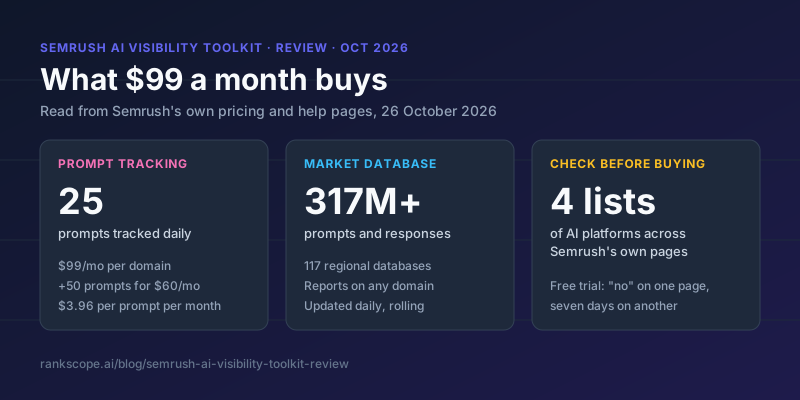
The Semrush AI Visibility Toolkit is a $99-a-month add-on that does two jobs. It reports on how any domain shows up in AI answers, using a database of over 317 million prompts and responses, and it tracks 25 prompts of your own every day. The first job is the reason to buy it. The second is a small prompt tracker at a high price per prompt. And if you already pay for a Semrush plan from Starter up, you may own more tracking than the toolkit sells.
We have not used a paid account. This review is built from the five pages Semrush publishes about the toolkit, read on 26 October 2026, plus our own comparisons of the same category. That turned out to be a review in itself, because the five pages do not agree with each other.
One disclosure up front: RankScope sells an AI visibility tracker, so we compete with part of this product. We show where Semrush does something we do not.
What the toolkit is
Semrush's getting-started help page lists the parts:
- Visibility Overview. Enter a domain and get an AI Visibility Score, "a benchmark from 0-100", broken down by AI platform and by country.
- Competitor Research. Compare your visibility with up to four competitors and see topic and prompt gaps.
- Prompt Research. The questions people ask AI platforms in your topic, with an "AI Topic Volume" and intent.
- Brand Performance. Share of voice, sentiment, the domains cited when your brand is discussed, and the prompts where you and competitors appear. One domain on the base plan.
- Prompt Tracking. Your own 25 prompts, run daily inside Semrush's Position Tracking tool, reporting visibility and average position.
- Site Audit for AI. An "AI Search Health" check on up to 100 pages, which Semrush says tests your pages against eight AI crawlers.
The first four run on Semrush's own prompt data. Only Prompt Tracking runs prompts you wrote. That split is what the rest of this review turns on.
Where the data comes from
Semrush's data-sources help page is the most useful thing it publishes about this product. What it says:
- The database holds "over 317 million prompts and responses on ChatGPT, Gemini, Google AI Overviews, and AI Mode".
- The prompts come from "AI search clickstream data and Google's keyword dataset for AI Overviews".
- Responses "are captured from real requests and not via any APIs of LLMs", and for ChatGPT it analyses "the latest model of ChatGPT in search mode".
- The data is "updated daily on a rolling basis", across 117 regional databases.
- Brand Performance uses a separate set of queries, updated weekly.
Two things follow from that.
You can look at domains you never set up. A competitor's AI visibility, a prospect's, a brand you are thinking of partnering with. A prompt tracker, ours included, only knows about prompts someone wrote into it. For an agency pitching a client or a team sizing up a market, this is the part a prompt tracker cannot replace.
The database prompts are Semrush's sample, not your buyers' questions. Clickstream-sourced prompts reflect what people in that panel typed. If your buyers ask long, specific questions in a niche, the sample may hold few of them. That is what the 25 tracked prompts are for, and why 25 feels small.
"Updated daily on a rolling basis" also deserves a careful read. It means part of the database refreshes each day, not that every prompt is re-run daily. Semrush does not say how long a full cycle takes. When you look at a score, you do not know how old the underlying answers are.
The price, and what a prompt costs
On Semrush's AI pricing page on 26 October 2026, the Base plan was $99/mo per domain. We toggled the page between monthly and annual billing in a browser: it showed $99 both ways. Semrush's toolkit help page agrees on $99 per month and adds the details the pricing page leaves out:
- 25 prompts for Prompt Tracking.
- "You can add 50 more prompts to your Prompt Tracking limit for $60 per month."
- 300 AI Analysis reports a day, 1,000 Prompt Research queries a day.
- 1 domain for Brand Performance.
- Exports of up to 1,000 rows, up to 10 a day.
Additional users start at $45/mo. Enterprise is custom.
The toolkit is also not the only way to buy this. Semrush's main prices page, read the same day, lists AI prompt tracking inside its bundled plans:
| Semrush plan | Monthly | Billed annually | AI prompts tracked daily |
|---|---|---|---|
| SEO | $139 | $117.33/mo | "Monitor custom prompts", no number given |
| Starter | $199 | $165.17/mo | 50 |
| Pro+ | $299 | $248.17/mo | 100 |
| Advanced | Custom | Custom | Unlimited |
| AI Visibility Toolkit | $99 | $99/mo | 25 |
That table is the most practical finding in this review. If you are on Starter or Pro+, the prices page says you already track 50 or 100 prompts, more than the toolkit's 25. Check your account before adding the toolkit to it.
A worked example: what 100 tracked prompts cost
Twenty-five prompts is enough to test whether an AI engine knows you. It is not enough to track a category: one question shape per competitor, plus a handful of use cases, passes 25 quickly. So here is what roughly 100 tracked prompts cost a month, at prices read from each vendor's page in October 2026:
| Option | Prompts | Monthly price | Per prompt | Engines, per the vendor's page |
|---|---|---|---|---|
| Semrush toolkit + one 50-prompt add-on | 75 | $159 | $2.12 | See the next section |
| Semrush Pro+ (includes the full SEO suite) | 100 | $299 | $2.99 | "Google Search, ChatGPT, Perplexity, Gemini & more" |
| Otterly.AI Standard | 100 | $189 | $1.89 | ChatGPT, AI Overviews, Perplexity, Copilot (read 20 Oct) |
| RankScope Professional | 150 | $149 | $0.99 | ChatGPT, AI Overviews, Perplexity, AI Mode |
| Peec AI Pro | 150 | $245 | $1.63 | Any 3 of 6 on self-serve plans (read 20 Oct) |
Two caveats keep this honest. First, the toolkit row stops at 75 because Semrush's help page mentions one 50-prompt add-on and does not say whether you can buy several. Second, "a prompt" is not the same unit everywhere. Semrush's data-sources page says Prompt Tracking runs each prompt daily "on your chosen platform and location", which reads as one platform per tracked prompt; RankScope runs each prompt on every engine your plan includes. If you need one prompt watched on four engines, ask Semrush how it counts that before comparing.
Semrush Pro+ is not overpriced at $299: most of that buys the SEO suite. The comparison only matters if AI tracking is the reason you are buying.
Four pages, four engine lists
This is where the review got interesting. We read every Semrush page that describes the toolkit on the same day and wrote down which AI platforms each one names.
| Semrush page (26 Oct 2026) | Part of the product | Platforms named |
|---|---|---|
| AI pricing page | Whole plan | ChatGPT, Google AI, Gemini, Perplexity |
| Toolkit help page (KB 1493) | Prompt Tracking and Brand Performance | "platforms like Google AI Mode and ChatGPT" |
| Getting-started page (KB 1496) | Prompt Tracking | ChatGPT Search, Google AI Mode, Gemini |
| Data-sources page (KB 1607) | Database | ChatGPT, Gemini, AI Overviews, AI Mode |
| Data-sources page (KB 1607) | Prompt Tracking | Google AI Mode, AI Overviews, Gemini, ChatGPT Search |
| Data-sources page (KB 1607) | Brand Performance | Google AI Mode, ChatGPT, Perplexity, Gemini |
| Main prices page | Bundled plans | "Google Search, ChatGPT, Perplexity, Gemini & more" |
Read together, the most likely picture is that the product covers ChatGPT, Gemini and Google's two AI surfaces, with Perplexity in Brand Performance, and that the shorter lists are older pages nobody updated. That is our inference, not Semrush's statement. If one engine decides your purchase, Perplexity especially, confirm it with Semrush in writing.
The free trial has the same problem. The toolkit help page says: "No, the AI Visibility Toolkit does not offer a free trial." The footer of the AI pricing page says: "Try Semrush free for seven days." Both were live on 26 October 2026. Semrush also runs a free AI visibility checker, which its own search snippet describes as powered by the toolkit, and a free plan that lists "AI Visibility features" without saying which.
We are not pointing this out to score a point. Every vendor in this category, us included, has published pages that disagreed with its own product. It is the reason any review of these tools needs a read date on every number.
What went wrong in our own Semrush coverage
Until 21 October 2026, our post on Semrush alternatives for AI visibility said Semrush had no AI citation tracking. One of its titles said so too. Semrush had been selling it since at least late 2025; Backlinko published a tutorial for the AI Visibility Toolkit in November 2025, and Profound reviewed it the same month. We found the error in a sweep of competitor claims, rewrote the post, and said so at the top of it.
We cannot measure what it cost in traffic. The cost we can name is credibility: anyone who knew Semrush and read our claim had a reason to doubt everything else on the page.
Other reviews age the same way. Profound's review of this toolkit, published 18 November 2025 and still ranking on the first page for the product's name, reports Gemini as "coming soon", six regional databases and a prompt database of about 100 million. Semrush's pages now say Gemini is covered, 117 regional databases, and over 317 million prompts. Profound's review was probably accurate when written. Eleven months is a long time in this category.
Demand: the launch spike is over
Search interest in the product's name tells a story of its own. Monthly US searches for "semrush ai visibility toolkit", from DataForSEO:
| Month | Searches |
|---|---|
| Nov 2025 | 480 |
| Dec 2025 | 4,400 |
| Mar 2026 | 9,900 |
| May 2026 | 6,600 |
| Jul 2026 | 1,000 |
| Aug 2026 | 880 |
More than a tenfold fall from the March peak. We would not read that as people giving up on the product; launch interest decays for every tool, and Semrush customers can probably find it inside their accounts without searching. It does mean most of what was written about it dates from the peak, which is the stale-review problem again.
How to use Semrush AI visibility in the first week
If you buy it, or already have it on a bundled plan, this order gets the most out of the first few days.
- Run Visibility Overview on three domains before your own. Pick two competitors and one brand you think is doing well in AI answers. A score means little alone. Three comparison points tell you whether 40 is good in your category.
- Open Prompt Research for your main topic and export it. This is the database at work: the questions Semrush has seen people ask AI platforms in your space. Read the list for shapes you would never have written yourself. If your own prompt list came from your keyword list, expect it to look short and generic beside this one.
- Choose your 25 tracked prompts from that export, not from your keyword list. AI prompts are longer and more specific than search keywords. "Best CRM for a 10-person agency that already uses Google Workspace" is a prompt; "best CRM" is a keyword.
- Check which platform each tracked prompt runs on. Given the help pages' disagreement, look at what the Prompt Tracking setup offers you in the product itself and write it down. That is the only list that counts.
- Wait two weeks before reading a trend. AI answers change a lot from one day to the next. A GetMentions study of 530,875 citations (July 2026) found a median of 82% of ChatGPT's cited sources for a query changed from one day to the next. One week of daily data is a baseline, not a direction.
The AI Visibility Score is the number everyone will ask you for, and the one to trust least. Semrush does not publish its formula on its help pages. Use it to compare domains measured the same way on the same day, and do not put it in a board report as if it measured something absolute.
Who should buy it
- Agencies and consultants who need to look at domains they do not own. Pitch research, competitor teardowns, market sizing. The database does this and prompt trackers do not.
- Teams that live in Semrush and want AI visibility in the same reports as rankings and traffic, without another login.
- Anyone who needs Gemini. Semrush names it on most of its pages. We do not track it.
Who should look elsewhere
- Semrush Starter and Pro+ customers. Check your plan first; the prices page lists more tracked prompts than the toolkit includes.
- Teams whose real need is tracking their own buyers' questions across several engines every day. At 25 prompts, the per-prompt cost is high, and the counting rule needs confirming.
- Anyone who needs to read how an answer changed. We did not find answer-text history or day-to-day diffs listed on any of the five pages. That does not mean the product lacks them; it means you should check in a demo.
How it compares with our own tracker
Where Semrush is ahead: the market database, coverage of Google's Gemini app, the AI readiness site audit, and the fact that it sits inside a suite many teams already pay for. RankScope reports on the prompts you track (on the Agency plan, also on prospects in pitch workspaces); nothing on our pricing page is a market-wide prompt database like Semrush's.
Where we are ahead: price per tracked prompt, and the record of each answer. RankScope tracks ChatGPT, Google AI Overviews, Perplexity and Google AI Mode. Starter is $49/mo, or $39/mo billed annually, for 40 prompts on ChatGPT and AI Overviews; Professional is $149/mo, or $124/mo billed annually, for 150 prompts on all four engines. Every plan runs daily scans and keeps a diff of what changed in each answer. There is no free trial; the free AI visibility checker needs no credit card.
For a plain buying decision across all the trackers, see AI visibility tool pricing. For the Semrush-specific trade-off, the Semrush alternatives post goes further. And Ahrefs Brand Radar is the closest like-for-like product from the other big suite.
FAQ
What is the Semrush AI Visibility Toolkit?
It is a Semrush add-on that reports how brands appear in AI-generated answers. It has two halves: reports on any domain drawn from Semrush's database of over 317 million prompts and responses (Visibility Overview, Competitor Research, Prompt Research, Brand Performance), and Prompt Tracking, which runs 25 prompts you choose every day. It also includes an AI readiness check in Site Audit.
How much does the Semrush AI Visibility Toolkit cost?
$99 per month per domain, read on Semrush's AI pricing page on 26 October 2026, with the same figure shown for monthly and annual billing. That includes 25 tracked prompts. Semrush's help page lists 50 more prompts for $60 per month, and additional users start at $45 per month.
Is there a free trial of the Semrush AI Visibility Toolkit?
Semrush's pages disagree. The toolkit help page says it does not offer a free trial. The AI pricing page footer says to try Semrush free for seven days. Semrush also has a free AI visibility checker and a free plan that lists AI Visibility features. Confirm with Semrush before you rely on a trial.
Which AI platforms does Semrush track?
It depends which Semrush page you read. On 26 October 2026 the AI pricing page listed ChatGPT, Google AI, Gemini and Perplexity. The data-sources help page listed Google AI Mode, AI Overviews, Gemini and ChatGPT Search for Prompt Tracking, and Google AI Mode, ChatGPT, Perplexity and Gemini for Brand Performance. The getting-started page listed ChatGPT Search, Google AI Mode and Gemini for Prompt Tracking. Confirm the engine you need before buying.
Is the Semrush AI toolkit worth it?
Worth it if you want to see AI visibility for domains you have not set up prompts for, such as competitors, and you already work in Semrush. Not the best value as a prompt tracker: 25 prompts for $99 is $3.96 a prompt a month, and Semrush's Starter plan lists 50 tracked prompts, so existing Starter customers should check what they already have.
How does Semrush calculate AI visibility?
Semrush describes its AI Visibility Score as a benchmark from 0 to 100 but does not publish the formula on its help pages. The underlying data comes from over 317 million prompts and responses that Semrush says are captured from real requests, not through LLM APIs, sourced from AI search clickstream data and Google's AI Overviews keyword dataset, and updated daily on a rolling basis.
Get started with RankScope → No setup fee · Cancel anytime · From $49/mo, or $39/mo billed annually