Best Semrush Alternative for AI Search Visibility in 2026
Let's start with something most posts in this category won't say: Semrush is excellent. If you're doing traditional SEO — tracking keyword rankings, building backlinks, running technical audits, spying on competitor content — Semrush is one of the strongest tools you can buy. The keyword research database is massive, the competitive intelligence is detailed, and the platform's breadth is genuinely hard to match.
This isn't a post about abandoning Semrush.
It's about a gap Semrush doesn't fill — and increasingly, can't afford to ignore. In 2026, AI search engines have become a real traffic channel. ChatGPT, Google AI Overviews, Perplexity, and Google AI Mode are now handling hundreds of millions of queries that used to go to traditional Google results. Brands that get cited in AI-generated answers get traffic, leads, and brand recognition from those answers. Brands that don't get cited are invisible — even if they rank well in organic search.
Semrush, as of 2026, has no AI citation tracking built in.
It can tell you which keywords trigger a Google AI Overview. It cannot tell you whether your brand is cited inside that AI Overview. It has no data on what ChatGPT says about your product category, whether Perplexity recommends a competitor over you, or how your share of voice in AI search has changed over the past month.
That's the gap. This post covers what fills it.
What Semrush Does Well (Honestly)
Before the alternatives, here's what Semrush actually delivers — because understanding what it's strong at clarifies what you're actually shopping for when you look for an "alternative."
Keyword research. The Semrush keyword database is one of the largest available, covering over 25 billion keywords across 130 countries. The keyword magic tool surfaces intent clusters, related terms, and question variants at scale. For teams doing volume keyword research, it's a genuine workhorse.
Competitive intelligence. Semrush's domain analysis lets you see competitors' estimated organic traffic, their top-ranking keywords, their backlink profile, and which pages earn them the most visibility. This is legitimately useful for identifying content gaps and understanding why a competitor ranks where they do.
Backlink analysis. Semrush's backlink database is thorough. The toxic backlink identification and disavow workflow, link gap analysis, and backlink audit tools are among the best in class.
Site audit. The technical SEO audit covers over 140 checks — crawl errors, site speed, structured data problems, internal linking issues, mobile usability — and surfaces them in priority order. For large sites, this is a meaningful time saver.
ContentShake AI. Semrush has built a genuinely capable AI content workflow in ContentShake AI — topic briefing, first-draft generation, optimization scoring, and publish-to-WordPress integration. If you're looking for an AI-assisted content production workflow, this is worth evaluating.
Reporting. Agency-grade reporting with white-label customization, scheduled delivery, and drag-and-drop report builders. For client-facing teams, this is a real convenience.
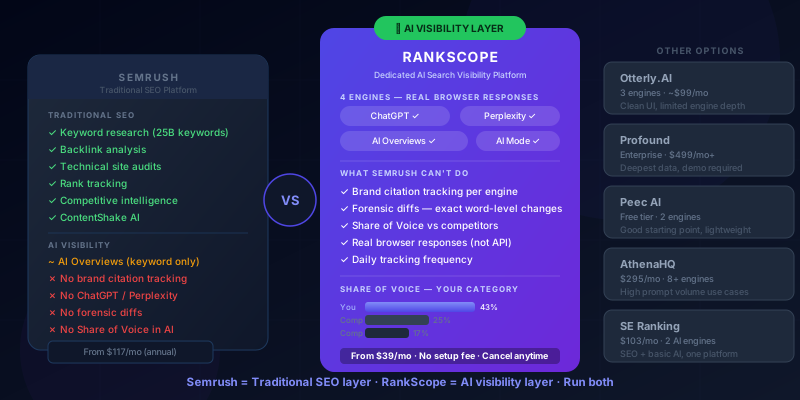
Where it stops: none of the above tells you anything about what happens to your brand inside AI-generated answers. That's not Semrush being bad at its job — it's Semrush being built for a different job than AI citation tracking.
What Semrush Cannot Do for AI Visibility
To be specific about the gap, here's what Semrush doesn't track and why it matters:
1. Whether your brand is cited in AI Overviews
Semrush's AI Overviews monitoring (via the Position Tracking tool) shows you whether a tracked keyword has an AI Overview. It doesn't tell you whether your brand is cited in it. These are completely different questions.
"Keyword X triggers an AI Overview" is a fact about Google's behavior. "Your brand is cited in that AI Overview" is a fact about whether you're winning in that channel. Most Semrush users think they have AI Overviews coverage; they have a much weaker signal than they realize.
2. What ChatGPT, Perplexity, or AI Mode say about your brand
Semrush is built around Google. ChatGPT, Perplexity, and Google AI Mode (the full AI-first search interface, not just AI Overviews) are not in Semrush's data model. For categories where ChatGPT is increasingly used as a research starting point — software comparisons, product discovery, B2B vendor evaluation — this blind spot is significant.
3. Share of Voice in AI answers
Share of Voice in AI search means: when queries about your product category are posed to AI engines, what percentage of responses include your brand? This is the metric that tells you whether you're winning or losing in AI-generated results relative to competitors. Semrush has no mechanism to calculate this because it doesn't read AI response content — it only tracks keyword positions in traditional search.
4. Forensic diff tracking
When your AI visibility metrics change — citation rate drops, a competitor's mentions spike — you need to know what actually changed in the AI responses. Did the AI change how it frames your category? Did it start citing a competitor? Did the response structure change entirely?
Forensic diff tracking captures the exact text of AI answers over time and highlights word-level changes between any two dates. This diagnostic capability is what turns raw citation data into something you can act on. No traditional SEO tool, including Semrush, has this.
The 6 Best Semrush Alternatives for AI Search Visibility
1. RankScope — Best Dedicated AI Visibility Layer
RankScope was purpose-built for generative engine optimization — the practice of optimizing for how AI search engines represent your brand, not just traditional search rankings. It tracks brand citations across four engines: ChatGPT, Google AI Overviews, Perplexity, and Google AI Mode.
The key differentiator from Semrush and from lighter alternatives is depth: RankScope doesn't just count whether your brand is mentioned — it tracks the full text of AI responses over time, calculates Share of Voice against specific competitors, and surfaces forensic diffs when anything changes.
Engine coverage: All four major AI engines. ChatGPT and Perplexity are table stakes. Google AI Overviews and Google AI Mode are where Semrush leaves a blind spot and where most brands have the most traffic at stake — Google AI Overviews now appears in roughly 15-20% of all US Google searches.
Real browser responses, not API outputs. This distinction matters for accuracy, particularly on Google's AI surfaces. API responses and browser-rendered AI answers can diverge — Google personalizes, tests, and updates AI Overviews in ways that API queries don't always capture. RankScope uses actual browser sessions to pull what a real user sees. This is why forensic diffs are meaningful: you're tracking the real response, not a synthetic API approximation.
Forensic diffs. When citation rates shift, RankScope shows you the exact text change in AI responses — highlighted at the word level, filterable by engine and date range. If your brand dropped from a ChatGPT response in week three, you can see whether a competitor was added, the response was restructured, or the AI changed how it describes the category entirely. This is the diagnostic layer that SEO teams actually need to optimize.
Share of Voice per engine. For any tracked query set, RankScope calculates what percentage of AI-generated answers mention your brand versus each tracked competitor, broken down by engine. This is the competitive metric that tells you whether you're gaining or losing ground in AI search.
Pricing:
- Starter: $49/month — 2 engines (ChatGPT + AI Overviews), 40 prompts, 3 competitors, 5 manual scans
- Pro: $149/month — all 4 engines, 150 prompts, 10 competitors, 30 manual scans, GA4/GSC/Looker integration, API access
- Agency: $399/month — all 4 engines, 400 prompts, unlimited competitors, 25 client workspaces, white-label
No setup fee. No demo required. No annual lock-in.
What Semrush still wins on: Everything RankScope doesn't do. Keyword research, backlink analysis, technical site audits, content gap analysis, rank tracking, competitive domain analysis, white-label SEO reporting. These tools are complementary, not competing. Most teams running serious AI visibility tracking alongside traditional SEO use Semrush for one and RankScope for the other.
Get started with RankScope → — No setup fee · Cancel anytime
2. Otterly.AI — Best for Clean Reporting UI
Otterly built a genuinely well-designed AI visibility product. The interface is cleaner than most tools in this space, citation trend data is easy to pull into stakeholder presentations, and setup is simple enough that non-technical team members can configure and read the dashboards.
Otterly covers ChatGPT, Perplexity, and Gemini — three engines, no Google AI Overviews or AI Mode. For teams where the primary reporting need is showing AI visibility trends to leadership, the UI advantage matters. For teams actively diagnosing and optimizing, the missing forensic diff layer and limited engine coverage are real constraints.
Where it fits: Teams where stakeholder-friendly reporting is the priority and Google's AI surfaces aren't critical tracking needs.
Pricing: Starts around $99/month. No free tier.
3. Profound — Best for Enterprise Depth
Profound is the market-leading option at the enterprise end. If you're managing AI visibility for a large brand with complex tracking needs — hundreds of custom prompts, deep competitive coverage, advanced data exports, API integrations — Profound has the most mature product architecture in this space.
The barrier: pricing starts at $499/month and typically requires a sales demo and procurement process. There's no self-serve option, which makes evaluation cumbersome unless you're already at a stage where enterprise procurement is normal. For teams at that scale, it's often worth the process.
Where it fits: Enterprise marketing and communications teams with significant budget and deep AI visibility requirements.
Pricing: $499/month+, demo required.
4. Peec AI — Best Low-Friction Entry Point
Peec AI is a lighter tool built for teams at the beginning of their AI visibility journey. It has a free tier, covers ChatGPT and Perplexity, and requires minimal setup. For a brand that's just started thinking about AI search presence and wants basic monitoring before committing budget, Peec AI is a reasonable starting point.
The practical limitations are what you'd expect: no Google AI Overviews, no forensic diffs, limited competitive tracking, and reduced data depth. These constraints don't matter if you're trying to answer "are we ever cited in AI answers?" but they do matter once you're trying to optimize, diagnose, or report competitively.
Where it fits: Early-stage AI visibility exploration, small brands, teams evaluating the space before committing to a paid plan.
Pricing: Free tier available. Paid plans for additional prompt volume.
5. AthenaHQ — Best for High-Volume Prompt Libraries
AthenaHQ focuses on AI citation tracking at scale — large prompt libraries mapped to your full product and category coverage, detailed competitive visibility, and growing engine support. Their G2 ratings are strong (4.9/5 Spring 2026), and the product has matured significantly over the past 12 months.
At $295/month for the self-serve plan, AthenaHQ sits between RankScope and Profound in pricing and capability. If your use case involves hundreds of tracking prompts across competitive categories, it handles that scale well. The tradeoff versus RankScope is primarily price — AthenaHQ costs 7.5x more than RankScope's Starter plan — without a proportional advantage in engine depth or forensic tracking.
For a detailed breakdown of how AthenaHQ stacks up specifically against RankScope, see the AthenaHQ alternative guide.
Where it fits: Mid-market teams with high prompt volume needs and budget aligned to the $295/month tier.
Pricing: $295/month self-serve.
6. SE Ranking AI Toolkit — Best Consolidation Option
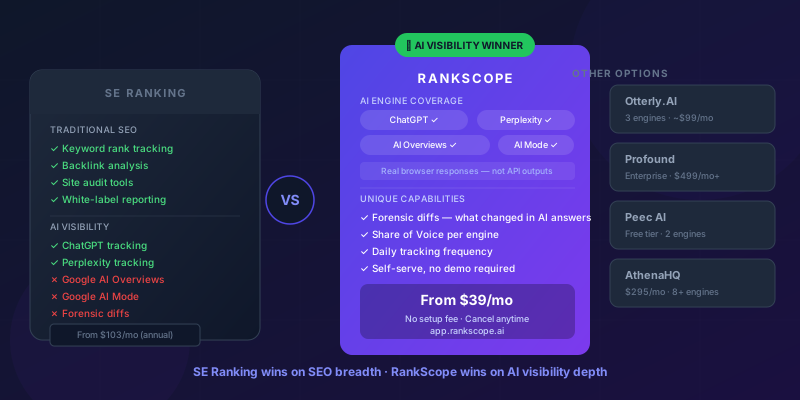
SE Ranking is worth mentioning here because it's a Semrush competitor that has added AI visibility features — tracking ChatGPT and Perplexity citations alongside its full traditional SEO toolkit. If you're currently evaluating whether to stay with Semrush or switch to a cheaper all-in-one that includes some AI monitoring, SE Ranking is worth the comparison.
The AI module covers two engines (ChatGPT and Perplexity) and is included in SE Ranking's paid plans starting at $103.20/month billed annually. It doesn't cover Google AI Overviews or AI Mode, doesn't include forensic diffs, and is clearly a secondary feature on a traditional SEO platform.
For teams where the primary question is "one consolidated tool vs two separate tools," SE Ranking is the consolidation option. For teams where AI visibility is the primary objective, a dedicated tool gives more depth at lower cost.
For the full comparison, see Best SE Ranking Alternative for AI Visibility.
Where it fits: Teams that want a cheaper Semrush alternative that bundles basic AI monitoring with traditional SEO in one platform.
Pricing: Starts at $103.20/month billed annually.
Side-by-Side Comparison
| Semrush | RankScope | Otterly.AI | Profound | SE Ranking | |
|---|---|---|---|---|---|
| Primary focus | Traditional SEO | AI visibility (dedicated) | AI monitoring | Enterprise AI visibility | Traditional SEO + AI add-on |
| AI citation tracking | No (keyword-level only) | Yes | Yes | Yes | Yes |
| ChatGPT | No | Yes | Yes | Yes | Yes |
| Google AI Overviews | Keyword presence only | Yes (citations) | No | Yes | No |
| Perplexity | No | Yes | Yes | Yes | Yes |
| Google AI Mode | No | Yes | No | Yes | No |
| Real browser responses | No | Yes | No | Yes | No |
| Forensic diffs | No | Yes | No | Partial | No |
| Share of Voice | No | Yes (per engine) | Yes | Yes | Basic |
| Traditional SEO tools | Full suite | No | No | No | Full suite |
| Starting price | $117.33/mo (annual) | $49/mo | ~$99/mo | $499/mo+ | $103.20/mo (annual) |
| Self-serve signup | Yes | Yes | Yes | Demo required | Yes |
Why the AI Visibility Gap Matters Now
It's worth being precise about what's happening in search and why the Semrush gap has become a meaningful strategic blind spot.
Google AI Overviews — the AI-generated summaries shown at the top of Google results — now appear in roughly 15-20% of all US Google searches, according to multiple industry studies. Google AI Mode, the full AI-first interface, is now the default for an expanding segment of Google users. ChatGPT processes over 10 million queries per day for research and discovery tasks. Perplexity has positioned itself as the AI-native research engine for professional and academic audiences.
These aren't fringe channels. They're where a meaningful slice of informational and commercial intent queries now resolve.
In traditional search, being in position 3 is still being on the page. In AI search, either your brand is cited in the AI-generated answer or you're not in the response at all. There's no position 3 in a ChatGPT response — there's cited or invisible.
Semrush tells you whether you rank in position 3 on Google. It doesn't tell you whether you're cited in the AI Overview that now appears above position 1.
This is why teams running GEO strategies alongside traditional SEO need a dedicated measurement layer. Generative engine optimization is the practice of optimizing for those AI-generated answers — and you can't optimize what you don't measure.
How to Think About the Two-Tool Stack
The cleanest way to frame this: Semrush answers Google-in-2020 questions. RankScope answers Google-in-2026 questions.
Semrush tells you:
- Which keywords are you ranking for?
- What's your organic traffic estimate versus competitors?
- Which pages have backlinks pointing at them?
- What technical errors is Googlebot seeing on your site?
RankScope tells you:
- Is your brand cited when someone asks ChatGPT about your category?
- What percentage of Google AI Overviews in your product space mention you versus a competitor?
- When your AI citation rate dropped last month, what specifically changed in the AI responses?
- Which competitor is gaining share of voice in Perplexity, and what are they doing differently?
These are genuinely different questions. They require different data models, different infrastructure, and different product decisions. Neither tool can reasonably do the other's job.
The teams we see getting the most traction on AI visibility are the ones who stopped treating it as "one more thing to check in Semrush" and started treating it as a separate measurement layer with dedicated tooling. That doesn't mean expensive — RankScope starts at $49/month, which is less than most Semrush upgrades — but it means intentional.
For a deeper look at what AI search visibility actually means and how to measure it, the complete guide to GEO in 2026 covers the full framework.
What to Look for in Any Semrush Alternative for AI Visibility
If you're evaluating options beyond the ones covered here, these are the questions that separate serious tools from shallow ones:
1. Does it track Google AI Overviews at the citation level, not just keyword presence? Knowing a keyword triggers an AI Overview is not the same as knowing your brand is cited in it. Make sure the tool you evaluate distinguishes between these.
2. Does it cover all four major AI engines? ChatGPT and Perplexity are table stakes. Google AI Overviews and Google AI Mode are the gaps most tools miss. Engine coverage matters because citation patterns vary dramatically across platforms — a brand that does well in ChatGPT may be nearly invisible in AI Overviews.
3. Real browser responses or API outputs? For Google AI surfaces especially, browser-rendered responses and API outputs diverge. Real browser tracking is what gives you an accurate picture of what users actually see.
4. Forensic diffs? Citation metrics tell you something changed. Diffs tell you what changed and give you something to act on. Without this diagnostic layer, you're monitoring without diagnosis.
5. Is Share of Voice calculated per engine? A blended average hides too much. You want to know whether you're gaining or losing versus specific competitors in ChatGPT specifically, in AI Overviews specifically. Engine-level SoV is the metric that's actually useful for optimization decisions.
6. What's the tracking frequency? AI responses change frequently. Weekly snapshots can miss citation drops and recoveries entirely. Daily tracking is the minimum for meaningful trend data.
For a broader comparison of the entire AI visibility tools market, the best AI visibility tools breakdown covers every major option with detailed use case guidance.
Semrush vs RankScope: The Honest Summary
Semrush is the right tool for traditional SEO. It has earned its market position with a genuinely comprehensive platform, a large and accurate data infrastructure, and years of product iteration on the problems SEO teams actually face.
RankScope is the right tool for AI search visibility. It's purpose-built for the measurement problem that Semrush wasn't designed to solve: tracking what AI engines say about your brand, diagnosing why it changes, and giving you the competitive data to make optimization decisions.
The strategic position for most marketing teams in 2026: run both.
Semrush handles the Google-organic layer. RankScope handles the AI-generated answer layer. The two tools cover different ground with near-zero functional overlap. The combined monthly cost ($117 for Semrush Pro + $49 for RankScope Starter) is less than Semrush's Guru plan alone — and you get genuine AI visibility coverage instead of hoping Semrush's keyword-level AI Overviews flag is close enough.
For teams where budget forces a single choice and AI citation tracking is the primary need: RankScope at $49/month gives you dedicated 4-engine coverage with forensic diffs and Share of Voice. That's the right call if AI visibility is what you're actually solving for.
Get started with RankScope → — No setup fee · Cancel anytime
Frequently Asked Questions
Does Semrush have any AI citation tracking? Not at the citation level. Semrush's Position Tracking tool can flag when a tracked keyword triggers a Google AI Overview in search results. It cannot tell you whether your brand is cited inside that AI Overview, and it has no tracking for ChatGPT, Perplexity, or Google AI Mode.
What's cheaper than Semrush for AI visibility? RankScope's Starter plan at $49/month is significantly cheaper than Semrush's Pro plan at $117.33/month — and it's purpose-built for AI citation tracking rather than being a secondary feature. Peec AI has a free tier for basic monitoring.
Can I cancel Semrush and use RankScope instead? Only if you don't need traditional SEO tools. RankScope is an AI visibility platform — it doesn't do keyword research, backlink analysis, or site audits. If you're doing any meaningful traditional SEO work, replacing Semrush with RankScope isn't the right move. Adding RankScope alongside Semrush is.
How long does RankScope take to set up? Under 30 minutes. You add your brand, configure prompts (or use the prompt suggestions), select competitors, and data starts coming in within 24 hours. No sales call, no onboarding fee, no demo required.
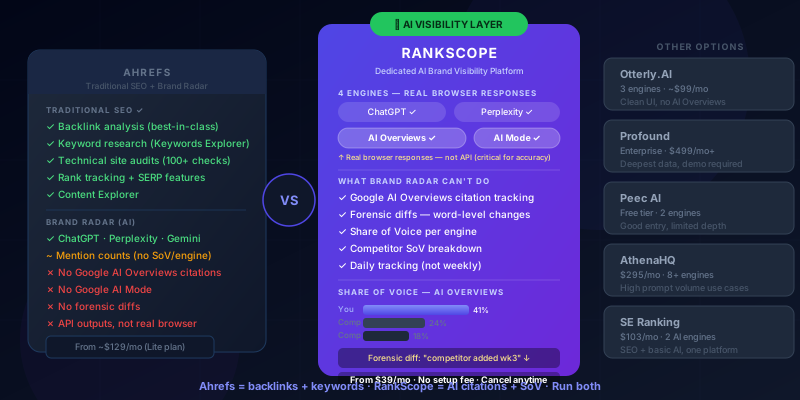
Is Ahrefs or Semrush better for AI visibility? Neither — both are traditional SEO platforms without meaningful AI citation tracking. Ahrefs has Brand Radar, which shows some AI Overviews appearance data, but it's a secondary feature with limited depth. Moz has no AI visibility features at all. For dedicated AI visibility, a purpose-built tool is the right choice. For a breakdown of Ahrefs' AI visibility gaps specifically, see the Ahrefs alternative for AI visibility post. For the Moz AI gap, see the Moz alternative for AI search visibility post.
What do most enterprise teams use alongside Semrush? Enterprise marketing teams running active GEO programs typically layer a dedicated AI visibility platform on top of their existing Semrush or Ahrefs subscription. The AI visibility layer captures what traditional SEO tools don't — citation rates, share of voice in AI answers, and forensic tracking of response changes. For enterprise scale, options include RankScope Pro/Agency, Profound ($499/mo+), or AthenaHQ ($295/mo). If your team also runs HubSpot for CRM and demand generation, see the best HubSpot alternative for AI search visibility — the same blind spot applies, and the fix is the same dedicated layer.