AthenaHQ has earned its reputation. It's rated 4.9/5 on G2, gets mentioned in most serious roundups of AI visibility tools, and the product is genuinely well-built — covering 11 AI models on its Starter plan with content optimization, citation intelligence, and a full GEO workflow layer. If you're a large marketing team or enterprise brand that needs a command center for AI search, AthenaHQ is worth a serious look.
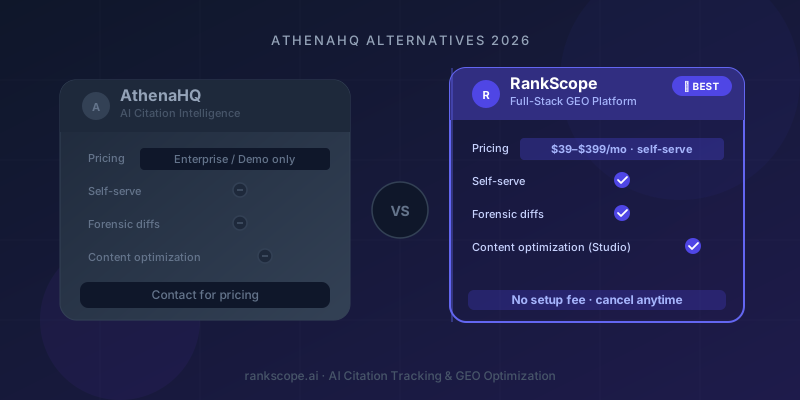
AthenaHQ has a free Essential plan, but its paid self-serve plan starts at $295/month. That price point — plus the platform's complexity — puts it out of reach for a lot of teams: startups getting their first AI citation baseline, growth-stage SaaS companies with a $100-200 monthly budget, and agencies that need a simple, demonstrable workflow for client reporting rather than a full enterprise orchestration platform.
This post covers the six best AthenaHQ alternatives in 2026. We'll be straightforward about what each tool does, what it actually costs, and which teams it's built for. We'll also be honest about what AthenaHQ does well — because if you're switching away from it, you should know what you're leaving behind.
What AthenaHQ Does Well
Before the alternatives, let's be honest about what you're actually evaluating. AthenaHQ isn't a weak product — the reasons to look elsewhere are mostly structural.
Broadest engine coverage in the category. AthenaHQ's Starter plan tracks 11 models (ChatGPT, Perplexity, Google AI Overviews, Google AI Mode, Gemini, Claude, Copilot, Grok, DeepSeek, Meta AI, Mistral), and the free Essential plan covers 5 of them (AthenaHQ pricing page, 21 October 2026). If you specifically need Grok, DeepSeek or Meta AI coverage, few tools list them.
Full GEO workflow management. AthenaHQ isn't just a monitoring dashboard — it's built to run an organization's entire AI search strategy. End-to-end workflow management, an AI agent for content creation, on-page and off-page GEO actions, dynamic robots.txt and llms.txt management, brand voice enforcement, SAML SSO, audit logs. The feature depth is real.
G2 recognition. 4.9/5 rating in the Answer Engine Optimization category, Spring 2026. That kind of rating comes from actual customers getting actual results. It's not marketing spin.
Competitive intelligence. Citation source analysis, competitor monitoring, share of voice benchmarking, and real-time brand sentiment. The Athena Citation Engine (ACE) claims to predict content citation probability using ML trained on millions of AI search results — a genuinely differentiated capability if the model holds up.
Why Teams Look for an AthenaHQ Alternative
The product is solid. The reasons teams look elsewhere are mostly about fit and price.
1. The price gap is significant
AthenaHQ's paid self-serve plan starts at $295/month, and enterprise pricing is custom from there. The free Essential plan (300 credits) is enough to try it, not to run a program on. By comparison, the next tier of tools in this space runs $49–$149/month for comparable (or better) coverage of the highest-traffic AI surfaces. If you're budget-constrained, the math just doesn't work.
2. Platform complexity vs. speed to value
AthenaHQ is built to run an organization's entire AI search program. That's a strength for large teams — and it's genuine overhead for small ones. Configuring the full platform, setting up GEO workflows, training the AI content agent, integrating BI tools — there's a real time investment before you start pulling useful data. Teams that want to sign up and have citation baselines in 24 hours tend to find lighter tools more practical.
3. Real browser responses vs. API responses, and why it matters
This is a technical distinction, but it has a real impact on data accuracy. RankScope captures actual browser-rendered responses. AthenaHQ doesn't say on its site whether it collects answers through APIs or real browser sessions; ask before you rely on its Google AI numbers.
Here's why that difference matters: Google AI Overviews and Google AI Mode are rendered dynamically in Chrome. A query for "best project management software" might produce an AI Overview in a real browser session that cites six specific sources — with your brand appearing third. The same query through Google's API may return different content, different citations, or no AI Overview at all, depending on how the request is constructed. What users actually see is the browser experience, not the API layer.
For ChatGPT and Perplexity, this gap is small — the API and browser outputs are broadly consistent. For Google's AI surfaces, the difference is meaningful. If you're optimizing for Google AI Overviews specifically, you want data from what's actually rendering in search, not what the API says should render.
4. Forensic diffs aren't listed
AthenaHQ tracks your metrics over time. Its pricing page doesn't list a way to see exactly what the AI responses said — on any two specific dates, with the text changes highlighted. That diff layer is what turns "your citation rate dropped 18% this week" from an alert into a diagnosis. Without seeing the actual before/after response text, you know something changed but not what the model actually said.
Quick Comparison: AthenaHQ Alternatives
| Tool | Engines | Key Differentiator | Price | Free Trial |
|---|---|---|---|---|
| RankScope | ChatGPT, Google AI Overviews, Perplexity, Google AI Mode | Real browser responses + forensic diffs + Signals + Studio | $49–$399/mo | No · no setup fee |
| AthenaHQ | 11 on Starter (incl. ChatGPT, Perplexity, AI Overviews, AI Mode, Gemini, Claude, Copilot, Grok); 5 on the free plan | Broad model coverage + full GEO workflow | Free Essential · Starter $295/mo · Enterprise custom | Free plan |
| Otterly.AI | ChatGPT, AI Overviews, Perplexity, Copilot (AI Mode, Gemini, Claude as add-ons) | Clean UX, strong mid-market fit | From $29/mo | Yes |
| Peec AI | Any 3 of ChatGPT, Perplexity, AI Overviews, AI Mode, Gemini, Naver AI Briefing, ERNIE, Bing AI Mode | Pick-your-engines monitoring | From $95/mo | Yes |
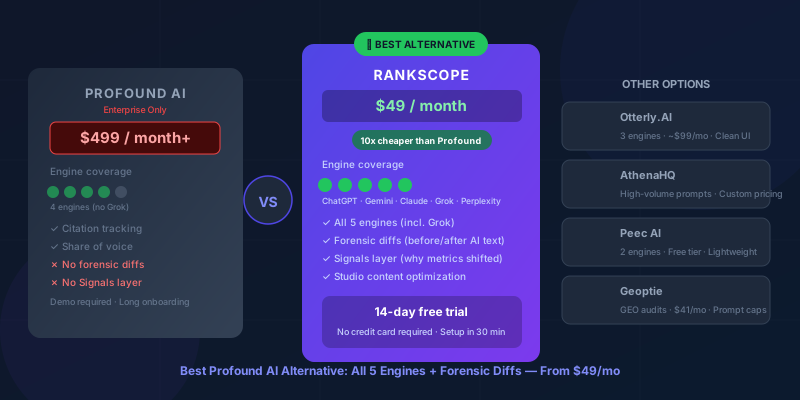
| Profound | Up to 9 on Enterprise, including Claude | Enterprise-grade depth + attribution | Custom (7-day free trial) | No |
| Rankscale.ai | 9 on Pro and up (incl. ChatGPT, Perplexity, AI Overviews, AI Mode, Gemini, Claude, Copilot) | Competitive share of voice | $17/mo billed yearly; Pro $99/mo | 7-day trial on Pro |
| Geoptie | Any 4 of 7 (ChatGPT, Claude, Perplexity, Gemini, Copilot, AI Mode, AI Overviews) | GEO content scoring + gap analysis | From $49/mo | Not stated |
| Suede Web Systems | ChatGPT, Perplexity, Gemini | Narrative/issue monitoring for regulated industries | Custom · Demo | Demo only |
The 6 Best AthenaHQ Alternatives in 2026
1. RankScope — Best Overall AthenaHQ Alternative
RankScope is the most practical alternative to AthenaHQ for teams that need accurate, actionable AI citation data without enterprise-tier overhead. It covers the four highest-traffic AI surfaces — ChatGPT, Google AI Overviews, Perplexity, and Google AI Mode — and adds capabilities that AthenaHQ's pricing page doesn't list.
The starting price is $49/month. That's not a stripped-down monitoring tier; the Starter plan gives you real citation data across ChatGPT and Google AI Overviews, share of voice metrics, and competitor tracking.
Real browser responses — the accuracy differentiator
This is the technical difference that matters most for teams that care about data fidelity. RankScope captures actual browser-rendered AI responses — the same thing a real user would see when they open Chrome and type a query. AthenaHQ doesn't say on its site whether it collects answers through APIs or real browser sessions.
For ChatGPT and Perplexity, the gap is small. For Google AI Overviews and Google AI Mode, it's significant. Google's AI interfaces render differently in live browser environments versus API responses. What a user actually sees — which citations appear, how your brand is referenced, what competitors are mentioned — can differ from what the API returns. If you're building an optimization strategy around Google's AI surfaces, you want data from the actual rendered environment, not the API layer.
Forensic diff tracking
When your citation rate changes, RankScope shows you the actual AI response text — on any two dates you choose — with changes highlighted. Which sentences appeared or disappeared? Which competitor got added? What framing changed? This is what turns metric changes from alerts into diagnoses. It's the difference between "your citation rate dropped 15% last week" and "here's the exact text that changed in the responses."
For teams actively doing generative engine optimization, forensic diffs are how you verify that content changes actually worked — and in which direction.
Signals + Studio: from tracking to action
Signals surfaces explanations for why your metrics moved — did a competitor start appearing in your query slots? Did the model's response structure change? Did a content update affect your citation pattern? Studio generates GEO quality scores for your content and produces specific action plans: what to rewrite, what factual gaps to fill, what format signals to strengthen.
AthenaHQ has content optimization features at the self-serve tier — but Studio is available in RankScope's Pro plan at $149/month, versus AthenaHQ's $295/month minimum.
Pricing: $49/mo Starter · $149/mo Pro · $399/mo Agency · 20% off annual · No setup fee · Cancel anytime
Best for: Startups through growth teams that need 4-engine AI citation tracking from day one. Agencies building GEO services for clients who need forensic evidence of optimization work. Teams that care specifically about accuracy on Google's AI surfaces.
Pros:
- 6x cheaper than AthenaHQ's paid Starter plan ($49/mo vs $295/mo)
- Real browser-rendered responses (not API outputs) — accuracy matters for Google AI surfaces
- Forensic diffs show exactly what changed in AI responses
- Signals + Studio connect monitoring to content action
- Self-serve, no demo required, no setup fee
Cons:
- 4 engines only — no Claude, Copilot, or Grok coverage
- Not a full workflow management platform (no AI content agent, no SAML SSO, no BI integrations)
- No free trial (cancel anytime, no setup fee)
2. Otterly.AI — Best for Mid-Market Teams
Otterly.AI is the clearest mid-market alternative in the category. Every plan covers ChatGPT, Google AI Overviews, Perplexity and Microsoft Copilot, with a polished dashboard that non-technical stakeholders can read and understand without training.
Price the add-ons before you evaluate it: Google AI Mode, Gemini and Claude are paid add-ons on Otterly (AI Mode is $9/mo on Lite, $59/mo on Standard). If both Google AI surfaces matter to your team, add that to the plan price. Our Otterly.AI pricing guide works through common setups.
With that said: if you want a clean tool your leadership team can read without training, Otterly.AI is genuinely good at what it does. The onboarding is fast and the competitive benchmarking is more accessible than most tools at this price point.
Key features:
- Brand mention tracking and citation rate across ChatGPT, Google AI Overviews, Perplexity and Copilot
- Competitive share of voice — multiple brands tracked side by side
- Clean dashboard designed for marketing directors and leadership reporting
- Trend visualization for citation rate over time
Pricing: Lite $29/month (15 prompts), Standard $189/month (100), Premium $489/month (400); engine add-ons extra (Otterly's pricing page, 20 October 2026)
Best for: Marketing and content teams at mid-size companies that prioritize clean reporting and want fast onboarding without platform complexity.
Pros:
- Best interface in the category for non-technical stakeholders
- Competitive benchmarking at a usable price point
- Fast to set up — operational within an hour
Cons:
- Google AI Mode is a paid add-on
- No forensic diff tracking
- No content optimization workflow
For a full breakdown, see our Otterly.AI alternative guide.
3. Peec AI — Best Lightweight Starting Point
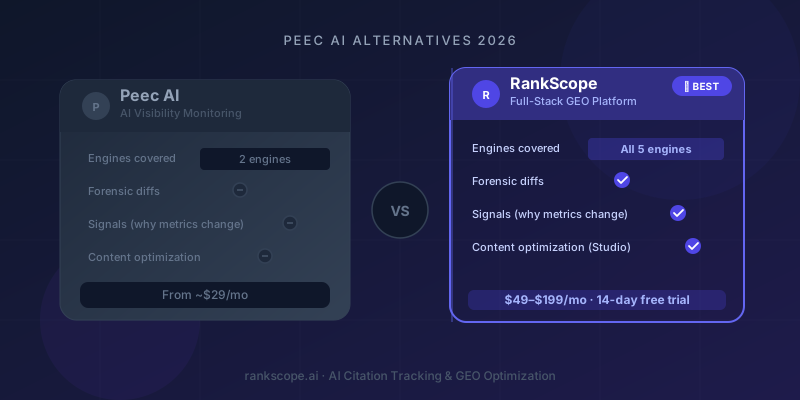
Peec AI is the entry-level option. Each self-serve plan tracks any 3 engines you choose from 8 models (ChatGPT, Perplexity, Google AI Overviews, Google AI Mode, Gemini, Naver AI Briefing, ERNIE and Bing AI Mode), with a simple interface; extra models are a paid add-on and Claude, DeepSeek and Grok are Enterprise only. Older comparisons, ours included, said Peec had a free tier; its pricing page shows none (checked 20 October 2026).
The limitations are clear: three engines per plan, no forensic analysis, no content optimization. But if you're establishing a first citation baseline on the engines you choose, Peec does that job.
Key features:
- Citation tracking on any 3 engines you choose
- Share of voice metrics vs. named competitors
- Lightweight, simple interface
Pricing: Starter $95/mo (50 prompts), Pro $245/mo, Advanced $495/mo; no free plan (Peec AI pricing)
Best for: Early-stage teams establishing their first AI citation baseline. Founders who want to understand what AI visibility data looks like before committing budget.
Pros:
- Flexible engine choice
- Very fast setup
- Good for understanding the category before scaling up
Cons:
- 3 included models per self-serve plan; extra models are a paid add-on and Claude is Enterprise only
- No forensic diffs or Signals
- No optimization workflow
- Limited scalability
See our full Peec AI alternative guide for a deeper comparison.
4. Profound — Best for Enterprise with Claude Coverage
Profound sits at the high end: custom Enterprise pricing through a demo, with no trial or self-serve plan shown (Profound pricing), built for large brands with dedicated SEO or AI search teams and real data infrastructure requirements. The data depth is genuine — broad engine coverage including Claude, high query volume, detailed attribution, and enterprise support.
If you're coming from AthenaHQ and specifically need Claude coverage, serious query volume, and enterprise-grade attribution — Profound is the most direct equivalent, though you will need a quote to compare price.
Key features:
- Deep AI response analysis across up to 9 engines on Enterprise: ChatGPT, Perplexity, Google AI Mode, Gemini, Copilot, DeepSeek, Claude, Google AI Overviews and Exa
- Enterprise-level attribution and reporting frameworks
- High query volume configurations
- Dedicated onboarding and support
Pricing: Free 7-day trial, then custom Enterprise pricing
Best for: Large brands with enterprise AI monitoring budgets. Organizations that specifically need Claude coverage. Companies that need enterprise-grade data infrastructure and have a dedicated team to run it.
Pros:
- Deepest data in the category
- One of the few tools with Claude coverage
- Enterprise-grade support and reporting
Cons:
- No published price; enterprise procurement — not viable for most growth teams
- No forensic diff tracking
- Requires setup time and team resources to get value
See our Profound AI alternative guide for a full breakdown.
5. Rankscale.ai — Best for Competitive Share of Voice
Rankscale.ai focuses specifically on share of voice — what percentage of relevant AI responses mention your brand versus named competitors across your category. If that competitive framing is the primary metric your leadership cares about, Rankscale has more depth on this specific use case than most tools.
Rankscale is self-serve and publishes its pricing. Earlier versions of this page said it required a demo; it does not (Rankscale pricing page, 21 October 2026).
Key features:
- Share of voice calculations across defined competitor sets
- Branded vs. unbranded query analysis
- Category-level visibility trends
- 9 engines on Pro and up: ChatGPT, Perplexity, Google AI Mode, AI Overviews, Gemini, DeepSeek, Mistral, Claude, Copilot
Pricing: Essentials $17/month billed yearly; Pro $99/month (7-day free trial); Pro+ $229; Growth $385; Enterprise $780
Best for: Teams focused on competitive positioning in AI search, category-level share of voice reporting, and organizations with significant benchmarking requirements.
Pros:
- Strongest competitive share of voice depth in the category
- Good for board-level AI visibility reporting
- Clear focus on the metrics that resonate with CMOs
Cons:
- Pro+ and above cost more than RankScope Professional
- No forensic diffs or content optimization
6. Geoptie — Best for Content Gap Analysis
Geoptie occupies a specific niche at the intersection of monitoring and content improvement. If your primary goal is improving existing content to rank in AI results — and measuring the impact of those improvements — Geoptie is worth a look. It scores content against GEO quality signals and surfaces specific topic gaps where competitors are cited and you aren't.
Key features:
- GEO content scoring for existing pages
- Topic gap analysis — where competitors appear and you don't
- Citation tracking across ChatGPT and Perplexity
- Optimization recommendations based on what's working in your category
Pricing: From ~$79/month; scales with query and content volume
Best for: Content teams actively publishing to improve AI visibility who need to measure impact. Teams doing a GEO audit and wanting to prioritize content updates systematically.
Pros:
- Strong content gap analysis layer
- Practical for content teams rather than just analysts
- Self-serve with transparent pricing
Cons:
- Two engines only
- Less competitive benchmarking depth
- Smaller brand — less community/ecosystem around it
7. Suede Web Systems — Best for Regulated-Industry Narrative Monitoring
Suede Web Systems has emerged in 2026 as a specialist player targeting a use case most GEO tools weren't built for: AI narrative monitoring for regulated industries and organizations managing complex public affairs issues. If you've been comparing AthenaHQ to Suede specifically, this section is for you.
Suede's positioning is distinct from the rest of this list. Where most GEO tools are built for marketing teams tracking product citations, Suede is designed for corporate affairs, government relations, and communications teams that need to monitor how AI models frame regulatory issues, siting disputes, litigation, and institutional reputation — not just brand mentions. Think energy companies, healthcare systems, law firms, and large corporations navigating regulatory scrutiny.
Key features:
- AI response monitoring across ChatGPT, Perplexity, and Gemini
- Framing and sentiment analysis for issues, not just brand names
- Market-by-market geographic monitoring (relevant for multi-jurisdiction regulated issues)
- Competitive intelligence framed around issue narratives rather than product categories
- Designed for corporate affairs and public affairs teams rather than marketing
Pricing: Custom; demo required. No self-serve option.
Best for: Large corporations, law firms, utilities, healthcare systems, and government-adjacent organizations that need to track how AI models frame complex institutional or regulatory issues — not standard product visibility monitoring.
Pros:
- Genuine specialization in regulated-industry narrative monitoring
- Issue-level framing analysis that most GEO tools don't offer
- Useful for teams where "brand citations" isn't the right frame (it's about issue framing and sentiment)
Cons:
- No self-serve — demo-only access
- No transparent pricing
- Not built for standard commercial GEO use cases (tracking product citations, monitoring branded search)
- No Google AI Overviews or Google AI Mode coverage
- Very different product than what most AthenaHQ users are looking for
The Suede vs. AthenaHQ question: If you're an enterprise marketing team that uses AthenaHQ for brand citation tracking and are evaluating Suede as an alternative — they're not really competing for the same use case. AthenaHQ is a GEO and marketing platform; Suede is an issues-monitoring tool for regulated industries. Teams that end up using both typically have a commercial GEO program (AthenaHQ or RankScope) running alongside Suede for their regulatory/public affairs monitoring.
RankScope vs. AthenaHQ: The Detailed Comparison
For teams specifically comparing these two, here's how they stack up across every dimension that matters.
Engine coverage
AthenaHQ: 11 models on its Starter plan (ChatGPT, Perplexity, Google AI Overviews, Google AI Mode, Gemini, Claude, Copilot, Grok, DeepSeek, Meta AI, Mistral); 5 on the free Essential plan.
RankScope: ChatGPT, Google AI Overviews, Perplexity, Google AI Mode (4 engines). Focused on the highest-traffic surfaces. No Claude, Copilot, or Grok.
The coverage gap is real. If you specifically need Claude or Copilot data — because those are the surfaces your audience uses, or because your enterprise stakeholders report on them — AthenaHQ, Rankscale, Geoptie and Profound all list Claude, and Otterly.AI includes Copilot on every plan. For most teams, the four engines RankScope covers represent the substantial majority of AI search volume.
Response accuracy
AthenaHQ: Collection method not stated on its site.
RankScope: Captures browser-rendered responses. Slower and more resource-intensive, but reflects what real users actually see. For Google AI Overviews and AI Mode specifically, browser-rendered data differs meaningfully from the API layer.
If your strategy prioritizes Google's AI surfaces (the fastest-growing part of the market), RankScope's approach gives you more reliable data about what's actually happening in live search.
Forensic diff tracking
AthenaHQ: Tracks metrics over time. Doesn't show you the actual AI response text before and after.
RankScope: Shows you the exact AI response text on any two dates, with changes highlighted. This is the diagnostic capability that separates monitoring from optimization.
Content optimization
AthenaHQ: Content optimization AI agent, content gap analysis, on-page and off-page GEO actions, brand voice enforcement. Feature-rich and AI-agent-driven.
RankScope: Signals (explains why metrics moved) + Studio (GEO quality scores + action plans). More focused; less full-workflow automation.
Price
AthenaHQ: free Essential plan; Starter $295/month; custom enterprise.
RankScope: $49/mo Starter · $149/mo Pro · $399/mo Agency. 6x cheaper than AthenaHQ Starter at entry level.
Platform complexity
AthenaHQ: Full GEO workflow management platform. SAML SSO, audit logs, BI integrations (Tableau, Power BI, Looker), unlimited seats with RBAC, dedicated GEO specialist (enterprise). Real infrastructure for large teams.
RankScope: Focused tracking and optimization tool. No SSO, no BI integrations. Fast to set up, fast to get value from.
The complexity question is about fit, not quality. AthenaHQ's feature set is appropriate for a 20-person digital marketing team running a coordinated AI search strategy. It's overhead for a 3-person startup that needs to know if they're getting cited.
How to Choose the Right AthenaHQ Alternative
You're a startup or early-stage team: RankScope Starter at $49/month. Get your citation baseline on ChatGPT and Google AI Overviews, understand the data, and move to Pro for all 4 engines as the channel proves ROI. If you want to see what AI visibility data looks like before spending anything, run our free AI visibility checker.
You're a growth team (10–100 person company): RankScope Pro at $149/month gives you multi-brand tracking, full Signals and Studio access, and enough query volume to run meaningful share of voice analysis. Otterly.AI is the alternative if you want a cleaner UI or Copilot coverage and don't need forensic diffs.
You're an agency: RankScope Agency at $399/month. Multiple client workspaces, forensic diffs (which are a compelling deliverable — you can show clients the exact AI response text before and after a content change), and Studio for action-oriented reporting. If you're building out GEO services for agency clients, this workflow is considerably cleaner than most tools in the category.
You're an enterprise brand with $500+ budget: Evaluate RankScope Pro alongside Profound and AthenaHQ. If Claude coverage matters to your stakeholders, look at AthenaHQ, Profound or Rankscale. If you care most about accuracy on Google AI surfaces and forensic analysis, RankScope Pro is the better fit. The $295/month price difference from AthenaHQ self-serve to RankScope Pro ($149/month) is real and recurring.
You specifically need broad model coverage: AthenaHQ Starter tracks 11 models, including Claude, Copilot and Grok, on a self-serve plan. Rankscale Pro covers 9 for $99/month, without Grok. If those platforms are material to your brand's AI search strategy, compare those two first.
Frequently Asked Questions
What is the best AthenaHQ alternative?
RankScope is the best AthenaHQ alternative for most teams. It costs $49/month versus AthenaHQ's $295/month, captures real browser-rendered AI responses (not API outputs), and adds forensic diff tracking that shows exactly what changed in AI responses between dates. For teams focused on ChatGPT, Google AI Overviews, Perplexity, and Google AI Mode — the four highest-traffic AI surfaces — RankScope covers everything that matters at a fraction of the price.
How much does AthenaHQ cost?
AthenaHQ has a free Essential plan (300 credits, 5 engines); its paid Starter plan is $295/month (3,600 credits, 11 models). Enterprise plans are custom-priced (AthenaHQ pricing page, 21 October 2026). For comparison, RankScope starts at $49/month Starter, $149/month Pro, and $399/month Agency, all with no setup fee and cancel anytime.
AthenaHQ vs RankScope — what's the difference?
The key differences: (1) Price — AthenaHQ $295/month vs. RankScope $49/month; (2) Response accuracy — RankScope uses real browser-rendered responses; AthenaHQ doesn't say how it collects answers; (3) Forensic diffs — RankScope shows actual before/after AI response text; AthenaHQ's pricing page doesn't list them; (4) Engine breadth — AthenaHQ Starter covers 11 models including Claude, Copilot, Grok; RankScope covers 4 (ChatGPT, Google AI Overviews, Perplexity, Google AI Mode); (5) Platform complexity — AthenaHQ is a full workflow management platform; RankScope is focused on tracking and optimization.
What does AthenaHQ do?
AthenaHQ is a GEO and AI search visibility platform that tracks brand citations across 11 models on its Starter plan (ChatGPT, Perplexity, Google AI Overviews, Google AI Mode, Gemini, Claude, Copilot, Grok, DeepSeek, Meta AI, Mistral). Beyond monitoring, it includes content optimization tools, an AI content agent, citation intelligence (the Athena Citation Engine uses ML to predict citation probability), competitive monitoring, and enterprise workflow features. It's rated 4.9/5 on G2 in the Answer Engine Optimization category (Spring 2026). A free Essential plan covers 5 engines; paid self-serve starts at $295/month.
What is the best AthenaHQ alternative for agencies?
RankScope's Agency plan at $399/month is the strongest option for agencies. It supports multiple client workspaces, full forensic diff tracking, Signals, and Studio content optimization. Forensic diffs are particularly valuable for agencies — you can show clients the exact AI response text before and after a content change, which is concrete evidence of GEO work that most clients haven't seen before.
The Bottom Line
AthenaHQ is a quality product. The 4.9/5 G2 rating is real. The 11-model coverage is real. The workflow management capabilities are real. If you're a larger organization running a serious, coordinated AI search program and you have $295/month to invest at the self-serve tier — it's worth evaluating on its own terms.
For everyone else — startups, growth teams, agencies, and mid-market companies who want actionable AI citation data without enterprise-level pricing or platform complexity — there's a better fit at a better price.
RankScope covers the four AI surfaces that drive the most real user volume (ChatGPT, Google AI Overviews, Perplexity, and Google AI Mode), captures data from actual browser-rendered responses for accuracy, adds forensic diffs that show you exactly what changed in AI outputs, and starts at $49/month with no demo and no setup fee. That combination — accuracy, depth, price — is the reason most teams switching from AthenaHQ land here.
The 6x price difference isn't trivial. At $49/month versus $295/month, you could run RankScope Starter for 6 months for the cost of one month of AthenaHQ's self-serve tier. For most growth teams, that's the right way to allocate AI search tooling budget before the channel has proven its ROI.
Ready to see your AI visibility data today? Get started with RankScope →