GEO for Digital Agencies: How to Track AI Visibility for Every Client
A client calls. They've been talking to a competitor. The competitor told them their brand shows up in ChatGPT every time someone asks about their category — and the client's brand doesn't. The client wants to know why, and what you're doing about it.
If you don't have a clear answer, you're behind.
This is the conversation that's happening at agencies right now, and it's happening faster than most shops anticipated. Buyers have shifted. A meaningful percentage of purchase research now runs through AI assistants before it ever hits Google. For brands that sell in considered categories — B2B software, professional services, high-consideration consumer products — the AI citation question is increasingly the highest-stakes visibility question they have.
Agencies that can track, explain, and improve client AI citations are adding a service line that clients genuinely want. Agencies that can't are going to be defending retainers they haven't earned.
What GEO for Agencies Actually Is
GEO for agencies is the managed-service version of Generative Engine Optimization (GEO) — tracking, improving, and reporting client brand citations inside AI-generated answers from ChatGPT, Google AI Overviews, Perplexity, and Google AI Mode.
In practice, this means three things:
- Measurement infrastructure — setting up citation tracking for each client across the relevant AI engines, with a query library built around the questions their actual buyers are asking
- Optimization work — using citation data to drive content and technical recommendations that improve how AI engines reference each client's brand
- Client reporting — translating citation data into the kind of clear, outcome-tied reporting that justifies budget and demonstrates agency value
The measurement and reporting layer is where most agencies are starting, because the value is immediately visible to clients and the setup time is low. The optimization work builds on top of that foundation.
Why Agency Clients Are Asking About This Now
Three things converged in 2025 and 2026 to make AI visibility a client-facing issue:
ChatGPT crossed 400 million weekly active users. At that scale, it's a meaningful discovery channel for brands in almost every B2B and consumer category. Clients who search their own brand name in ChatGPT and find a competitor instead are, reasonably, alarmed.
Perplexity is where research-oriented buyers go. Perplexity processes over 100 million queries per day, and its user base skews toward the educated, research-oriented professionals who are exactly the buyers many agency clients are targeting. Citation in Perplexity is direct, visible — Perplexity shows its sources inline — and increasingly influential for considered purchases.
Traditional rank reports no longer tell the full story. A client can rank position 3 for their target keyword in Google and still be getting almost no mentions in AI-generated answers about their category. Rank reports measure the Google game; they say nothing about the AI game. The clients who are asking about AI visibility have figured out that these are two different games.
The New Agency Deliverable: AI Citation Reporting
The most immediate GEO service most agencies can offer is AI citation reporting — a monthly deliverable that shows clients exactly where they stand in AI search and whether that's improving.
A complete AI citation report for a client covers four things:
1. Citation Rate Per Engine
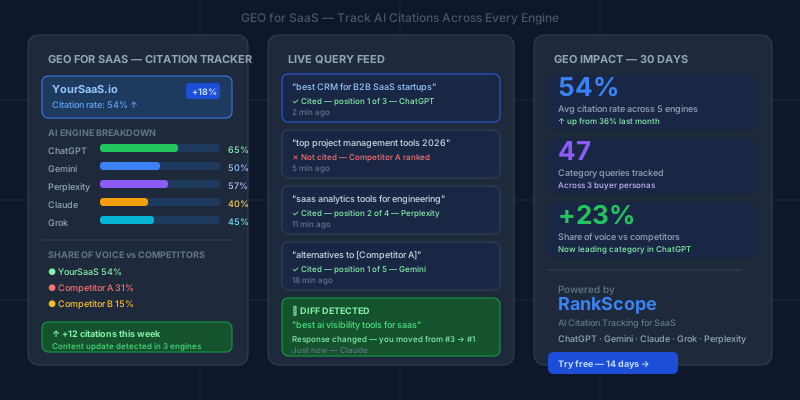
What it is: For each AI engine (ChatGPT, Google AI Overviews, Perplexity, and Google AI Mode, Grok), the percentage of the client's target query set on which their brand is cited in the AI-generated answer.
What it tells the client: "When your buyers ask AI tools about your category, here's how often your brand gets named on each platform."
Benchmark to set expectations: New brands with no GEO work done typically start at 0–15% citation rate. A well-optimized brand in a moderately competitive category can reach 30–60% over 6–12 months. Category leaders in AI search frequently hit 60%+.
Why engine-by-engine matters: Citation patterns vary significantly across platforms. A client's brand might have 65% citation rate on ChatGPT (driven by training data from before the cutoff) but 20% on Perplexity (which relies more on live RAG retrieval of current content). Those two situations have completely different fixes. Aggregating across engines hides the signal.
2. AI Share of Voice vs. Competitors
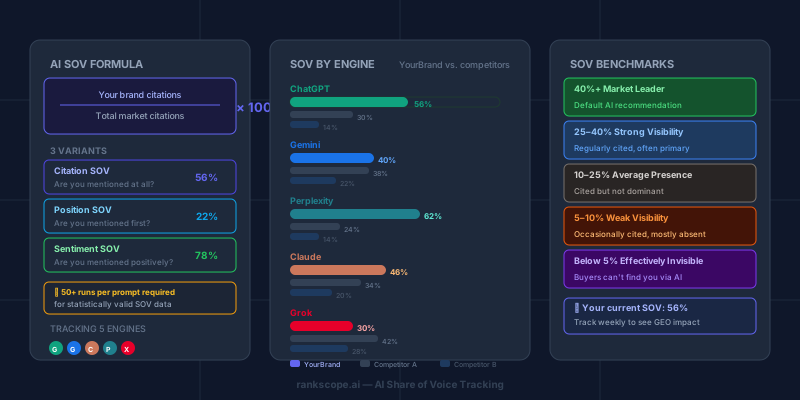
What it is: Of all brand mentions across the client's tracked queries, what percentage named the client vs. competitors.
Why it's the metric that lands with clients: Share of voice maps directly to the competitive framing clients already understand. "You have 38% AI share of voice in your category, Competitor A has 44%, Competitor B has 18%" is a number a CMO or founder can react to immediately.
How to calculate it: AI share of voice = (client brand citations) ÷ (all brand citations in category across tracked queries) × 100. Run the same query set for the client and their top three competitors. Compare. Track monthly.
What movement looks like: A share of voice shift of 5–10 percentage points over 90 days is meaningful. It takes sustained GEO work — content restructuring, entity clarity improvements, third-party corroboration — to move it, which is exactly the kind of ongoing work agencies are positioned to provide.
3. Citation Sentiment
What it is: Whether AI-generated mentions of the client are positive, neutral, or carry qualifiers ("can be expensive," "has a learning curve," "some users prefer competitors for X use case").
Why it matters for clients: A client being cited in ChatGPT answers is better than not being cited. But a client being cited with "while [Client A] is widely used, some users find the pricing opaque" is a conversion problem masquerading as a visibility win. Sentiment tracking separates citation volume from citation quality.
What agencies do with it: Negative or qualified sentiment in AI citations usually traces to specific content — a negative review on a comparison site, a community discussion about a known product limitation, or a competitor's comparison page that frames the client unfavorably. Identifying the source and addressing it (response content, updated positioning, proactive review generation) is concrete agency work.
4. Forensic Response Diffs
What it is: The exact changes in AI engine responses between this month's tracking run and last month's — new brands appearing, brands dropping out, qualifiers added or removed, order changes.
Why it matters for reporting: Diff data is the closest thing to an audit trail for AI visibility changes. When a client asks "what changed this month?" — you can show them specifically: "Perplexity added a competitor to the answer for 'best [category] tools for enterprise' that wasn't there in April. Here's the new sentence, and here's what we recommend to address it."
Without diff data, you're comparing two snapshots and guessing at what changed. With it, you have a specific, actionable story.
Setting Up Multi-Client GEO Tracking
The operational challenge for agencies is running citation tracking across five AI engines for multiple clients simultaneously without it becoming a manual research project every month.
RankScope is built for exactly this workflow — a multi-client GEO platform that handles the tracking infrastructure so agencies can focus on the interpretation and recommendations. If you're evaluating whether RankScope fits your agency's workflow, the RankScope for agencies page covers the multi-client workspace, white-label options, and agency-tier pricing in detail.
Step 1: Build the Query Library for Each Client
The query library is the foundation. For each client, define the 20–50 queries their buyers are most likely to ask AI engines. The query set typically includes four categories:
Category queries: "best [category] tools for [use case]," "top [category] platforms for [buyer segment]," "what's the best [product type]?"
Problem queries: "how do I [solve the problem the client's product addresses]," "what's the fastest way to [outcome]?"
Comparison queries: "[client brand] vs [competitor]," "alternatives to [competitor]," "[client brand] review"
Feature queries: "tools that [specific feature]," "[category] with [specific integration]"
Build this collaboratively with the client — they know what language their buyers use. The initial query library usually takes one client kickoff session. RankScope stores each client's library separately so queries don't bleed across accounts.
Step 2: Configure Engine Coverage and Frequency
Not every client needs every engine tracked at the same frequency. General rule of thumb for agency setup:
B2B SaaS clients: All five engines, weekly tracking. Buyer behavior is heavily AI-research-driven, and Perplexity is particularly important for professional tool decisions.
Consumer brands: ChatGPT and Gemini as primary. Grok if the client has strong social media presence. Weekly or bi-weekly.
Professional services (law, finance, healthcare): ChatGPT and Perplexity as primary (both are used for professional research), Claude for enterprise context. Bi-weekly is sufficient for most.
E-commerce: ChatGPT and Perplexity. Gemini for Google Shopping adjacent queries. Weekly during peak consideration periods.
Step 3: Define the Competitive Set
For each client, identify the three to five competitors whose citation rates you'll track alongside the client's. This is what feeds the share of voice calculation.
Choose competitors based on what the client already tracks in traditional SEO reporting — this makes AI share of voice data immediately contextual for clients who already have a mental model of their competitive landscape. You're adding a new dimension to a conversation they already know how to have.
Step 4: Establish the Reporting Cadence
Monthly is the standard for GEO reports, for the same reasons monthly is standard for SEO reports: it gives enough time for changes to show meaningful movement while staying frequent enough to be actionable.
The report structure that works for most agencies:
- Executive summary — citation rate this month vs. last month per engine (3–5 bullet points)
- Share of voice chart — client vs. top 3 competitors, trended over 3–6 months
- Notable diffs — specific AI response changes flagged, with context
- Recommended actions — 2–3 specific content or technical changes based on what the data shows
- Progress on last month's recommendations — closes the loop on previous work
The GEO Optimization Work That Moves the Numbers
Reporting is the delivery mechanism. The actual agency value is the optimization work that improves the numbers in the report. There are five levers agencies work for clients, in roughly this priority order:
Lever 1: Technical AI Crawler Access
Before any content work, verify that AI crawlers can actually reach the client's site. If GPTBot, ClaudeBot, or PerplexityBot are blocked in robots.txt, no amount of great content will improve RAG-based citation rates.
Check: curl -s https://[client-domain]/robots.txt | grep -i "GPTBot\|ClaudeBot\|PerplexityBot"
If blocked, add explicit allow rules. This is a 15-minute fix that unlocks all subsequent optimization work. See the complete GEO checklist for a full technical audit list.
Lever 2: Entity Clarity on Key Pages
The single most common reason a client brand isn't being cited by AI engines is unclear entity positioning. If the homepage doesn't unambiguously state what category the brand is in, what problem it solves, and who it serves — AI systems can't confidently include it in a category answer.
The test: read the first two sentences of the client's homepage. Without any additional context, could an AI system place this brand in a specific product category? If the answer is "maybe" or "it depends on reading further," the entity clarity is insufficient.
Common agency fix: rewrite the hero section and the main meta description to make category, problem, and audience explicit. "We help businesses work smarter" → "[Client] is a [category] platform for [specific buyer segment] that [specific outcome]." Same message, extractable entity signal.
Lever 3: Content Structure on High-Value Pages
AI engines retrieve content and synthesize it into answers. The content that gets extracted and cited is structured to lead with direct answers, not build to them. This is the most common structural gap in client content.
The pattern to fix: most content buries the answer in paragraph three after three paragraphs of context-setting. This is how humans write for persuasion — but AI systems extract from the top of sections, not from the conclusion. Restructure high-value pages so every section leads with the claim, then follows with the evidence and context.
For agency clients, audit the five pages most relevant to their primary AI queries first. Restructuring those five pages usually has more impact than writing ten new ones.
Lever 4: Third-Party Corroboration
AI engines don't take a brand's own claims at face value. They cross-reference against third-party sources. For agency clients, the most actionable corroboration sources are:
- G2, Capterra, TrustRadius — review profiles with category-consistent language (the review platform's category tag should match the language the client uses on their own site)
- Comparison and alternative content — posts like "[client brand] vs [competitor]" on third-party sites, or directory listings that place the client in competitive context
- Community mentions — Reddit, Slack communities, LinkedIn discussions where real users recommend the client's brand
The agency play: identify which corroboration sources the client is weak on, and drive an outreach campaign. G2 review requests to existing customers, submissions to relevant comparison sites, getting listed in category roundups. These are standard agency activities; the GEO framing gives them a data-backed prioritization layer.
Lever 5: Original Data and Research Content
AI engines strongly prefer to cite specific, verifiable statistics — numbers with sources. Original research content that produces citable data (survey results, platform benchmarks, analysis of industry data) earns disproportionate AI citations relative to the word count.
For agencies managing content programs, this means one original research piece per quarter per client is worth ten general-purpose blog posts for GEO purposes. The barrier is production: clients often don't have the data, don't want to share it, or don't see the value. The agency role is framing it correctly — "one data post that gets cited in AI answers every time someone asks about your category for the next 12 months" is a concrete output that most clients understand.
Positioning GEO as an Agency Service
The agencies winning GEO business right now are not the ones who have been doing GEO for years (the discipline is less than three years old). They're the ones who moved fastest to package it clearly.
The service positioning that's working:
"AI Visibility Audit + Retainer" — a one-time audit ($1,500–$3,000) that benchmarks current citation rate and share of voice, identifies the top gaps, and produces a prioritized action plan. This converts to a monthly retainer that includes ongoing tracking, optimization work, and reporting.
"GEO Add-On to SEO Retainer" — existing SEO retainer clients get AI citation tracking added for $400–$700/month depending on scope. The data from GEO tracking informs some of the content decisions in the SEO program anyway, so the overlap is genuine value, not upsell.
"Monthly AI Report" — for clients who are hesitant to commit to optimization work but want the data, a standalone reporting service at $300–$500/month. Low barrier to entry; many clients who start here add the optimization work within 60–90 days once they see their share of voice lagging a competitor.
The key pricing principle: RankScope Agency at $399/month covers multiple brands. If an agency has five clients on a GEO retainer at $500/month each, the tool cost is less than 16% of the revenue line. Margins are strong.
What to Lead With in Client Conversations
The framing that opens the most doors: "Your brand is being evaluated by AI before it hits your website. Do you know what ChatGPT and Perplexity say about you right now?"
Most clients haven't checked. Ask them to. Open ChatGPT and type "best [their category] tools for [their use case]." Show them the results in real time. Whether their brand appears or doesn't, the reaction is the same — they want to understand and improve it.
Follow that with: "We track this across all five AI engines, measure how you compare to your competitors, and report it monthly. Then we do the work to move the numbers."
That pitch is clear, specific, and maps to a pain point clients already feel. It doesn't require educating them on SEO history or explaining why traditional rankings are insufficient. The AI visibility gap speaks for itself.
GEO vs. Traditional SEO: The Agency Value Comparison
A question that comes up in agency sales calls: if a client's Google rankings are strong, why does AI visibility matter separately?
The honest answer is that they're measuring two different things, and strong Google rankings don't reliably translate to strong AI citations.
| Dimension | Traditional SEO | GEO for Agencies |
|---|---|---|
| What you're optimizing for | Google keyword rankings | AI engine citation rate |
| Primary success metric | Organic traffic + position | Citation rate + AI share of voice |
| Key signals | Backlinks, domain authority | Content structure, entity clarity, corroboration |
| Measurement tool | Google Search Console, rank tracker | GEO platform (RankScope) |
| Reporting cadence | Monthly rank report | Monthly AI citation report |
| Timeline to results | 3–12 months | 4–12 weeks for citation rate changes |
| Client visibility into the data | GSC dashboard (client has access) | Agency-curated report (agency owns the story) |
The last row is worth noting from an agency business perspective. Clients have direct access to Google Search Console. They can check their own rankings. They may not need the agency to tell them that position 4 improved to position 3. AI citation data is less accessible — most clients have no idea how to check it systematically across five engines. The agency that owns that data owns the narrative.
Both strategies reinforce each other when run in parallel. A brand with strong Google SEO has higher domain authority, which AI systems use to evaluate trustworthiness. A brand with well-structured, entity-clear content improves its Google performance while simultaneously improving AI citation rates. The best GEO tools for agencies are ones that complement the existing SEO stack rather than replacing it.
How RankScope Fits Into the Agency Stack
RankScope is a GEO platform built for tracking brand citations across ChatGPT, Google AI Overviews, Perplexity, and Google AI Mode. For agencies, the relevant capabilities are:
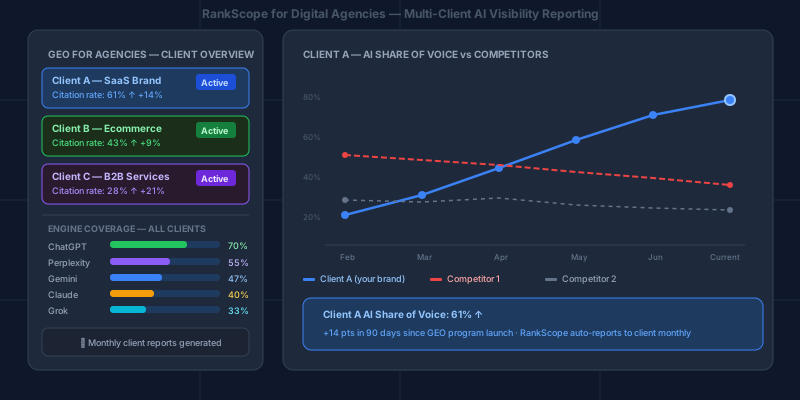
Multi-brand management — each client gets a separate brand workspace. Query libraries, engine configurations, and citation data are siloed per client. No cross-contamination of data, no single account-level view that clients might accidentally see.
Coverage of the 4 key engines — the most common limitation of cheaper alternatives is single-engine tracking (usually just ChatGPT). Citation patterns differ significantly across engines; agencies need Google AI Overviews, Perplexity, and Google AI Mode alongside ChatGPT to deliver an honest picture. A client that's strong in ChatGPT but absent from Google AI Overviews has a different problem from a client that's weak across the board.
Forensic diff detection — the feature that makes monthly reporting tell a story rather than just present numbers. When an AI response changes between tracking runs, RankScope flags the exact change. This is what lets agencies say "Google AI Overviews added a new competitor to the recommended list for your primary category query in April — here's what we're doing about it."
Share of voice tracking — competitive context built into the data. Agencies configure the competitor set per client and get client-vs-competitor share of voice automatically, eliminating manual comparison across separate brand accounts.
Exportable data — citation data can be exported for inclusion in custom client reports or combined with traditional SEO reporting in whatever format the agency uses.
RankScope starts at $49/month for a single brand. No setup fee · cancel anytime. For agencies running multiple clients, the Agency tier at $399/month covers multiple brands. Most agencies start with two or three GEO clients, validate the reporting workflow, then expand.
The Window for Differentiation Is Open — But Not for Long
GEO as a trackable, reportable agency service is still early. Most agencies are in one of two places: they haven't started yet, or they're doing ad hoc AI checks without a systematic framework. The agencies that have built a proper GEO practice — measurement infrastructure, optimization playbook, client-facing reporting — are a small minority.
That minority is winning new business and defending existing retainers. The window to be in that group is open, but it's closing. SEO platforms are adding AI citation features. Enterprise agencies are building GEO teams. The AI visibility question is moving from "interesting new thing" to "table stakes" faster than most industry shifts do, because the client pressure is direct — they can literally open ChatGPT and see the gap themselves.
The agencies that add GEO systematically now — even starting with two or three clients and a simple monthly report — are building the expertise and the proof points that let them sell it confidently as the market demand matures. The agencies that wait are building a catch-up problem.
For the full framework on what GEO work actually moves AI citations, start with how to optimize content for AI search and the GEO for SaaS guide for a parallel look at how the client side of this conversation is evolving. For agencies with ecommerce clients, the GEO for ecommerce guide covers the specific citation signals and tracking setup for product-centric brands.
Frequently Asked Questions
What is GEO for agencies?
GEO for agencies is the practice of tracking, improving, and reporting client brand citations inside AI-generated answers from ChatGPT, Google AI Overviews, Perplexity, and Google AI Mode as a managed service. Agencies that offer GEO services monitor citation rate, AI share of voice, and citation sentiment for each client, then use that data to drive content and technical optimization work that improves how AI engines reference each client's brand.
How do agencies track AI citations for multiple clients?
Agencies use a GEO platform like RankScope to manage citation tracking across all clients from a single workspace. Each client gets their own query library — the 20–50 queries their buyers are most likely to ask AI engines. RankScope runs those queries across ChatGPT, Google AI Overviews, Perplexity, and Google AI Mode on a set schedule, and the resulting citation data — rate, share of voice, sentiment, and response diffs — is available per client for reporting.
What should agencies include in an AI visibility report for clients?
A client AI visibility report should include: citation rate per AI engine (the % of target queries for which the client is mentioned), AI share of voice vs. named competitors (client citations as a % of all brand citations in the category), citation sentiment trend (whether mentions are becoming more positive or acquiring qualifiers), and forensic diffs (which AI responses changed since last month and how).
How much does GEO reporting add to an agency retainer?
Agencies typically price GEO reporting as an add-on to existing SEO retainers, ranging from $300–$800/month per client depending on scope. RankScope Agency at $399/month covers multiple brands — a fraction of the retainer revenue if the agency has even two or three clients on a GEO add-on.
Which AI engines matter most for client GEO tracking?
All five major AI engines matter, but priorities vary by client vertical. ChatGPT (400M+ weekly active users) and Perplexity (100M+ daily queries) are highest priority for most B2B clients. Gemini is critical for consumer and Android-heavy audiences. Claude is gaining enterprise adoption and matters for professional services clients. Grok is relevant for clients with active Twitter/X communities.
Is GEO different from traditional SEO for agency clients?
Yes, significantly. Traditional SEO for agency clients means improving Google keyword rankings — measured by position and organic traffic. GEO for agency clients means improving AI citation rates — measured by how often the client is named in AI-generated answers and what share of the competitive conversation they own. The two strategies are complementary and agencies should run both in parallel.