What is Generative Engine Optimization (GEO)?
Search has changed. When someone asks ChatGPT "what's the best project management tool for remote teams?" they don't get ten blue links. They get a paragraph. Maybe two. A handful of brands get named. The rest don't exist.
That's the shift Generative Engine Optimization is built for.
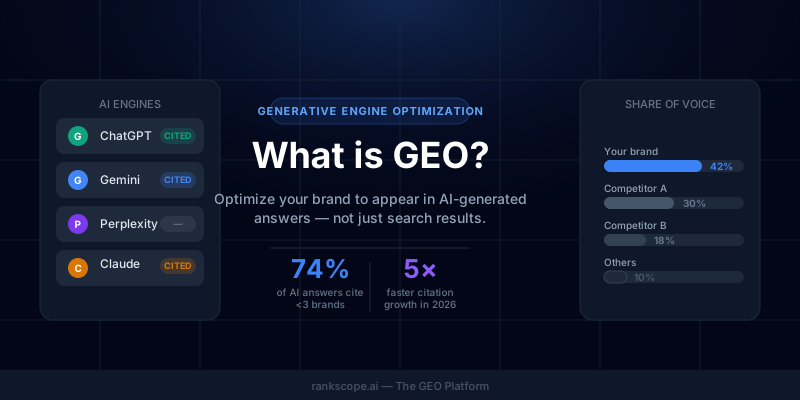
Generative Engine Optimization (GEO) is the discipline of optimizing your content, brand, and digital presence so that AI search engines cite you when answering queries relevant to your business. Not ranking on page one. Being in the answer. (New to GEO? Our AI search glossary covers every term you'll encounter.)
Why GEO Is Different from SEO
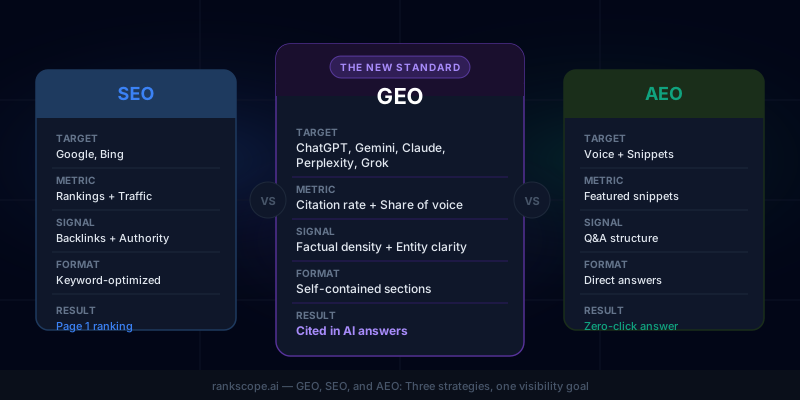
Traditional SEO gets you ranked in a list. GEO gets you cited in a synthesized response.
When Google returns ten blue links, every result gets a chance — users scroll, click, compare. When ChatGPT or Perplexity answers a question, it typically names two or three sources. Everyone else is invisible.
The optimization signals are also fundamentally different:
| Signal | Traditional SEO | GEO |
|---|---|---|
| Primary ranking factor | Backlinks + authority | Content structure + factual density |
| Content format | Keywords + headers | Direct answers + entity clarity |
| Measurement | Rankings + traffic | Citation rate + share of voice |
| Target platform | Google, Bing | ChatGPT, Google AI Overviews, Perplexity, Google AI Mode |
| Discovery mechanism | Crawl + index | Training data + RAG retrieval |
GEO doesn't replace SEO — a strong search presence helps AI systems trust you as a source. But GEO requires a separate strategy, separate metrics, and separate content standards. For a full breakdown of how the three disciplines compare, see GEO vs SEO vs AEO.
How AI Search Engines Decide What to Cite
Understanding why AI systems cite some brands and not others is the foundation of GEO.
Large language models like GPT-4 and Claude are trained on enormous datasets of web content. What they learned during training shapes their baseline understanding of which sources are authoritative on which topics. But modern AI search tools (ChatGPT with Browse, Perplexity, Bing Copilot, Google AI Overviews) also do real-time retrieval — they fetch fresh web content before generating their answer. If you want to understand how these AI search engines work at a fundamental level — what RAG is, how they synthesize answers, how they differ from traditional search — our guide to what AI search is explains it from the ground up.
So citations come from two places:
-
Training data — If your brand was well-represented in the data these models trained on, they may cite you from memory. This is harder to influence after the fact. (Each model's training data ends at a specific date — GPT-4o cuts off at October 2023, for example. See our ChatGPT knowledge cutoff guide for the full breakdown.)
-
Retrieval-Augmented Generation (RAG) — The AI queries the web in real time, retrieves relevant pages, and synthesizes them into an answer. This is where GEO work pays off immediately.
For RAG-based citations, AI systems heavily favor content that is:
- Factually dense — specific data, numbers, and definitive statements over vague generalities
- Directly answerable — the answer to the likely question appears clearly near the top of the section
- Well-structured — clear headings, clean HTML, logical hierarchy
- Trustworthy — published on a domain with existing authority signals
- Self-contained — each section makes sense on its own, without requiring context from the rest of the page
A page that takes four paragraphs to get to its point is unlikely to be cited. A page that leads with a direct, specific answer and backs it up with data gets cited.
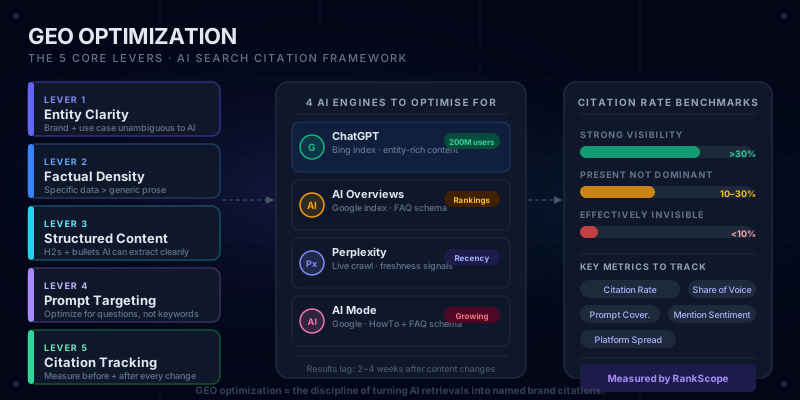
The Five Pillars of GEO
1. Content Structuring for AI Extraction
AI systems extract answers at the section level. They don't read your full post — they pull the segment most relevant to the query. That means every H2 section needs to stand alone: a clear question or topic as the heading, a direct answer in the first sentence, supporting detail below.
The format that gets cited most often: question as heading → direct answer → specific supporting data → brief elaboration. Think of it as writing for someone who will only ever see one paragraph of your page.
2. Entity and Topic Authority
AI models think in entities — named things with attributes and relationships. "RankScope" is an entity. "Generative Engine Optimization" is an entity. Your brand needs to be clearly associated with the right entities in your content, your schema markup, your author profiles, and your third-party mentions.
The more consistently you appear alongside the key entities in your space — across your own site, in press coverage, in community discussions — the more likely AI systems are to recognize you as an authoritative source on those topics.
3. Factual Density and Original Data
AI systems strongly prefer content with verifiable, specific claims. "Most companies struggle with AI visibility" is weak. "74% of ChatGPT responses name fewer than three brands for any given product category" is citable.
Original research is the highest-value content format for GEO. If your product generates data, publish it. If you've run a study, cite the numbers. Specificity is the signal. For a grounding-level view of where AI search sits today — how fast ChatGPT is growing, how many brands are invisible in AI Overviews, what citation rates actually look like — our GEO statistics post compiles 47 data points from primary sources.
4. Multi-Platform Presence
Different AI platforms retrieve and weight content differently:
- ChatGPT (with Browse enabled) retrieves from Bing's index. Strong Bing SEO and IndexNow submission helps.
- Perplexity retrieves aggressively from live web content. Fast-loading pages with clean markup perform better.
- Google AI Overviews draws from Google's index. Top-10 Google rankings are a significant advantage here.
- Claude (via claude.ai) retrieves when given tools access. Anthropic trains on Common Crawl data, so web presence matters.
- Grok uses X/Twitter data alongside web retrieval. Social mentions and discussions factor in.
A GEO strategy needs to account for each platform's retrieval behavior, not just optimize for one.
5. Monitoring and Iteration
Unlike traditional SEO rankings, AI citations aren't visible in any standard analytics tool. GA4 doesn't show you that Perplexity cited your blog post 47 times this week. Server logs show bot traffic from PerplexityBot and GPTBot, but not what they cited or why.
This is the measurement gap GEO tools like RankScope solve. Tracking your citation rate — how often you appear when relevant queries are asked — across each AI platform is the only way to know if your GEO work is having an impact. See how RankScope's platform handles this across Perplexity, ChatGPT, Google AI Overviews and Google AI Mode, or read the how RankScope works page for the full technical explanation of why real browser responses give you more accurate citation data than API-based tools. If you're evaluating which GEO monitoring tool to use, our guide to the best GEO tools in 2026 covers nine platforms with real pricing and honest pros/cons — our LLM SEO tools comparison goes even deeper on the tracking and optimization category — and our broader AI visibility tools comparison covers the full landscape including Evertune, Ahrefs Brand Radar, and more.
If you're also looking to speed up your SEO production — keyword research, content briefs, schema markup, redirect maps — see our guide on using ChatGPT for SEO as a productivity tool.
Key GEO Metrics to Track
Once you're optimizing for AI visibility, these are the numbers that matter:
Citation Rate — What percentage of relevant queries include a mention or citation of your brand? A brand with a 35% citation rate on "project management tools" queries appears in 35 out of every 100 answers when that topic comes up.
Share of Voice — Of all citations across your tracked queries, what percentage name your brand vs. competitors? If the AI mentions five tools in most answers and you appear in 20% of those mentions, your share of voice is 20%.
Mention Sentiment — Are citations neutral, positive, or negative? AI systems sometimes cite brands in the context of limitations or complaints. Monitoring sentiment tells you whether citations are helping or hurting.
Citation Source — Which of your pages are getting cited? Understanding what content earns citations lets you replicate the format and structure that's working.
Platform Coverage — Are you being cited on ChatGPT but invisible on Perplexity? Platform-by-platform tracking identifies where your GEO gaps are.
GEO vs. AEO: What's the Difference?
Answer Engine Optimization (AEO) is a related term that predates the current wave of LLM-powered search. It originated with featured snippets and voice search — optimizing to be the direct answer in a search result.
GEO is broader. It encompasses:
- Citation tracking across multiple AI platforms (not just Google)
- Share of voice monitoring vs. competitors
- Model-specific optimization (what works for Perplexity may differ from ChatGPT)
- Brand sentiment in AI-generated content
- Training data influence strategies
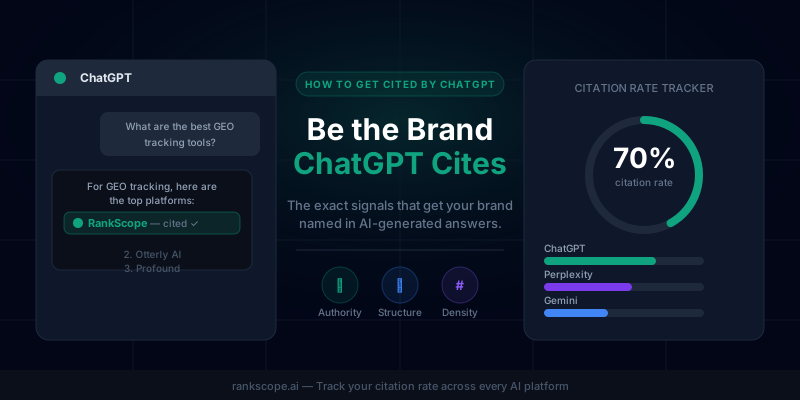
AEO is essentially a subset of GEO. If you're optimizing for featured snippets, you're doing a narrow form of GEO. The full discipline goes further. For a complete breakdown of what AEO covers and how it connects to GEO, see what is answer engine optimization. For specific tactics on earning citations, read how to get your brand cited by ChatGPT.
You'll also see the discipline called AI search engine optimization — the same practice, framed around the search behavior shift rather than the generative output. All three terms (GEO, AEO, AI SEO) describe the same strategic goal: being cited in AI-generated answers rather than merely ranked in a list.
Who Needs GEO?
Any brand that competes in a space where buyers ask AI assistants for recommendations needs a GEO strategy. That's increasingly every B2B and consumer category.
The urgency is higher for:
- SaaS and software products — Buyers routinely ask "what's the best tool for X?" to ChatGPT before starting a trial. See our full guide to GEO for SaaS companies for the SaaS-specific playbook.
- Professional services — "Best [type] agency in [city]" queries are moving to AI
- E-commerce — Product comparison queries are increasingly answered by AI before Google
- Healthcare and finance — High-trust categories where AI citations carry significant weight
The brands that build GEO authority now will be much harder to displace than those who start in two years. AI models learn from the web, and the web learns from AI citations — early presence compounds.
Getting Started with GEO
The practical starting points:
-
Allow AI crawlers — Check your robots.txt. GPTBot, ClaudeBot, PerplexityBot, and Googlebot-Extended should all be allowed. Blocking them means the platforms can't retrieve your content. Then run a free AI visibility checker to see whether the engines cite you today.
-
Audit your content structure — For your most important pages, does each section lead with a direct answer? Is the content specific and data-backed or generic?
-
Add structured data — FAQ schema, Article schema, and Organization schema all help AI systems understand what your content is and who published it.
-
Establish a citation baseline — Before optimizing, you need to know where you stand. Run your key queries through ChatGPT, Perplexity, and Gemini and record whether your brand appears. Or use a GEO platform like RankScope to track this automatically across hundreds of queries.
-
Prioritize original data — If your product or business generates data others don't have, publish it. Nothing gets cited more reliably than original research.
-
Monitor consistently — GEO isn't a one-time optimization. AI models update, retrieval algorithms change, and competitors publish new content. Weekly monitoring is the minimum. Our step-by-step GEO checklist walks you through the full setup process.
Generative Engine Optimization is the newest and fastest-growing discipline in search marketing. The brands building GEO programs today are getting cited in millions of AI-generated answers. The ones waiting are disappearing from them.
RankScope tracks your brand's citation rate, share of voice, and AI visibility across ChatGPT, Google AI Overviews, Perplexity, and Google AI Mode — all in one dashboard. Get started and see where you stand.
For the practical side, see AI visibility optimization: the levers that move citation rate, and one that turned out not to.