What Is Answer Engine Optimization (AEO)?
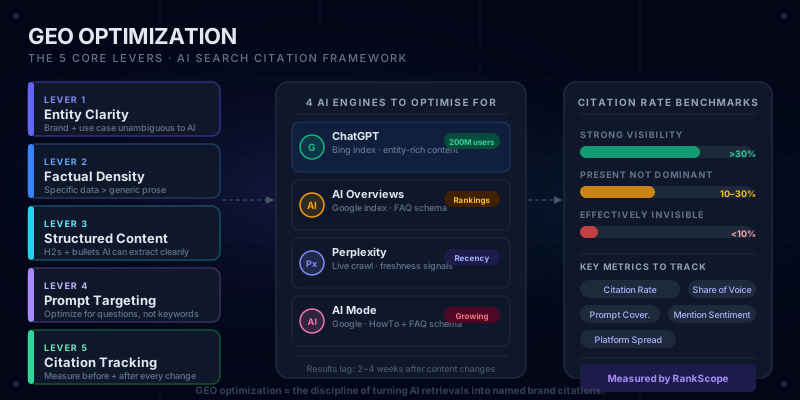
Answer Engine Optimization (AEO) is the practice of structuring content and building brand signals so that AI answer engines, such as ChatGPT, Google AI Overviews, Perplexity and Google AI Mode, can extract, summarize and cite your brand when someone asks a question. Where SEO targets a ranked list of links, AEO targets the answer that appears in place of the list.
That is the definition. The rest of this page covers how answer engines decide what to cite, what to change on your own pages, and how to tell whether it worked.
One disclosure first. An earlier version of this page, published in March, told readers to add FAQ schema to every page as one of the most effective moves in AEO. We later checked Google's own documentation and found that advice had been wrong since 2023, for us and for most sites reading it. We have rewritten the page, and the correction is part of the material below.
What Counts as an Answer Engine
An answer engine is any system that responds to a question with a synthesized answer rather than a list of links to choose from.
The term predates large language models. Around 2014 to 2016 it mostly meant Google's featured snippet (the boxed "position zero" answer) and voice assistants reading one of those snippets aloud. In 2026 the category is much wider:
| Surface | What the user sees | Where the answer comes from |
|---|---|---|
| Google AI Overviews | A generated summary above the organic results, with source links | Pages in Google's index |
| Google AI Mode | A conversational answer that replaces the results page | Pages in Google's index, with follow-up questions |
| ChatGPT | A chat answer, with citations when it searches the web | Its own web search plus what the model learned in training |
| Perplexity | A cited answer built from a live web search | Fresh retrieval on each query |
| Microsoft Copilot, Gemini, Claude | Chat answers, with sources when they browse | A mix of retrieval and training data |
| Featured snippets and voice assistants | One extracted passage, sometimes read aloud | A single page already ranking on page one |
The last row is where AEO started. Everything above it is where most of the work now happens.
Google's own AI Overview for the query "answer engine optimization", which we pulled on September 25, 2026, lists ChatGPT, Google AI Overviews, Perplexity, Microsoft Copilot and voice assistants as the platforms AEO targets. Featured snippets do not appear in it at all.
AEO, GEO, AI SEO: One Job, Three Names
Here is an opinion we hold and could be wrong about: in 2026, AEO and Generative Engine Optimization (GEO) are the same practice under two labels.
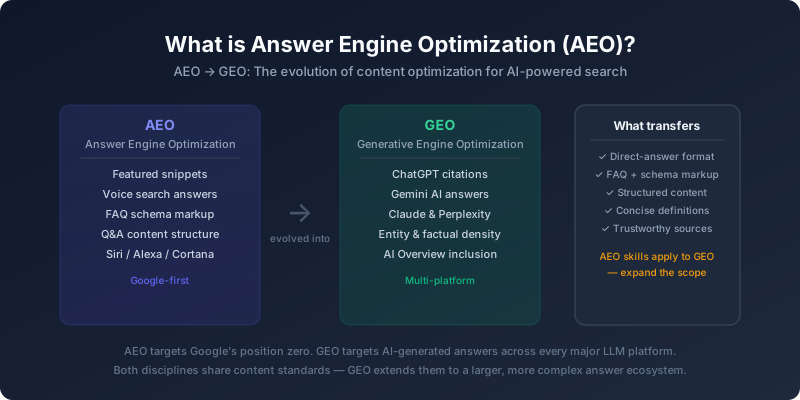
The older version of this page drew a firm line. AEO was Google-centric (featured snippets, voice, schema) and GEO was the multi-platform expansion (ChatGPT, Perplexity, entity signals). That distinction made sense in 2023. It does not describe how the terms are used now.
Read the definitions on the current results page side by side. HubSpot defines AEO as "the practice of improving how often and how accurately your business appears in AI-generated answers." Profound defines it as "the process of ensuring that a brand, product, or service is accurately represented in AI-generated" responses. Swap "AEO" for "GEO" in either sentence and nothing breaks. We define GEO as getting your brand cited in AI-generated answers from the same engines in our guide to generative engine optimization.
So why do both terms survive? Mostly lineage. Marketing platforms and content teams that came from featured-snippet work tend to say AEO. Tools and researchers that came from the academic GEO paper tend to say GEO. "AI SEO" and "LLM SEO" are the same thing again, used by people who see it as an extension of search engine optimization.
The one distinction still worth keeping is mechanical, not about vocabulary:
- Extraction (featured snippets, voice): the engine lifts one passage from one page that already ranks.
- Synthesis (AI Overviews, ChatGPT, Perplexity): the engine reads several sources, including ones off your site, and writes a new answer that may cite you, paraphrase you, or name you without linking at all.
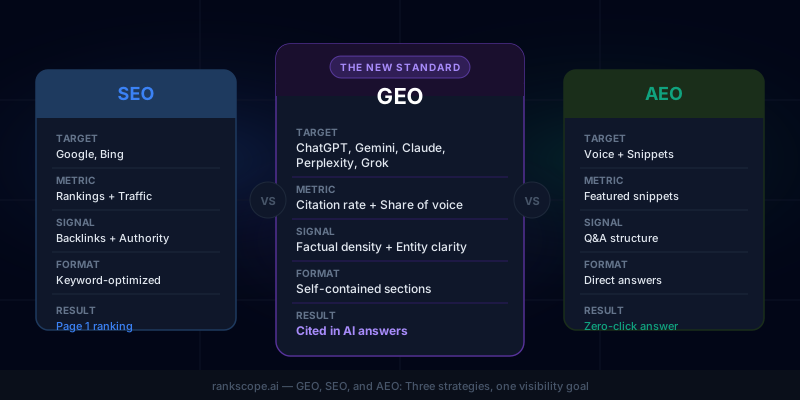
Most of what follows applies to both. Where it applies to only one, we say so. For how both compare with SEO, including a results page where ranking and citation diverge, see GEO vs SEO vs AEO.
How Answer Engines Decide What to Cite
Every synthesized answer goes through roughly three stages. You can lose at any of them, and the fixes are different at each one.
1. Retrieval: can the engine find your page at all?
This is the stage most AEO guides skip, and it is where we lost the most.
Google's AI Overviews and AI Mode draw on pages in Google's index. A page that is not indexed cannot be cited there, no matter how well it is written. In September 2026 we audited our own site and found 11 of 92 URLs that Google had not indexed. Every one of them was invisible to Google's AI answers, whatever we did to the copy.
We tested five technical explanations for those 11 pages (the sitemap blocked to crawlers, pages missing from the sitemap, pages not serving, pages with no internal links, and crawl lag on new posts) and ruled out all five. Internal links did not even separate the groups: indexed pages had a median of 6.0 pointing at them, unindexed pages 6.5. Our best explanation, which we have not proven, is that Google spends less crawl effort on a site with little authority. If that is right, no amount of on-page AEO work fixes it.
So check this first. Search Console's URL Inspection tool will tell you whether a page is indexed. If it is not, formatting work on that page is wasted until it is.
2. Extraction: can the engine lift a clean answer from your page?
Once a page is retrieved, the engine looks for the passage that answers the question. It does not read your page the way a person does. It will not wait three paragraphs for the point, and it will not infer what a vague sentence meant.
A page is easy to extract from when:
- the answer to the heading's question is in the first sentence under that heading
- each section makes sense on its own, without the paragraph before it
- the claim is specific: a named tool, a number, a date, a condition
- the terms stay consistent (if you call it "AEO" in one section, do not call it "answer optimization" in the next)
3. Corroboration: does anyone else say the same thing about you?
Synthesis engines assemble answers from several sources and tend to repeat what those sources agree on. Your own page is one voice. Reviews, forum threads, videos, comparison articles and news coverage are the others.
The results page for this term shows it plainly. Of the eleven sources Google's AI Overview cited on September 25, two were YouTube videos. A Reddit thread in r/localseo with over 120 comments ranked second in the organic results, above Forbes. None of that is content the site owner controls directly.
This is the part of AEO that looks most like PR, and it is the slowest.
Core AEO Strategies
Lead with the answer
Put the direct answer in the first sentence of the page and the first sentence of every section. Then explain.
Our own page failed this. The March version opened with a scene-setting paragraph ("When someone asks Google a question, it doesn't always just return a list of links...") and got to the definition in paragraph two. Compare the passage Google quoted from Content Science Review for the same term: "Answer Engine Optimization (AEO) is the practice of structuring and optimizing content so that AI-driven systems can extract, summarize..." The AI Overview's own first sentence is almost word for word the same.
A quick test: cover everything below your first sentence. If a stranger could not answer the heading's question from what is left, rewrite it.
Make every section stand alone
Answer engines quote passages, not pages. A section that begins "As mentioned above" or depends on a table two screens earlier will be skipped in favour of one that does not.
Write each H2 section as if it might be the only thing a reader sees. Restate the subject by name instead of using "it". Put the condition inside the sentence ("for Starter-sized teams tracking two engines, X") rather than in a paragraph of caveats before it.
Use numbers you can source, and delete the ones you cannot
Specific claims get cited. Vague ones do not. That part of the old advice holds.
The trap is what happens next. The March version of this page illustrated "be factually specific" with a sentence claiming that AEO-optimized pages "receive 8.6% higher click-through rates." We could not find a source for that figure. It is gone. So are four other statistics in the old version about AI user counts and search share, none of which had a source attached.
This is a wider problem than one page. When we audited our blog in September 2026 we found seven different values for ChatGPT's user count across our own posts, ranging from 100 million to 900 million, most with no citation. Each one had been copied from an earlier post rather than from a source.
Our rule now: every statistic carries a link to where it came from and the date it applied to, or it is deleted. Never replace an unsourced number with a different, more plausible unsourced number. That feels like a fix and is the same defect again.
Treat structured data as machine-readable context, not a rich-result lever
This is the advice we got wrong.
On August 8, 2023, Google announced that FAQ rich results "will only be shown for well-known, authoritative government and health websites" (Google Search Central). The same announcement began phasing out HowTo rich results, and a September 2023 update removed them from desktop too.
We did not check that before building on it. Our site emitted FAQPage markup on 66 blog posts and HowTo markup on 13, partly on the belief that it would earn expanded results in Google. It could not. rankscope.ai is a software company, not a government or health site.
The markup was not worthless. Structured data is still a clean, machine-readable statement of what a page asserts, and that is useful to any system parsing the page. But two things we found while auditing it are worth more than the markup itself:
- 37 of 408 FAQ questions existed only in the schema, with no matching question visible on the page, usually because the wording had drifted by a word or two. Google ignores FAQ markup that does not match visible content. The fix was structural: render the visible FAQ and the schema from the same source, so they cannot drift.
- Our schema made a false claim about our own product. One page's FAQ markup told Google that RankScope retrieves answers through official APIs. It does not; it captures answers in a real browser, which is the whole point of the product. Nobody caught it because nobody reads schema. Audit your markup with the same care as your body copy.
Get mentioned where the engines look
Because synthesis engines corroborate, the most effective AEO work often happens off your site:
- answer the question properly in the Reddit and community threads that already rank for it
- get included in the "best tools" and comparison articles that AI answers cite for your category
- publish original data other people will reference (numbers from your own work, like the ones on this page)
- keep your product described the same way everywhere: your site, review profiles, directories, founder posts
That last point has a limit. The facts should be consistent everywhere. The wording should not be identical. We once had the same sentence listing our supported engines repeated nearly word for word in 43 of 71 blog posts. Consistent facts help an engine trust a description. A copied refrain just looks copied.
A Worked Example: This Page
Here is what happened to the term "answer engine optimization" on our own site, with the numbers.
The demand. Google Ads reports 2,400 US searches a month for "answer engine optimization", at a $25.49 cost per click, steady across the past year. A related form, "what is answer engine optimization", grew from 210 searches a month to 2,400 over the same twelve months.
Our position. Over the 90 days to late September 2026, this page collected 31 impressions in Google Search and no clicks. Search Console showed no row at all for "answer engine optimization" or any close variant. Our page was not in the running.
The citation set. On September 17 we pulled Google's AI Overview for the term and looked up the authority of every source it cited. The weakest cited source was Content Science Review, at 857 referring domains. Our site had 28. The rest were far larger: Forbes, HubSpot, Coursera, CXL, Siteimprove, Profound, Webflow.
What we did with that. We dropped the term. We were using "weakest source cited" as an entry price for an AI answer, and 857 against 28 looked hopeless.
Why we reversed it a day later. We retired that whole method. The minimum of a citation set is the least stable number you can compute from it (one domain leaving changes it completely), and AI citation sets turn over fast: one study of 530,875 citations found that on ChatGPT, Gemini and Google AI Mode most of a typical answer's sources change from one day to the next (GetMentions, July 2026). We had one reading per query. The method was killing terms with 2,400 searches a month on a single snapshot. The full account is in what actually moves AI citation rate.
Today. We re-pulled the same result on September 25. Content Science Review is still the weakest source cited, now at roughly 870 referring domains. We have 37. By the old method, this term is still closed.
We rewrote the page anyway, to the shape Google's own answer uses: a one-sentence definition, then how it works, then core strategies. Is that enough to be cited against sources thirty times our size? Probably not soon. We are publishing because nobody, including us, can currently predict which queries will produce a citation, and skipping a term on a forecast means never learning that the forecast was wrong.
We will re-run this result in four weeks and compare.
How to Measure AEO
Search Console alone will mislead you here.
When an AI Overview cites a page, Search Console can record an impression at a high position even when the page is nowhere in the organic top ten. We saw this on our own site: Search Console reported one of our pages at an average position of 2.8 for "best llm seo checker" while the live results page had us outside the organic top ten. The position was an AI Overview citation slot, not a ranking. Blend those into a sitewide average and the number describes nothing.
Clicks are no better. In 90 days of our own data, longer question-shaped queries where we held positions 1 to 3 produced zero clicks across 718 impressions, with an AI Overview above the results every time. We cannot tell from Search Console whether the answer satisfied those searchers or whether the queries were never human. Either way, the ranking bought nothing.
What to track instead:
- Citation rate per prompt. For a fixed list of the questions your buyers ask, what share of answers name you?
- Share of voice against named competitors on the same prompts. The arithmetic is in how to calculate share of voice in AI search.
- Which URL was cited. It is often not the page you optimized, and it shows where the engine thinks the authority on that topic sits.
- Before and after a specific change, on the same prompt set. Two dated runs with one change between them is evidence. A moving average is not.
Run the list on a schedule. Answers change as models update and competitors publish. We were cited in Google's AI Overview for "llm seo tools" in early September 2026, and by September 17 we were not. We only knew because we checked again.
Common AEO Mistakes
Adding FAQ schema and expecting rich results. Unless you are a well-known government or health site, Google has not shown FAQ rich results for you since August 2023. Keep the markup for machines if you like, but match it to visible questions word for word.
Optimizing pages Google has not indexed. Check indexing before you touch the copy. An unindexed page cannot be cited by Google's AI answers.
Treating featured snippets as the goal. They are one extraction surface out of several, and the smallest. A page can hold a snippet and be absent from the AI Overview directly above it.
Publishing numbers without sources. A statistic with no source is a liability that other pages copy. When it turns out to be wrong, it is wrong in a dozen places.
Assuming a citation is permanent. It is a reading at a point in time. Re-check on a schedule.
Treating Google as one surface. AI Overviews and AI Mode return different answers and cite different sources for the same question. Check both.
Measuring with sitewide averages. Average position and sitewide click-through blend branded and non-branded queries, human and automated traffic, and organic rankings with citation slots. Split them before you trust any of it.
Where Tooling Fits
You can do all of the above by hand. The part that stops scaling is measurement: running 30 to 50 buyer questions across four engines every week and comparing each run with the last.
RankScope tracks whether ChatGPT, Google AI Overviews, Perplexity and Google AI Mode mention and cite your brand, and captures each answer in a real browser the way your customer sees it, rather than through an API. Plans start at $49/mo, or $39/mo billed annually, for 40 monitored prompts across ChatGPT and Google AI Overviews. Professional adds Perplexity and Google AI Mode with 150 prompts. Every plan includes daily scans, a diff view of what changed between runs, and Share of Voice trending against named competitors.
To see where you stand before paying for anything, the free AI Visibility Checker runs real prompts against real engines. No credit card required.
Frequently Asked Questions
What is answer engine optimization?
Answer engine optimization (AEO) is the practice of structuring content and building brand signals so that AI answer engines, such as ChatGPT, Google AI Overviews, Perplexity and Google AI Mode, can extract, summarize and cite your brand when someone asks a question. SEO targets a ranked list of links; AEO targets the answer that appears in place of that list.
What is the difference between AEO and SEO?
SEO aims to rank a page in a list of links. AEO aims to have your content used inside the answer itself. They overlap: a page usually has to be indexed, and often has to rank, before an answer engine will draw on it. But a page can rank well and never be cited by the AI answer above it, and the reverse happens too.
Is AEO the same as GEO?
In practice, yes. In 2026 both terms describe getting a brand cited in AI-generated answers across ChatGPT, Google AI Overviews, Perplexity and similar engines, and the definitions used by vendors on both sides are interchangeable. AEO originally meant featured snippets and voice search, and some writers still use it that way. Which term people use mostly reflects where they came from.
Do I need FAQ schema for AEO?
No. Since August 2023 Google has shown FAQ rich results only for well-known, authoritative government and health websites, so for most sites the markup will not produce an expanded result. It can still help systems parse a page, but only if every question in the markup also appears, in the same words, on the visible page. Clear visible questions and answers matter more than the markup.
Can small websites get cited by answer engines?
Sometimes, and it depends heavily on the query. We have seen Google's AI Overview cite a site with a single referring domain for one query in our category, while the AI Overview for "answer engine optimization" cites nothing smaller than about 870. Nobody can reliably predict which queries are open, so publish across a range of questions and measure what happens.
How long does AEO take to show results?
Changes to pages that are already indexed can show up in AI answers within days, because answers are regenerated as pages are re-crawled. Off-site work, such as reviews, mentions and inclusion in comparison articles, takes months. Pages that are not indexed will not show up in Google's AI answers at all until they are.
How do I know if answer engines are citing my content?
Run a fixed list of the questions your buyers ask through ChatGPT, Google AI Overviews, Perplexity and Google AI Mode, record which brands and URLs each answer names, and repeat on a schedule. Search Console alone is not enough, because it mixes AI Overview citation slots with organic rankings in the same position figure.