GEO for SaaS Companies: How to Track AI Citations with RankScope
A B2B buyer is evaluating project management tools. They don't open Google. They open ChatGPT and type: "What's the best project management software for engineering teams?"
ChatGPT returns a paragraph. It names three or four products. It explains the tradeoffs. The buyer shortlists those tools and starts trials.
If your SaaS product isn't in that answer, you don't exist for that buyer. There's no page two. No sponsored result. No retargeting pixel. The opportunity passed before they ever visited your website.
That's the problem Generative Engine Optimization for SaaS is built to solve.
What Is GEO for SaaS?
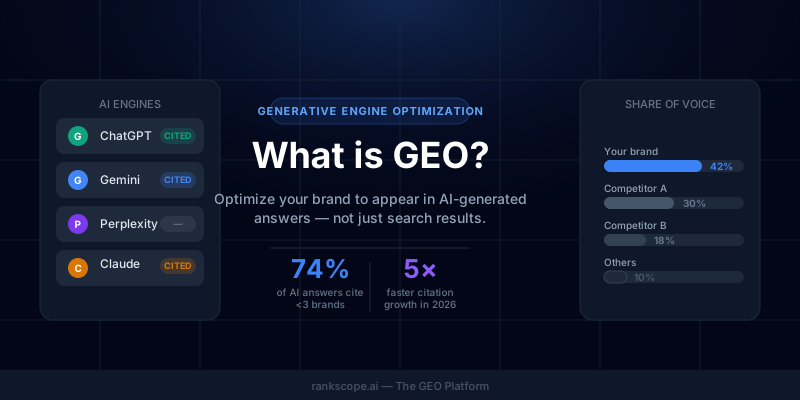
GEO for SaaS is the practice of optimizing your product's digital presence — content, positioning, third-party mentions, technical infrastructure — so that AI search engines cite your product when buyers ask category questions.
It's the SaaS-specific version of Generative Engine Optimization (GEO): a discipline focused on getting named in AI-generated answers rather than ranked in traditional search results. For SaaS companies, this matters more than almost any other sector because:
-
SaaS buyers are power users of AI tools. They're exactly the audience most likely to ask ChatGPT, Perplexity, or Claude for tool recommendations before starting a Google search.
-
The category query is the highest-intent moment in SaaS. "Best CRM for startups" or "top security monitoring tools for enterprise" — these are queries from buyers actively evaluating. Getting cited here is equivalent to a warm referral.
-
The competitive damage is invisible. You won't see a drop in organic traffic when a competitor starts getting cited instead of you. The loss happens silently, in conversations you never see.
Most SaaS marketing teams are still running the same playbook: blog content for SEO rankings, G2 reviews for social proof, PPC for demand capture. All of that still matters. But none of it tells you whether ChatGPT is recommending your competitors while you're not looking.
How AI Engines Decide Which SaaS Products to Cite
AI citation isn't random. Understanding the mechanism is the foundation of any GEO strategy for SaaS. There are two distinct pathways — and they require different approaches.
Pathway 1: Training Data
Every major LLM — GPT-4o, Gemini, Claude — was trained on a snapshot of the web. The content it absorbed during training shapes its default understanding of which products are legitimate, which are well-regarded, and which solve which problems.
If your product had strong web presence before a model's training cutoff — blog coverage, comparison articles, community discussions, G2 reviews, press — it may be embedded in the model's category understanding. GPT-4o's training data runs through October 2023. GPT-5-series models run through August 2025. Claude's most recent training cut off in early 2026.
You can't retroactively insert yourself into past training runs. But you can build the web presence now that influences the next one.
Pathway 2: Real-Time RAG Retrieval
Modern AI search tools — ChatGPT with Browse, Perplexity, Google's AI Overviews, Bing Copilot — don't answer from training data alone. They query the live web before responding, retrieve relevant pages, and synthesize those pages into a response. This is called Retrieval-Augmented Generation (RAG).
RAG is where GEO work has immediate, measurable impact. When a buyer asks Perplexity "best DevOps monitoring tools," Perplexity fetches current pages and builds its answer from what it finds. The content that gets retrieved and cited is:
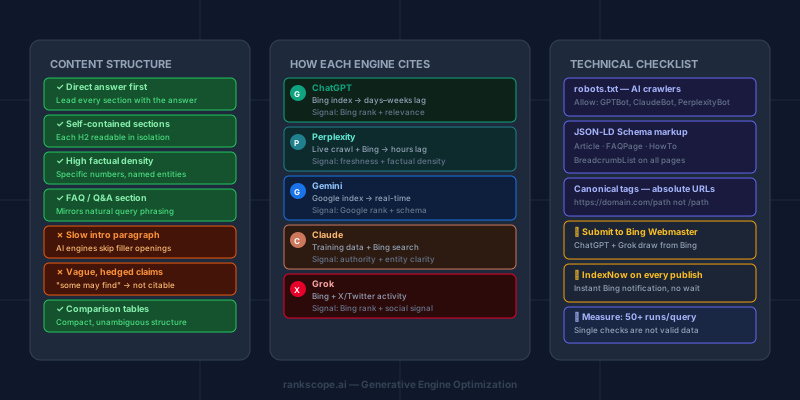
- Directly answerable — the relevant information appears clearly in the first sentence of the section, not buried in paragraph four
- Factually dense — specific numbers, named integrations, pricing ranges, customer examples — not "our platform helps teams work better"
- Well-structured — clean headings, logical flow, no walls of text that force an AI to guess what the section is about
- Technically accessible — AI crawlers (GPTBot, ClaudeBot, PerplexityBot) allowed in robots.txt; schema markup present
For the full breakdown of how each engine retrieves and weights content, see how to optimize content for AI search.
The GEO Signals That Matter Most for SaaS
1. Category Positioning Clarity
The single most important GEO signal for a SaaS product is whether AI engines can unambiguously associate your brand with a specific category and problem.
Vague positioning kills AI citations. If your homepage says "the platform that helps modern teams do more," an AI synthesizing an answer about project management tools has no way to confidently include you. If your homepage says "RankScope is a GEO platform that tracks brand citations inside ChatGPT, Google AI Overviews, Perplexity, and Google AI Mode," the association is unambiguous.
Every key page on your site — homepage, product page, pricing page — should answer three questions in plain language:
- What category is this product in?
- What specific problem does it solve?
- Who is it for?
2. Factual Density in Product Content
AI engines use factual density as a quality proxy when multiple sources cover the same topic. Specific information wins over vague claims.
Low factual density (won't get cited):
"Our analytics dashboard gives you the insights you need to make better decisions."
High factual density (gets cited):
"RankScope's citation analytics tracks brand mentions across 4 AI engines (ChatGPT, Google AI Overviews, Perplexity and Google AI Mode), scans daily, and surfaces response diffs that show exactly when an AI engine's answer changed — including which competitors appeared or disappeared."
For SaaS content, factual density means: specific feature names, actual pricing, real integration counts, measurable outcomes where possible, and named use cases. The more specific your claims, the more extractable they are.
3. Third-Party Corroboration
AI engines don't take your word for it. They cross-reference your brand against third-party sources to validate that you're a real, credible product. For SaaS companies, the key corroboration sources are:
- G2, Capterra, TrustRadius — review platforms that establish your product as a real, used tool in your category
- Comparison and alternative pages — posts like "X vs Y" or "best alternatives to [competitor]" that place your product in competitive context
- Tech press and industry publications — TechCrunch, Product Hunt launches, niche industry blogs
- Reddit and community discussions — organic mentions in forums where real users recommend tools
- Developer documentation and integration pages — confirms technical legitimacy
The more consistently these third-party sources describe your product using the same category language you use on your own site, the stronger the entity association signal becomes.
4. Technical AI Crawler Access
This one is simple but frequently overlooked: if you block AI crawlers in your robots.txt, you will not be cited in RAG-powered responses, regardless of your content quality.
Your robots.txt should explicitly allow:
User-agent: GPTBot
Allow: /

User-agent: ClaudeBot
Allow: /

User-agent: PerplexityBot
Allow: /

User-agent: GoogleBot-Extended
Allow: /
Add @context JSON-LD schema (Organization, SoftwareApplication, FAQPage) on every key page. Schema markup helps AI systems understand what your product is, who it's for, and what category it belongs to — without having to infer it from prose. See the complete GEO guide for 2026 for full technical setup details.
5. Answer-Optimized Content Structure
Traditional SaaS content is written to rank in Google. AI-optimized SaaS content is written to be extracted into an AI response. These are different formats.
The key structural shift: lead every section with the direct answer, not the setup. AI engines extract the first complete, answerable sentence of a section far more reliably than conclusions buried in paragraph three.
Traditional format:
The challenge with attribution in SaaS is that most tools only track last-touch. This creates a blind spot for top-of-funnel channels like content and community. That's why we built our multi-touch attribution model — it gives you credit across every touchpoint.
AI-optimized format:
Our multi-touch attribution model gives SaaS teams full-funnel credit across every touchpoint, solving the blind spot that last-touch attribution creates for top-of-funnel channels like content and community.
Same information. The second version is extractable. The first isn't.
The Three Metrics SaaS Teams Should Track
Most SaaS marketing teams track organic traffic, keyword rankings, and demo conversions. None of those metrics tell you whether you're being cited in AI search. You need a different measurement stack.
Metric 1: Citation Rate
Definition: The percentage of your target queries for which your product is mentioned in the AI-generated answer.
How to measure: Define your 20–50 most important category queries (the questions your ideal buyers are asking AI tools). Run each query through each major AI engine. Record whether your product was named. Citation rate = mentions / total queries × 100.
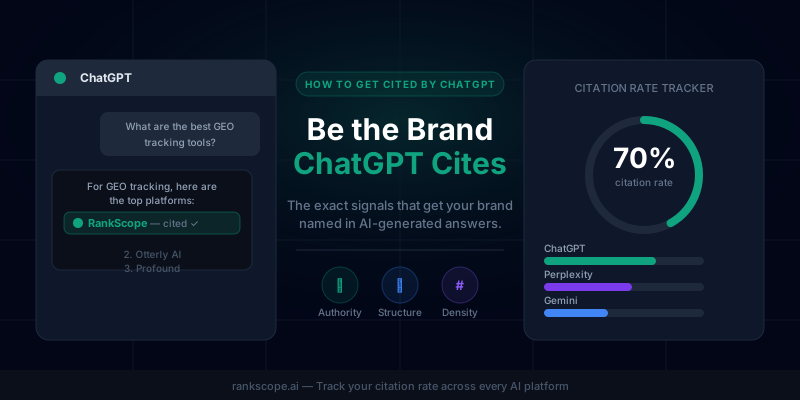
What to aim for: A citation rate above 30% on your core category queries is a strong signal. Below 10% means you have a real GEO gap. Above 60% means you're establishing category leadership in AI search.
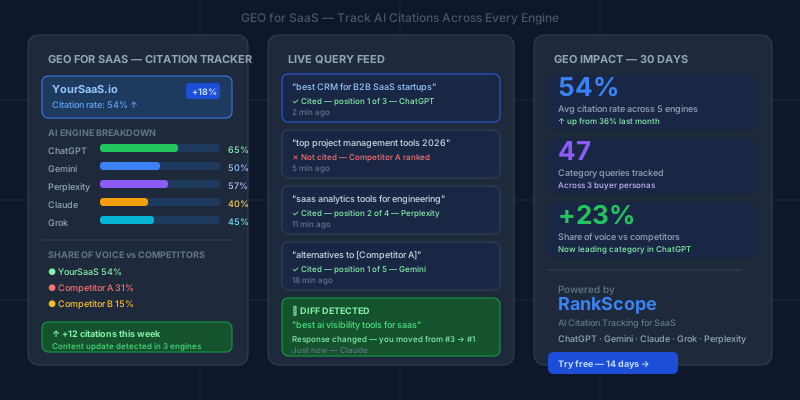
How RankScope tracks it: RankScope automates this process — you configure your target queries once, and it runs them across its 4 tracked engines on your chosen frequency, returning citation rate trends over time without manual sampling.
Metric 2: Share of Voice
Definition: Your citations as a percentage of all citations in your category across the same query set.
Why it matters for SaaS: Citation rate tells you how visible you are. Share of voice tells you how visible you are relative to competitors. A 40% citation rate sounds strong — until you see that your main competitor is at 80%.
How to calculate: Share of voice in AI search = (your brand citations) / (total citations for all brands in your category) × 100. Track this monthly to see whether you're gaining or losing ground to competitors.
Metric 3: Citation Sentiment
Definition: Whether AI-generated mentions of your product are positive, neutral, or carry qualifications or warnings.
Why it matters: Being cited is better than not being cited. But being cited with "some users report a steep learning curve" or "pricing is not transparent" is a mixed signal. Sentiment tracking shows whether the narrative around your product in AI answers is improving as you work on GEO.
How RankScope tracks it: RankScope's forensic diff detection shows exactly when AI responses change — when a qualifier appears, when a competitor gets added to an answer you were previously in, or when your product climbs from third mention to first in a response.
How SaaS Teams Use RankScope in Practice
RankScope is a GEO platform built specifically for tracking AI citations. For SaaS marketing teams specifically, RankScope for teams is designed around team-level workflows — shared dashboards, collaborative query libraries, and reporting that works across content, SEO, and growth functions. Here's how SaaS teams typically put it to work:
Setup: Define Your Query Universe
The first step is building the query library your buyers are actually using. For a SaaS product, this typically includes:
- Category queries: "best [category] tools," "top [category] software for [use case]"
- Problem queries: "how do I [solve problem your product addresses]"
- Comparison queries: "[your product] vs [competitor]," "alternatives to [competitor]"
- Feature queries: "tools that [specific feature you have]"
A typical SaaS team starts with 30–50 queries and expands as they identify the language different buyer segments use.
Tracking: See What AI Engines Actually Say
Once queries are configured, RankScope runs them across ChatGPT, Google AI Overviews, Perplexity, and Google AI Mode on a set schedule. For each query, you can see:
- Which products were mentioned and in what order
- What context surrounded each mention
- Whether the response changed since the last run
- Which competitors appeared in answers your product didn't
The forensic diff view is particularly useful — it shows you the exact wording changes in AI responses over time, so you can see whether a content update you published last week is starting to show up in how AI engines describe your product.
Analysis: Where Are You Losing?
The competitive gap analysis is where most SaaS teams find their biggest insights. Common patterns:
You're present in ChatGPT but absent from Perplexity — usually a technical access or freshness issue. Perplexity crawls aggressively and weights recency. New content often shows up in Perplexity citations within days. Check whether PerplexityBot is allowed in your robots.txt and whether your most important pages have been updated recently.
A competitor is mentioned before you in most answers — often an entity clarity issue. Their homepage probably states their category more clearly than yours, and/or they have more third-party corroboration associating them with the category. Strengthen your entity signals and category positioning language.
You're cited inconsistently — named in some runs, absent in others — this is normal at low citation rates. AI responses vary across sessions. With RankScope tracking multiple runs per query, you get a statistically reliable citation rate rather than a single data point that could go either way.
Optimization: What to Fix First
Based on citation tracking data, the typical SaaS GEO fix priority order:
- Technical access (day 1) — ensure all AI crawlers are allowed, add schema markup
- Homepage entity clarity (week 1) — make your category and problem statement unambiguous
- Core content structure (weeks 1–4) — rewrite your top 5 product pages to lead with direct answers
- G2/review presence (weeks 2–6) — get 10+ reviews on major platforms with consistent category language
- Comparison content (weeks 4–8) — publish "[your product] vs [competitor]" pages that place you in competitive context
- Original data content (weeks 8–12) — publish one piece of original research or data; AI engines strongly favor citable statistics
GEO vs Traditional SaaS SEO: Running Both in Parallel
A common question from SaaS marketing teams: do we replace our SEO program with GEO, or run them in parallel?
The answer is parallel — they're complementary, not competitive.
| Dimension | Traditional SaaS SEO | GEO for SaaS |
|---|---|---|
| Goal | Rank in Google | Get cited in AI answers |
| Primary signal | Backlinks + domain authority | Content structure + factual density |
| Content format | Keywords + headers | Direct answers + entity clarity |
| Measurement | Rankings + organic traffic | Citation rate + share of voice |
| Timeline to results | 3–12 months | 4–12 weeks |
| Target platform | Google, Bing | ChatGPT, Google AI Overviews, Perplexity, and Google AI Mode, Grok |
Strong traditional SEO builds the domain authority that AI systems use to evaluate trustworthiness. Good GEO content (direct answers, factual density, clear structure) also tends to rank better in Google. The strategies reinforce each other when done well.
The risk is optimizing for only one. SaaS teams that ignore GEO are losing deals to competitors being cited in AI conversations they'll never see. Teams that ignore traditional SEO lose the domain authority that makes AI systems more willing to cite them.
The Compounding Advantage of Early GEO
There's a structural reason to start GEO work now rather than wait: it compounds.
When an AI engine cites your product in a response, that response may get indexed, shared, or referenced in content that's later crawled by the same AI engine. Citations beget more citations. Products that establish early GEO authority build a feedback loop: more citations → more web content referencing them → stronger training signal → more citations.
The reverse is also true. Competitors who are establishing AI citation dominance in your category right now are building a moat that gets harder to close with every passing quarter. Gartner's estimate that traditional search volume drops 25% by 2026 as buyers shift to AI-powered answers means that moat has real pipeline consequences.
For SaaS companies, the question isn't whether to invest in GEO. It's whether to do it now — while the field is still relatively open — or later, when category leaders in AI search are already established.
Getting Started: Your First 30 Days of GEO for SaaS
Week 1 — Baseline and audit
- Set up RankScope with your top 30 category queries
- Run initial citation checks across all five engines
- Audit your robots.txt for AI crawler access
- Check your homepage for entity clarity (category, problem, audience — all clear?)
Week 2 — Technical and structural fixes
- Allow all AI crawlers if blocked
- Add SoftwareApplication + Organization JSON-LD schema if missing
- Rewrite your homepage's category statement to be unambiguous
- Rewrite the top 3 sections of your main product page to lead with direct answers
Week 3 — Content and corroboration
- Request G2 / Capterra reviews from customers (consistency of category language matters)
- Publish one "how we compare to [competitor]" piece or one detailed use case page
- Ensure your 5 most important pages have been crawled recently (submit to Bing IndexNow for ChatGPT Search pickup)
Week 4 — Measure and iterate
- Pull your first full citation report from RankScope
- Identify your highest-gap queries (where competitors are cited and you aren't)
- Map each gap to a specific content or technical fix
- Set your monthly benchmark: citation rate and share of voice per engine
After four weeks, you'll have a baseline and a clear picture of where the gaps are. Most SaaS teams see measurable citation rate improvements within 6–8 weeks of consistent GEO work.
Why RankScope for SaaS GEO
RankScope is a GEO platform built specifically for this use case — tracking brand citations across the five major AI engines and surfacing the data SaaS marketing teams need to understand and improve their AI search visibility.
What makes it the right tool for SaaS teams:
The 4 engines that matter most. Most buyers check more than one AI tool. A SaaS team tracking only ChatGPT is missing what Perplexity (increasingly popular for research), Google AI Overviews (the default in Google search), and Google AI Mode say about their product. RankScope tracks the 4 engines that cover the highest-traffic AI search surfaces.
Forensic diff detection. The most actionable RankScope feature for SaaS teams: it shows you exactly when AI responses about your category change — when a qualifier is added, when a competitor appears or disappears, when your product moves up or down in the ranking. This is the signal that tells you whether your GEO work is having an effect.
Automated GEO agents. Once you've established a baseline, RankScope's Agents feature can run your query workflows on autopilot — surfacing action plans when citation patterns change so your team doesn't have to manually check dashboards each week.
Share of voice vs. competitors. Knowing your own citation rate is half the picture. Knowing how it compares to the two or three competitors you actually compete with is what drives strategy. RankScope's competitive share of voice tracking shows you where you're winning and where you're losing ground in AI search.
Self-serve, transparent pricing. RankScope starts at $49/month, or $39/mo billed annually. No setup fee, no demo required, no opaque enterprise pricing, no surprise overages. SaaS teams can get value from the data before committing to a larger plan.
For SaaS teams that are serious about AI search visibility, understanding your GEO platform options and how to measure GEO performance are the logical next steps after reading this. If you're working with an agency on your GEO program, the GEO for agencies guide covers how agencies track and report AI citations at scale — useful context for evaluating what your agency should be delivering. And if your SaaS product sells through ecommerce channels or you're curious how product-led brands approach the same problem, the GEO for ecommerce guide covers AI citation tracking for product-centric brands. The tools exist. The data is accessible. The only question is how quickly your competitors are moving.
Frequently Asked Questions
What is GEO for SaaS?
GEO for SaaS is the practice of optimizing a SaaS product's digital presence so that AI search engines like ChatGPT, Google AI Overviews, Perplexity, and Google AI Mode cite it when buyers ask category questions. When someone asks an AI "what's the best tool for X," GEO determines whether your product gets named in the answer.
How does RankScope track AI citations for SaaS companies?
RankScope runs automated queries across ChatGPT, Perplexity, and both of Google's AI surfaces, AI Overviews and AI Mode and analyzes the responses for brand citations. It tracks citation rate (how often your product is named), share of voice (your citations vs. competitors), citation sentiment (positive, neutral, or negative framing), and forensic response diffs (exactly when and how answers change).
Why should SaaS companies care about GEO?
SaaS buyers increasingly use AI assistants to discover, research, and shortlist tools before ever visiting a vendor website. Gartner estimates that traditional search volume will drop 25% by 2026 as users shift to AI-powered answers. If your product isn't cited in those answers, you're missing the most intent-rich discovery moment in the funnel — and a competitor who is cited gets the deal consideration instead.
What AI engines should SaaS companies track?
SaaS companies should prioritize the AI engines their buyers use most. ChatGPT (400M+ weekly active users) and Perplexity (100M+ queries/day) are critical for most B2B and SaaS verticals. Google AI Overviews and Google AI Mode are essential if Google search is a primary channel. Gemini, Claude, and Grok are also growing. Citation patterns differ significantly across engines — a product that's prominent in ChatGPT answers may be absent from Google AI Overviews. RankScope tracks ChatGPT, Google AI Overviews, Perplexity, and Google AI Mode — the 4 highest-priority surfaces for most SaaS companies.
How long does it take to improve AI citation rates?
GEO improvements typically take 4–12 weeks to show measurable citation rate changes. Content structure improvements and technical fixes (AI crawler access, schema markup) can show impact in 2–4 weeks via RAG retrieval. Training data influence takes longer — 3–6 months of consistent web presence before a model's next training cycle picks it up.
Is GEO for SaaS different from traditional B2B SEO?
Yes, significantly. Traditional B2B SEO optimizes for Google keyword rankings — backlinks, page authority, and keyword placement. GEO for SaaS optimizes for AI citation in synthesized answers — content structure, factual density, entity clarity, and third-party corroboration. The measurement metrics are entirely different: citation rate and share of voice instead of ranking positions and organic traffic. Most SaaS teams need both strategies running in parallel.