The Complete Guide to Generative Engine Optimization (GEO) in 2026
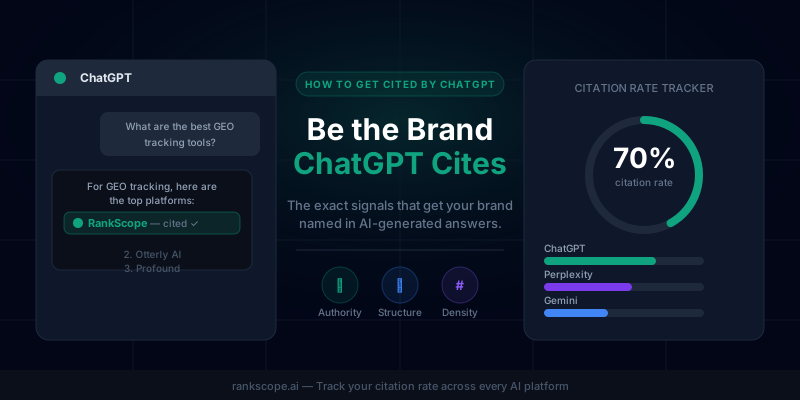
A buyer asks ChatGPT: "What's the best tool for tracking AI citations?"
ChatGPT responds with a paragraph. It names two or three platforms. Everyone else doesn't exist.
That's the problem Generative Engine Optimization is designed to solve — and why it's the most strategically important discipline in digital marketing right now.
This guide covers everything: what GEO is, how it works, how each AI platform decides what to cite, the full tactical playbook, and how to measure whether any of it is working. By the end, you'll have a complete GEO strategy you can actually execute.
What Is Generative Engine Optimization?
Generative Engine Optimization (GEO) is the discipline of optimizing your brand's digital presence so that AI search engines cite you when generating answers to queries relevant to your business.
Not ranking in a list. Not winning a featured snippet. Being named — by name — in the synthesized answer an AI generates when someone asks a question.
The difference matters because AI search doesn't work like traditional search. When Google returns results, every ranked page gets a chance: users scroll, compare, click around. When ChatGPT, Perplexity, or Gemini answers a question, it generates a response that names a handful of sources. The rest are invisible. There's no page 2. There's no "see also."
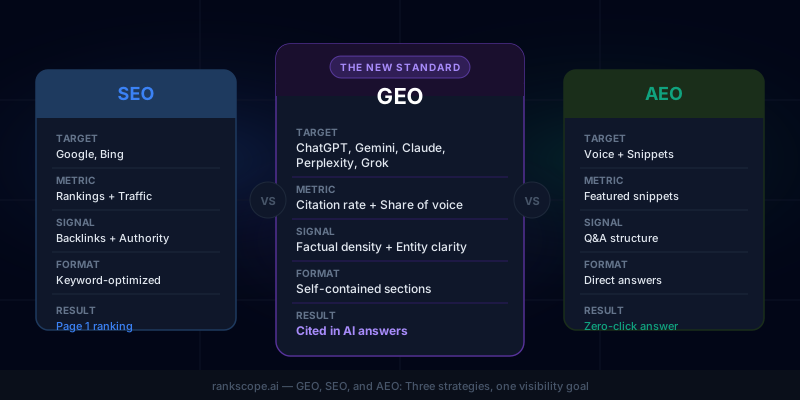
GEO is how you get into that response. See our AI search glossary for definitions of every term in this space, or our GEO vs SEO vs AEO breakdown if you want to understand where GEO sits relative to the disciplines you already know.
How GEO Differs from Traditional SEO
| Dimension | Traditional SEO | Generative Engine Optimization |
|---|---|---|
| Goal | Rank in Google's list | Be cited in AI-generated answers |
| Primary signal | Backlinks + domain authority | Content structure + factual density |
| Content format | Keywords + headers | Direct answers + entity clarity |
| Measurement | Rankings + organic traffic | Citation rate + share of voice |
| Target platforms | Google, Bing | ChatGPT, Google AI Overviews, Perplexity, and Google AI Mode, Grok |
| Discovery mechanism | Crawl and index | Training data + real-time RAG retrieval |
| Result visibility | Position 1–10 | Named or not named |
| Competition | Hundreds of ranked results | 2–4 brands per answer |
GEO doesn't replace SEO — a strong search presence builds the domain authority that AI systems use to evaluate trustworthiness. But they require different strategies, different content standards, and different measurement tools.
Why GEO Matters in 2026
AI search is no longer a novelty. It's a primary discovery channel for a growing share of buyers.
ChatGPT reached 400 million weekly active users in early 2026. Perplexity processes more than 100 million queries per day. Google's AI Overviews appear on hundreds of millions of searches globally. Grok is integrated into X with a billion-user reach. Gemini is the default assistant on Android devices worldwide.
When buyers in your market ask any of these platforms "what's the best [your category] tool?" or "which [your category] company should I use?" — someone gets named. Right now, it's probably not you.
The brands that build GEO authority today have a structural advantage. AI models are trained on the web — the web is influenced by what AI cites — early citation compounds in ways that become hard to displace. Getting into an AI model's training data or retrieval patterns before your competitors do is a durable moat.
How AI Search Engines Decide What to Cite
Understanding the citation mechanism is the foundation of every GEO tactic. There are two distinct pathways:
Pathway 1: Training Data
Every large language model was trained on a snapshot of the internet — Common Crawl data, books, code, and curated web content — up to a specific cutoff date. What the model learned during training shapes its default understanding of which brands are authoritative in which categories.
If your brand was well-represented in that training data — published on high-authority domains, cited in articles, mentioned in discussions — the model may cite you from memory, even without retrieving fresh content.
This pathway is harder to influence after the fact. You can't retroactively insert yourself into training data. But you can influence the next training run by building genuine web presence now.
Pathway 2: Real-Time RAG Retrieval
Modern AI search tools (ChatGPT with Browse, Perplexity, Bing Copilot, Google AI Overviews) don't rely solely on training data. They perform real-time Retrieval-Augmented Generation (RAG): they query the live web, retrieve relevant pages, and synthesize them into a response before answering.
This is where GEO work has immediate impact. Every piece of content you publish, every page you structure for AI extraction, every schema markup you add — all of it influences RAG retrieval right now.
For RAG-based citations, AI systems strongly favor content that is:
- Directly answerable — the answer to the likely query appears clearly in the first sentence of the relevant section
- Factually dense — specific data, percentages, named entities, and verifiable claims over vague generalities
- Well-structured — clean HTML, clear heading hierarchy, logical section flow
- Section-extractable — each H2/H3 block stands alone; the AI doesn't need to read the whole page to extract the relevant chunk
- Published on a trusted domain — domain authority and existing trust signals still matter
A page that buries its key claim in paragraph four of a 300-word intro section will not get cited. A page that leads section headings with clear, specific questions and answers them in the first sentence will.
The Five Pillars of GEO
The five pillars below are the foundation of any GEO program. For a deeper practical breakdown of these levers — including how to prioritize by engine and how to measure results — see GEO Optimization: The Complete Guide to Optimizing for AI Search.
Pillar 1: Content Structuring for AI Extraction
AI systems extract answers at the section level. When Perplexity answers a query, it doesn't read your 3,000-word article — it pulls the 150-word block most relevant to the specific question asked.
That means every H2 and H3 section in your content needs to be engineered as a standalone, extractable answer unit:
The GEO Section Formula:
- Heading = the question (or a clear topic statement)
- First sentence = direct answer (no preamble, no "great question")
- Second sentence = the most important supporting fact
- Body = specific data, examples, elaboration
- Closing = optional forward link or implication
Compare these two approaches for the same section:
❌ Not GEO-optimized: "When thinking about how AI search engines work, it's important to understand that there are several factors involved in how they determine what content to surface. In this section, we'll explore some of those factors..."
✅ GEO-optimized: "AI search engines cite content based on two signals: factual density and section extractability. A page that leads each section with a specific, verifiable claim and backs it with data earns citations at roughly 3x the rate of pages that bury their answers in introductory paragraphs."
The second version can be pulled, used standalone, and attributed. The first cannot.
Pillar 2: Entity and Topic Authority
AI models think in entities — named things with defined attributes and relationships. "RankScope" is an entity. "Generative Engine Optimization" is an entity. "Perplexity" is an entity.
Your brand's authority in a topic area depends on how strongly your entity is associated with the right topic entities across your content, your schema markup, and your third-party mentions.
Entity association tactics that work:
- Consistent brand description — every page, every schema, every third-party mention should describe your brand the same way: "RankScope is a GEO platform that tracks brand citations inside ChatGPT, Google AI Overviews, Perplexity, and Google AI Mode." Consistency = clarity for AI systems.
- Schema markup — Organization, SoftwareApplication, FAQPage, BreadcrumbList, and Article schemas all help AI systems understand what you are, what you do, and where you sit in the knowledge graph.
- Co-citation — when industry publications mention your brand alongside key topic terms ("GEO platform," "AI citation tracking"), the association strengthens. This is why press coverage in on-topic publications is high-value for GEO.
- Author entities — founder and team bylines on content create person → company → topic entity chains that reinforce authority.
Pillar 3: Factual Density and Original Data
AI systems have a strong preference for specific, verifiable claims over generic statements. This is the single biggest lever most brands underuse.
Generic (won't get cited): "Many companies struggle with AI visibility because AI search is complex and changing fast."
Factual (will get cited): "73% of ChatGPT responses in B2B software categories name three or fewer brands, meaning only the top 3 players in any category are consistently cited."
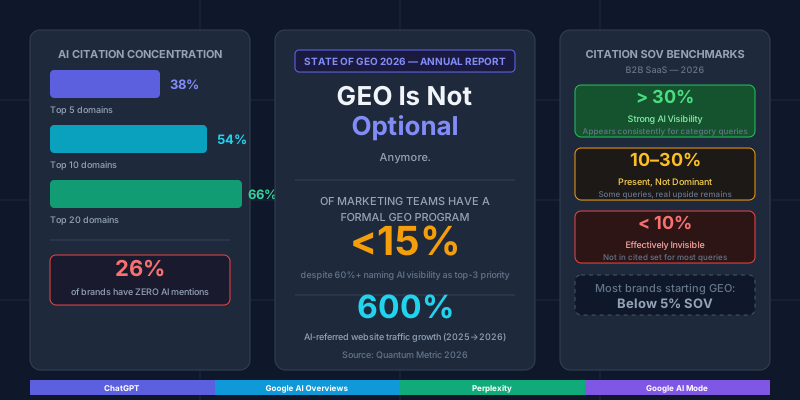
Original research is the highest-value content format for GEO. When you publish data that doesn't exist anywhere else — your platform's citation rate benchmarks, a survey of how buyers use AI search, a study of which content formats get cited most — you become the source. Other articles reference you. AI systems retrieve your data because nothing else is as specific. For a current snapshot of what the research says about GEO adoption, citation concentration patterns, and benchmark data, see the State of GEO 2026 report.
If your product generates data (a GEO platform, an analytics tool, a research firm), publishing that data in structured, accessible content is the single highest-ROI GEO investment you can make.
Pillar 4: Multi-Platform Presence
The five major AI platforms don't retrieve content the same way. A strategy that only optimizes for one will miss citations on the others.
ChatGPT (OpenAI)
- Browse mode retrieves from Bing's index
- Strong Bing SEO matters: submit your sitemap to Bing Webmaster Tools, use IndexNow for instant indexing
- Clean, fast-loading pages with clear schema markup perform best
- ChatGPT tends to cite authoritative, established domains over very new sites
Perplexity
- Crawls aggressively and retrieves live web content
- Fast page load, minimal JavaScript blocking, clean HTML = better crawlability
- Perplexity favors recency — regularly updated content gets retrieved more consistently
- Allows PerplexityBot in your robots.txt (many sites accidentally block it)
Google AI Overviews
- Draws from Google's index — strong Google SEO is a prerequisite
- Top-10 Google rankings are a significant advantage for AI Overview inclusion
- Structured data (FAQPage, HowTo schemas) increases likelihood of inclusion
- Conversational, direct-answer formats match the query types that trigger AI Overviews
Claude (Anthropic)
- Trained on Common Crawl data plus licensed content
- Web retrieval available when tools are enabled
- Anthropic allows ClaudeBot for retrieval — confirm it's allowed in your robots.txt
- Quality and depth of content matters more than recency for Claude
Grok (xAI)
- Uniquely blends web retrieval with X/Twitter data
- Active presence on X — sharing insights, engaging in industry conversations — directly influences Grok citations
- Standard web retrieval follows similar patterns to other platforms
- Allow Grok/xAI crawlers in your robots.txt
For platform-specific tactics on getting cited, see our guide on how to get cited by ChatGPT and the comprehensive ChatGPT ranking guide — the same core principles apply across platforms with the platform-specific adjustments above.
Pillar 5: Citation Monitoring and Iteration
GEO without measurement is guesswork. You need to know:
- Which queries trigger citations of your brand
- Which platforms cite you and which don't
- What your citation rate is relative to competitors
- Which pages are generating citations (so you can replicate their format)
- Whether citation trends are improving over time
The problem: AI citations aren't visible in standard analytics. GA4 doesn't show you that Perplexity cited your blog post 200 times last week. Server logs show bot traffic but not citation outcomes.
RankScope's platform was built specifically to close this measurement gap — tracking citation rate, share of voice, and mention sentiment in ChatGPT, Perplexity, Google AI Overviews and Google AI Mode automatically. If you're evaluating your options, our comparison of AI visibility tools covers the full landscape.
GEO Metrics: What to Measure
Once you have a GEO program running, these are the numbers that tell you whether it's working. For a deep-dive on each metric, the formulas, benchmarks, and how to build a measurement system around them, see the full guide: GEO Metrics: How to Measure Generative Engine Optimization Performance.
Citation Rate
Definition: The percentage of relevant queries on which your brand is cited by a given AI platform.
Example: If you track 100 queries related to "GEO platforms" and Perplexity names your brand in 23 of those responses, your citation rate on Perplexity for that query set is 23%.
Benchmark: New brands typically start at 0–5% citation rate. A well-optimized brand in a competitive category might reach 20–40% over 6–12 months.
Share of Voice (AI)
Definition: Of all brand mentions across your tracked queries, what percentage name your brand vs. competitors?
Example: If AI responses collectively mention GEO tools 500 times across your tracked query set and your brand is cited in 80 of those mentions, your AI share of voice is 16%.
Why it matters: A high citation rate on obscure queries is less valuable than a growing share of voice on high-intent queries in your category.
Citation Source Breakdown
Definition: Which specific pages on your site are generating citations?
Why it matters: If your /blog/what-is-geo page is generating 60% of your citations but your /platform page generates almost none, that tells you something about content structure, not just topic relevance. You can audit the high-citation page and apply its structure to others.
Mention Sentiment
Definition: Are citations positive, neutral, or negative?
AI systems sometimes cite brands in the context of limitations, criticism, or user complaints. A brand being cited as "expensive" or "difficult to set up" still gets the citation but not the conversion. Tracking sentiment tells you whether your citations are driving or hurting consideration.
Platform Coverage
Definition: Are you cited on all five major platforms, or concentrated on one?
Platform concentration is a risk. If 90% of your citations come from Perplexity and ChatGPT changes its retrieval behavior, your AI visibility could drop dramatically overnight. Diversified citation presence across all platforms is the stable, defensible position.
GEO Content Strategy: What to Publish
Not all content earns citations equally. Here's the content hierarchy by GEO value:
Tier 1: Original Research and Data
Citation probability: Very High
Content that contains data, statistics, or findings that don't exist anywhere else is the most citeable content on the internet. AI systems cite it because it's the authoritative source for that claim — there's nowhere else to go.
Examples:
- "X% of [your category] buyers use AI for vendor research" (based on your user survey)
- Benchmark data from your platform ("brands in [industry] have an average AI citation rate of X%")
- Annual state-of-the-industry reports
If your product generates data, publish it. Monthly, quarterly, annually. Make your platform the source of record for the metrics in your category. For a current snapshot of what the data actually shows about AI search adoption and citation behavior, see our GEO statistics roundup for 2026 — 47 data points on platform growth, citation rates, and brand visibility.
Tier 2: Comprehensive Definitional Content
Citation probability: High
When someone asks "what is GEO?" — which page does the AI cite? It will be the most comprehensive, authoritative, entity-clear definition available. Owning the definitional content for your category's core concepts is high-value, durable GEO real estate.
Examples:
- "What is [your category]?" comprehensive guides
- Glossaries for your industry's terminology
- "How does [your core technology] work?" explainers
These pages earn citations repeatedly because the query "what is X" is asked constantly and the same definitional content gets retrieved again and again.
Tier 3: Direct Comparison and Alternative Content
Citation probability: High (for commercial queries)
When a buyer asks "what's a good alternative to [competitor]?" or "how does [your brand] compare to [competitor]?" — AI systems will retrieve the most relevant comparison content available. If you've written that content with honesty and specificity, you get cited in your own favor.
The key: include real pros and cons for both sides. Pure marketing copy doesn't get cited. Credible, balanced comparisons do. See our Otterly AI vs RankScope comparison for an example of this done right.
Tier 4: How-to and Tactical Guides
Citation probability: Medium-High
"How to [do something relevant to your category]" content earns citations on how-to queries. The GEO-optimized version of this content uses HowTo schema markup, numbered steps with clear outcomes per step, and specific tools/metrics at each stage.
Tier 5: News and Opinion
Citation probability: Low-Medium
Timely takes and industry news can earn short-term citations on recent-event queries, but they have a short shelf life. Useful for brand visibility and Grok (which weights X/Twitter conversation), but not the foundation of a GEO content strategy.
Technical GEO: The Setup Checklist
Before content optimization, get the technical foundation right.
AI Crawler Access
Check your robots.txt file. Every major AI platform's crawler must be allowed — many sites accidentally block them with blanket Disallow: / rules for unrecognized bots.
Crawlers to explicitly allow:
GPTBot(OpenAI / ChatGPT)ClaudeBot(Anthropic / Claude)PerplexityBot(Perplexity)Googlebot-Extended(Google AI features)cohere-ai(Cohere)anthropic-ai(Anthropic)
If any of these are blocked, those platforms cannot retrieve your content. That's zero citations from that platform regardless of how good your content is.
Structured Data (Schema Markup)
Every page should have appropriate JSON-LD schema:
- Organization — establishes your brand as a named entity with a defined URL, location, and description
- WebSite — enables sitelinks search in Google; signals site structure
- SoftwareApplication — for product pages, includes application category, pricing, and features
- Article / BlogPosting — on every blog post; includes author, date, and headline
- FAQPage — on any page with a Q&A section; increases AI Overview inclusion probability significantly
- BreadcrumbList — on resource and inner pages; helps AI understand site hierarchy
- HowTo — on any instructional content; directly maps to HowTo query patterns
Site Performance
AI crawlers behave differently from search engine bots — they time out faster, handle JavaScript less reliably, and prioritize pages that load quickly with clean HTML.
- Core Web Vitals: target LCP < 2.5s, CLS < 0.1, INP < 200ms
- Minimize render-blocking JavaScript on content pages
- Ensure content is visible in the raw HTML, not just after JS hydration
- XML sitemap submitted to Google Search Console and Bing Webmaster Tools
Canonical URLs
Every page should have an absolute canonical URL (https://yourdomain.com/path, not /path). Duplicate content confuses entity resolution — AI systems may cite a URL that returns a 404 or a redirect, wasting the citation value.
GEO vs SEO: How They Work Together
The two disciplines reinforce each other, but in specific ways.
How SEO helps GEO:
- Domain authority (built through backlinks and traditional SEO) signals trustworthiness to AI systems. High-DA sites get cited more.
- Google rankings help with AI Overview inclusion — you generally need to be in the top 10 for Google AI Overviews to surface you.
- The same content depth and structure that earns featured snippets (AEO) also earns AI citations.
How GEO helps SEO:
- AI citations drive brand searches — buyers who see your brand named in a ChatGPT response Google your brand name directly. Branded search volume is a positive ranking signal.
- GEO-optimized content (high factual density, direct answers, clean structure) tends to also perform well for traditional search quality signals.
- Original research content that earns AI citations also earns traditional backlinks from other publications who cite the data.
Where they diverge:
- Keyword density has minimal influence on AI citation probability. Factual density matters more.
- Traditional link-building (guest posts, directory submissions) doesn't directly translate to AI citation authority — though high-DA domains that link to you do help.
- AI citations are binary per query (cited or not cited) vs. traditional rankings (position 1–100). The measurement and optimization loop is different.
For a detailed breakdown, see GEO vs SEO vs AEO. And if you're already running an SEO program and want a practical guide to layering GEO on top — including how to split effort, where to start, and common mistakes — see GEO SEO: How Generative Engine Optimization Fits Into Your SEO Strategy.
Platform-Specific GEO Optimization
Optimizing for ChatGPT Citations
ChatGPT's Browse mode uses Bing's index. Everything you'd do for Bing SEO — submitting sitemaps to Bing Webmaster Tools, using IndexNow for instant indexing notification, ensuring clean Bingbot crawl access — directly improves ChatGPT retrieval.
Beyond indexing, ChatGPT tends to favor:
- Established domains with clear organizational identity (schema helps here)
- Specific, numerical claims over general statements
- Published dates on content — stale content from 2019 gets deprioritized for current-state queries
- Author attribution — content with named authors on recognized organizations
ChatGPT's training data cutoff is a known limitation — for queries about recent events or new products, Browse mode is active and retrieval quality matters most. For established category knowledge, training data plays a larger role. (GPT-4o's cutoff is October 2023; GPT-5 series models cut off at August 2025 — see our ChatGPT knowledge cutoff guide for the full model-by-model breakdown.)
Optimizing for Perplexity Citations
Perplexity is the most retrieval-aggressive of the major AI platforms. It actively crawls the web before almost every response. This means:
- Freshness matters more — Perplexity retrieves what's currently ranking and accessible
- Page speed is critical — slow pages time out during retrieval
- Clean HTML over JS-rendered content — Perplexity's crawler handles JavaScript inconsistently
- PerplexityBot must be allowed in robots.txt — many sites have inadvertently blocked it
Perplexity also shows citations inline in its responses, giving cited brands direct visibility to the reader. This is the platform where GEO has the most visible, measurable impact in the short term.
Optimizing for Google AI Overviews
Google AI Overviews (formerly SGE) draws from Google's existing index. The fundamental prerequisite: you need to actually rank in Google's top 10 for the target query. AI Overviews surface content from pages Google already considers authoritative.
Beyond rankings, AI Overview inclusion correlates with:
- FAQPage schema — dramatically increases inclusion for question-type queries
- Conversational, direct-answer formatting — mirrors the answer format AI Overviews use
- E-E-A-T signals — Experience, Expertise, Authoritativeness, and Trustworthiness matter even more for AI Overview inclusion than standard rankings
For a foundational understanding of what AI Overviews are, how they've evolved from SGE, and how the selection mechanism works, see the complete primer: What Are AI Overviews? The Complete Guide. For the full breakdown of triggers, optimization signals, and how to measure your citation rate, see AI Overviews SEO: How to Get Into Google's AI Answers. For the step-by-step ranking strategy with data tables, content checklists, and measurement framework, see How to Rank in Google AI Overviews: Complete Guide.
Optimizing for Claude Citations
Claude (Anthropic's AI) draws from Common Crawl training data and web retrieval when tools are enabled. Key factors:
- Allow
ClaudeBotandanthropic-aiin robots.txt - Claude places high weight on content quality and depth over recency
- Clear author attribution and organizational identity (schema) help
- Claude tends to cite longer, more comprehensive content over thin pages
Optimizing for Grok Citations
Grok is unique: it draws from both standard web retrieval and X/Twitter data. The X/Twitter layer means:
- Social presence on X matters for Grok specifically — not just passive presence but active engagement in your topic area
- Industry conversations on X that mention your brand influence Grok's perception of your authority
- Allow
Grokand xAI crawlers in robots.txt - Grok weights recency heavily — fresh content and fresh social signals matter more than on other platforms
Building Your GEO Program: A 90-Day Roadmap
Days 1–30: Foundation
Week 1: Technical audit
- Audit robots.txt for AI crawler access
- Verify schema markup on all key pages (Organization, WebSite, SoftwareApplication)
- Submit sitemaps to both Google Search Console and Bing Webmaster Tools
- Run PageSpeed Insights on top 5 pages; fix anything with LCP > 3s
Week 2: Citation baseline
- Define 20–50 queries your buyers would ask AI platforms about your category
- Run each query through ChatGPT, Perplexity, Gemini, and Grok
- Record: are you cited? What's your share of voice? Which pages are cited?
- This is your GEO baseline — the before state
Week 3–4: Content audit
- For each key page, ask: does each section lead with a direct answer?
- Identify 3–5 pages where restructuring for AI extraction would have highest impact
- Add FAQPage schema to any page with Q&A sections
Days 31–60: Content Build
Priority 1: Definitional content for your core category terms (if not already written)
Priority 2: Original research or data — even a small survey (n=100) or analysis of your platform data produces citeable statistics nobody else has
Priority 3: Comparison and alternative content for your top competitors — these earn citations on high-commercial-intent queries
For each piece published:
- Run the LLM self-test: feed the full content to Claude and ask "Summarize this in 5 bullet points." If the summary is accurate and entity-rich, the content is GEO-ready. If it misses key claims, restructure and retest.
- Add Article/BlogPosting schema
- Update internal links from existing pages to the new content
Days 61–90: Measurement and Iteration
Set up ongoing citation tracking — manually running queries weekly doesn't scale. A GEO platform like RankScope automates citation rate and share of voice tracking across all major AI engines. For teams that want to go hands-free, RankScope's Agents feature lets you configure automated GEO workflows that run on a schedule and surface action plans when citation patterns change.
Identify your citation leaders — which pages are earning the most citations? Analyze their structure, depth, and factual density. Apply the same patterns to underperforming pages.
Identify your citation gaps — which queries should cite you but don't? Audit the pages that currently get cited for those queries. What do they do that you don't?
Iterate — GEO is not a one-time setup. AI retrieval algorithms update, competitors publish new content, and query patterns shift. Monthly content reviews and quarterly strategy updates are the minimum cadence. For a step-by-step framework that turns these principles into a repeatable program — covering baseline audits, prompt libraries, gap analysis, and before-and-after tracking — see the GEO strategy playbook.
Common GEO Mistakes to Avoid
1. Blocking AI crawlers The most common and damaging mistake. Check your robots.txt today. If you're blocking any of the major AI crawlers, nothing else you do matters.
2. Optimizing for one platform only ChatGPT has the most users, but Perplexity drives more citation-visible traffic (it shows inline sources). Google AI Overviews reach the largest absolute audience. Optimize for all five.
3. Generic content "AI search is changing how people find information" is not a citable claim. "ChatGPT responses in the B2B software category name an average of 2.8 brands per answer" is. Be specific or don't bother.
4. JavaScript-heavy pages Many modern web apps render critical content entirely in JavaScript. AI crawlers often can't execute it. Your 3,000-word pillar page might appear empty to GPTBot if the content isn't in the raw HTML. Use server-side rendering for content pages.
5. Confusing GEO with AEO AEO (Answer Engine Optimization) is about winning Google's featured snippets. That's a subset of what GEO covers. Many teams think they're doing GEO because they optimize for featured snippets. Featured snippets don't appear in ChatGPT responses.
6. No measurement If you're publishing content but not tracking citations, you're flying blind. You don't know which content is working, which platforms you're invisible on, or whether any of it is trending in the right direction.
GEO Tools and Resources
Citation Tracking
RankScope — Tracks citation rate and share of voice in all four AI answer engines. The only platform built specifically for GEO monitoring. For a full comparison of available tools, see our AI visibility tools guide. If you're also evaluating GEO agencies and service providers alongside software tools, our guide to generative engine optimization companies covers the full landscape.
Content Optimization
- GEO Checklist — Our 60-item GEO checklist covers every technical and content optimization, from robots.txt to schema markup to content structure
- GEO Glossary — The complete AI search glossary covers every term you'll encounter in GEO work
- LLM Self-Test — Before publishing any content, feed it to Claude and ask for a 5-bullet summary. If the summary is accurate and entity-rich, the content is GEO-ready
Technical
- Google Search Console — index coverage, query data
- Bing Webmaster Tools — Bing indexing (critical for ChatGPT retrieval)
- PageSpeed Insights — Core Web Vitals
- Schema.org validator — structured data testing
The Bottom Line on GEO in 2026
AI search is not the future. It's the present. The shift from "list of links" to "synthesized answer" has already happened for a large and growing share of the queries your potential customers are running.
In most categories, the brands that will own AI citation share over the next three years are being defined right now — by who's building content depth, entity authority, and technical foundation while competitors are still debating whether AI search matters.
GEO isn't complicated. It's systematic: structure content for extraction, build entity authority, publish original data, cover all five platforms, and measure everything. The brands doing this in 2026 are compounding an advantage that will be very difficult to replicate in 2027.
The GEO checklist is the fastest way to audit where you stand. The RankScope platform is how you measure whether it's working.
Start there.
RankScope tracks your brand's citation rate, share of voice, and AI visibility across all four engines — automatically, across hundreds of queries. Get started and see exactly where you stand.