How to Rank in ChatGPT: Complete Guide (2026)
When someone types a question into ChatGPT and it has web access, the result looks nothing like a Google search page. There's no list of ten blue links. There's a synthesized answer — and a handful of brands get named. Maybe three. Maybe one. Everyone else doesn't exist in that response.
That's the problem this guide solves. Getting your brand into those cited positions requires a different playbook from traditional SEO. It's called Generative Engine Optimization (GEO), and the tactics that work are specific, learnable, and measurable.
This guide covers both sides of the ChatGPT ranking problem: the training data layer (what ChatGPT knows from its knowledge base) and the real-time retrieval layer (what ChatGPT fetches when web search is active). If you want to understand the broader landscape of what GEO means across all AI engines, how to optimize content for AI search covers the full picture. This post goes deep on ChatGPT specifically.
How ChatGPT Decides What to Rank
Understanding the two mechanisms that drive ChatGPT's answers is the starting point for everything else.
Mechanism 1: Training Data
Every version of GPT is trained on a massive dataset of web content scraped up to a specific date. That training data is where ChatGPT's understanding of the world — including your brand — comes from. If your brand appeared frequently and consistently in high-quality web sources before the training cutoff, you're embedded in the model's knowledge. If you didn't, you're not.
The most recent GPT-4o training cutoff is October 2023. GPT-4.5 and GPT-5 series models extend further — for the full breakdown by model, see our ChatGPT knowledge cutoff guide.
You can't change what's in the training data retroactively. But you can influence future model updates and, more importantly, control what happens at retrieval time — which is where most of the real-time ranking happens today.
Mechanism 2: Real-Time Retrieval (Search Mode)
ChatGPT's Search mode (also called Browse mode or web-enabled mode) lets the model fetch live web content via Bing before constructing an answer. This is the default for paid ChatGPT plans and is increasingly enabled for free users.
When Search mode is active:
- ChatGPT identifies the most relevant Bing search queries to answer your question
- It fetches the top organic Bing results for those queries
- It reads the content of those pages
- It synthesizes a cited response drawing on what it found
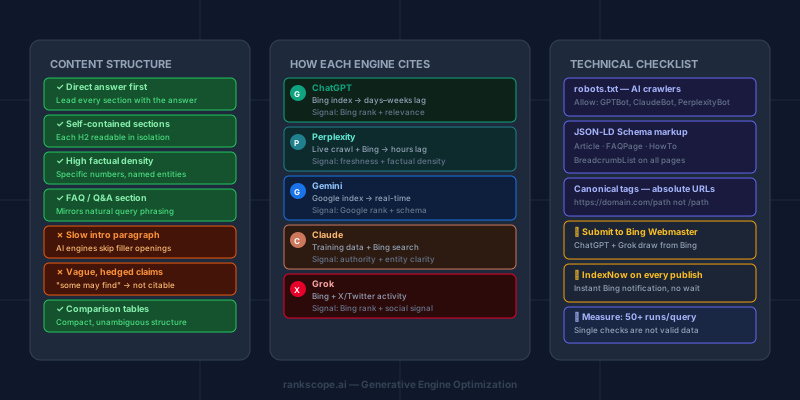
The key word is Bing. Not Google. ChatGPT does not use Google's index for retrieval. It uses Microsoft's Bing — which means your Bing SEO matters just as much as, or more than, your Google SEO for this specific purpose.
This is the mechanism you can most directly control. And it's where most brands should focus their short-term effort.
Step 1: Open the Door for ChatGPT Crawlers
Before any content strategy matters, ChatGPT needs to actually be able to read your site. Check your robots.txt file for these entries:
User-agent: GPTBot
Allow: /

User-agent: ChatGPT-User
Allow: /

User-agent: OAI-SearchBot
Allow: /
GPTBot is OpenAI's main training crawler — it feeds future model updates. ChatGPT-User is the retrieval crawler used during live Search mode queries. OAI-SearchBot handles additional retrieval requests. If any of these are blocked or missing, you're invisible to ChatGPT regardless of how good your content is.
If you want Claude, Perplexity, and Gemini coverage too, add anthropic-ai, PerplexityBot, and allow GoogleBot-Extended. The GEO checklist has the full robots.txt template.
Step 2: Get Into Bing's Index
Bing is the retrieval engine behind ChatGPT Search. If Bing hasn't indexed your pages, ChatGPT cannot retrieve them.
Submit your sitemap to Bing Webmaster Tools:
- Go to bing.com/webmasters
- Add your site and verify ownership
- Submit your sitemap.xml URL
- Enable IndexNow — this lets you push new URLs to Bing's index immediately on publish rather than waiting for the crawler
IndexNow is the fastest path to Bing indexing. For a new blog post targeting a competitive query, submitting via IndexNow on publish day versus waiting for Bing's crawler can mean the difference between appearing in ChatGPT Search results within 24 hours versus 3 weeks.
Check your current Bing coverage: Search site:yourdomain.com in Bing and compare the result count to your actual page count. Large discrepancies indicate crawl or indexing issues specific to Bing.
Step 3: Rank in Bing for Your Target Queries
Bing indexing is necessary but not sufficient. Pages that appear in Bing's top 10 for a query are dramatically more likely to be retrieved and cited by ChatGPT than pages ranked 11–50.
Bing's ranking algorithm overlaps significantly with Google's — backlinks, domain authority, content quality, page speed, and on-page relevance all matter — but there are differences:
- Bing weights anchor text more heavily than Google. Backlinks where the anchor text contains your target keyword are particularly valuable for Bing rankings.
- Bing weights social signals (especially from LinkedIn and X/Twitter) to a greater degree than Google. Brand activity and mentions on these platforms can influence Bing ranking.
- Bing favors older domains with longer publishing history. Newer domains need to demonstrate consistent content publishing to build authority faster.
For any query where you want ChatGPT to cite you, verify where you rank in Bing first. If you're not in the top 10 on Bing, that's the most direct bottleneck to fix.
Step 4: Make ChatGPT Know What Category You're In
Entity clarity is the second biggest lever after Bing retrieval, and most brands underestimate it.
ChatGPT thinks in entities — named things with attributes and relationships. When it constructs a response recommending tools in your category, it's drawing on its understanding of which entities belong to that category. If your brand's category association is unclear or ambiguous, ChatGPT defaults to the clearer option.
This means your homepage, platform page, and about page need to state plainly:
- What you are (the category)
- What problem you solve (the use case)
- Who your customers are (the audience)
Not in marketing speak. In plain declarative sentences.
Weak: "RankScope empowers modern marketing teams to unlock the full potential of AI-powered search visibility."
Strong: "RankScope is a GEO platform that tracks how often your brand is cited in ChatGPT, Google AI Overviews, Perplexity, and Google AI Mode — and shows you what to change to get cited more."
The second version is what ChatGPT can synthesize into a coherent, cited recommendation. The first is noise.
Your Organization and SoftwareApplication JSON-LD schema should reinforce these same associations explicitly. And third-party sources — G2 reviews, comparison posts, press coverage — should make the same category connection. When ChatGPT sees your brand described consistently as a "GEO platform" across your site, G2, Reddit discussions, and industry blogs, that consistent entity signal is far stronger than any one page can create alone.
For a deeper look at how entity signals work across all AI engines, see the complete GEO guide.
Step 5: Structure Content So ChatGPT Can Extract It
ChatGPT doesn't read your pages the way a human does. It extracts the most relevant passage for the specific question it's answering. That means the structure of your content — not just its topic — determines whether it gets cited.
The structure that works:
- H2 heading as a clear statement or question — not clever, just clear. "How ChatGPT's Retrieval Works" beats "The Mechanics Behind the Magic."
- Direct answer in the first sentence of the section — before context, before caveats, before narrative setup. If your section is about knowledge cutoffs, sentence one should be the answer: "GPT-4o's training data ends at October 2023; GPT-4.5's cutoff is August 2025."
- Specific data in sentences two and three — the detail that makes it citable, not vague.
- Elaboration and nuance below — important for human readers, but ChatGPT typically extracts from the top of the section.
The structure that fails: Opening sections with "In this section, we'll explore..." or "It's important to understand that..." or "As we discussed earlier..." — these are preambles that don't answer anything and push the actual answer down the page. ChatGPT's synthesis typically won't wait for it.
FAQ sections are particularly powerful. ChatGPT is frequently asked questions and retrieves content that directly answers them. A well-structured FAQ with clear question-answer pairs and FAQ schema markup is one of the most reliable citation formats.
This is also covered in our guide on how to get cited by ChatGPT, which goes deeper on the content formats that consistently win citations.
Step 6: Maximize Factual Density
When ChatGPT retrieves multiple pages covering the same topic, factual density is the primary differentiator. The page with the most specific, verifiable facts is the one that gets cited.
Compare these two sentences about the same fact:
- Weak: "ChatGPT is used by many millions of people worldwide and continues to grow."
- Strong: "ChatGPT reached 300 million weekly active users as of February 2025, adding the equivalent of Perplexity's entire user base every two weeks."
The second sentence is citable. It has a number, a date, a comparison, and a concrete framing. ChatGPT can lift that into a response without needing surrounding context.
Practical ways to increase factual density:
- Include specific version numbers, dates, and pricing when describing tools
- Add benchmarks from your own product data (e.g., "brands using structured content see a 34% higher citation rate on average")
- Use comparison tables for features, pricing, or metrics
- Replace "many" with numbers, "recently" with dates, "significant" with percentages
Original data is the highest form of factual density. If your product generates data, publish it in a way that can be cited. A blog post called "We Analyzed 50,000 ChatGPT Responses: What Gets Cited" will outperform a generic tips post in citations every time. AI engines prefer novel information — content that gives them something they can't find reproduced elsewhere.
Step 7: Build the Third-Party Web Presence
ChatGPT doesn't just look at your site. It evaluates how you're talked about across the rest of the web. A brand mentioned only on its own domain looks very different from one that appears in reviews, community discussions, comparison posts, and news coverage.
This "web presence breadth" matters both for training data (historical mentions that shaped the model's initial knowledge) and for retrieval (independent corroboration that your brand is a real, relevant player in your category).
The key presence channels:
Product review directories: G2, Capterra, Trustpilot, GetApp, Product Hunt. These platforms are heavily crawled by both Bing and OpenAI's training systems. Your product listing there — with your category clearly stated and consistent with your site — is a strong entity signal. Reviews that mention your brand alongside your category terms ("a good GEO tool," "best AI citation tracker") are particularly valuable.
Community discussions: Reddit threads in r/SEO, r/marketing, r/SaaS, r/startups — these appear in training data and rank in Bing. A genuinely helpful answer in a relevant thread that mentions your brand organically is worth more than a formal press release. Don't spam. Participate helpfully in discussions where your product is actually relevant.
Third-party comparison and roundup posts: Being included in "best of" lists and comparison posts on independent sites creates co-citation signal. When five different sites write about "best GEO tools" and all five include RankScope, that consistent pattern teaches both Bing and training models that RankScope belongs in that category. Our own best AI visibility tools roundup is an example of the format that generates this effect at scale.
Press and industry publications: Coverage in marketing publications, SaaS newsletters, and relevant industry blogs — even smaller ones — creates independent authority signals. It doesn't need to be TechCrunch. A mention in a respected marketing newsletter with 10,000 subscribers carries real weight.
Step 8: Measure Your Citation Rate
This is where most brands fail. They implement some GEO improvements and then check whether they appear in ChatGPT once or twice. That's not measurement — that's a spot-check on a highly variable system.
ChatGPT doesn't give the same answer to everyone. Responses vary by model version, conversation history, geography, time of day, and built-in randomness. A single manual check is almost meaningless statistically.
How to measure citation rate properly:
-
Define your query set — The 20–50 queries where you most want to appear. "Best GEO tools," "how to track ChatGPT citations," "generative engine optimization platform," etc. Be specific about the actual user queries — not just your target keywords.
-
Run the full set systematically — Not once. Run each query multiple times across different sessions. ChatGPT response variability means you need a sample of at least 10–20 runs per query to get a statistically meaningful citation rate.
-
Record the number — Out of 50 queries, how many name your brand? That's your citation rate. A baseline of 20% means you appear in 10 of 50 queries. Track this weekly or bi-weekly.
-
Separate by mode — ChatGPT with Search mode enabled behaves differently from ChatGPT without web access. Track them separately if you can — Search mode reflects your Bing retrieval performance, while no-web mode reflects your training data presence.
-
Track competitors too — Which competitor is getting cited where you aren't? What pages are they using? That's your content gap list.
Doing this manually is workable at small scale. At 50+ queries across multiple AI engines, it becomes a job in itself. RankScope automates the full cycle — running queries, recording citations, tracking citation rate over time, and flagging changes — across ChatGPT, Perplexity, and both of Google's AI surfaces, AI Overviews and AI Mode simultaneously. If you want to take this further, RankScope's Agents feature lets you configure automated GEO workflows that run on a set schedule and surface action plans when citation patterns shift — so you're not manually checking dashboards every week. For a complete step-by-step guide to building a prompt library, establishing a baseline, and tracking systematically across all major AI engines, see the full guide on how to track brand mentions in AI search.
ChatGPT Search Mode vs Standard ChatGPT: What Changes
It's worth understanding how ranking changes between Search mode and standard (no-web) mode because the optimization priorities differ.
ChatGPT Search mode (web-enabled):
- Retrieves from Bing's organic index in real time
- Favors pages ranking in Bing's top 10 for the retrieval query
- Provides citations and links to sources — the most visible citation format
- Content published today can appear in Search mode results within days (via IndexNow)
Standard ChatGPT (training data only):
- Draws on knowledge from training data only, up to the model's cutoff date
- Cannot reference anything published after the cutoff
- No citations or source links in the response — just brand names
- Influenced by web presence during and before the training period
Most commercial ChatGPT users have Search mode enabled by default in 2026. That makes Bing retrieval the higher-leverage short-term lever. But training data matters for the non-Search-mode responses that still occur, and for future model updates that will incorporate current web content into their next training cycle.
What Not to Do
A few specific mistakes that actively hurt your ChatGPT ranking:
Blocking AI crawlers. This is the single fastest way to become invisible. Check your robots.txt right now. Many hosting providers and CDN configurations add crawler restrictions by default — verify GPTBot and OAI-SearchBot are explicitly allowed, not just not blocked.
Generic, unsourced content. "ChatGPT ranks content that is helpful and trustworthy." That sentence is true but impossible to cite. Add a number, a source, a specific example. Every vague sentence is a missed citation opportunity.
Keyword stuffing entity descriptions. "RankScope is the best AI visibility platform for AI visibility and GEO and citation tracking and AI monitoring and brand tracking with AI." This reads as spam to retrieval systems. State your category once, clearly, and let the specifics do the work.
Ignoring Bing. Most SEO work defaults to Google. That's correct for Google rankings. For ChatGPT rankings, Bing is the retrieval engine and requires deliberate attention — separate sitemap submission, separate performance monitoring, separate backlink strategy if your Bing authority lags your Google authority.
Single spot-checks instead of systematic sampling. If you check ChatGPT once, see your brand mentioned, and conclude your GEO is working — you may be wrong. One appearance in one session doesn't tell you your citation rate. Measure systematically.
A 30-Day Action Plan
Week 1: Technical foundation
- Audit
robots.txt— confirm GPTBot, ChatGPT-User, OAI-SearchBot are allowed - Submit your sitemap to Bing Webmaster Tools and verify your domain
- Enable IndexNow for your domain
- Run
site:yourdomain.comin Bing and identify any indexing gaps - Add or verify Organization and SoftwareApplication JSON-LD schema on your key pages
Week 2: Content structure audit
- Take your 5 most important pages and rewrite section intros to lead with direct answers
- Remove buried leads and preamble from key sections
- Add FAQ sections to your homepage and product pages with FAQ schema markup
- Audit your entity descriptions — are they specific and unambiguous?
Week 3: Factual density improvements
- Replace vague claims with specific numbers on your top 5 pages
- Add a comparison table to at least one page if you don't have one
- Identify any original data your product generates that could become a citable stat
- Check that comparison and alternative posts clearly state your category association
Week 4: Establish your baseline
- Define your 20–50 target queries
- Run each query through ChatGPT (Search mode enabled) and record citation results
- Note which competitors appear in queries where you don't
- Identify the content gaps those competitors are filling
- Set a monthly cadence to re-run this measurement and track trends
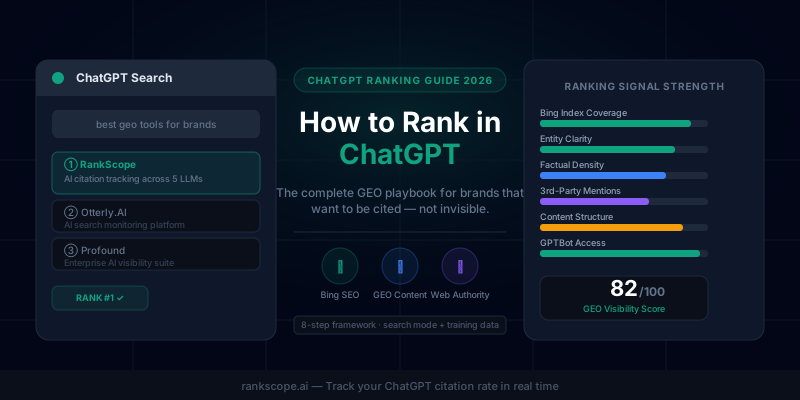
Ranking in ChatGPT comes down to a short list of fundamentals: Bing visibility, entity clarity, content extractability, factual density, and web presence breadth. None of these require a big budget. They require deliberate execution and consistent measurement. If you're evaluating which platform to use for tracking and optimization, our LLM SEO tools comparison covers every major option with real pricing.
The brands winning in ChatGPT citations right now are mostly not doing anything exotic. They're doing SEO fundamentals correctly for Bing, structuring content so AI engines can extract it cleanly, and building the third-party presence that makes their category association credible. Start with the 30-day plan above and you'll have a measurable baseline — and a clear picture of where the gaps are — within a month.
RankScope tracks your citation rate across ChatGPT, Google AI Overviews, Perplexity, and Google AI Mode — using real browser responses, not API outputs, so the data reflects what your actual users see. See how it works, or get started and get your citation baseline in minutes.