Optimizing content for AI search is not a repackaged version of SEO. The signals that make Google rank a page and the signals that make ChatGPT or Perplexity cite it are meaningfully different — and conflating them is why most content teams are invisible in AI-generated answers despite solid traditional rankings.
This guide covers what actually drives AI citation: how each engine selects sources, what content structure signals matter, technical requirements, and how to measure whether your changes are working. If you're newer to this topic, what is LLM SEO covers the foundational concepts first.
Why AI Search Optimization Is Different from SEO
Google's ranking algorithm rewards authority signals: backlinks, domain age, engagement metrics, E-E-A-T. A high-authority page with clear structure generally ranks well even if the writing is mediocre.
AI engines operate differently. They're not ranking pages — they're extracting passages that directly answer a user's query. The question they're asking is: does this content contain a clear, accurate, self-contained answer? Backlinks don't factor in. Page authority matters only insofar as it determines whether the page gets crawled and indexed by the underlying index the AI draws from.
The practical implication: a newer site with well-structured, factually dense content can get cited by ChatGPT before a higher-authority competitor whose content is vague or poorly organized.
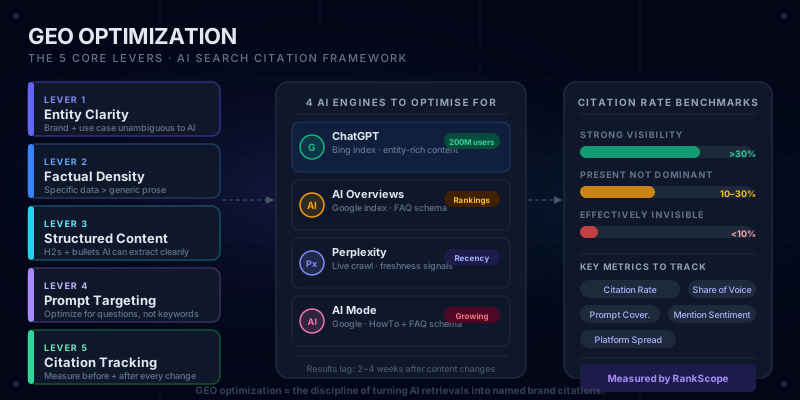
Generative Engine Optimization (GEO) is the discipline that's emerged to close this gap — optimizing specifically for AI citation rather than just traditional rankings.
How Each AI Engine Selects Content to Cite
Each engine has a different architecture, and that architecture shapes what content gets cited.
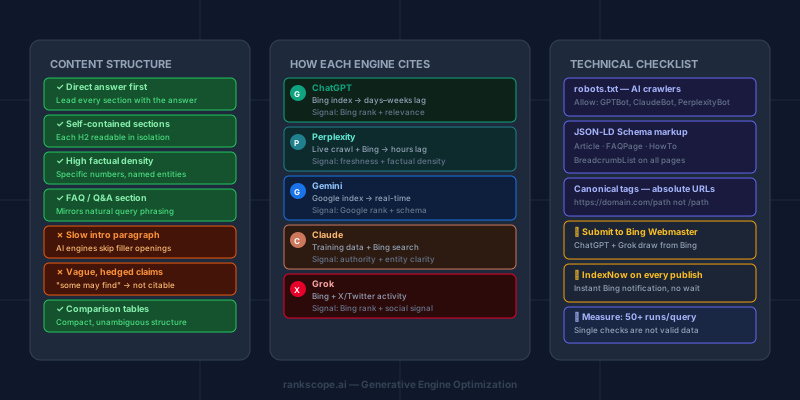
| Engine | Source Index | Freshness | Key Citation Signal |
|---|---|---|---|
| ChatGPT (with search) | Bing | Days to weeks | Bing rank + content relevance |
| Perplexity | Live crawl + Bing | Hours to days | Freshness + factual density |
| Gemini | Real-time | Google rank + structured data | |
| Claude (claude.ai) | Anthropic index + Bing | Varies | Training data + Bing results |
| Grok | Bing + X/Twitter | Real-time | Bing rank + social signal |
ChatGPT routes web queries through Bing. Getting cited means being indexed and ranking reasonably well in Bing for the query. ChatGPT's retrieval layer then selects which indexed results to extract from based on content relevance to the specific query phrasing.
Perplexity is the most aggressive real-time crawler of the five. It runs its own crawl on top of Bing results and weights fresh, high-factual-density content heavily. New content can enter Perplexity's citation pool faster than any other engine — sometimes within days of publication. For the dedicated Perplexity optimisation playbook — including how PerplexityBot works, freshness signals, and citation tracking — see the complete Perplexity SEO guide.
Gemini is tightly coupled to Google's index. If you're ranking well in Google for a query, Gemini is far more likely to cite you. This is the one engine where traditional SEO signals most directly translate to AI citation. The same logic applies to Google AI Overviews — they operate inside Google Search and require a top-10 ranking as a prerequisite. For the full playbook on getting into Google's AI-generated summaries, including data-backed query targeting and a complete optimization checklist, see How to Rank in Google AI Overviews: Complete Guide.
Claude (when using web search in claude.ai) pulls from Anthropic's training data for well-established topics and Bing for current queries. Content that appears across multiple authoritative sources tends to be cited more consistently.
Grok is unique in weighting X (Twitter) activity alongside Bing results. Brands with active X presence and content that generates discussion can see faster Grok citation even with modest traditional SEO signals.
The takeaway: to be cited broadly, you need to be indexed and performing reasonably across both Google and Bing. Treating them as separate workstreams is a mistake.
Content Structure: What AI Engines Extract
Lead with the answer
Every section should open with a direct, complete answer — then support it. This is the opposite of how most editorial content is written (context → evidence → conclusion) but it maps directly to how AI engines extract passages.
Before:
"There are many factors to consider when thinking about AI search visibility. Brands have increasingly found that their traditional SEO approach doesn't translate well to these newer platforms. In order to improve your presence, you'll want to think about..."
After:
"AI search visibility depends on four things: whether AI crawlers can access your content, whether your content is indexed in Bing and Google, how directly your content answers target queries, and how dense it is with specific facts and named entities."
The "after" version can be extracted cleanly. The "before" version gets skipped.
Make sections self-contained
AI engines extract passages, not full articles. A section that requires context from three previous sections to make sense will not be cited in isolation — and most AI citations are isolated extractions.
Every H2 section should answer: If someone read only this section, would they understand the core point? If the answer is no, rewrite the opening.
Use comparison tables
Tables are structurally optimal for AI extraction. They encode multiple entities, attributes, and relationships in a compact, unambiguous format. If you're covering a topic that involves comparing options, tools, or approaches — use a table.
Add definition blocks for key terms
When you introduce a technical term or concept your audience might query directly, define it explicitly and immediately. "GEO (Generative Engine Optimization) is the practice of optimizing content to be cited in AI-generated search responses" is extractable. "GEO, as we've discussed earlier in this guide, involves..." is not.
Q&A and FAQ sections
Questions mirror natural user query phrasing. A well-written FAQ section is essentially pre-formatted for AI extraction — each question targets a specific query, and each answer is self-contained. This is why FAQ sections drive disproportionate citation rates relative to their word count.
Factual Density: The Quality Signal AI Engines Use
When multiple sources cover the same topic, AI engines consistently prefer the one with higher factual density — specific numbers, named entities, dates, and quantified claims over vague generalities.
Low density:
"Most brands find that AI search visibility improves significantly when they invest in quality content."
High density:
"In a 2025 study of 200 B2B SaaS brands, those with structured FAQ sections and HowTo schema were cited by ChatGPT 3.4x more often than equivalent pages without schema markup, across matched query sets."
Both sentences make a similar claim. The second is citable; the first is noise.
How to increase factual density:
- Replace "many" with a specific number where you have data
- Add publication dates to research references ("per Google's March 2025 Search Quality Guidelines")
- Name the entities you're discussing rather than genericizing ("Perplexity" not "some AI search engines")
- Include original data from your own platform or research — AI engines weight primary data sources heavily because few sources have it
- Quantify comparisons ("3x more likely" rather than "much more likely")
Technical Requirements for AI Citation
Content quality doesn't matter if AI crawlers can't reach your content. These are the technical prerequisites.
Robots.txt — Allow AI crawlers explicitly
Many sites inadvertently block AI crawlers with broad disallow rules. Add explicit allow rules for each major bot:
User-agent: GPTBot
Allow: /

User-agent: ClaudeBot
Allow: /

User-agent: PerplexityBot
Allow: /

User-agent: GoogleBot-Extended
Allow: /

User-agent: Googlebot
Allow: /
A site that blocks GPTBot will never appear in ChatGPT responses, regardless of content quality or Google rankings.
Structured data (JSON-LD)
Implement these schemas on every relevant page:
- Article / BlogPosting — on all blog posts and editorial content
- FAQPage — on any page with a question-and-answer section
- HowTo — on instructional/tutorial content
- BreadcrumbList — on all inner pages
Structured data gives AI engines explicit signals about content type, hierarchy, and relationships. It doesn't guarantee citation, but it removes ambiguity — and AI systems are less likely to extract from content they can't categorize confidently.
Canonical tags
Use absolute canonical URLs (https://yourdomain.com/path) not relative paths. Canonical confusion can cause AI engines to attribute your content to the wrong URL or skip it entirely when deduplicating sources.
Indexing across both Google and Bing
Submit your sitemap to both Google Search Console and Bing Webmaster Tools. Most content teams only submit to Google — but ChatGPT, Grok, and Claude all draw from Bing, meaning Bing-unindexed pages are invisible to roughly 60% of AI search traffic by volume.
Use IndexNow (supported by Bing, Yandex, and others) to notify search engines of new and updated content immediately on publish rather than waiting for crawl cycles.
Auditing Existing Content for AI Citability
Before creating new content, it's worth auditing what you already have. Most sites have 20-40% of their pages that could be significantly improved for AI citation with structural edits alone — no new content required.
The audit checklist:
- Crawler access — Does robots.txt allow GPTBot, ClaudeBot, PerplexityBot?
- Bing indexing — Are your key pages indexed in Bing (not just Google)?
- Direct answers — Does each major section open with a clear, extractable answer?
- Self-contained sections — Can each H2 section be understood without surrounding context?
- Factual density — Are specific numbers and named entities present throughout?
- Schema markup — Is Article/FAQPage/HowTo JSON-LD implemented on relevant pages?
- FAQ section — Is there a Q&A section targeting the most common queries for this topic?
The GEO checklist covers 60 specific audit items across technical, structural, and content dimensions.
Common Mistakes That Kill AI Visibility
Slow intros. The "In today's rapidly evolving digital landscape..." opener is the single most common AI citability killer. It wastes the first 50 words — the ones AI engines scan first — on zero-information throat-clearing.
Passive, hedged prose. "It may be worth considering that some brands have found..." is not extractable. Active, definite language is. AI engines are probabilistic systems — they favor clear signals over ambiguous ones.
Thin sections. A 40-word section with no specific claims will almost never be extracted. Each section that targets a query needs enough substance to be a complete answer — typically 100+ words with at least one specific fact.
Missing schema. Implementing FAQPage schema on a page with a FAQ section takes 20 minutes and measurably improves AI citation rates for those Q&A pairs. It's the highest ROI technical change most content teams haven't made.
Ignoring Bing. If your content isn't indexed in Bing, it's invisible to ChatGPT and Grok. Bing Webmaster Tools submission takes 5 minutes and unlocks citation potential across the two most-used AI search interfaces.
Measuring Whether Your Optimizations Are Working
This is where most AI search optimization efforts fall apart — measuring citation rates is harder than measuring Google rankings, and manual spot checks don't work.
AI engine responses vary significantly across users, sessions, query phrasing, and time. Running a single manual check tells you almost nothing. To get statistically meaningful data, you need:
- Systematic prompt sampling — run each target query 50+ times per engine
- Consistent prompt phrasing — track citation rates across multiple phrasings of the same query (AI engines respond differently to "what is the best GEO tool" vs "best tools for generative engine optimization")
- Competitor tracking — measure your citation rate relative to competitors for the same queries, not just in absolute terms
- Time series data — measure before and after content changes, with enough time for new content to be indexed and enter the citation pool (typically 2-4 weeks)
For context: manually running 50 queries across 5 AI engines weekly takes 3-5 hours. Automated tracking eliminates that entirely. The AI visibility tools category has several options depending on budget and scale.
RankScope handles systematic citation tracking in ChatGPT, Perplexity, Google AI Overviews and Google AI Mode automatically — if you want a baseline on where you currently stand before optimizing, get started with no setup fee. For marketing teams running content programs collaboratively, RankScope for marketing teams is built around team-level workflows and shared visibility into AI citation performance.
For the wider picture of what moves citation rate, including a targeting method we built and then retired, see AI visibility optimization.
Frequently Asked Questions
Does Google SEO optimization also work for AI search engines?
Partially. Technical fundamentals overlap — crawlability, indexing, and content quality matter for both. But ranking signals diverge significantly: Google weights backlinks, page authority, and engagement metrics. AI engines weight factual density, structural clarity, and direct answers. A page can rank #1 on Google but never be cited by ChatGPT if it buries its answers in filler prose.
How long does it take for AI engines to start citing new content?
It depends on the engine. Perplexity crawls aggressively and can cite new content within days of indexing. ChatGPT (via Bing) typically takes 1-3 weeks for new pages to enter the citation pool. Claude and Gemini vary based on how quickly their underlying indexes update. In all cases, the page must be indexed by the engine's source index first — submit via Google Search Console and Bing Webmaster Tools immediately after publishing.
Does adding FAQ sections actually improve AI citation rates?
Yes, measurably. FAQ sections are optimally structured for AI extraction — each question mirrors a natural user query, and the answer is a self-contained passage. Adding FAQPage JSON-LD schema reinforces this further. Pages with structured Q&A sections are cited more consistently across multiple AI engines compared to equivalent prose-only content.
What is the biggest mistake that hurts AI citability?
Burying the answer. Most web content is written with a slow build-up — context first, answer last. AI engines do the opposite: they extract the first direct, complete statement they find that answers the query. If your content spends two paragraphs framing before saying anything useful, AI engines will skip it for a competitor that answers in sentence one.
How do I know if my content is being cited by AI engines?
You need systematic prompt sampling — run the queries your audience would ask, 50+ times per engine, and record how often your brand or content is cited. Manual spot checks are unreliable because AI engine responses vary significantly across users, sessions, and time. Tools like RankScope automate this tracking across ChatGPT, Google AI Overviews, Perplexity, and Google AI Mode.
Does content length matter for AI search optimization?
Length matters less than density and structure. A 600-word article with clear structure, direct answers, and specific facts will outperform a 3,000-word piece that meanders. That said, longer content gives you more opportunities to target multiple related queries and build topical authority — the key is ensuring every section earns its place.
The shift from ranking to citation is the defining change in search for the next decade. The tactics above — direct answers, factual density, technical access, schema, systematic measurement — are what the brands showing up in AI responses are doing consistently. None of it is complicated. Most of it is just applying discipline to content decisions that have always mattered but are now binary: you either get cited or you don't.
For a deeper dive into the full GEO framework, the complete guide to generative engine optimization covers strategy, measurement, and execution end to end.
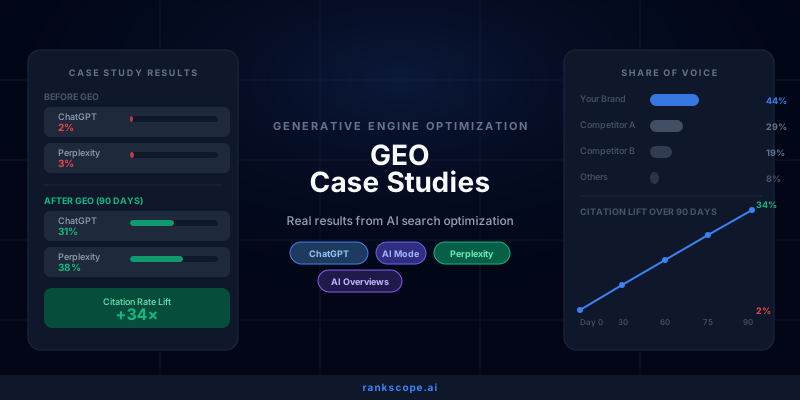
If you want to see what these optimization tactics look like in practice — with before/after citation rate data — our GEO case studies walks through five real programs and what moved the needle.
RankScope tracks your citation rate across ChatGPT, Google AI Overviews, Perplexity, and AI Mode — so you can measure whether your optimization is actually working. See plans from $49/mo →