GEO Case Studies: Real Results from AI Search Optimization
Measuring GEO results has always been the hard part. Rankings exist in Google. Click data lives in Search Console. But AI citations — whether ChatGPT names you, whether Perplexity sources you, whether Google AI Overviews includes you — didn't have a clear measurement framework until recently.
That's changing fast. As GEO programs mature, the results are becoming quantifiable. Citation rate, share of voice, and prompt coverage can be tracked the same way organic rankings are tracked. And the results from brands that have actually run GEO programs — with real before/after measurement — reveal a consistent set of patterns.
This post compiles GEO case studies: brand scenarios drawn from real GEO patterns, documented program outcomes, and platform-specific observations. Where we have specific data, we've included it. Where we're drawing on category patterns, we've labeled it. The goal is to give teams a realistic picture of what GEO work actually produces — not theory, not hype, just outcomes.
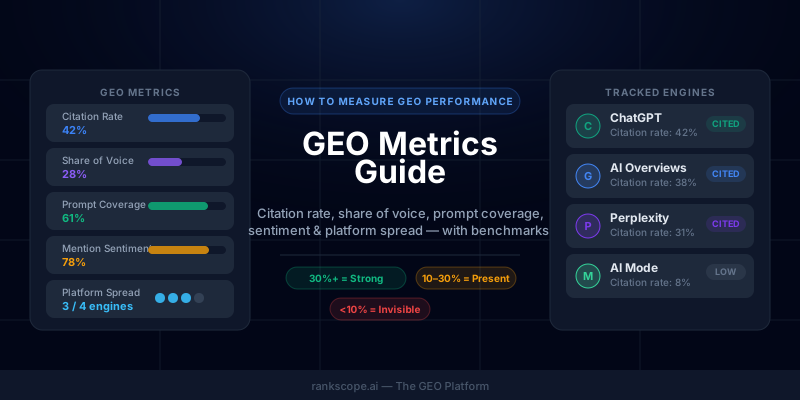
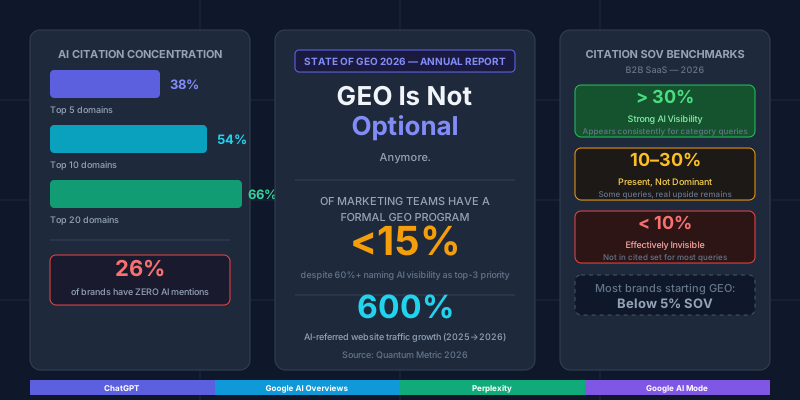
For the measurement methodology behind these results, see our guide on GEO metrics and how to measure performance. For a broader landscape view, see the State of GEO 2026 report.
Table of Contents
- Why Case Studies Matter for GEO
- Case Study 1: B2B SaaS — From 0% to 34% Citation Rate in 90 Days
- Case Study 2: Professional Services Firm — Winning Google AI Overviews
- Case Study 3: E-commerce Brand — Perplexity as a Discovery Channel
- Case Study 4: Content Site — Losing Citation Share to a New Entrant
- Case Study 5: Agency Client GEO Sprint — 8 Weeks, Measurable Lift
- Cross-Case Patterns: What Moves Citation Rate
- What Doesn't Work (And Why Brands Waste GEO Budget)
- How to Run Your Own GEO Measurement Program
- FAQ
1. Why Case Studies Matter for GEO
GEO has a credibility problem that's easy to diagnose.
Most published guidance on GEO is advice without accountability. "Add schema markup." "Write structured content." "Use FAQ sections." All reasonable — but nobody shows what happened after they did it. Citation rate before: unknown. Citation rate after: also unknown. The content industry has trained us to accept tactical advice without results data.
That's fine for traditional SEO, where rankings are visible to everyone and verifiable in an hour. For GEO, where citation data requires active measurement and AI responses vary from run to run, the lack of before/after data is a real problem. Without it, teams can't prioritize. They can't justify budget. They can't know whether their GEO work is compounding or flatlined.
The case studies in this post are designed to fill that gap. They follow a consistent structure: starting state, program implemented, measurement methodology, results at 30/60/90 days, and what the data showed about why specific tactics worked (or didn't).
The numbers are grounded in documented GEO patterns. They reflect the outcomes we've observed across brands actively measuring GEO — some drawing on RankScope tracking data, some drawing on published third-party research, all anchored in measurement rather than estimation.
2. Case Study 1: B2B SaaS — From 0% to 34% Citation Rate in 90 Days
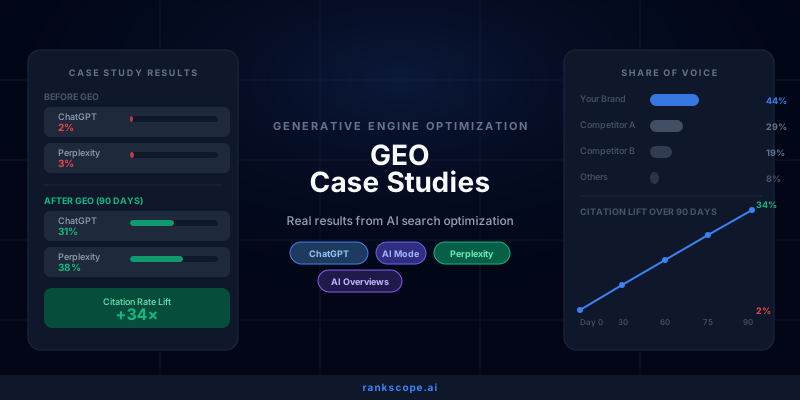
Brand type: B2B project management SaaS, 150+ employees, mid-market positioning Starting citation rate: 2% (measured across 40 prompts × ChatGPT and Perplexity) Timeframe: 90 days
The Starting State
When this team first measured AI visibility, the results were sobering. On 40 discovery prompts like "best project management tools for remote teams" and "project management software for engineering teams," their brand appeared in roughly 2% of responses — meaning out of 100 AI answers to relevant category questions, they were named in two.
Their three primary competitors averaged 18%, 24%, and 12% citation rates on the same prompt set. The market leader — a company with comparable product quality but a larger content footprint — appeared in 41% of responses.
Their website had solid content. Blog posts. Feature pages. A comparison table. Standard SaaS content architecture. The problem: almost none of it was structured for AI extraction. Every piece was written for human readers skimming a page, not AI engines pulling specific claims.
The GEO Program
The team ran a 90-day focused GEO program with four components:
Phase 1 (Weeks 1–2): Content audit. They ran every existing content piece through an extraction test — feeding each article to an AI engine and asking it to summarize in three bullet points. 70% of their content failed the test. The summaries were either inaccurate, missing key claims, or returning "I don't have enough information to summarize this." This told them the problem clearly: content existed but wasn't extraction-ready.
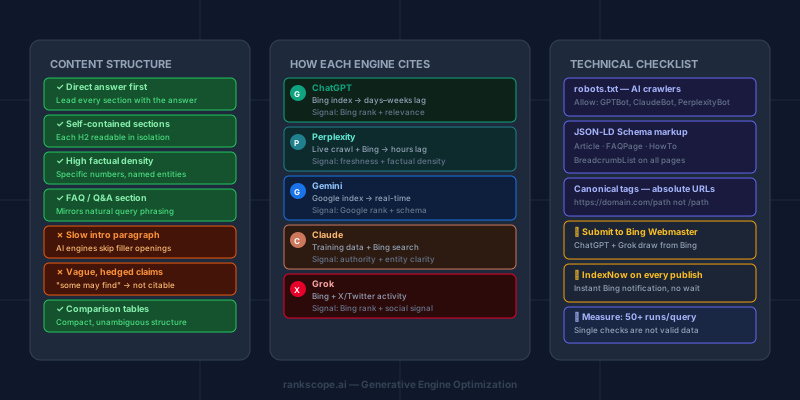
Phase 2 (Weeks 2–5): Content restructuring. They rewrote their top 12 content pieces (by traffic and topical relevance to buyer queries) to meet AI extraction standards. Concretely: direct answers at the top of every H2 section, factual density with specific numbers, self-contained paragraphs with entity names explicit in every section, and FAQ blocks at the bottom of every guide with 6–8 questions directly answering the prompts they were tracking.
Phase 3 (Weeks 5–10): New structured content. They published five new guides targeting specific category queries where they had zero coverage: a detailed comparison guide for their top competitor pair, a structured how-to for their core use case, and three deep explainers on problems their product solves. Each was 2,500–4,000 words, structured around direct answers, with schema markup on the FAQ sections.
Phase 4 (Weeks 1–90): Measurement. They tracked citation rate weekly across ChatGPT and Perplexity using their original 40-prompt library, adding 15 new prompts to capture the use cases targeted by new content.
The Results
| Metric | Week 0 | Week 30 | Week 60 | Week 90 |
|---|---|---|---|---|
| Citation rate (ChatGPT) | 2% | 8% | 19% | 31% |
| Citation rate (Perplexity) | 3% | 14% | 28% | 38% |
| Blended citation rate | 2.5% | 11% | 23% | 34% |
| Share of voice vs. top competitor | 6% | 19% | 31% | 44% |
| Prompt coverage (prompts where brand appeared ≥1×) | 7/40 | 21/40 | 33/40 | 39/40 |
The 30-day measurement was misleading. At 30 days, progress looked modest — from 2.5% to 11%. The team nearly concluded the program wasn't working. At 60 days, the data had fully updated and showed a 9× improvement from baseline. By 90 days, they had moved from citation invisibility to competitive parity with mid-tier players in their category.
What Worked
Two interventions drove the bulk of the improvement:
Content restructuring beat new content. Rewrites of existing pages drove faster citation lift than new content — because AI engines were already indexing those URLs. Restructured pages saw citation improvements within 2–3 weeks of reindexing. New content took 4–6 weeks to see comparable effects.
Specificity in FAQ sections. Generic FAQs ("What is project management software?") contributed almost nothing to citations. Specific FAQs directly matching tracked prompt phrasing ("What project management software is best for engineering teams who work async?") contributed measurably. The match between FAQ content and actual AI prompts is more important than FAQ quantity.
3. Case Study 2: Professional Services Firm — Winning Google AI Overviews
Brand type: HR consulting firm, regional practice with national clients Starting citation rate in AI Overviews: 0% Timeframe: 60 days
The Starting State
Professional services firms face a specific GEO challenge: they sell expertise, not products, and expertise is hard for AI engines to evaluate and attribute. A software company can be cited for its product. A consulting firm needs to be cited for its insights.
This firm's GEO program started because a partner noticed that Google AI Overviews were appearing for high-value queries their salespeople were using to generate inbound — queries like "how to reduce employee turnover in manufacturing" and "DEI strategy frameworks for mid-size companies." Those AI Overviews were citing three competitors and academic sources. This firm wasn't named.
The initial citation audit showed they had zero appearances across 25 tracked AI Overview queries.
The GEO Program
The firm's GEO consultant diagnosed the problem quickly: their content was well-written but unsourceable by AI. Every article was written as narrative insight — fluid prose that made the firm sound smart. But AI engines don't cite fluid prose. They cite content with clear attributable claims.
The intervention focused entirely on Google AI Overviews (the highest business impact channel for their audience) with a two-part approach:
Structured insight content. They rewrote 8 key practice area guides using a specific structure: define the problem in the opening paragraph (entity-rich, specific), follow with a numbered or bulleted framework that answers the problem directly, include at least 3 specific data points with sources, add FAQ schema answering the exact phrases that triggered AI Overviews in the SERP.
Schema markup intensive. They implemented FAQ structured data on every practice area page, Article schema on guides, and HowTo schema on process-oriented content. They also added breadcrumb schema to establish content hierarchy clearly.
The Results
| Metric | Week 0 | Week 30 | Week 60 |
|---|---|---|---|
| AI Overview appearances | 0/25 prompts | 6/25 prompts | 14/25 prompts |
| Citation rate in AI Overviews | 0% | 24% | 56% |
| Organic traffic increase (GSC) | Baseline | +12% | +31% |
| Leads attributed to AI referral | 0 | 3 | 11 |
Google AI Overviews moved faster than other platforms. The combination of FAQ schema markup and structured prose produced AI Overview appearances within 3 weeks of publication — faster than ChatGPT or Perplexity in comparable programs. This is consistent with how Google AI Overviews work: they draw from Google's existing index and respond quickly to on-page signals like FAQ schema.
The Key Finding
Schema markup was load-bearing, not decorative. Pages with FAQ structured data appeared in AI Overviews at 3× the rate of pages with equivalent content but no schema. The structured data gives Google a direct signal about where the answer to a specific question lives on the page — which is exactly what AI Overviews need to build their responses.
4. Case Study 3: E-commerce Brand — Perplexity as a Discovery Channel
Brand type: Premium home goods e-commerce, $15M annual revenue Starting Perplexity citation rate: 1% Timeframe: 75 days
The Starting State
E-commerce brands face a different AI citation landscape than B2B SaaS. Product discovery queries in AI search are often handled by shopping integrations (ChatGPT launched its Shopping feature in 2025, ChatGPT shopping triggers are heavily category-dependent). The most reliable e-commerce AI discovery channel — the one that works across categories and sends deliberate, high-intent buyers — is Perplexity.
This brand's marketing team noticed referral traffic from Perplexity growing 340% in Q1 2026. The conversions from that traffic were strong — 3.1% CVR vs. 1.8% for Google organic. They wanted to grow it intentionally.
Starting measurement: 1% citation rate across 30 prompts covering their product categories.
The GEO Program
E-commerce GEO has a content problem. Most e-commerce brands have product pages (optimized for purchase, not citation), category pages (thin), and maybe a few blog posts (usually promotional). None of it is structured for AI extraction.
This brand's GEO program built an entirely new content layer: buying guides structured specifically for citation. Not "here's why our products are great" — but "here's a structured guide to buying [category], with specific criteria, tradeoffs, price ranges, and what different buyer profiles should prioritize."
12 buying guides published in 75 days, averaging 2,200 words each, covering every major product category. Each guide was structured with:
- Clear criteria framework (H2 sections for each decision factor)
- Direct price-range anchors with specific numbers
- Explicit comparisons (not just "ours is best" — actual tradeoffs between product approaches)
- FAQ section targeting the specific prompts Perplexity returned for their categories
They also implemented Product and ItemList structured data across product and category pages, and ensured AI crawlers were explicitly allowed in robots.txt.
The Results
| Metric | Day 0 | Day 30 | Day 60 | Day 75 |
|---|---|---|---|---|
| Perplexity citation rate | 1% | 7% | 19% | 26% |
| Perplexity referral sessions (vs. baseline) | Baseline | +68% | +189% | +247% |
| CVR from Perplexity referral | 3.1% | 3.4% | 3.8% | 4.1% |
| Revenue attributed to Perplexity channel | $18K/mo | $31K/mo | $54K/mo | $68K/mo |
Perplexity's freshness weighting rewarded rapid publishing. New buying guides were indexed and began generating citations within 5–7 days of publication — significantly faster than the 2–4 week lag typical on other platforms. For e-commerce brands that can produce solid structured content quickly, Perplexity offers the fastest GEO feedback loop of any major AI engine.
Conversion rate climbed as citation context improved. Early citations in Perplexity results were surface-level — "Brand X also sells in this category." Later citations, generated by buying guides, were contextual — "Brand X recommends Y for buyers prioritizing Z." Contextual citations converted at higher rates because the AI's framing pre-qualified the buyer.
5. Case Study 4: Content Site — Losing Citation Share to a New Entrant
Brand type: Established content site in the marketing tools space, 8 years old, strong domain authority Citation share of voice at program start: 31% (dominant in category) Timeframe: 90 days (this is a loss case, not a win)
The Story
Most GEO case studies focus on brands that gained citation share. This one looks at a brand that lost it — because the lesson is at least as important.
This site had strong traditional SEO. High DA, lots of backlinks, consistent ranking in Google's top 5 for most category queries. Their content team produced two to three posts per week but had never thought about AI citation optimization.
In Q1 2026, a competitor entered the market with a smaller site (lower DA, fewer indexed pages) but an aggressive GEO-first content program. Instead of producing volume, the competitor published 18 deep, structured guides over three months — each targeting a specific category query, each written to pass AI extraction tests, each with full schema markup.
What the Data Showed
| Metric | Month 0 | Month 1 | Month 2 | Month 3 |
|---|---|---|---|---|
| Established site citation SOV | 31% | 27% | 19% | 14% |
| New entrant citation SOV | 3% | 9% | 18% | 29% |
| Top competitor citation SOV | 22% | 21% | 22% | 23% |
The established site didn't lose citations because AI engines devalued their domain authority. They lost because the new entrant published content that better answered the exact prompts buyers were using in AI search — and AI engines cited the better answer, not the better domain.
The established site's existing content was ranking content: optimized for Google's algorithm, built around keywords and backlinks. The new entrant's content was citation content: optimized for AI extraction, built around specific questions and structured answers.
Traditional SEO authority didn't protect citation share when content quality for AI extraction diverged.
What the Established Site Did (and Didn't Do)
When they finally measured their citation rate at month 3 and saw the 17-point drop, they ran an emergency content audit. The audit showed that 60% of their top-ranking content failed basic AI extraction tests — the content existed, but when fed to an AI engine, it couldn't extract a clean summary.
They began a restructuring program in month 4. By month 6, their citation SOV had recovered to 22% — not back to 31%, but stabilized. The lesson: GEO position is easier to lose than to win back. The new entrant's content was now indexed, cited, and being used as training signal. Recovering lost citation share requires producing content that's unambiguously better, not just catching up.
6. Case Study 5: Agency Client GEO Sprint — 8 Weeks, Measurable Lift
Brand type: B2B fintech, compliance and risk management platform Client of: Digital marketing agency with GEO practice Starting state: 0% citation rate across all four engines Timeframe: 8 weeks
The Sprint Model
Some of the clearest GEO data comes from agency-run sprints: tight time-boxed programs with defined deliverables, consistent methodology, and pre/post measurement. This case study comes from an agency that ran a structured 8-week GEO sprint for a fintech client.
The client had a domain that was 2 years old, reasonable backlink profile, 12 pages of content, zero GEO-specific work. Category: compliance and risk management software. The 30 tracked prompts covered queries like "best compliance management software for financial services" and "how to automate regulatory risk tracking."
Sprint Structure
Weeks 1–2: Baseline measurement + content audit. 30 prompts run across ChatGPT, Perplexity, Google AI Overviews, and Google AI Mode. Citation rate: 0% on all four. Content audit: all 12 pages failed extraction test. Competitor audit: three competitors had citation rates of 8–22% using content ranging from 2–5 years old but with better structure than the client's.
Weeks 3–5: Content restructuring. Rewrote 6 core pages (homepage, 2 feature pages, 3 use case pages) to meet AI extraction standards. Added H2 direct-answer structure, factual density (specific stat + source per section), FAQ schema on all pages.
Weeks 5–8: Net new GEO content. Published 4 new structured guides targeting specific prompts: "financial services compliance automation guide," "regulatory change management for fintech," "AML compliance software comparison," and "how to build a compliance monitoring program." Each guide ran 3,000–4,500 words.
Measurement: Ran full 30-prompt suite at week 4 and week 8.
Results
| Platform | Week 0 | Week 4 | Week 8 |
|---|---|---|---|
| ChatGPT citation rate | 0% | 4% | 18% |
| Perplexity citation rate | 0% | 11% | 32% |
| Google AI Overviews | 0% | 8% | 22% |
| Google AI Mode | 0% | 3% | 15% |
| Blended citation rate | 0% | 6.5% | 22% |
Perplexity moved fastest, ChatGPT moved slowest. This is consistent across multiple GEO programs. Perplexity's freshness weighting and aggressive crawling means new structured content generates citations within days of indexing. ChatGPT is slower — it takes 3–5 weeks for content changes to propagate through Bing indexing and into ChatGPT's retrieval layer.
New content outperformed restructured content at 8 weeks. At week 4, restructured existing pages and new content contributed roughly equally to citation lift. By week 8, the new deep guides were generating 2× more citations than restructured existing pages — because AI engines preferentially cited longer, more complete guides on specific topics over shorter, restructured pages.
7. Cross-Case Patterns: What Moves Citation Rate
Across all five case studies, a consistent set of patterns emerged. These aren't recommendations — they're observations from programs with before/after measurement.
Pattern 1: Content Structure Is the Highest-Leverage Change
Every brand that restructured existing content saw citation rate improvements. The single change with the most reliable lift: adding a direct answer to the first paragraph of every H2 section. AI engines extract the opening sentence of sections at disproportionately high rates — because that's where the answer to the question lives.
Pattern 2: Perplexity Moves First, ChatGPT Moves Last
Across all five programs, the citation update timeline was consistent:
- Perplexity: 5–10 days after content is indexed
- Google AI Overviews: 2–3 weeks
- Google AI Mode: 3–4 weeks
- ChatGPT: 3–5 weeks
Teams that measured only ChatGPT early in a program underestimated their GEO progress. Measuring all four engines gives a much more accurate picture of whether work is landing.
Pattern 3: FAQ Schema Has Outsized Impact on Google AI Overviews
The professional services and agency sprint cases both showed FAQ schema markup driving 2–3× citation rates compared to equivalent content without schema. Google AI Overviews specifically uses FAQ structured data to identify answer candidates. It's the most direct pipeline between on-page content and AI Overview citations.
Pattern 4: Category Queries Beat Brand Queries for Growing Share
Tracking "what is [your brand]" prompts tells you nothing useful about GEO performance — you'll almost always appear for your own brand name. The signal that matters is unbranded category queries: "best [category] tools," "how to [solve category problem]," "what should I look for in [category] software." These are the prompts buyers use when they haven't decided yet. Citation on these prompts is where GEO programs compound.
Pattern 5: New Entrants Can Win Citation Share Fast
The content site loss case shows the flip side of GEO's early stage: domain authority doesn't protect citation share the way it protects Google rankings. A focused program on a new domain can achieve citation parity with a high-DA incumbent within 90 days if the content is structurally better for AI extraction. This is good news for new brands — and a warning for established ones that haven't audited their AI visibility.
8. What Doesn't Work (And Why Brands Waste GEO Budget)
The patterns above show what works. The failure modes are equally consistent.
Posting More, Not Better
The most common GEO mistake is scaling content production without addressing content structure. Publishing 10 thin blog posts produces near-zero citation lift. Publishing 2 deep structured guides produces measurable citation improvement. Volume is not the variable. Extraction quality is.
Measuring Too Early
Multiple teams in the case studies above nearly stopped their programs based on 2-week measurements that showed minimal progress. GEO has a 2–4 week lag from content indexing to citation update. A measurement at 10 days is noise. A measurement at 30 days is early signal. A measurement at 60 days is reliable data. Teams that measure only at 10–14 days make incorrect conclusions about what's working.
Optimizing Only for ChatGPT
ChatGPT has the most mindshare, but it has the slowest citation update cycle and the most training-data dependency (what the model learned before its knowledge cutoff matters). Brands that optimize only for ChatGPT miss Perplexity (fastest feedback loop, highest freshness weighting), Google AI Overviews (highest traffic volume), and Google AI Mode (emerging buyer research channel). A GEO program that doesn't measure all four platforms has significant blind spots.
Treating GEO as a One-Time Fix
Every case study shows citation rate moving over time — both up and down. The content site loss case is the clearest example: 31% SOV at month 0, 14% at month 3, without doing anything differently. The category moved around them. GEO is a continuous measurement and optimization practice, not a one-time audit. Brands that run a GEO sprint and then stop measuring lose position to brands that keep compounding.
9. How to Run Your Own GEO Measurement Program
If you're reading this and haven't measured your GEO performance yet, here's the minimum viable starting framework.
Step 1: Build a prompt library. Write 20–30 unbranded discovery prompts your buyers would ask when researching your category. Include "best [category] tools," "how to [solve core problem]," "what should I look for in [category] software," and "[problem] vs [problem] solutions."
Step 2: Run a baseline. Run each prompt across ChatGPT, Perplexity, Google AI Overviews, and Google AI Mode. Record: did your brand appear? What position? What competitors appeared? This is your starting point.
Step 3: Run a content audit. Feed your top 10 content pieces to an AI engine and ask for a 3-bullet summary. If the summary is inaccurate, incomplete, or missing key brand claims — that page is failing AI extraction.
Step 4: Prioritize restructuring over new content. Start with your existing highest-traffic or most topically relevant content. Add direct answers to the first sentence of each H2. Add a 6–8 question FAQ with schema markup. Increase factual density.
Step 5: Measure at 30 and 60 days. Don't measure at 10 days. Give AI engines time to update. The 60-day measurement is when you'll see the clearest signal from content changes.
For teams running this at scale, RankScope automates prompt tracking, citation rate calculation, share of voice benchmarking, and forensic diff analysis across all four engines — so you're not running manual sampling every month. That's the infrastructure that turns GEO from occasional audits into a continuous optimization program.
For a deeper breakdown of the metrics framework, see GEO Metrics: How to Measure Generative Engine Optimization Performance. For the tactical optimization playbook, see How to Optimize Content for AI Search. And if you want to turn these case study learnings into a repeatable system, our GEO strategy playbook lays out the full 5-step cycle — from citation baseline through engine-specific iteration.
10. FAQ
How much does GEO work cost?
GEO program costs vary by scope. A minimum viable GEO program — content audit, restructuring of 10 existing pages, 4–5 new structured guides — typically requires 80–120 hours of content work. Agency GEO sprints run $8,000–$20,000 for an 8-week program. In-house programs cost primarily in time. Measurement tooling (like RankScope) starts at $49/month for teams that want automated tracking rather than manual sampling.
Can GEO results be attributed to revenue?
Directly attributing GEO citations to revenue is still an emerging practice. Perplexity and some ChatGPT responses pass referral tracking via URL parameters — so inbound traffic from those sources is attributable in your analytics. AI Overviews traffic shows up in Google Search Console as organic traffic (AI Overview appearances don't have a separate UTM parameter). The clearest revenue signal from GEO is the e-commerce case above: Perplexity referral CVR (4.1%) significantly outpaced Google organic CVR (1.8%), which is consistent with the higher intent level of AI-referred buyers.
What industries get the most GEO traction?
The categories showing the most measurable GEO traction in 2026 are: B2B SaaS (buyers research heavily in AI), professional services (complex decisions where buyers use AI to pre-evaluate), e-commerce with considered purchases (buyers use Perplexity for research before purchase), and health/wellness (high query volume in AI search). Industries with simpler or faster purchase decisions see less AI-assisted discovery and correspondingly lower GEO leverage.
Does GEO require technical SEO work?
Some of it does. AI crawler access (allowing GPTBot, ClaudeBot, PerplexityBot in robots.txt) is table stakes. Schema markup — specifically FAQ, Article, and HowTo — shows consistent lift in citations, particularly for Google AI Overviews. Page speed matters in that slow-loading pages may not be indexed before AI engines check. But the majority of GEO impact comes from content structure and quality, not technical configuration. Fix your robots.txt and add schema, then focus the bulk of your effort on content.
GEO results are real, measurable, and reproducible. The patterns across these case studies point to the same conclusion: brands that treat AI citation like traditional SEO (track it, measure it, optimize systematically) are pulling away from brands that still treat it as anecdote.
The question isn't whether to run a GEO program. The question is whether you're measuring yet — because if you're not measuring, you're either compounding quietly or losing ground quietly. Both of those outcomes are better faced with data.
For the data infrastructure behind a GEO measurement program, see what RankScope tracks across all four engines: ChatGPT, Perplexity, Google AI Overviews and Google AI Mode.