State of GEO 2026: The Definitive Report on Generative Engine Optimization
Generative Engine Optimization entered 2025 as an emerging concept. By mid-2026, it has become an operational reality that marketing and SEO teams can no longer treat as optional. AI-generated answers now shape buying decisions. Citation share of voice is a metric that boardrooms are starting to track alongside traditional organic rankings.
This report compiles what we know about GEO in 2026: the scale of AI search adoption, how citations are distributed, what content gets cited and what doesn't, how brands are (and aren't) responding, and what the data says about what works. Where we have RankScope platform data, we've used it. Where we're drawing on published research, we've cited the source.
We'll update this report as material new data becomes available. If you want the methodology or raw benchmark data, get in touch.
Table of Contents
- The Scale of AI Search in 2026
- How Citations Are Distributed
- The GEO Adoption Gap
- What Gets Cited — and What Doesn't
- Platform-by-Platform: How the Four Engines Differ
- Citation Share of Voice: Benchmarks and Baselines
- The B2B SaaS Citation Landscape
- What Separates Cited Brands from Invisible Ones
- The Measurement Problem
- What Comes Next: GEO in H2 2026 and Beyond
1. The Scale of AI Search in 2026
The volume numbers alone tell most of the story.
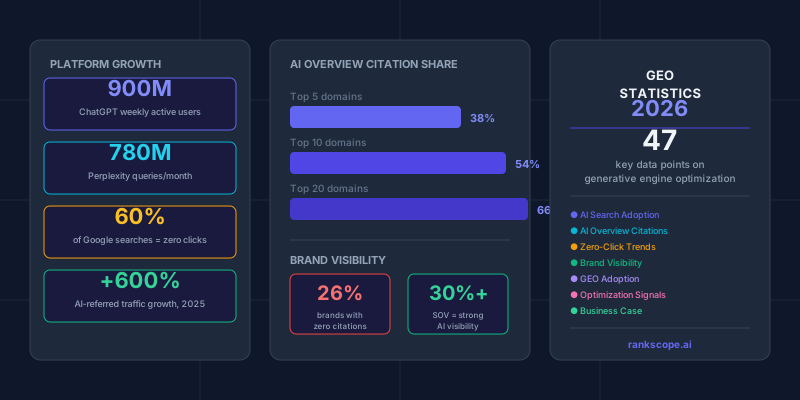
ChatGPT reached 900 million weekly active users in February 2026, OpenAI announced, along with 50 million paying subscribers. (TechCrunch, February 2026)
Perplexity served 780 million search queries in May 2025, up from roughly 230 million a month in August 2024: more than a threefold increase in nine months. (AdWeek, 2025)
Google AI Overviews has over 1.5 billion users a month, Sundar Pichai said in Alphabet's Q1 2025 results. (Google, April 2025)
ChatGPT prompt volume jumped nearly 70% between January and June 2025. This wasn't slow, compounding growth — it was a step change in user behavior. (Bain, 2025)
39% of consumers — and over half of Gen Z — now use AI for product discovery. (Salesforce Consumer Shopping Trends, 2025) This is the number that should capture every marketing team's attention. Product discovery is the top of the funnel. AI is inside it.
AI Search Sits Alongside Google, Not Instead of It
The key context for GEO strategy in 2026 is that AI search is not replacing traditional search — it's running in parallel, and often handling the highest-stakes queries.
Users increasingly switch between both: a Google search for quick lookups, an AI chat for complex decisions, product comparisons and recommendations.
When a Google AI summary appears, users click a traditional result far less often: 8% of visits against 15% without one, in Pew Research Center's 2025 browsing panel. (Pew Research Center, July 2025) The implication: brands need visibility in the answer itself, not just a listing on the results page.
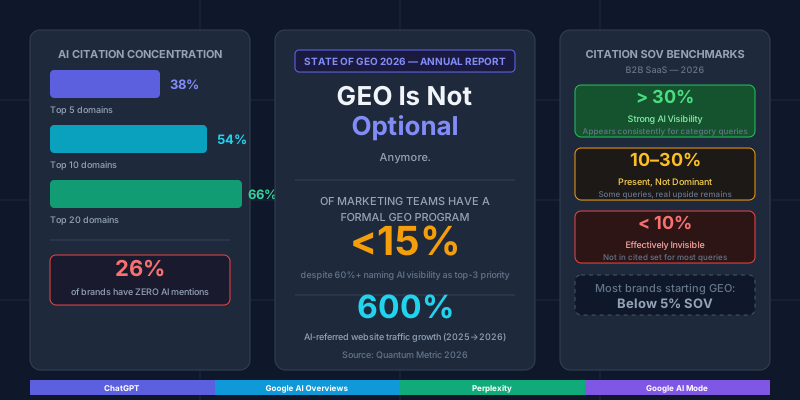
Quantum Metric reported AI-referred traffic rates up 600% since January 2025 in its 2025 peak-season benchmark. (Quantum Metric) The traffic that clicks through from AI answers is small in absolute terms, but it is growing from a low base.
2. How Citations Are Distributed
AI search has created a new kind of visibility problem. Traditional SEO distributes traffic across many pages and domains through a long tail of rankings. AI citation doesn't work that way.
AI citation is winner-takes-most, not winner-takes-all, but the concentration is severe.
In Google AI Overviews, the distribution looks like this:
- Top 5 domains capture 38% of all citations
- Top 10 domains capture 54% of all citations
- Top 20 domains capture 66% of all citations
Ranking in Google helps, but it does not decide citation. On one query we checked in September 2026 ("answer engine optimization"), 7 of the 9 organic page-one results were also cited in the AI Overview, but the #2 result was not, and one cited source did not rank on page one at all. See GEO vs SEO vs AEO for the full comparison.
The Citation Concentration Problem
Here's the practical implication of citation concentration: if you're not in the small set of authoritative sources for your topic, you're effectively invisible to users making decisions through AI search. Being on page 2 of traditional Google results is suboptimal. Being absent from AI citations is a structural business risk as more decisions move through these channels.
The good news: citation concentration also means that moving from zero to one — getting into the cited set for even a handful of your most important queries — has measurable business impact. The gap between present and absent is larger than the gap between position 1 and position 5.
3. The GEO Adoption Gap
Understanding the market matters for benchmarking where you are relative to where the category is going.
GEO tool adoption is nascent but accelerating. The market for dedicated GEO monitoring platforms (distinct from traditional SEO tools) barely existed in 2024. By early 2026, multiple platforms have emerged and are seeing month-on-month growth as teams move from manual checking to systematic monitoring.
The Teams Most Ahead on GEO
From patterns in early GEO adoption, the teams moving fastest share a few characteristics:
- B2B SaaS and technology companies — where buyers use AI search to research vendor comparisons and "what's the best tool for X" queries
- Content-forward companies with existing SEO operations — they adapt what they already do rather than starting from scratch
- Companies with strong editorial brands — Semrush, HubSpot, Cloudflare, Salesforce were getting cited before "GEO" was even a term, because they already published the kind of authoritative, entity-rich content AI engines prefer
The teams furthest behind are those treating GEO as a future priority. AI citation authority compounds the same way organic search authority does — the cost of delay is measured in months of lost visibility that competitors are accruing.
4. What Gets Cited — and What Doesn't
This is where the data becomes most actionable. Original research and platform data consistently show the same patterns.
Content Formats That Win AI Citations
Structured guides are the most-cited page type. An analysis of over 1 million URLs cited across ChatGPT, Google AI Overviews, Google AI Mode, Perplexity, Gemini, and Microsoft Copilot found that URLs with /guide/ in the path averaged 42% more citations than the overall average. Blog posts came next. Pricing pages performed worst. (OtterlyAI URL Citation Study, May 2026)
Original research and data attracts citations disproportionately. Content that publishes original numbers — surveys, platform data, observed measurements — becomes a primary source. Once a data point is attributed to your publication, it spreads across secondary articles that also get cited, creating compounding citation value. This is one of the most underused tactics in GEO strategy.
Comparison and alternative content performs strongly. Queries of the form "best X for Y" and "[Tool A] vs [Tool B]" are among the highest-volume decision queries in AI search. Content that directly addresses these comparisons — with real depth, honest assessments, and specific data — gets cited at high rates.
FAQ-dense content gives an engine more passages to lift. Each well-answered question is a self-contained passage that can match a related query. Note that FAQ schema does not earn Google rich results for most sites (restricted to government and health sites since August 2023); the value is in the visible questions and answers.
Entity-rich definitions and glossaries are citation anchors. AI engines need authoritative definitions for concepts and entities. Content that definitively explains what a term means — with entity relationships, context, and precision — tends to be returned as a citation for the definitional query and all related queries.
Content Formats That Get Ignored
Thin promotional copy is almost never cited. A page that says your product is great, lists its features, and includes a CTA is not answering a question a user is asking. AI engines need content that directly answers questions — not content that sells to people who've already decided.
Generic listicles without original data perform poorly. "10 tips for X" content that synthesizes what everyone already knows doesn't have the factual density that AI engines prefer. Adding specific numbers, citing primary sources, and including genuine analysis separates the content that gets cited from the content that doesn't.
Duplicate frameworks with no original angle get filtered out. AI engines are remarkably good at recognizing when a page is re-stating what other pages already say. Original angle — a counter-argument, a data point nobody else has, a structural framework that's genuinely yours — is what makes a page a citation-worthy primary source rather than secondary noise.
5. Platform-by-Platform: How the Four Engines Differ
A major mistake in early GEO strategy is treating all AI engines as interchangeable. They retrieve and rank sources differently. A one-size-fits-all approach leaves significant citation share on the table.
ChatGPT
ChatGPT uses Bing's web index for retrieval when users ask questions that require current information. This means Bing indexing is a prerequisite for ChatGPT citations — content that Bing hasn't indexed simply doesn't exist in ChatGPT's retrieval layer.
ChatGPT citations skew toward high-authority domains. Reddit has become a disproportionate citation source after OpenAI's partnership with Reddit — user-generated content from r/subreddits often surfaces in ChatGPT answers for product questions. This is a meaningful signal for brand monitoring: your Reddit presence matters for ChatGPT visibility.
ChatGPT prompt volume — nearly 70% growth in H1 2025 — is outpacing other AI engines in absolute terms. It remains the highest-volume single platform to optimize for.
Google AI Overviews
AI Overviews draw from Google's web index and apply strong trust signals from Google's own ranking factors. Pages that rank in Google's organic top 10 for a query are disproportionately cited in AI Overviews for the same query.
The trigger rate has changed meaningfully: in January 2025, 91.3% of AI Overview triggers were informational queries. By October 2025, that had dropped to 57.1% as Google began triggering AI Overviews on commercial and transactional queries. (Semrush AI Overviews Study, 2025) This is the most important trend in Google AI Overviews: it's moving from pure informational responses into the buyer's decision journey.
Perplexity
Perplexity crawls the live web aggressively and weights freshness heavily. Its index updates faster than Google's or Bing's, which means very recent content can appear in Perplexity citations before it appears in Google AI Overviews. Perplexity is also more likely to cite mid-authority domains if they have highly relevant, fresh content.
Perplexity's query volume grew 239% in under 12 months. Its user base skews toward researchers, professionals, and technical users — the exact demographic that makes B2B buying decisions.
Google AI Mode
Google AI Mode is a separate, more conversational AI search interface that draws from Google's index but processes queries through a deeper reasoning layer than standard AI Overviews. AI Mode is more willing to synthesize across multiple sources and produce longer, more structured answers.
AI Mode launched broadly in 2026 and is still establishing its citation patterns. Early data suggests it has a broader citation distribution than AI Overviews — slightly less winner-takes-most — but follows similar domain authority weighting. It's the least mature of the four major platforms, which makes it the highest opportunity for brands willing to optimize early.
For a deeper dive on getting into each of these engines specifically, the Complete Guide to GEO in 2026 has platform-specific tactics for each one.
6. Citation Share of Voice: Benchmarks and Baselines
Share of voice in AI search is the same concept as in traditional media monitoring: what percentage of citations in your category does your brand capture? The difference is that you're measuring AI-generated answers, not media coverage.
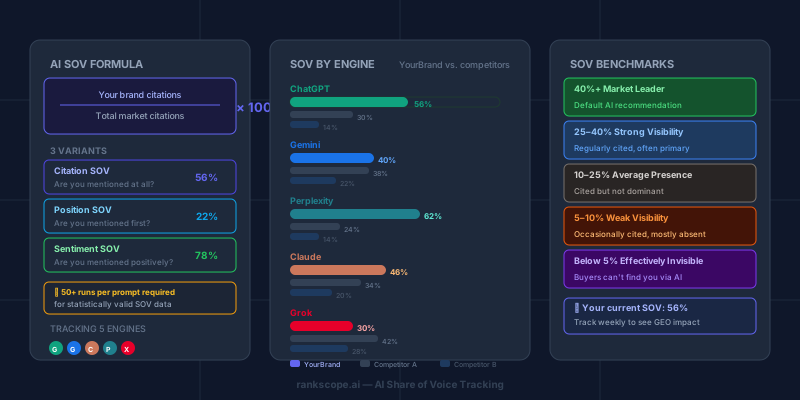
The formula: AI Citation SOV = (your brand citations ÷ total citations across all tracked brands) × 100
Three variants of this metric matter in practice:
- Citation SOV — are you named at all?
- Position SOV — are you named first or most prominently?
- Sentiment SOV — are you named positively, neutrally, or negatively?
For the methodology behind these metrics and how they differ across engines, see our guide to calculating share of voice in AI search.
Is There a Benchmark?
There is no published benchmark for what a good citation share is, from us or anyone else we have found, and it depends heavily on how many brands compete for the same prompts. Compare yourself with named competitors on a fixed prompt set, and track the direction over time.
Most brands have never measured their citation share at all. That is usually not because their content is bad. It is because their content was not structured for extraction, their brand is not present on the sources AI engines draw on, and nobody has been measuring.
How Citation SOV Differs from Traditional SOV
Traditional share of voice (in media monitoring) measures how many times your brand appears in press coverage relative to competitors. It's a count of brand mentions across channels.
AI citation SOV is narrower and more intent-focused. It measures specifically how often your brand appears in the AI-generated answer to a user query — and it matters most for the queries your potential buyers are actually asking. A high number of brand mentions in press coverage that AI engines don't draw from is irrelevant to your AI citation SOV.
7. The B2B SaaS Citation Landscape
B2B SaaS is arguably the category with the most at stake in GEO. Enterprise software buyers increasingly start their vendor research with AI search. "What's the best [category] software for [use case]" is exactly the query that benefits from AI answers — and the vendors in those answers get disproportionate consideration.
What the B2B Citation Landscape Looks Like in 2026
In the categories we have looked at, the structure tends to be similar, though we have not measured it systematically:
One or two dominant brands. Usually the category incumbents, with years of published content and strong Google rankings that carry over into AI citations.
A handful of consistently cited challengers. Brands with original content and presence on the third-party roundup pages AI engines draw on.
A long tail that rarely appears. Many have good products and no AI presence.
The implication for newer or smaller SaaS brands: citation share in B2B SaaS categories is still being competed for. Often the dominant brands got there by default, because they already ranked in Google and their content happened to suit extraction, not because they optimized for AI answers. That is the opening for brands that do.
How Analyst Relations Affects B2B Citations
Industry analyst platforms — primarily Gartner Reviews — play an outsized role in B2B AI citations. Research analyzing 1 million+ URLs cited across major AI engines found that Gartner's review pages (gartner.com/reviews/) capture 81.7% of all analyst-relations-site citations. Critically, 96% of those Gartner citations come from its user-review product, not its gated research reports. (OtterlyAI, Analyst Relations AI Search Study, 2026)
The implication: for B2B SaaS, a Gartner Reviews presence isn't just a trust signal — it's an AI citation source. Being present and reviewed on Gartner Reviews increases the probability that AI engines will cite you when answering vendor comparison queries.
G2, Capterra, and similar review aggregators follow the same pattern. They're not just lead generation channels anymore. They're AI citation nodes.
8. What Separates Cited Brands from Invisible Ones
The gap between brands that consistently appear in AI-generated answers and brands that don't is not primarily about product quality or company size. It's about a specific set of content and presence characteristics.
The Cited Brand Profile
They publish original data. The most consistently cited brands have published research that contains numbers no one else has. Original data creates primary source status — other publications cite the data, and AI engines cite both the primary and secondary sources.
Their content is entity-rich and precisely structured. AI engines extract information at the entity level — specific names, numbers, claims, and relationships between concepts. Content that's vague, generic, or organized around brand positioning rather than information architecture gets passed over.
They're present on the sources AI engines trust. Gartner Reviews, G2, major industry roundup pages, high-authority editorial sites. These third-party mentions create the external evidence that AI engines use to validate a brand as a credible source in its category.
They allow AI crawlers. This should be obvious, but a surprising number of sites still block GPTBot, ClaudeBot, PerplexityBot, and other AI crawlers in robots.txt. Any page that isn't crawlable by AI bots cannot be cited.
They update content regularly. AI engines — especially Perplexity — weight freshness. Content that was last updated in 2023 competes poorly against equivalent content updated in Q1 2026.
The Invisible Brand Profile
They publish about their product, not their category. Content that talks about your features and pricing is not answering the questions your buyers are asking before they know they want your product. Category education content — what is X, how does X work, what are the best X tools — is what generates citations.
They have no original data. Synthesis content that aggregates what everyone already knows provides no new information for AI engines to cite. Without original data or genuine analysis, there's no reason for an AI engine to prefer your content over dozens of similar pages.
They're absent from third-party sources. If your brand doesn't appear on the roundup pages that AI engines draw from, you won't appear in the AI answers. This is often the single fastest lever for increasing citation SOV — getting added to the authoritative comparison and roundup articles in your category.
They haven't measured their baseline. Many brands can't answer "what is our current citation SOV for our 10 most important queries?" because nobody has run a systematic baseline. Without measurement, you can't optimize — and you can't prove to stakeholders that GEO work is moving the needle.
For a practical methodology on setting up brand monitoring across AI engines, see our guide on how to track brand mentions in AI search.
9. The Measurement Problem
The biggest barrier to GEO execution in 2026 isn't understanding what to do — it's measurement. Manual AI citation checking doesn't scale, and the data you get from manual spot checks is statistically unreliable.
Why Single Checks Are Meaningless
AI search engines don't return the same answer to every user. ChatGPT, Perplexity, and Google AI Mode all introduce variability across sessions, users, locations, and time. An answer that cites your brand in one session may not cite it in the next.
This means a single check of whether ChatGPT mentions your brand tells you almost nothing about your true citation rate. Meaningful citation data requires systematic sampling — running the same prompt dozens or hundreds of times and measuring the percentage of runs where you appear.
Without 50+ runs per query, your citation rate estimate has error bars too wide to act on. This isn't perfectionism — it's the statistical reality of working with probabilistic AI outputs. A brand with 30% true citation SOV will appear in about 15 out of 50 runs. A brand with 10% SOV will appear in about 5. The difference between those is the difference between being a visible player and being effectively absent — and you can't tell which you are without systematic measurement.
What Good GEO Measurement Looks Like
A robust GEO measurement setup tracks:
Citation rate — for each target query, the percentage of AI responses that name your brand. Measured across at minimum 50 runs per query, per engine.
Share of voice — your citation count as a percentage of total brand citations in your category, per engine. This is the competitive metric: it tells you not just whether you appear, but how your presence compares to alternatives.
Position in response — whether you're named first, in the middle, or as an afterthought. Being mentioned last in a list of five alternatives is meaningfully different from being the first recommendation.
Sentiment framing — are you cited positively, neutrally, or with caveats? AI engines often frame recommendations with context ("X is good for Y but may not suit Z") — and that framing matters for how users perceive the recommendation.
Competitor framing — which competitors are being cited in your place on queries where you're absent? This tells you who you're losing business to in the AI channel and what content gaps are driving the loss.
Trend over time — is your citation SOV improving or declining? A single snapshot is a baseline. A series of measurements over weeks and months tells you whether your GEO work is having an effect.
The Tool Landscape for GEO Measurement
In 2026, multiple platforms offer GEO monitoring. They vary significantly in which engines they cover, how they sample, whether they track sentiment and competitor framing, and whether they provide historical trends.
When evaluating a GEO monitoring tool, the critical questions are:
- Which engines does it monitor? (ChatGPT, Google AI Overviews, Perplexity, Google AI Mode are the minimum required set in 2026)
- How does it handle AI response variability — statistical sampling or single-run checks?
- Does it track competitors, not just your own brand?
- Can it detect when AI responses about your brand change — and tell you why?
RankScope tracks citation rate, share of voice, sentiment, and competitor framing across ChatGPT, Perplexity, and both of Google's AI surfaces, AI Overviews and AI Mode — using real browser automation rather than API outputs, which means you see what real users see rather than what the API returns under controlled conditions. See how it works.
10. What Comes Next: GEO in H2 2026 and Beyond
Several trends are likely to define the next 12 months of GEO.
AI Overviews Expanding Into Commercial Queries
The shift in AI Overview triggers — from 91.3% informational in January 2025 to 57.1% by October 2025 — is not going to stop. Google is clearly moving AI-generated answers into commercial and transactional territory. By end of 2026, a meaningful share of "best X" and "what should I buy for Y" queries will have AI Overview responses. The brands that have built AI citation authority on informational queries today will be positioned to capture those commercial impressions as they emerge.
AI Mode as the Default Search Interface
Google AI Mode gives a full conversational answer in place of the results page, and it cites sources differently from AI Overviews for the same question. Its citation patterns are still forming, so brands that measure it now will see how it treats their category before most competitors do.
The Death of the "We'll Do GEO Later" Strategy
There's a common assumption in marketing teams that GEO can be treated as a future priority — something to address once AI search becomes more mainstream. That strategy is already losing. Citation authority builds over time. Brands that enter 2027 without a GEO program will face the same gap that brands without an SEO program faced in 2010: technically fixable, but expensive and slow to close.
Consolidation in the GEO Tool Market
The GEO monitoring market that barely existed in 2024 will consolidate in 2026 and 2027 as venture-backed players compete for the enterprise segment. Traditional SEO tools (Semrush, Ahrefs, SE Ranking) are all launching or expanding AI visibility products. The tools that survive will be those that offer real citation data — statistical sampling, multi-engine coverage, and actionable competitor intelligence — rather than single-run spot checks dressed up as analytics.
Original Research as the Primary GEO Strategy
The evidence strongly suggests that original research content is the highest-leverage GEO tactic available in 2026. Content with original data becomes a primary source — other publications cite it, AI engines cite those publications, and the original report accumulates citation authority across a long tail of queries.
The GEO strategies that will look prescient in retrospect are the ones investing in data collection and research publication now: surveys, platform data, original studies, and benchmarks that no one else has. This is not a new SEO insight — original research has always earned links. The difference in the GEO context is that being the primary source on a set of data points earns AI citations that compound indefinitely.
Methodology & Data Sources
This report draws on:
RankScope platform data — aggregated, anonymized citation rate and share of voice data from the RankScope platform, covering B2B technology categories in the US market, January–May 2026.
Published primary research:
- OtterlyAI URL Citation Study, May 2026 (1,028,959 URLs, 1,932,200 citation instances)
- OtterlyAI Analyst Relations AI Search Study, 2026
- Semrush AI Overviews Study, 2025 (trigger rate analysis)
- The Digital Bloom, Top Cited Domains Study, 2025
- Quantum Metric AI Referral Traffic Analysis, 2026
- Bain AI Search Usage Study, 2025
- Salesforce Consumer Shopping Trends, 2025
Platform data and public reports:
- TechCrunch (ChatGPT user milestones)
- AdWeek (Perplexity query volume)
- SimilarWeb (zero-click search data)
All statistics are sourced and linked within the report. Where data represents a range or estimate, the variance is explained inline. We have not interpolated or extrapolated from limited data points to generate statistics — each claim is grounded in a named source.
If you spot an error or want to share data for future editions, reach out.
Start Measuring Your GEO Position
The first step in any GEO program is knowing where you stand. Most brands haven't run a systematic citation baseline — they don't know their current citation rate, their share of voice, or which competitors AI engines are recommending in their place.
RankScope does this automatically. Set up your prompt library, connect your competitors, and you'll know within hours exactly where your brand stands in AI-generated answers across ChatGPT, Google AI Overviews, Perplexity, and Google AI Mode. Start at rankscope.ai.
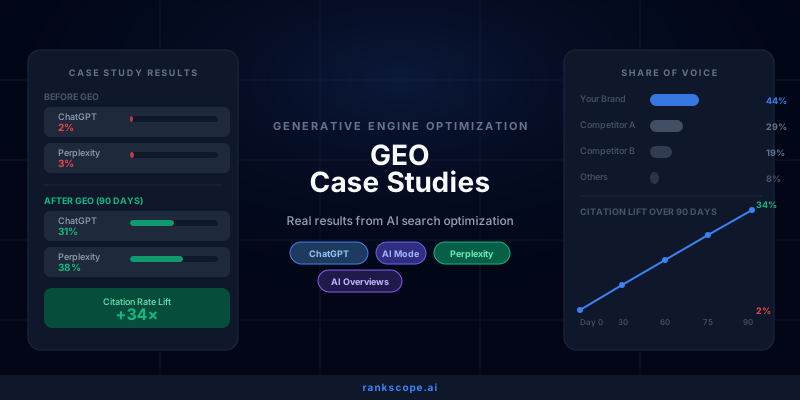
For documented before/after results from brands that have run GEO programs — including citation rate improvements, share of voice gains, and the specific tactics that worked — see our GEO case studies.
Last updated: May 2026. We'll update this report as new data becomes available.