How to Track Brand Mentions in AI Search
Your brand is being discussed right now in AI-generated answers — and the people asking those questions are making buying decisions based on what they read.
The challenge is that tracking brand mentions in AI search is fundamentally different from tracking them anywhere else. Social listening tools scan the web for text. AI search engines generate fresh answers on demand. There's nothing to scan — you have to query the engines yourself, systematically, and measure what comes back.
This guide covers exactly how to do that: the manual approach, what it tells you and where it breaks down, the metrics that actually matter, how automated tracking changes the equation, and how to convert monitoring data into improved citation rates.
Why AI Brand Monitoring Is Different from Traditional Brand Monitoring
Traditional brand monitoring — platforms like Brand24, Mention, or Brandwatch — works by crawling the web for text that mentions your brand. Social posts, news articles, forum threads, review sites. The web is indexed; you search it. If you want a broader overview of how ongoing LLM monitoring works — including the metrics framework and workflow setup — that guide covers the full picture.
AI search engines don't work that way. When someone asks ChatGPT "what's the best tool for X?", ChatGPT generates a fresh answer based on its training data and real-time web retrieval. That answer isn't stored anywhere public. It's not a page you can crawl. The only way to know whether your brand appears is to ask the question yourself.
This creates a tracking challenge that requires a different approach:
- You can't use Google Alerts or web scraping — there's nothing static to find
- You can't check once and consider it done — AI responses vary between sessions, meaning a single check can be misleading
- You have to think in prompts, not keywords — the unit of measurement is how often you appear across a set of realistic user queries
The other complicating factor: AI-generated brand discovery is growing fast. Google AI Overviews now appear in over 11% of all Google searches. ChatGPT processes over 100 million queries per day. Perplexity's user base grew more than 300% through 2025. Brands that aren't tracking AI mentions are flying blind in a channel that's increasingly influencing purchase decisions.
For context on what you're actually trying to optimize toward, the complete guide to generative engine optimization explains the broader strategy that tracking feeds into.
The Four AI Engines You Need to Monitor
Not all AI search platforms work the same way, and each has a different footprint in the market. Here's what matters for tracking purposes:
ChatGPT
ChatGPT's citation behavior depends on whether web search is enabled. ChatGPT Search mode (now the default for most users on ChatGPT Plus and Teams) retrieves live web results via Bing and cites specific sources. Standard mode draws from training data only, which has a knowledge cutoff.
For brand monitoring purposes, focus on Search mode queries — these reflect what most active ChatGPT users experience in 2026, and they're the mode where new content you publish can appear within days.
Volume: Over 100 million daily queries. Dominant in B2B and professional use cases.
Google AI Overviews
AI Overviews appear in Google's standard search results — no separate app, no separate session. They're the AI-generated summaries that appear at the top of Google results for a large and growing percentage of queries. Google doesn't publish exact numbers, but third-party research puts the trigger rate above 11% of all queries in 2026.
This is the engine that most brands underweight in their monitoring, because it looks like "just Google." But a brand that appears in the AI Overview for a high-volume category query captures significantly more visibility than one that appears only in the blue links below it.
Volume: Billions of queries/day. The highest-volume AI touchpoint for most categories.
Perplexity
Perplexity emphasizes source transparency — it cites its sources directly and openly. That means your content, if Perplexity considers it authoritative on a topic, will appear with a visible link alongside the AI-generated answer. Perplexity is particularly strong in research-heavy industries and has an active, educated user base.
Volume: Tens of millions of monthly active users; growing aggressively.
Google AI Mode
Google AI Mode is a more conversational AI interface layered on top of Google Search, distinct from AI Overviews. It's accessible from the search bar for logged-in Chrome users and handles multi-turn queries with more depth than a standard AI Overview. It draws from Google's index but generates longer, more structured responses.
A monitoring setup that covers only the first three engines and misses AI Mode has a meaningful gap, especially for users who research products through extended conversational queries.
Method 1: Manual Tracking (What It Gets Right and Where It Breaks)
Manual tracking is where every brand starts. Run a few prompts, see what comes back, record the results. Here's how to do it properly, and where the limits are.
How to Track Manually
In ChatGPT:
- Enable web search (ChatGPT Search mode) — make sure the search icon is active before running queries
- Enter an unbranded discovery prompt: "What are the best tools for [your category]?" or "How do I solve [specific problem]?"
- Read the full response and note: did your brand appear? At what position? What did the response say about your brand? Which competitors were mentioned?
- Repeat the same prompt 5–10 times in fresh sessions to account for response variability
In Perplexity:
- Go to perplexity.ai and run the same unbranded discovery prompts
- Note both the text of the response and the cited sources — Perplexity shows its citations explicitly
- Check whether your domain appears as a cited source, not just whether your brand is mentioned in the text
- Run each prompt across multiple sessions
In Google AI Overviews:
- Go to google.com and search for category queries that typically trigger AI Overviews
- Look for the AI-generated summary block at the top of results
- Note whether your brand appears in the summary text or in the cited sources listed within the Overview
- AI Overviews don't appear on every query — test multiple query formulations
In Google AI Mode:
- Access AI Mode via the Google search bar (available to logged-in users on Chrome)
- Run multi-turn queries: start with a broad category question, then follow up with specifics ("what about [your category] for teams?")
- Record citations and brand mentions across the full conversation thread
The Problem with Manual Tracking
Manual tracking works for a first baseline — to answer "do we appear at all?" before investing in automated tools. But it has four significant limitations:
1. Response variability makes single checks misleading. AI engines don't return the same response to the same prompt every time. ChatGPT responses vary by session context, model version, user geography, and time of day. If you check once and see your brand mentioned, you don't know if that's a 90% citation rate or a 10% one. You happened to get the response where you appeared.
2. Scale breaks down fast. Most brands need to track 20–50 prompts across 4 engines, with 10–50 runs per prompt per engine. That's 800–10,000 manual queries just for a single measurement period. At a weekly cadence, that's not feasible without automation.
3. No historical comparison. A manual check tells you your status right now. It doesn't tell you whether your citation rate improved or declined after publishing new content last month, or whether a competitor recently started appearing in responses where they used to be absent.
4. Difficult to track competitors systematically. Knowing you appear isn't enough — you need to know what share of citations in your category you hold relative to competitors. Manual tracking can capture this in a small prompt set, but the data gets unmanageable quickly.
Manual tracking is the right first step. It's not a sustainable measurement system.
Method 2: Structured Prompt Sampling
Before moving to automated tools, you can make manual tracking significantly more useful with a structured approach.
Build a Prompt Library
Your prompt library is the foundation of any AI brand monitoring program, manual or automated. These are the specific queries that represent how buyers in your market actually discover and evaluate products through AI.
Good prompts look like:
- "What are the best [category] tools for [use case]?"
- "How do [your target buyers] track [specific problem]?"
- "What software do marketing teams use to [outcome]?"
- "Compare [your category] tools — what are the main options?"
- "What should I look for in a [your category] platform?"
Prompts to avoid for citation rate measurement:
- "Tell me about [your brand name]" — this is useful for sentiment monitoring but doesn't reflect discovery queries
- Prompts that are so specific they'd only ever name you — they inflate citation rate without reflecting real buyer behavior
- Prompts that are too broad to be informative — "what are all the software tools?" generates noise
Aim for 20–50 prompts that span the main buyer questions in your category. Weight toward unbranded discovery queries — these are the ones where your visibility actually matters.
Sample and Aggregate, Not Spot-Check
For each prompt, run it multiple times and aggregate. Even with manual tracking:
- 10 runs per prompt per engine gives you a rough citation rate
- 20+ runs per prompt gives you meaningful signal
- Single-run checks are essentially useless for measuring citation rate
Record your results in a spreadsheet: prompt, engine, run number, brand appeared (Y/N), position (1st/2nd/3rd/etc.), competitors appeared, rough sentiment (positive/neutral/negative when mentioned).
This structured approach turns raw observations into comparable data you can track across measurement periods.
Tracking Competitors Alongside Your Brand
Don't just track whether you appear — track who appears in your place when you don't. For each prompt where you're not cited, record which brands are. These are the competitors you need to understand:
- What content do they have on this topic?
- Are they cited from their own domain, or from third-party sources?
- What do AI engines say about them that they don't say about you?
These citation gaps are direct inputs to your GEO content strategy — each gap represents a specific topic where you can publish or improve content to compete for that citation.
The Metrics That Actually Matter
Raw "did I appear?" tracking is the weakest form of AI brand monitoring. Here are the metrics that give you actionable data:
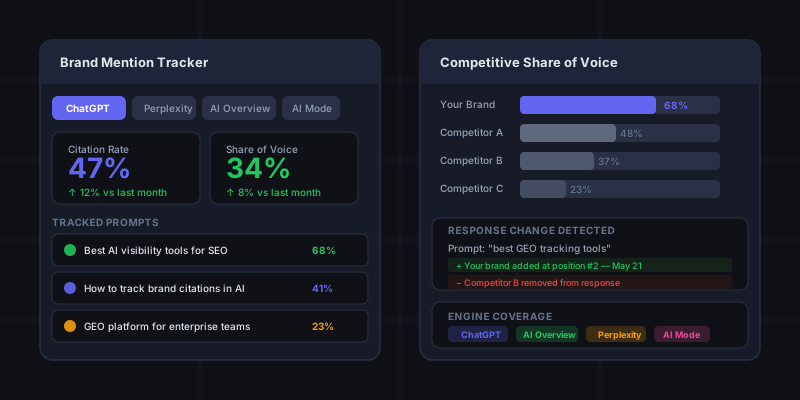
Citation Rate
Definition: The percentage of times an AI engine mentions your brand when given a specific prompt.
Formula: (Number of runs where your brand appeared ÷ Total runs) × 100
Why it matters: A 5% citation rate and a 60% citation rate feel completely different to the buyers running those queries. Citation rate is the number that tells you whether you're a consistent recommendation or an occasional fluke.
Benchmark: For most B2B SaaS categories, a citation rate above 30% for your top 5–10 prompts indicates meaningful AI visibility. Below 10% means you're effectively invisible for that query.
Share of Voice
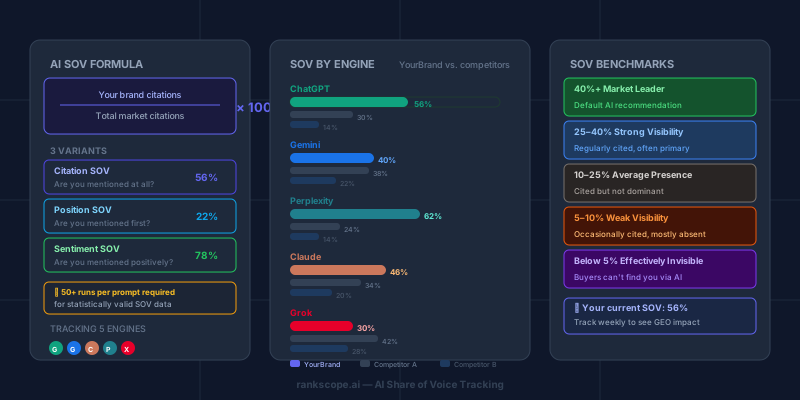
Definition: Your brand's citations as a percentage of all brand citations in your category across a prompt set.
Formula: (Your citations ÷ Total citations for all tracked brands) × 100
Why it matters: Citation rate tells you your absolute performance. Share of voice tells you your relative performance. A 40% citation rate in a category where the market leader has 80% is a very different situation than a 40% rate where no competitor exceeds 20%.
For a deep dive on calculating and interpreting this metric, see the complete guide to share of voice in AI search.
Position in Response
Definition: Where in the AI response your brand is mentioned — first, second, third, or later.
Why it matters: AI-generated answers create a clear hierarchy. The brand named first receives disproportionate attention and trust. Being cited eighth in a list of recommendations is meaningfully different from being cited first.
Track both presence (did you appear?) and position (where?). A high citation rate at low position may indicate you're seen as a secondary option — useful information for positioning work.
Sentiment
Definition: Whether AI-generated mentions of your brand are positive, neutral, or negative in framing.
Why it matters: "RankScope is one option, though some users find the pricing steep" is a citation — but it's doing negative work for you. Sentiment tracking catches cases where you appear but are framed unfavorably, so you can identify the content or positioning signals AI engines are drawing on.
Sentiment is harder to measure quantitatively at scale, but it's worth recording qualitatively during manual tracking passes and looking for consistent patterns.
Engine-Level Breakdown
Definition: How your citation rate and share of voice compare across ChatGPT, Google AI Overviews, Perplexity, and Google AI Mode separately.
Why it matters: AI engines don't agree on which brands are authoritative. Your citation rate on Perplexity may be entirely different from your citation rate in Google AI Overviews. A brand that appears consistently in ChatGPT but is absent from AI Overviews is missing the highest-volume AI touchpoint.
Tracking by engine tells you where your strengths and gaps actually are — which is the prerequisite for knowing where to focus optimization effort.
Method 3: Automated AI Brand Monitoring
At any serious scale — more than 10 prompts, more than one engine, more than monthly tracking — automation is the practical path. This is also where AI rank tracking as a practice comes into its own: if you want a full breakdown of citation rate benchmarks, how Share of Voice is calculated, and how to interpret tracking data per engine, the AI rank tracker guide covers the measurement methodology in depth.
What Automated Tools Do Differently
Automated AI visibility tools don't just save time. They change what's measurable:
Statistical reliability. Tools like RankScope run each prompt dozens or hundreds of times per engine, giving you statistically reliable citation rates rather than spot-check observations.
Change detection. When an AI response changes — your brand gets added or removed, a competitor's framing shifts, a source changes — automated tools detect the change and show you exactly what moved. This is the forensic diff capability that matters most for active optimization: you publish content, you check whether it moved the needle, you see the actual change in AI response text.
Historical trending. Automated tracking builds a timeline of your citation data. You can see whether your citation rate improved after your last content push, whether a specific competitor has been gaining share, or whether your AI Overviews visibility has shifted over the past 90 days.
Competitor monitoring at scale. Tracking your own citation rate alongside 5–10 competitors across 50 prompts and 4 engines is essentially impossible manually. Automated tools aggregate this into a comparable share of voice view.
What to Look for in an AI Monitoring Tool
When evaluating tools for tracking brand mentions in AI search, the key criteria are:
Engine coverage. The four engines that account for the majority of AI-generated discovery — ChatGPT, Google AI Overviews, Perplexity, and Google AI Mode — should all be covered. Tools that track only two or three miss meaningful market share. Google AI Overviews in particular is under-covered by most monitoring tools despite appearing in more than 11% of all Google searches.
Prompt volume and flexibility. Can you define your own prompt library, or are you limited to keywords? Brand monitoring in AI search is prompt-based, not keyword-based — the tool should let you write the specific queries that reflect how buyers in your category actually search.
Forensic diff detection. Does the tool show you what changed in AI responses, not just that your citation rate changed? The diff view is what makes optimization actionable: you can see exactly when and how AI engine responses updated in response to content or technical changes.
Measurement frequency. Weekly or more frequent tracking is needed for active optimization campaigns. Monthly-only tools are better than nothing but miss fast-moving changes.
Competitor tracking. Can you track multiple competitors in the same dashboard? Share of voice is a relative metric — you need competitor data alongside your own.
For a full comparison of the tools available in this category, the guide to AI brand monitoring tools covers the major options with honest pros and cons.
What to Do With What You Find
Tracking is the start, not the destination. Here's how to turn brand mention data into improved AI visibility.
Step 1: Map Your Citation Gaps
After running your first systematic tracking pass, you'll have a list of prompts where competitors are cited and you're not. These citation gaps are your highest-priority content opportunities.
For each gap prompt:
- Which competitor(s) appear in your place?
- What content on their site does the AI engine draw from? (Check the cited sources)
- What topic does that content cover that you haven't addressed?
This mapping gives you a direct content roadmap derived from actual AI engine behavior — not guesswork about what might work.
Step 2: Identify What's Driving Competitor Citations
Before writing a single word of new content, understand why competitors are being cited. There are two main citation mechanisms at play:
Your site content — the AI engine retrieves and cites content from your domain directly. This is the mechanism you can influence most directly through publishing and content optimization.
Third-party mentions — the AI engine has encountered your brand on third-party review sites, comparison articles, industry publications, and community discussions. This is training signal and retrieval corroboration: ChatGPT is more confident recommending a brand that appears consistently across multiple independent sources.
If a competitor is appearing because they have a well-structured comparison article on their site, you can publish similar content. If they're appearing because they're covered in 15 industry roundups and you're in none, the content play is getting into those roundups — not just publishing more on your own domain.
The guide on how to get cited by ChatGPT covers both mechanisms in detail.
Step 3: Use Forensic Diffs to Close the Loop
The most valuable part of ongoing brand mention tracking isn't the monthly report — it's catching the moment when AI responses change.
After you publish a new piece of content or earn a backlink from an industry source, you want to know: did it move anything? Without change detection, you're waiting 30–90 days for aggregated metrics to shift. With forensic diff tracking, you can see the exact response update — when it happened, what text changed, whether your brand was added or repositioned.
This closes the loop between GEO actions and outcomes. It's the difference between optimizing based on data and optimizing based on intuition.
Step 4: Fix Technical Access Before Worrying About Content
One thing tracking often reveals: brands that are invisible across all prompts on all engines despite having strong content. The most common cause is AI crawler blocking.
Check your robots.txt file. GPTBot, OAI-SearchBot, and PerplexityBot are the major AI crawlers. Many hosting configurations block these by default. If AI engines can't crawl your site, they can't cite it — no matter how good your content is.
This is often the highest-leverage fix for brands with low citation rates and otherwise solid content.
Engine-Specific Tracking Nuances
ChatGPT: Training Data vs. Retrieval
ChatGPT has two citation mechanisms you need to track separately. When web search is enabled (Search mode), it retrieves live content via Bing. When Search mode is off, it draws from training data with a knowledge cutoff.
For Search mode tracking, your Bing indexing status matters. If your content isn't indexed by Bing, it won't be retrieved. Check Bing Webmaster Tools and verify your key pages are indexed there — not just in Google.
For training data tracking, your goal is to build a web presence breadth that gives AI engines strong confidence in your brand's category association: your own content, plus third-party reviews, community mentions, comparison articles, and press coverage.
Google AI Overviews: The Most Undertracked Engine
Google AI Overviews are triggered more by informational and comparison queries than by navigational ones. The prompts most likely to generate an AI Overview in your category are "what is X", "how to do Y", and "best tools for Z" type queries — exactly the category queries that matter most for discovery.
One nuance: AI Overviews don't always name brands in the same way ChatGPT does. They often cite sources (visible links below the generated text) without naming the brand directly in the text. Track both text mentions and source citations — the latter can drive meaningful traffic even without an explicit brand name in the AI-generated summary.
Perplexity: Source Citations Are the Main Event
Perplexity is the most transparent of the four engines about where its information comes from. Every response shows numbered citations at the top, linked to the actual pages it drew from.
When tracking your brand mentions in Perplexity, check both layers: is your brand name in the response text, and is your domain listed as a cited source? Getting into the cited sources list — even without your brand being explicitly named — is valuable visibility.
Perplexity indexes quickly and weights content freshness highly. New content can appear in Perplexity results within hours of publication.
Google AI Mode: Multi-Turn Queries
Google AI Mode is designed for multi-turn conversations, which means a single prompt check misses how users actually interact with it. Track multi-turn sequences, not just initial queries: "what are the best tools for X?" followed by "which of those are best for [specific use case]?" followed by "what's the pricing like?"
Your citation rate may differ substantially between the initial query and the follow-up, depending on how AI Mode builds on previous context.
Setting Up a Brand Mention Tracking Workflow
Here's a practical workflow for getting started, whether you're using manual methods, structured sampling, or automated tools.
Week 1: Build Your Prompt Library and Take a Baseline
- Write 20–50 unbranded discovery prompts in your category
- Run each prompt in ChatGPT (web search on), Perplexity, and Google AI search (note both AI Overviews and AI Mode results)
- Record: brand appeared (Y/N), position, competitors named, rough sentiment
- Calculate baseline citation rate and share of voice
- Identify your top 5 citation gaps — the prompts where a competitor appears consistently and you don't
Week 2: Audit the Gaps
- For each citation gap prompt, visit the pages AI engines are citing for competitors
- Note the topic coverage, content format, factual density, and structure
- Check whether you have content on the same topic — and if so, what it's missing
- Review your
robots.txtfor AI crawler blocking - Check your Bing indexing status via Bing Webmaster Tools
Week 3: Fix Technical Access and Publish
- Resolve any AI crawler blocking issues in
robots.txt - Submit your sitemap to Bing Webmaster Tools if you haven't
- Create or update one piece of content targeting your highest-priority citation gap
- Ensure new content follows AI-extractable structure: direct answers at section starts, specific data, self-contained sections
Week 4: Set Up Ongoing Monitoring
- Set a recurring schedule to re-run your prompt library (weekly for active campaigns, biweekly minimum)
- Set up automated tracking if your prompt volume justifies it (more than 20 prompts, more than 2 engines)
- Run a full re-measurement and compare to your Week 1 baseline — note which citations moved
- Configure threshold-based alerts for citation rate drops and competitor Share of Voice spikes — see the complete guide to AI search monitoring for alert setup and recommended thresholds
This four-week workflow takes you from zero visibility into your AI brand mentions to an operational monitoring and optimization cycle. The goal isn't a one-time report — it's the continuous loop of measuring, identifying gaps, closing gaps, and confirming the result.
Common Tracking Mistakes to Avoid
Treating a single check as your citation rate. Run the same prompt through ChatGPT five times right now. You'll likely get different responses that mention different brands. One appearance is not data — it's a sample of one from a probabilistic system. Minimum 10 runs per prompt for any meaningful signal.
Tracking only branded queries. Searching for your brand name specifically tells you something about sentiment and brand description, but it doesn't tell you whether buyers discover you through AI. Track unbranded discovery queries — the ones where someone who doesn't know you yet would find you.
Ignoring Google AI Overviews. Because it looks like a Google search result rather than a separate AI product, AI Overviews is systematically undertested in brand monitoring setups. It's the highest-volume AI touchpoint in most categories. Include it.
Focusing only on your own brand. Citation rate in isolation is less useful than citation rate relative to competitors. If you appear in 20% of responses but your top competitor appears in 80%, that's a different situation from appearing in 20% when no competitor exceeds 15%.
Checking manually at scale. Past 20 prompts or 2 engines, manual tracking becomes unreliable due to time pressure — you'll start taking shortcuts (running prompts once instead of 10 times, skipping engines, checking less frequently). Invest in automation before the manual process degrades your data quality.
Frequently Asked Questions
How do you track brand mentions in AI search? Run unbranded discovery prompts relevant to your category through ChatGPT, Perplexity, Google AI Overviews, and Google AI Mode. Record whether your brand appears in each response. Run each prompt at least 10 times to get a meaningful citation rate. Use a spreadsheet for small-scale tracking; automated tools like RankScope for larger prompt libraries or multi-engine tracking.
What is citation rate in AI search? Citation rate is the percentage of runs where your brand appears when you run a specific prompt. If you run a prompt 50 times and your brand appears in 20 responses, your citation rate for that prompt is 40%. It's the core measurement metric for AI brand visibility — more meaningful than a single appearance check.
Can Google Search Console show AI brand mentions? GSC tracks clicks from organic Google search results and some AI Overview appearances, but it doesn't show brand mention data inside AI-generated answers. You need dedicated AI visibility tools for citation tracking inside ChatGPT, Perplexity, and AI Overviews responses.
What's the difference between citation rate and share of voice? Citation rate is your absolute performance on a prompt — how often you appear. Share of voice is your relative performance — your citations as a percentage of all brand citations across your competitor set. Both matter: citation rate tells you how visible you are; share of voice tells you how visible you are compared to your competition.
How long does it take to see results from GEO optimization? Changes in AI citation rates typically appear 2–6 weeks after content is published, depending on how quickly AI engines index and incorporate new material. Perplexity can index content within hours; ChatGPT via Bing retrieval typically within days to weeks; Google AI Overviews with the standard Google indexing timeline. Training data updates for base model behavior happen on longer cycles.
Do I need to track every AI engine? Focus on the four engines that account for the majority of AI-generated brand discovery: ChatGPT, Google AI Overviews, Perplexity, and Google AI Mode. Beyond these four, additional engines (Gemini standalone, Claude.ai, Grok) have meaningful but smaller footprints for most B2B categories.
Brand mentions in AI search don't behave like web mentions. They're probabilistic, engine-specific, and invisible unless you actively query for them. The brands building systematic tracking programs now — running prompt libraries regularly, measuring citation rates across all four major engines, and using forensic diffs to connect optimization work to outcomes — will be the ones with compounding AI visibility advantages over the next two years.
The starting point is simpler than it sounds: 20 prompts, four engines, a spreadsheet, and a monthly cadence. Everything else scales from there. If you're managing brand visibility for a consumer or B2B brand specifically, RankScope for brands is built for exactly this use case — tracking how AI talks about your brand and giving you the data to improve it.
RankScope automates this entire process — running your prompt library in ChatGPT, Perplexity, Google AI Overviews and Google AI Mode, detecting when AI responses change, and showing your citation rate and share of voice in a single dashboard. For brand teams that want to go hands-free, RankScope's automated GEO agents can run on a set schedule and generate action plans when your citation patterns shift. Get started at rankscope.ai — no setup fee, cancel anytime.