Generative Engine Optimization Strategy: A Practical Playbook for 2026
Most teams learn about GEO and immediately want to know what to publish. That's the wrong first question.
Before you write a single word of content, you need to know where you stand. Which queries are currently triggering AI citations in your category? Which competitors are being named? Where do you appear — and where are you invisible? Without that baseline, you're making investments you can't measure and optimising for outcomes you can't see.
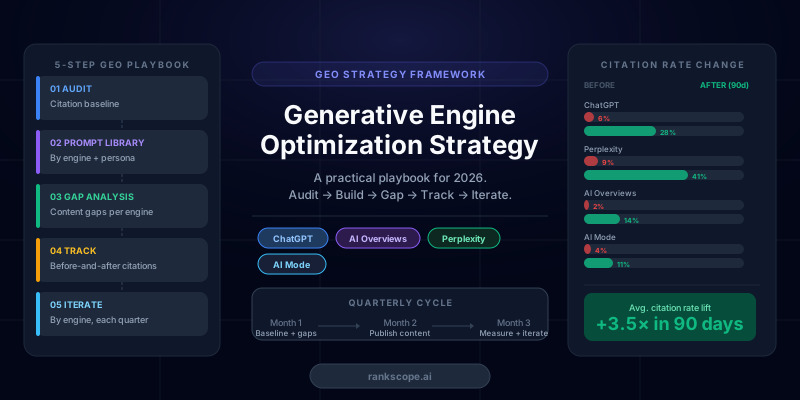
A real GEO strategy starts with measurement, moves through gap identification, and only then prescribes content. This playbook lays out that sequence in five concrete steps, with the specific outputs and decisions at each stage.
If you're new to the concept and want a grounding in what GEO is and why it matters before jumping into strategy, start with what is generative engine optimization. For the full reference guide on how GEO works across each major AI platform, the complete guide to GEO in 2026 covers the underlying mechanics.
Why Most GEO Efforts Fail
Before the framework, it's worth naming the failure mode.
Most teams that try GEO either (a) publish a batch of "AI-optimized" content and never measure whether it moved anything, or (b) measure citation rate once using a handful of manual prompts and conclude it isn't working. Neither approach gives you useful signal.
GEO is a feedback loop, not a one-time tactic. Each content change is a test, and the engine's response to that test tells you what to do next. Without the loop, you're flying blind — and the landscape of AI citation shifts fast enough that what worked six months ago is already outdated.
The five-step framework below is built for the feedback loop. Each step has a clear output that feeds the next.
Step 1: Audit Your Citation Baseline
What it is: A systematic measure of your current citation rate across AI engines and a map of which competitors are appearing in your place.
Why it comes first: You cannot know whether your GEO work is having an effect without a starting point. Skipping the baseline means every content investment is unmeasured, and unmeasured investment gets cut.
How to Run the Audit
A citation baseline is not a single Google search or a one-off ChatGPT query. AI engines return different responses to the same prompt depending on session, phrasing, and time of day. A valid baseline requires running each prompt multiple times (minimum 30 runs per prompt, ideally 50+) and calculating citation rate as a percentage — not a binary yes/no.
Here's the structure of a minimum viable baseline audit:
1. Select your prompt set. Start with 20–30 prompts across three types:
- Discovery prompts: "Best tools for [your category]," "Top [your category] platforms in 2026"
- Comparison prompts: "[Your brand] vs [Competitor]," "Alternatives to [Competitor]"
- Use-case prompts: "How do I [solve the problem your product solves]," "What's the best way to [use case]"
2. Run each prompt across all four major engines: ChatGPT, Google AI Overviews, Perplexity, Google AI Mode. A prompt that triggers citations in Perplexity may not trigger them in ChatGPT — they have different retrieval signals and source preferences. Treating them as one platform leads to bad data.
3. Record for each prompt run:
- Was your brand mentioned? (yes/no)
- Where in the response were you mentioned? (first mention, second mention, embedded, or absent)
- Which competitors were mentioned in your place?
- What was the sentiment framing? (positive, neutral, mentioned as example)
4. Calculate citation rate per engine: (runs where you were cited / total runs) × 100. For a 50-run sample, if your brand appeared in 12 responses, your citation rate for that prompt on that engine is 24%.
The baseline output you need:
| Prompt type | ChatGPT | AI Overviews | Perplexity | AI Mode |
|---|---|---|---|---|
| Discovery prompts | 8% | 0% | 17% | 3% |
| Comparison prompts | 35% | 12% | 28% | 9% |
| Use-case prompts | 4% | 6% | 11% | 2% |
Those numbers are illustrative, but they show what a useful baseline looks like. Not one aggregate number — citation rates broken down by prompt type and engine, because the gaps you find in step 3 are engine-specific.
RankScope automates this entire process. Connect your brand, load your prompt library, and the platform runs prompts systematically across all four engines, records citation data, and builds your baseline automatically — without manual copy-paste and spreadsheet tracking. See the RankScope platform for how baseline auditing works.
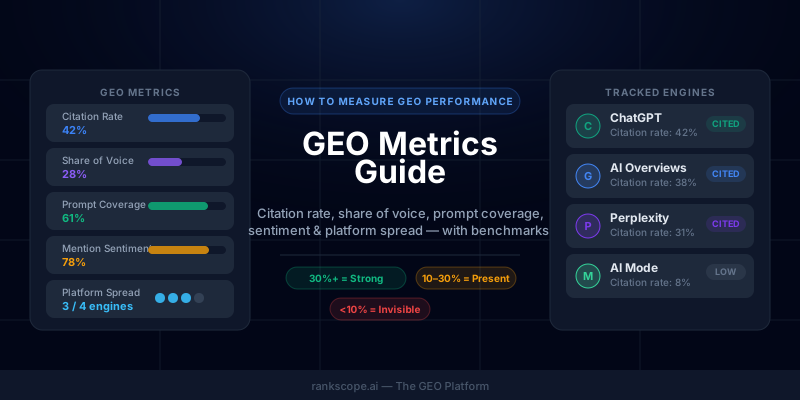
For context on what citation rate benchmarks look like across the category: data from RankScope platform users shows that brands just starting GEO typically measure below 5% citation rate on discovery prompts. Above 30% is considered strong. The detailed breakdown is in our GEO metrics guide.
For a breakdown of the specific tools available for each step in this process — baseline tracking, content optimization, auditing, and reporting — see the complete GEO tools comparison by use case.
Step 2: Build a Prompt Library by Engine and Persona
What it is: A structured, maintained set of prompts that mirrors the real questions your buyers ask AI engines — organized by engine characteristics and buyer persona.
Why it matters: Your prompt library is the instrument you use to measure GEO performance. A prompt library built around branded queries ("what is [your brand]?") tells you nothing useful. A library built around real discovery queries tells you whether you're visible to buyers who don't yet know you exist.
What Goes Into a Good Prompt Library
Structure prompts around three intents:
Category discovery — queries from buyers who know their problem but haven't found a solution:
- "Best [category] tools for [company type]"
- "What tools do [role] teams use for [use case]"
- "How do companies handle [problem] at scale"
Competitive evaluation — queries from buyers comparing options:
- "[Competitor A] vs [Competitor B]"
- "[Competitor] alternative"
- "Is [Competitor] worth it for [use case]"
Problem-solution — queries from buyers trying to solve a specific problem:
- "How do I [action] with [tool type]"
- "What's the best way to [task] in 2026"
- "How to [process] for [company type]"
Organise prompts by persona. A B2B SaaS company typically has at least three distinct buyer personas, each asking different questions. The prompts that a Head of Marketing asks ChatGPT look nothing like the prompts a RevOps lead asks. If your prompt library doesn't reflect that variation, you'll miss citation gaps that matter.
Build engine-specific variants. The same intent can be phrased differently to match how each AI engine processes queries. Perplexity users tend to ask shorter, more direct questions. ChatGPT users often ask in full sentences with context. Google AI Overviews surfaces on informational queries that mirror existing Google searches. Small phrasing adjustments can meaningfully affect citation rate on a given engine.
Minimum viable prompt library sizes:
- Early-stage GEO program: 20–30 prompts
- Mid-stage (3–6 months in): 50–40 prompts
- Mature program: 100+ prompts across multiple personas and use-case clusters
The mechanics of building and running a prompt library — including how to calculate citation rate at scale — are covered in detail in how to track brand mentions in AI search.
What Not to Include
Avoid branded queries ("what is [your brand]?") as primary measurement prompts. They inflate your apparent citation rate without telling you anything about buyer discovery. A brand appearing in 80% of responses to its own name and 0% of unbranded category queries is not winning at GEO — it's invisible at the stage that matters.
Step 3: Identify Content Gaps Per Engine
What it is: A cross-reference of your baseline data against what AI engines are currently citing, resulting in a prioritised list of content gaps mapped to specific engines.
Why it's engine-specific: The same content gap can exist on one engine and not another. Perplexity may already be citing your comparison guide, while ChatGPT is citing a competitor's version instead. Fixing the ChatGPT gap requires a different approach than the Perplexity one. Treating all engines as one target leads to generic content that doesn't move any single platform's citation rate meaningfully.
The Gap Analysis Process
1. Export your baseline data by engine. For every prompt where your citation rate is below 20% (or whatever threshold your program targets), note which brand or content source is being cited in your place.
2. Retrieve the content that's being cited. Visit the pages, guides, and posts that each AI engine is pulling from. Read them. Ask: why is this being cited for this query? What content signals does it have that yours lacks?
Common patterns you'll find:
- Competitor has a dedicated guide on this exact topic; you don't
- Competitor's page has a direct answer in the first paragraph; yours buries it
- Competitor has specific data, numbers, and named examples; yours has general claims
- Competitor's page has FAQ schema and structured data; yours doesn't
3. Map gaps to content types by engine. The patterns differ significantly by platform:
ChatGPT citation gaps tend to stem from:
- Missing entity authority on a topic (you haven't established expertise through multiple related pieces)
- Content that isn't structured for extraction (no clear H2/H3 hierarchy, no direct answers)
- Thin coverage of a query cluster (competitor has ten posts on the topic; you have one)
Google AI Overviews citation gaps tend to stem from:
- You're not ranking in Google's organic results for the query (AI Overviews draws primarily from Google-indexed content)
- Missing FAQ schema markup on relevant pages
- Missing structured data that Google uses to parse content type and context
Perplexity citation gaps tend to stem from:
- Your content is old and hasn't been updated recently (Perplexity weights freshness aggressively)
- Missing citations and sources within your content (Perplexity itself cites sources, and tends to cite content that itself contains attributions and data references)
- Content structure issues — sections that aren't self-contained don't extract well
Google AI Mode citation gaps tend to stem from:
- Similar patterns to AI Overviews, since AI Mode draws from Google's index
- AI Mode is newer and responds well to highly structured, recent content on topics Google is actively categorising
4. Prioritise gaps by engine and volume. Not every gap is worth filling. Rank gaps by: (a) how often that prompt type is asked, (b) how close you are to the citation threshold on that engine, (c) how much content work is required. Quick wins — queries where you're close but not yet cited — come before rebuilding entire topic clusters from scratch.
This step outputs a concrete content brief for each gap: what to write, what structure it needs, what data and specifics to include, and which engine it's primarily targeting. That brief feeds step 4.
For a practical framework on how AI content optimisation actually works — the structural, technical, and factual signals that each engine responds to — see how to optimize content for AI search.
Step 4: Publish and Track Before-and-After Citation Changes
What it is: A structured publish-measure-compare cycle that tells you exactly which content changes moved your citation rate, by how much, and on which engines.
The timing rule: Wait 2–4 weeks after publishing before measuring. This is the most commonly violated rule in GEO, and it's why so many teams conclude their GEO work isn't moving anything. AI engines don't update citations in real time. After you publish a new guide, ChatGPT needs to re-index the content (via Bing), recalibrate its retrieval signals, and update its response patterns. That process takes time.
Data from RankScope's platform shows that teams measuring within the first week after publishing underestimated their results by 40–60% compared to the same measurement four weeks later. Perplexity is the fastest to update (often within days). ChatGPT and Google AI Overviews consistently take 2–4 weeks. Google AI Mode follows Google's general indexing timeline, which can take longer for new content.
What to Measure
Pre-publish snapshot: Run your full prompt library across all engines the day before you publish the new content. Record all citation data. This is your "before" state for this iteration.
Post-publish snapshot: Run the same prompt library 3–4 weeks after publishing. Record the same data. Compare.
What a meaningful before-and-after looks like:
| Prompt | Engine | Before (citation rate) | After (citation rate) | Change |
|---|---|---|---|---|
| "Best AI citation tracking tools" | ChatGPT | 6% | 28% | +22pp |
| "Best AI citation tracking tools" | Perplexity | 18% | 41% | +23pp |
| "How to track brand mentions in AI" | ChatGPT | 0% | 14% | +14pp |
| "AI search visibility tools" | AI Overviews | 2% | 9% | +7pp |
| "Competitor A alternative" | Perplexity | 32% | 34% | +2pp (noise) |
Some changes are signal (the large ones on targeted prompts). Some are noise (small fluctuations on prompts you didn't target). The pattern tells you what worked.
Don't conflate correlation with causation. If you published three new pieces in the same week, you can't tell which one moved which prompt. Where possible, stagger content publishing so you can isolate the effect of individual pieces. This matters more as your program matures than in the early stages when any structured content is an improvement on nothing.
RankScope's forensic diff feature shows you exactly when AI engine responses changed and what the change was — not just whether your citation rate went up, but what the engine is now saying about your brand versus what it was saying before. This is particularly useful when a citation appears for the first time, to understand what content triggered it.
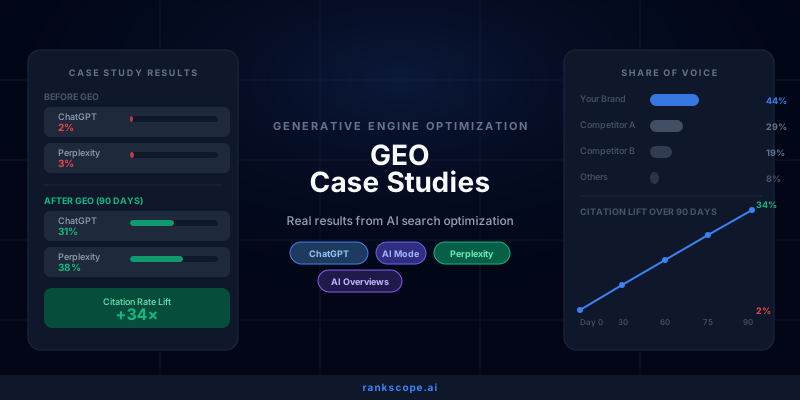
The GEO case studies on this site document before-and-after data from real programs — including the specific content changes that moved citation rate from 2% to 34% in 90 days. See GEO case studies for the full breakdowns.
Step 5: Iterate by Engine
What it is: Using the before-and-after data from step 4 to make engine-specific decisions about what to do next — updating existing content, publishing new pieces, or adjusting structure and formatting based on what moved each platform.
Why engine-specific matters: A single piece of content rarely performs equally across all four AI engines. The tactics that move your Perplexity citation rate (freshness, source citations, self-contained sections) are different from the tactics that move ChatGPT citation rate (entity authority, topic depth, structured guides) or Google AI Overviews (FAQ schema, Google ranking signals). Aggregating results across all engines masks what's actually working.
The Iteration Decision Tree
After comparing before-and-after data for a given content piece, you face three scenarios:
Scenario A: Citation rate improved on all engines. You found a content type or format that works across platforms. Prioritise publishing more content in the same format on adjacent queries. Document what made it work so you can replicate it.
Scenario B: Citation rate improved on some engines, not others. Diagnose which engine didn't respond. Check whether your content was indexed by that engine. Check whether the citation gap on that engine comes from a structural issue (your guide is missing the section that answers the specific sub-question that engine is retrieving for). Update the content to address the specific engine's gap.
Scenario C: Citation rate didn't improve on any engine. This usually means one of three things: (a) the content wasn't indexed yet — check indexing status and wait longer; (b) the content is structurally wrong for AI extraction — review it against the optimisation signals in our AI search content guide; or (c) the query is dominated by a competitor with significantly deeper entity authority and your single piece wasn't enough to break through.
Engine-Specific Iteration Tactics
ChatGPT iteration: If a piece didn't move ChatGPT citation rate, the most likely fixes are:
- Expand the content to cover more sub-questions in the same topic cluster (ChatGPT weights topic authority, not just individual page quality)
- Add more specific data, statistics, and named examples (factual density is the primary quality differentiator when multiple sources compete)
- Build more internal links between related pieces (entity connections across your site help establish topical authority)
- Ensure the content is indexed in Bing (ChatGPT's retrieval uses Bing's index)
Google AI Overviews iteration: If a piece didn't move AI Overviews citation rate, check:
- Is the page ranking in Google organic results for the target query? AI Overviews draws almost exclusively from Google-indexed, Google-trusted content. A page that doesn't rank in the top 20 organically rarely gets cited in AI Overviews.
- Add or improve FAQ schema markup — this is one of the clearest signals for AI Overviews extraction
- Review your traditional Google on-page SEO for the page — meta title, H1, internal links, page speed
Perplexity iteration: If a piece didn't move Perplexity citation rate:
- Update the publication date and refresh statistics (Perplexity weights recency aggressively)
- Add inline citations and source links within the content (Perplexity tends to cite sources that themselves cite other sources)
- Break content into shorter, more self-contained sections — Perplexity extracts discrete sections, not whole pages
- Submit the URL directly to Perplexity's crawler via their site submission process
Google AI Mode iteration: AI Mode is the newest of the four engines and its citation patterns are still being established. Treat AI Mode similarly to AI Overviews (it draws from Google's index) but with higher responsiveness to very recent, structured content on topics Google is actively categorising under AI-assisted search.
The Quarterly Cadence
GEO strategy is not set-and-forget. The AI search landscape changes — platforms update their retrieval algorithms, new AI engines gain users, and competitor content shifts the competitive baseline. A sustainable GEO program runs a full five-step cycle quarterly:
- Month 1: Run updated baseline, refresh prompt library, identify new gaps
- Month 2: Publish content to address identified gaps
- Month 3: Measure before-and-after, document what worked, brief next cycle
Brands that run this cycle consistently — not just once — compound their advantage. Each cycle adds to entity authority, fills more gaps, and builds the kind of deep topical coverage that makes AI engines reliably cite you across a wide range of relevant queries.
How RankScope Fits Into This Framework
Steps 1, 4, and 5 — baseline audit, before-and-after tracking, and engine-specific iteration — are where RankScope does the heavy lifting.
Manual prompt tracking (copy-paste from ChatGPT, spreadsheets, manual recording) works for the very first baseline if your prompt library is small. It breaks down at scale: a 50-prompt library run 50 times per prompt across 4 engines is 10,000 data points per cycle. You can't do that manually.
RankScope runs your prompt library automatically across ChatGPT, Google AI Overviews, Perplexity, and Google AI Mode. It calculates citation rate per prompt per engine, tracks how citation rate changes over time, and surfaces when AI engine responses change via forensic diffs. The before-and-after comparison in step 4 is automatic — you publish, wait, and the delta is waiting for you.
Steps 2 and 3 — building your prompt library and identifying content gaps — are strategic decisions that require human judgment. RankScope surfaces the data; you decide what it means and what to create.
For pricing and how the platform works, see RankScope platform and pricing. If you're running GEO for multiple clients, the agencies page covers how RankScope handles multi-brand programs.
Common GEO Strategy Mistakes
A few pitfalls that derail GEO programs that would otherwise work:
Optimising for one engine only. ChatGPT gets the most attention, but Google AI Overviews generates more clicks per citation because it surfaces in standard Google searches. A GEO program that ignores AI Overviews is leaving the highest-intent citations on the table.
Measuring branded queries. Citation rate on "what is [your brand]?" tells you nothing about whether buyers discover you when they don't already know you exist. Measure unbranded discovery prompts first.
Publishing content without structure. The content that AI engines cite most reliably has: a direct answer in the first sentence of each section, H2/H3 headers that mirror the exact questions being asked, specific data and numbers rather than general claims, and FAQ sections with schema markup. Pretty prose doesn't extract well. Structured answers do.
Not allowing AI crawlers. This seems obvious but it happens more often than you'd expect — especially on sites that added strict robots.txt rules before GEO was a concern. If GPTBot, ClaudeBot, and PerplexityBot are blocked, your content can't be retrieved regardless of how good it is. Check your robots.txt.
Giving up after one cycle. GEO has a 2–4 week feedback loop. A team that publishes content, measures after five days, sees no movement, and concludes GEO doesn't work hasn't run a GEO program. They've run a measurement error. Sustainable programs run three or more full cycles before evaluating the channel.
Where to Go From Here
This playbook gives you the five-step structure. The deeper guides in this cluster fill in the tactical detail at each stage:
- What is Generative Engine Optimization — if you need to ground your team in the fundamentals before pitching the strategy internally
- How to Build a GEO Strategy from Scratch — the step-by-step implementation guide: exactly what to log, how to run each step, and how to interpret before-and-after data
- GEO Optimization: The Complete Guide — the five core optimization levers in detail, plus how to prioritize effort by engine and measure results
- GEO Metrics Guide — the complete breakdown of citation rate, share of voice, prompt coverage, sentiment, and platform spread, with current benchmarks
- How to Optimize Content for AI Search — the structural and technical signals that determine what each AI engine cites
- GEO Case Studies — before-and-after citation data from brands that ran this framework, including exact tactics and timelines
The strategy is straightforward. The discipline is in running the cycle consistently, measuring every change, and iterating based on data rather than assumptions about what AI engines want.
For teams that want to see where they stand before committing to a full program, the RankScope platform runs your first citation baseline and shows you exactly which engines are citing competitors in your category today.
FAQ
What is the first step in building a GEO strategy? The first step is a citation baseline audit — running your prompt library across all four major AI engines (ChatGPT, Google AI Overviews, Perplexity, Google AI Mode) and recording your current citation rate per prompt per engine. Without a baseline, you can't measure whether your GEO work is having any effect.
How long does it take to see GEO results? Most brands see measurable citation rate improvement within 45–90 days of executing a structured GEO program. Allow 2–4 weeks after each content change before measuring, since AI engines take time to re-index and recalibrate. The full first GEO cycle — baseline through first iteration — takes approximately 8–12 weeks.
What should a GEO prompt library include? A GEO prompt library should include three types of prompts: unbranded discovery prompts ("best tools for X"), comparison prompts ("X vs Y"), and use-case prompts ("how to solve Z"). Avoid relying on branded prompts — they inflate your apparent citation rate without reflecting real buyer discovery patterns. A minimum viable library contains 20–30 prompts.
How do I identify content gaps for GEO? Cross-reference your citation baseline data with what AI engines are currently citing when you don't appear. Visit the pages being cited, identify what they have that your content lacks (structural clarity, specific data, FAQ schema, topic depth), and map those gaps to content briefs organised by engine. Content gaps differ by platform — a gap in Perplexity requires different fixes than the same gap in ChatGPT.
Is GEO strategy different from SEO strategy? Yes — SEO strategy focuses on Google rankings through keyword targeting, backlinks, and technical factors. GEO strategy focuses on AI citation rate through content structuring, entity authority, and systematic monitoring. They're complementary: a strong Google presence helps AI engines trust your content as a source. But GEO requires its own measurement system, its own content formats, and its own feedback loop. For a detailed guide on how to integrate both into a single workflow — including how to allocate effort and what mistakes to avoid — see GEO SEO: How Generative Engine Optimization Fits Into Your SEO Strategy.