GEO Optimization: The Complete Guide to Optimizing for AI Search (2026)
A potential customer opens ChatGPT and types: "What's the best tool for tracking AI citations?"
Your closest competitor gets named. You don't.
It's not because their product is better. It's because they've done GEO optimization and you haven't.
That's the entire problem this guide solves. GEO optimization — generative engine optimization — is the practice of making your brand citable inside AI-generated answers. Not ranked in a list of links. Actually cited, named, and described inside what the AI says.
This guide covers what GEO optimization means in practice, the five core levers that move citation rates, how to prioritize your effort by engine, the mistakes that quietly kill visibility, and how to measure whether any of it is working.
What GEO Optimization Actually Means
The phrase gets used loosely, so let's be precise.
GEO optimization is the work you do to increase your brand's citation rate inside AI search engines: ChatGPT, Google AI Overviews, Perplexity, and Google AI Mode. A citation means the AI mentioned your brand, product, or content in a generated response — not just that your URL appeared in a sidebar or source list.
That distinction matters. An AI engine can retrieve your page as a source and still not name you in the answer it gives. Optimization targets the naming, not just the retrieving.
The underlying mechanics differ from traditional SEO in one important way: AI engines don't rank pages, they synthesize answers. They pull fragments from multiple sources and construct a response. Your job as an optimizer is to be one of the sources that gets pulled — and one of the entities that gets named in the synthesis.
For a deeper look at how this compares to traditional search strategy, our guide on GEO vs SEO walks through the distinctions in detail. The short version: SEO and GEO optimize for different systems. Getting both right requires treating them as separate disciplines.
Why GEO Optimization Is Different From What You're Already Doing
Most content teams have spent years writing for keyword intent — matching what someone types into a search box. That discipline is still valid. It just doesn't transfer cleanly to AI search.
When someone asks ChatGPT or Perplexity a question, they're not typing "best AI citation tracking tool 2026." They're asking something like: "How do I know if my brand is showing up when people ask AI about my category?" The answer to that question pulls from sources that are optimized for the question itself, not for a keyword variant.
This is why content that ranks well on Google sometimes doesn't get cited in AI responses, and why some pages with modest Google rankings get cited constantly. The signals are different.
AI engines weight:
- Factual specificity over generic prose
- Structural extractability — can the relevant answer be pulled cleanly from a section?
- Entity completeness — is it obvious what your brand does, who it's for, and how it compares?
- Source credibility signals — do other credible sources reference you?
They're less sensitive to:
- Exact keyword density
- Meta tag optimization
- Thin content padded to length
- Broad authority metrics that don't translate to topic-specific trust
This doesn't mean your existing SEO work is wasted. Strong domain authority and indexing hygiene help AI engines trust you as a source. But GEO optimization layers on top of that foundation — it doesn't replace it.
The 5 Core Levers of GEO Optimization
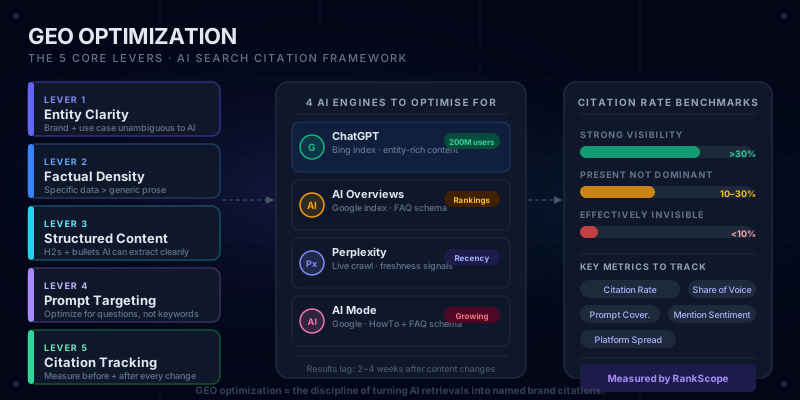
These are the five things that consistently move citation rates. They're not a checklist you run through once — they're ongoing practices that compound over time.
Lever 1: Entity Clarity
AI engines build mental models of entities: brands, products, people, concepts. If your entity model is blurry — if the AI isn't sure what you do, who you serve, or how you differ from competitors — you'll be referenced vaguely or skipped entirely.
Entity clarity means making these relationships unambiguous everywhere you appear online:
- Your homepage and about page should state explicitly what your product does and for whom — not in marketing language, but in descriptive, specific language that an AI could extract and use directly.
- Your brand name should appear in context consistently. "RankScope tracks AI citations across ChatGPT, Google AI Overviews, Perplexity, and Google AI Mode" is clear entity definition. "The leading platform for the AI era" is not.
- Your use cases should be named explicitly: which industries, which team roles, which problems. AI engines can't infer what you do from benefits statements.
- Wikipedia entries, Crunchbase profiles, LinkedIn company pages, and third-party review sites all contribute to how AI understands your entity. Consistency across them matters.
The benchmark question: if you fed an AI all your public web presence and asked it to describe what you do in three sentences, would those three sentences be accurate and specific? If not, entity clarity is the problem.
Lever 2: Factual Density
AI engines are essentially doing quality filtering at retrieval time. When multiple sources cover the same topic, they preferentially pull from sources with high factual density — specific numbers, named entities, dates, study citations, and concrete claims.
Vague prose gets deprioritized. Specific, verifiable statements get cited.
This shows up clearly in the Princeton GEO research (2024): content with statistics, quotes from named experts, and precise data was cited significantly more often than equally well-structured content with hedged, generic language.
In practice, factual density means:
- Include specific numbers whenever you make a claim. "Most brands start GEO with a citation rate below 5%" is citable. "Citation rates are often low" is not.
- Name your sources. "According to Gartner's 2025 digital commerce report..." gives AI engines a chain of provenance to follow.
- State findings directly. "Brands that structured content with H2/H3 headers saw a 23% higher citation rate in Perplexity compared to long-form prose" is extractable. "Well-structured content performs better" is not.
- Use original data when you have it. Your own research, platform benchmarks, or case study numbers are among the highest-value content types for GEO because no one else has them.
This is especially important for blog posts and educational content. Pages that read like whitepapers — dense with specific claims and sourced assertions — get cited more often than pages that read like marketing copy.
Lever 3: Structured Content
Structure is about extractability. AI engines pull fragments from your content to build answers. If your content is one long essay with no clear section divisions, they have to work harder to find the relevant fragment — and they often won't.
The structural elements that improve citation rates:
Direct answers at section openings. Start each section with the answer, then explain. "The main difference between GEO and SEO is their target system — SEO optimizes for link rankings, GEO optimizes for AI-generated citations" is extractable from the first line. Burying the answer after three paragraphs means AI engines may pull the wrong section.
H2/H3 heading hierarchy that maps to real questions. Headers like "What Is GEO Optimization?" and "How Long Does GEO Optimization Take?" match the natural language questions people ask AI. Headers like "Our Approach" and "Key Considerations" do not.
Bullet lists for multi-item answers. When you're listing things — features, steps, criteria, engines — use bullets, not run-on sentences. AI engines extract list items far more reliably than inline list content.
Definition boxes and callouts. If your CMS supports callout blocks or definition boxes, use them for key terms. These are among the most reliably cited content elements.
Tables for comparisons. Comparison content — feature tables, pricing comparisons, side-by-side tool evaluations — is extremely high-value for GEO. AI engines pulling structured comparison data can synthesize it into answers directly.
For a practical checklist of structural optimizations, how to optimize content for AI search goes deep on the technical side — crawler access, schema markup, and page-level structural signals.
Lever 4: Prompt Targeting
Keyword targeting asks: what would someone type into Google? Prompt targeting asks: what would someone ask an AI?
These are related but different. AI prompts tend to be:
- Longer and more conversational
- Question-framed rather than keyword-framed
- Specific about the use case or context
- Comparative ("X vs Y" or "what's the best X for Y")
Prompt targeting means building a library of the actual questions your audience asks AI engines, then creating content that answers those questions directly.
How to build a prompt library:
Start with your core use cases and map them to question formats. If you sell AI citation tracking software, your prompt library might include:
- "How do I know if my brand shows up in ChatGPT answers?"
- "What's the best tool for monitoring AI brand mentions?"
- "How do I track my share of voice in AI search?"
- "How is AI search different from Google search for brands?"
Run these prompts manually across ChatGPT, Perplexity, and AI Overviews. Note which competitors appear. Note what facts get cited. Note which content formats get pulled.
Then create or update content that answers those prompts better than what's currently being cited.
Engine-specific prompt variations matter. The same underlying question gets asked differently depending on the platform. Perplexity users tend toward research-style queries with follow-up questions. ChatGPT users ask more conversational questions. Google AI Overviews surfaces for informational queries tied to existing Google search behavior. Build prompt libraries that account for these differences.
Our GEO strategy guide includes a detailed framework for building and maintaining a prompt library as part of an ongoing optimization cycle.
Lever 5: Citation Tracking
This is where most GEO optimization efforts fall apart.
Teams run the first four levers — they improve entity clarity, add facts, restructure content, and write prompt-targeted posts. Then they wait. And they don't have a way to know if anything is working.
Citation tracking is the measurement infrastructure that closes the loop. It answers the questions that otherwise stay unanswered:
- Is my citation rate going up or down across each AI engine?
- Which specific content changes moved the needle?
- Are competitors gaining share of voice while I'm staying flat?
- Which prompts am I winning? Which am I invisible on?
Without tracking, GEO optimization is just publishing. It becomes a real discipline when you can measure before-and-after citation rates with statistical confidence.
What to track:
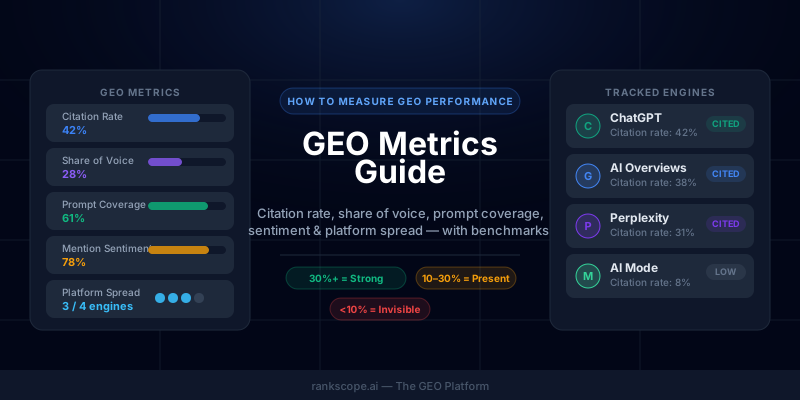
- Citation rate: percentage of prompt runs where your brand is mentioned. Measure across 50+ runs per prompt for statistical reliability.
- Share of voice: your citations as a percentage of total brand citations in your category.
- Platform spread: coverage across ChatGPT, Google AI Overviews, Perplexity, and AI Mode — each separately.
- Prompt coverage: how many of your target prompts trigger a citation?
- Mention sentiment: when you're cited, is the framing positive, neutral, or negative?
For benchmark data on what good citation rates look like, our GEO metrics guide includes platform benchmarks from real RankScope data — citation rate by category, share of voice benchmarks, and measurement timing guidance.
How to Prioritize GEO Optimization Effort by Engine
Not all AI engines are equal for your specific audience, and the tactics that work on one don't always transfer to another.
ChatGPT (200M+ weekly users)
Retrieval mechanism: Primarily uses Bing's web index for RAG retrieval, supplemented by training data. ChatGPT searches the web when enabled and synthesizes from Bing-indexed content.
What moves citation rates:
- Strong Bing indexing (not just Google)
- Entity-rich evergreen explainer content
- Direct answers to "what is" and "how does" questions
- Consistent brand presence across high-authority third-party sites
Priority level: Highest for most B2B brands. ChatGPT is still the dominant AI platform for research queries and is where most buyers first encounter your category.
Google AI Overviews
Retrieval mechanism: Tightly coupled with Google's existing index. Pages that rank well on Google are far more likely to appear in AI Overviews than pages that don't.
What moves citation rates:
- Existing Google rankings (this is the strongest single predictor)
- FAQ schema markup — structured question/answer blocks get extracted directly
- E-E-A-T signals (experience, expertise, authoritativeness, trustworthiness)
- Concise, directly-answerable H2 sections
Priority level: Critical if your organic search traffic is already Google-dependent. If you rank, you're already partly in the running. FAQ schema and structural work are the highest-leverage additional levers.
Perplexity
Retrieval mechanism: Aggressive live web crawling. Perplexity is more independent of Google's index than other engines — it crawls on its own schedule and surfaces newer content more readily.
What moves citation rates:
- Fresh publication dates (Perplexity weights recency more heavily than ChatGPT)
- High factual density and sourced claims
- Clear structure with scannable H2s
- Structured data and citations within your own content
Priority level: High for research-heavy audiences — developers, academics, analysts, and information-hungry B2B buyers. Perplexity's user base skews toward people who do extensive research before buying.
Google AI Mode
Retrieval mechanism: Google's newest AI product, distinct from AI Overviews. Combines Google's web index with deeper synthesis and multi-turn conversation.
What moves citation rates:
- FAQ-formatted content
- Authoritative domain signals
- Comprehensive topic coverage (AI Mode tends to pull from pages that cover a topic thoroughly rather than narrowly)
- Schema markup, especially HowTo and FAQ
Priority level: Growing rapidly. AI Mode is Google's long-term direction for search, and early optimization compounds as it scales. Worth investing in even if traffic volumes are currently lower than AI Overviews.
How to Prioritize Across All Four Engines
If you're starting from scratch, the practical prioritization order is:
- Fix entity clarity and structural issues across your entire site first. These improvements help all four engines simultaneously.
- Run a citation baseline across all four platforms before making content changes. You need a starting point to measure against.
- Prioritize the engine where your audience is most active. For most B2B SaaS brands, that's ChatGPT followed by Perplexity.
- Add FAQ schema and structural improvements for Google AI Overviews if you already have Google rankings. The lift-to-effort ratio is excellent.
- Create fresh, factual-dense content for Perplexity. New structured posts tend to surface faster here than on other platforms.
Don't try to run all four optimization tracks simultaneously from day one. Pick the engine with the highest audience overlap for your ICP, build a baseline, execute lever 1–4 for that engine, measure after 3–4 weeks, then expand.
Common GEO Optimization Mistakes
These are the patterns that show up consistently in brands who've been "doing GEO" for months without seeing citation rate improvements.
Writing for keywords instead of prompts
This is the most common mistake. Teams apply their existing SEO content process to GEO — keyword research, content brief, blog post — and publish content that's well-optimized for Google but irrelevant to how people actually interact with AI engines.
The fix: build a prompt library before you write anything. Know what questions people are asking AI in your category, then write content that answers those questions directly.
Publishing without a baseline
You can't measure improvement without a starting point. Teams who publish GEO-optimized content without recording their citation rate beforehand have no way to know if the work moved anything.
Run a citation baseline before any new publishing push. Record your citation rate across 50+ prompt runs per key query, across each platform. This takes a few days but makes every subsequent measurement meaningful.
Treating GEO as a one-time project
GEO optimization is not a rewrite you do once and then check off the list. AI engine behaviors change, new competitors emerge, retrieval mechanisms update, and your citation rate drifts without ongoing maintenance.
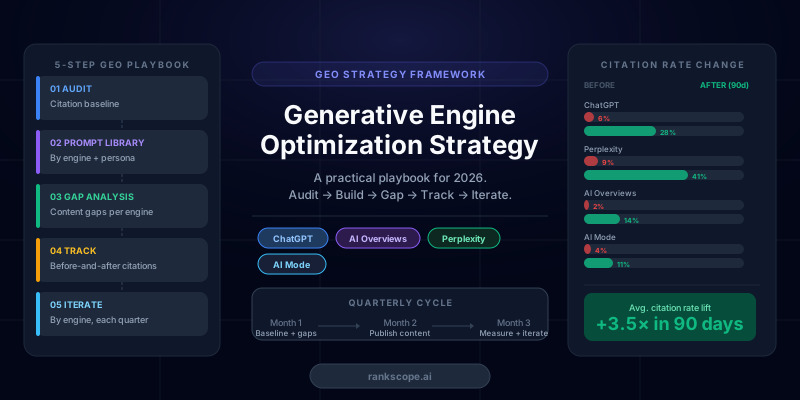
The teams seeing the most consistent GEO improvement run a quarterly optimization cycle: baseline → content work → measure → iterate. The full cycle is described in our GEO strategy guide. If you want the detailed step-by-step mechanics — what to log, how to run each step, and how to read the before-and-after data — the implementation guide for building a GEO strategy from scratch walks through each step in full.
Measuring too early
This one is counterintuitive. AI engines take 2–4 weeks to re-index updated content and recalibrate citation patterns. Checking your citation rate one week after publishing a new post will almost certainly show no change — not because the content isn't working, but because the system hasn't processed it yet.
Wait a full 4 weeks before evaluating the impact of any content change. Measuring at week 1 and concluding "GEO doesn't work" is one of the most common misreadings in the field.
Only tracking one engine
Teams that track only ChatGPT or only Google AI Overviews are working with incomplete data. Citation rates vary significantly by engine — a brand that's well-cited on Perplexity may be invisible on ChatGPT. Optimizing based on one platform's signal can steer you wrong for the others.
Track all four engines. Your optimization priorities may differ once you see the full picture.
Ignoring robots.txt
If your robots.txt blocks GPTBot, ClaudeBot, PerplexityBot, or GoogleBot-Extended, you will not be cited — regardless of how good your content is. AI engines can't index what they can't crawl.
Check your robots.txt before doing any other GEO work. This is the most common technical barrier, and it's invisible until you think to look.
Measuring GEO Optimization Results
Measurement is the lever that separates teams who are guessing from teams who are compounding.
The Basic Measurement Framework
Step 1: Define your prompt set. Choose 10–20 prompts that represent how your audience asks AI about your category. Mix branded queries ("what is [brand name]?") with unbranded discovery queries ("best tools for AI citation tracking") and comparison queries ("X vs Y").
Step 2: Record a baseline. Run each prompt 50+ times across each platform you're targeting. Record: Was the brand mentioned? What was said? Was the framing positive or neutral? Did competitors appear?
Step 3: Make one change at a time. GEO optimization is cleaner when you can attribute results to specific changes. Restructure one page, add facts to one post, improve entity clarity on one section. Wait 4 weeks. Measure again.
Step 4: Calculate citation rate change. Compare your post-change citation rate to baseline. A move from 4% to 12% citation rate on a key prompt is significant. A move from 4% to 5% is noise.
Step 5: Expand what works, abandon what doesn't. The tactics that move your citation rate on ChatGPT may not be the same tactics that work on Perplexity. Let the data lead.
What Good Looks Like
Based on RankScope platform benchmarks across hundreds of tracked brands:
- Citation rate above 30% on a key discovery prompt = strong visibility for your category
- Citation rate 10–30% = present but not dominant
- Citation rate below 10% = effectively invisible to buyers doing AI research
Most brands starting GEO optimization measure below 5%. Getting from below 5% to above 15% in three to six months is an achievable target for a focused optimization effort.
For a comprehensive breakdown of GEO metrics — including how to calculate share of voice, what prompt coverage means, and how to interpret sentiment data — see our GEO metrics guide.
How RankScope Fits Into GEO Optimization
All five levers require measurement to work properly. Entity clarity work needs citation rate data to validate it landed. Factual density improvements need before-and-after metrics. Prompt targeting needs data on which prompts are actually winning.
RankScope is built specifically for that measurement layer. The platform tracks citation rate, share of voice, and mention sentiment in ChatGPT, Perplexity, Google AI Overviews and Google AI Mode — running real browser sessions against each engine rather than approximating from APIs.
What that means for GEO optimization:
- Baseline in hours, not weeks. RankScope runs your full prompt library across all four engines simultaneously. What would take a team days of manual testing takes an afternoon of setup.
- Attribution by engine. You see citation rate separately per platform, so you know if your Perplexity optimization is working even while ChatGPT rates are flat.
- Competitor tracking. You see your share of voice vs competitors in the same answer — not just your own absolute numbers.
- Trend data. Citation rate over time per prompt and per engine. The trend line is what shows you whether your optimization cycle is working.
Teams running monthly or quarterly GEO optimization cycles use RankScope as the measurement bookend — run a baseline before the cycle starts, run a measurement after the cycle ends, compare.
If you're currently doing any GEO work without a measurement layer, start here — the Starter plan covers the baseline tracking you need to get from guessing to knowing.
If you're evaluating which GEO tools fit which jobs — tracking, content optimization, auditing, or reporting — the complete GEO tools comparison by use case breaks down every major platform by what it's actually built for.
The GEO Optimization Roadmap
Putting it all together, here's the sequence that works:
Month 1: Foundation
- Audit entity clarity across homepage, about page, and top-traffic pages
- Check robots.txt for AI crawler access
- Run a citation baseline across your top 10 prompts and all four engines
- Identify your highest-priority engine based on where your audience searches
Month 2: Structural + factual lift
- Restructure your top 5 most-relevant pages for extractability (H2/H3, direct answers, bullets)
- Add factual density: specific numbers, sourced claims, original data where available
- Add FAQ schema to pages with high potential for AI Overviews citation
Month 3: Prompt-targeted content
- Build or refine your prompt library based on baseline data
- Publish 2–3 posts directly targeting your highest-priority prompts
- Measure citation rate at the 4-week mark after publish
Month 4+: Iterate by engine
- Review which engines are responding, which are not
- Double down on tactics that moved the needle
- Expand prompt coverage to secondary queries
- Run the cycle again quarterly
This isn't a sprint. It's a system. Brands that treat GEO optimization as a quarterly discipline — rather than a one-time effort — are the ones that compound their citation rates over time.
Related reading: what actually moves citation rate, including the measurement we ran across 19 AI Overviews and why we stopped using it as a filter.
Frequently Asked Questions
What does GEO stand for? GEO stands for Generative Engine Optimization — the practice of optimizing your content and online presence to get cited in AI-generated answers from platforms like ChatGPT, Google AI Overviews, Perplexity, and Google AI Mode.
Is GEO optimization the same as SEO? No. SEO (Search Engine Optimization) targets rankings in Google's list of links. GEO optimization targets citations inside AI-generated answers. They use different metrics, different content signals, and different measurement systems. GEO and SEO work best as complementary disciplines — strong SEO provides the foundation, GEO adds the AI citation layer on top.
How long does GEO optimization take to work? Most citation rate changes from content optimization take 2–4 weeks to appear. AI engines need time to re-crawl updated content and recalibrate citation patterns. Entity clarity changes (like improving your homepage description) can sometimes move faster. Expect a full 4-week measurement window before drawing conclusions.
Which is more important — keyword ranking or citation rate? They serve different parts of the buyer journey. Keyword rankings drive traffic from Google. Citation rates determine whether AI engines recommend you when buyers are doing research. As AI search grows, citation rate is increasingly the metric that determines brand awareness among buyers who don't start their research on Google. The most resilient brands optimize for both.
What's the quickest GEO win for most teams? Check your robots.txt for blocked AI crawlers first — that's a zero-effort fix that removes a hard ceiling. After that, add FAQ schema to your highest-traffic pages and restructure the top 3–5 most relevant pages for extractability. These are high-leverage, low-effort changes that often show citation rate improvement within a single measurement cycle.
Do I need a dedicated tool for GEO optimization? You can start manually — running prompts by hand, recording results in a spreadsheet. But manual testing across 50+ runs per prompt, across four engines, for multiple queries, is prohibitively slow at any real scale. A dedicated tracking tool like RankScope automates that measurement layer so you spend time on the optimization work rather than the data collection.