How to Build a GEO Strategy from Scratch: Step-by-Step Guide (2026)
Most brands approach generative engine optimization the same way they approached social media in 2012: they add it to the content calendar, post some "GEO-optimized" pieces, and assume the citations will follow.
They don't. Not reliably. Not without a system.
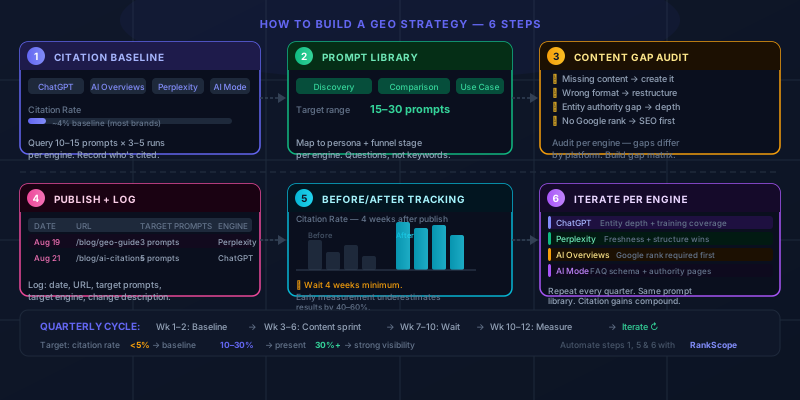
GEO isn't a content format. It's a measurement discipline — and measurement disciplines need a repeatable process. This guide gives you that process: six sequential steps that take you from knowing nothing about your current AI citation presence to running a continuous optimization cycle that compounds over time.
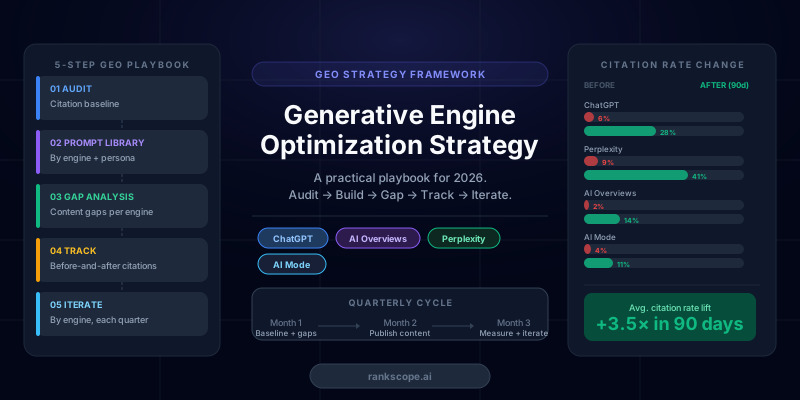
This post is the implementation counterpart to our GEO strategy framework, which covers the five-step strategic playbook at a higher level. If you want the how-to — the actual mechanics of each step, what to log, what to measure, what to do when results don't move — this is it.
Before You Start: Understand What GEO Actually Measures
Traditional SEO measures rankings. Position 1 for "best CRM software" means Google shows your page first. Clear, binary, auditable.
GEO measures citations. When someone asks ChatGPT "what's the best CRM software for sales teams?", it generates a paragraph. Your brand either appears in that paragraph or it doesn't. That appearance — or absence — is what GEO tracks.
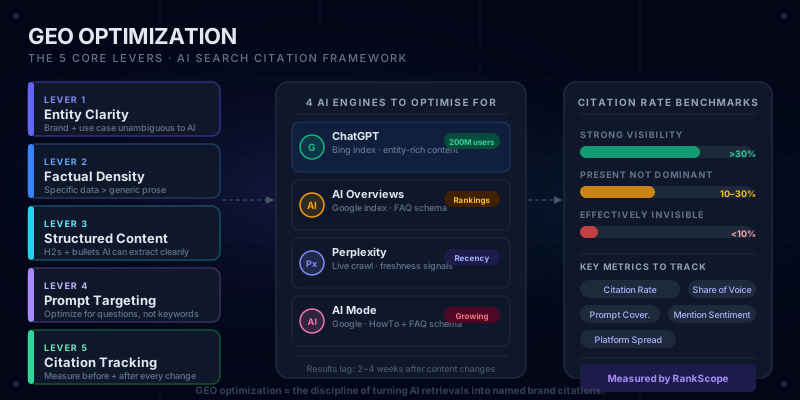
Generative engine optimization targets four separate AI systems, each with distinct citation mechanics:
- ChatGPT — Uses a combination of training data and Bing retrieval. Trained knowledge means older, authority-heavy content often has an advantage.
- Google AI Overviews — Tightly coupled to Google's existing organic index. If you don't rank on Google for the query, you rarely appear in AI Overviews for it.
- Perplexity — Real-time crawling with a freshness bias. Recent, well-structured content gets cited faster here than anywhere else.
- Google AI Mode — Blends conversational search with organic results. Rewards authoritative, FAQ-structured pages.
Each engine behaves differently. A strategy that ignores this will optimize for one engine at the cost of the others.
Step 1: Run a Citation Baseline Across Your Target Engines
You can't measure improvement without a starting point. The citation baseline is the most important thing you do — and the thing most brands skip.
What a citation baseline is
A baseline is a recorded snapshot of which brands get cited across your target prompts, across each AI engine, at a specific point in time. It answers:
- Are you cited at all?
- In what percentage of runs?
- On which engines?
- Alongside which competitors?
- In what context (positive, neutral, negative)?
How to run one
1. Pick your target engines. At minimum: ChatGPT, Google AI Overviews, Perplexity. Add AI Mode if you have Google Workspace access.
2. Build your initial prompt list (more on this in Step 2). For the baseline, you need at least 10–15 prompts that represent real buyer queries in your category.
3. Run each prompt 3–5 times per engine. AI responses aren't deterministic — the same query can return different citations on different runs. Single-run measurements are statistically unreliable. Three to five runs per prompt per engine gives you a usable sample.
4. Record the output. For each run, log: which brands were cited, their position in the response, any sentiment framing, and the exact date of the run.
5. Calculate citation rate. This is the core metric: the percentage of runs where your brand was mentioned. If you ran a prompt 5 times and appeared in 2 of those runs, your citation rate for that prompt is 40%.
What to expect at baseline
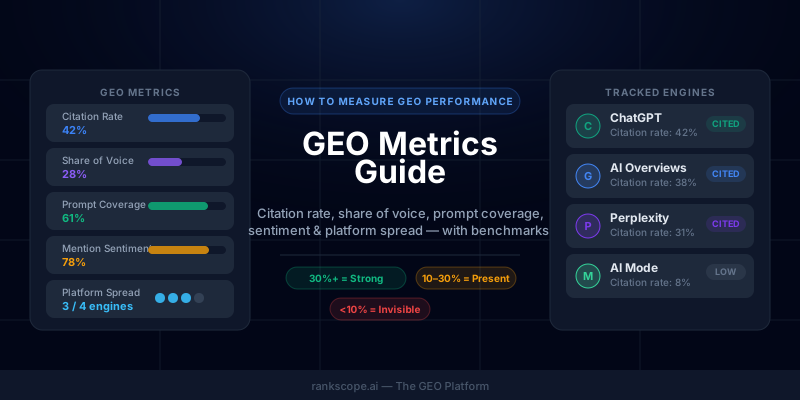
Most brands starting this process have a citation rate below 5% on unbranded discovery prompts — prompts that don't include your brand name. That's normal. It's the gap between where you are and where you want to be. The GEO metrics guide has benchmark data from real RankScope platform users if you want to calibrate where you stand.
Tool option: RankScope's platform automates baseline measurement across all four engines, running your prompt library, recording citation data, and calculating citation rate and share of voice automatically. The alternative is a spreadsheet and manual queries — workable for 10–15 prompts, extremely tedious past that.
Step 2: Map the Prompts Your Buyers Use
Keyword research identifies what people type into Google. Prompt research identifies what people ask AI systems. These are not the same thing, and confusing them is one of the most common GEO mistakes.
A keyword is "CRM software for small business." A prompt is "What CRM should a 10-person startup use that integrates with Gmail and doesn't require a dedicated admin?"
Real prompts are longer, more conversational, and more specific. They often imply a context the buyer hasn't fully stated. A good prompt library captures this specificity.
The three prompt categories you need
Discovery prompts — Unbranded, category-level queries that buyers use when they're first exploring solutions. These are your most important prompts because they capture buyers before they've formed brand preferences.
Examples:
- "What's the best tool for tracking AI citations?"
- "How do I know if my brand appears in ChatGPT?"
- "Best platforms for monitoring AI search visibility"
Comparison prompts — Branded or semi-branded queries that buyers use when they're actively evaluating options. These often include competitor names.
Examples:
- "RankScope vs Otterly.AI"
- "What's the difference between GEO tracking platforms?"
- "Is [Competitor] worth the price?"
Use-case prompts — Problem-framed queries that describe a specific situation, often asked mid-funnel when buyers are trying to solve something specific.
Examples:
- "How do I improve my citation rate in Perplexity?"
- "My brand doesn't appear in ChatGPT — why?"
- "How do agencies track AI visibility for multiple clients?"
How many prompts
15–30 is the practical range. Below 15, you don't have enough coverage to detect patterns. Above 50, measurement runs get expensive and slow. Most brands start with around 20 prompts and expand as they understand which prompt categories are driving the most buyer traffic.
Map prompts to personas and engines
For each prompt, note:
- Persona: Who's asking this? (CMO, content manager, agency, founder?)
- Funnel stage: Awareness, consideration, or decision?
- Primary engine: Where is this prompt most likely to be asked?
This mapping makes it easier to allocate content work. If your awareness-stage prompts are missing citations across all engines, that's a different fix than comparison prompts missing citations only on Perplexity.
Step 3: Audit Content Gaps by Engine and Persona
You now have a baseline (who's cited, where, how often) and a prompt library (what buyers ask). The audit connects them: for each prompt where you're not cited, it identifies why.
GEO content gaps fall into four categories:
1. Missing content — no page exists
The simplest gap. A buyer asks "how do I track AI citations by engine?" and there's no page on your site that answers that question clearly and directly. The fix is to create one.
2. Wrong content format
You have a page on the topic, but it's structured as marketing copy rather than as a document an AI can extract from. Dense paragraphs with no headers, vague claims without specific numbers, no direct answers at the top of each section. The fix is restructuring, not rewriting from scratch.
A useful self-test: paste your page into Claude or ChatGPT and ask it to summarize. If the summary misses your key points, your structure is the problem. GEO optimization covers the five structural levers in detail.
3. Missing entity authority
The AI engine doesn't associate your brand with this topic strongly enough to cite you. This typically affects ChatGPT and AI Mode more than Perplexity. The fix is depth: more comprehensive content on the topic, more internal links between related pages, more mentions of your brand alongside the topic across multiple pages.
4. No Google ranking underneath (AI Overviews-specific)
Google AI Overviews is the most tightly coupled to traditional organic rankings of all four engines. If you're not ranking on page 1 of Google for the relevant query, you're rarely going to appear in AI Overviews for it. The fix for this gap is SEO work first — get the Google ranking, and AI Overviews often follows.
Build a gap matrix
A simple spreadsheet works well here:
| Prompt | Engine | Gap Type | Priority | Fix |
|---|---|---|---|---|
| "best ai citation tracker" | ChatGPT | Missing content | High | Create comprehensive guide |
| "how to track brand in perplexity" | Perplexity | Wrong format | Medium | Restructure existing page |
| "rankscope vs otterly" | All | Missing comparison content | High | Create comparison post |
| "ai visibility monitoring" | AI Overviews | No Google ranking | Medium | SEO + on-page improvements |
Prioritize by impact: gaps in high-volume discovery prompts across multiple engines come first.
Step 4: Publish Content and Log It
This step is where most brands have the mechanics right but the discipline wrong. They create the content. They just don't log it properly.
Logging is what makes before-and-after measurement possible. Without it, you'll publish ten pages over six weeks, see your citation rate improve in week eight, and have no idea which page caused which change.
What to publish
Based on your gap matrix:
- For missing content: Write comprehensive, structured guides targeting each gap. Headers, direct answers, specific numbers, examples. Aim for the page that best answers the prompt — not the longest page or the most SEO-dense page. See our guide on how to optimize content for AI search for the full technical checklist.
- For wrong format: Restructure existing pages. Add a direct-answer opening paragraph. Add FAQ sections with exact phrasing that mirrors your target prompts. Add specific data and examples.
- For entity authority: Publish a cluster of related content on the same topic. Three deep, well-structured pages on a single topic build entity association faster than one mega-page.
- For Google ranking gaps: Treat these as SEO tasks first — keyword research, on-page optimization, link-building to the target page.
What to log
Create a content log with these fields for every piece you publish or update:
- Date (publish date or update date)
- URL (full path)
- Target prompts (from your prompt library — which prompts should this page improve citation rates for?)
- Target engine (which engine is this primarily designed to influence?)
- Gap type (missing content, format fix, entity authority, Google ranking)
- Change description (1–2 sentences: what you changed and why)
This log is your attribution chain. In four weeks, when you re-run the baseline and see a 12% improvement in Perplexity citation rate for discovery prompts, you'll be able to identify exactly which publish triggered it.
Step 5: Track Before-and-After Citation Changes
Four weeks after a significant publish or restructure, re-run your full prompt library. Compare the numbers to your baseline.
What to measure
Citation rate per prompt, per engine. This is your primary signal. Did the percentage of runs where you're cited go up?
Share of voice. Your citations as a percentage of total citations in the category. If you went from 8% to 15% citation rate but a competitor went from 20% to 35%, your share of voice may have declined even as your absolute numbers improved.
New prompts triggered. Are there prompts you weren't cited for at baseline where you now appear regularly? New citations on discovery prompts indicate your entity authority is growing.
Sentiment. Are you cited positively, neutrally, or framed against? Sentiment shifts matter — an increase in citation rate is less valuable if the framing becomes more negative.
The 4-week rule
Re-run measurements at 4-week intervals, not weekly. This is one of the most counterintuitive things about GEO measurement:
- Publish a new page.
- Run the same prompts one week later.
- Results look identical or slightly worse.
- You conclude the content didn't work.
That conclusion is wrong. AI engines — especially ChatGPT and AI Overviews — take 2–4 weeks to re-index content and recalibrate citation patterns. Teams that measure at one week consistently underestimate their GEO results by 40–60% compared to measurements taken at four weeks.
Wait four weeks. Then measure.
Reading the results
When you compare before-and-after:
| Signal | What it means |
|---|---|
| Citation rate up on target prompts, target engine | Content is working for that engine |
| Citation rate up broadly across engines | Entity authority is growing — good sign |
| Citation rate flat | Either too early to measure, or content format isn't what the engine wants |
| Citation rate up on Perplexity but flat on ChatGPT | Freshness/structure working for Perplexity; need different content type for ChatGPT |
| Citation rate down | Competitor published better content, or AI engine refreshed its model |
The detailed breakdown of how to interpret each of these scenarios is in the GEO metrics guide, including benchmark data for your category.
Step 6: Iterate Per Engine Based on Data
This is where the strategy becomes a system. The first cycle gives you data. Iteration uses that data to prioritize the next cycle.
Allocate by engine gap
After measuring, you'll typically see an uneven pattern. Perplexity improved. ChatGPT is flat. AI Overviews barely moved. Each gap has a different cause and a different fix.
If Perplexity is lagging: Check freshness. Perplexity heavily weights recent content. Update your target pages with current data. Add a "Updated August 2026" date. Publish new structured content on the topic. Perplexity often catches up within 2 weeks of a content refresh.
If ChatGPT is lagging: Check entity depth. ChatGPT tends to cite brands with broader entity coverage — more pages on related topics, more internal links between those pages, more mentions of your brand name alongside relevant concepts across the site. It's a slower lever than Perplexity's freshness signal, but it compounds.
If Google AI Overviews is lagging: Check your Google rankings. Pull GSC data for the queries underneath your target prompts. If you're not on page 1 of Google for the relevant keyword, prioritize SEO work on that page first. AI Overviews almost always requires a Google ranking as a foundation.
If AI Mode is lagging: Check page structure. AI Mode rewards FAQ-formatted, authoritative pages with clear entity definitions. Add FAQ schema to your target pages and ensure your headings directly mirror the questions your buyers ask.
Engine-specific tactics at a glance
| Engine | Primary Citation Signal | Best Content Type | Typical Lag |
|---|---|---|---|
| ChatGPT | Entity authority + training depth | Comprehensive guides, entity-rich pages | 4–6 weeks |
| Perplexity | Freshness + structure | Updated guides, structured posts | 1–3 weeks |
| Google AI Overviews | Google organic ranking | Any ranking content + FAQ schema | 3–5 weeks |
| AI Mode | Authority + FAQ structure | FAQ-formatted, structured pages | 3–4 weeks |
The quarterly GEO cycle
The six steps above aren't a one-time project. They're a quarterly cycle:
- Weeks 1–2: Run new baseline. Review gap matrix.
- Weeks 3–6: Content sprint — publish and restructure based on gaps.
- Weeks 7–10: Wait. (Don't measure too early.)
- Weeks 10–12: Measure before-and-after. Compare to baseline.
- Weeks 12–14: Analyze by engine. Prioritize next sprint.
- Repeat.
Brands that run this cycle consistently — even at modest content velocity — see compounding citation rate growth over 3–6 months. Brands that treat GEO as a one-time content task hit a ceiling fast.
The GEO case studies on this site document brands that ran this exact cycle, including before-and-after citation rate data and exact timelines. The fastest improvement (2% to 34% citation rate in 90 days) happened when a team ran three consecutive cycles focused entirely on discovery prompts.
What You Need to Run This Effectively
For small teams (1–3 people)
Manual tracking in a spreadsheet is viable up to about 20 prompts across 2–3 engines. Use Google Sheets to log baseline data, track content publishes, and record before-and-after measurements. The main bottleneck is the manual query runs — running 20 prompts × 3 engines × 5 runs = 300 individual queries per measurement cycle. That takes about 3–4 hours if you're efficient.
For growing teams
Once you hit 30+ prompts or 4 engines, manual tracking becomes impractical. The data volume is manageable; the time cost isn't. This is where a dedicated GEO platform starts paying for itself in time saved alone.
RankScope automates the entire measurement layer: it runs your prompt library, records citation data, calculates citation rate and share of voice per engine, tracks competitor movements, and surfaces when responses change. What takes 3–4 hours manually takes about 15 minutes with the platform.
What you can't outsource
The strategy layer. Someone on your team needs to interpret the data, prioritize the content gaps, and own the editorial decisions about what to publish. Tools surface the what. Humans decide the why and the how.
The Mistakes That Derail GEO Strategies
After seeing how different brands approach GEO, a few failure patterns show up repeatedly:
Starting without a baseline. Writing content before measuring citation rate means you're flying blind. You might improve, get worse, or stay flat — and you'll have no way to know which. Always measure first.
Treating all AI engines as one target. Publishing the same content formatted the same way and expecting it to improve citation rates across all four engines equally. It doesn't. Perplexity and ChatGPT have fundamentally different citation mechanics. The GEO SEO guide covers this in detail, including how to allocate effort across engines in an integrated strategy.
Measuring too early. Running baseline queries two weeks after publishing and concluding the work didn't move the needle. The data lag is real and well-documented. Wait four weeks, then measure.
Optimizing only for branded prompts. Checking "does ChatGPT mention us when you search our brand name?" This is easy to pass and useless for driving new awareness. The valuable citations come from unbranded discovery prompts where buyers are researching categories, not companies.
Not logging content changes. Publishing seven pages, seeing citation rate go up, and having no idea why. Attribution requires a log. Build the habit of logging every publish and update with the target prompts and engine.
How to Get Started Today
If you've never run a citation baseline:
This week:
- Pick 10 unbranded discovery prompts that real buyers in your category would use.
- Run each one in ChatGPT and Perplexity (3 runs each).
- Record which brands appear and how often.
- Calculate your citation rate.
If you already have baseline data:
- Pull your prompt library.
- Re-run it today and compare to your last measurement.
- Find the engine with the largest citation gap.
- Identify the gap type (missing content, format, entity authority, Google ranking).
- Publish or restructure one page this week targeting that gap.
- Log it. Wait four weeks. Measure.
The compounding happens at the system level. One well-structured page rarely moves the needle on its own. Twenty well-structured pages, published over three months, tracked against a consistent baseline, iterated by engine — that's where the citation rate charts start going up and staying up.
RankScope's platform automates steps 1, 5, and 6 of this process — the citation baseline, before-and-after tracking, and iteration data. The pricing page has plan options starting at $49/month with no setup fee.
Frequently Asked Questions
How long does it take to build a GEO strategy?
The initial setup — baseline measurement, prompt library, gap audit — takes 4–6 hours for a focused team. The first content sprint takes 2–4 weeks depending on how many gaps you're addressing. Meaningful citation rate movement typically appears 8–12 weeks after starting, with significant compounding by the 90-day mark.
Do I need to do GEO differently for each industry?
The six steps are the same across industries, but the content depth required varies. In highly competitive categories (project management, CRM, marketing software), citation rates are harder to move because established players have years of entity authority built up. In emerging categories, citation rates move faster. The mechanics are the same; the content investment required differs.
Can GEO work without a strong SEO foundation?
For Google AI Overviews — no. AI Overviews almost always requires a Google ranking as a prerequisite. For ChatGPT and Perplexity, the correlation with Google rankings is weaker. A brand with low Google authority can still build citation rate in ChatGPT through entity depth and content structure. But a strong SEO foundation accelerates GEO across all engines, so building both together is more efficient than optimizing them independently.
What's the minimum viable GEO strategy?
Pick the one AI engine your buyers use most. Build a baseline for that engine with 10 prompts. Identify your top 3 citation gaps. Publish or restructure one page to address each gap. Measure at 4 weeks. This takes one week of setup and about 3 pages of content work. It's not comprehensive, but it's enough to see whether GEO is moving the needle for your specific situation before investing in a full strategy.
How does this relate to the GEO strategy framework you published in July?
The July GEO strategy post covers the strategic framework — the five-step playbook and how each step connects to business outcomes. This guide covers the implementation mechanics — the specific how-to for each step, what to log, what benchmarks to use, and how to interpret results. They're complementary: the framework gives you the map, this guide gives you the turn-by-turn directions.