GEO SEO: How Generative Engine Optimization Fits Into Your SEO Strategy
Most SEOs first encounter GEO as a threat — someone in a Slack thread saying "AI is killing organic traffic" or a client asking why ChatGPT isn't recommending them. That framing is wrong, and it leads to wrong decisions.
GEO isn't replacing SEO. It's a new channel sitting alongside it, one that requires different tactics, different metrics, and a little honest accounting of where your buyers are actually searching. If you've spent the last decade building SEO expertise, most of that investment still holds. But a meaningful and growing chunk of buying behavior now happens in AI-generated answers — and those answers have their own rules.
This post covers what GEO actually adds to an SEO strategy, how the two disciplines differ, where effort should go, and what goes wrong when teams bolt GEO onto their stack without thinking it through.
If you're newer to the concept, start with what is generative engine optimization — then come back here. If you already understand the basics of GEO but want strategy, you're in the right place.
What GEO and SEO Are Actually Targeting
Before anything else, get the systems straight. They are not the same.
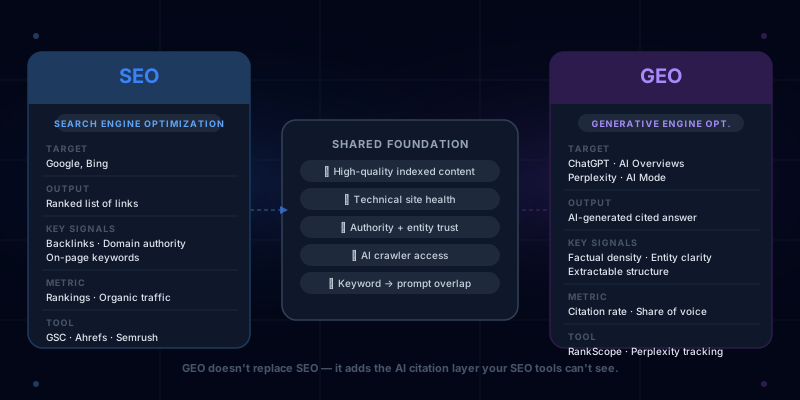
SEO gets you into Google's list of results. When someone searches "best CRM for startups," Google ranks ten blue links. SEO is about being one of those links — ideally in the top three, where most clicks actually go.
GEO gets you mentioned inside the AI-generated paragraph that appears above, or instead of, that list. When someone asks ChatGPT "what CRM should a startup use?" they get a conversational answer that names a few tools. GEO is about being one of the named tools.
The output surfaces are different. The retrieval mechanisms are different. And critically — the measurement is different. You can't use Google Search Console or Ahrefs to measure GEO, because those tools track rankings and backlinks, neither of which tell you anything about what ChatGPT is saying.
Here's the key distinction that most teams miss: ranking #1 on Google does not automatically mean ChatGPT cites you. Google's ranking index and ChatGPT's retrieval system are separate pipelines. A page can be #1 on Google and never appear in an AI answer — and a page buried on page 3 can be cited constantly by Perplexity.
That's not a flaw in the system. It's just how different systems work. And once you accept that, the strategic implication becomes obvious: you need to optimize for both, and you need separate measurement for each.
The Three Things GEO Adds to an SEO Stack
If you've already got a functioning SEO operation, GEO adds three things your current stack doesn't cover.
1. Structured content that AI engines can extract
SEO content is optimized for human readers and Google's ranking signals — keyword density, heading structure, readability scores. GEO content is additionally optimized for a different kind of reader: an AI engine that's trying to extract a self-contained, citable answer from your page.
These aren't always the same thing. A well-written SEO article often buries its key claims in the middle of paragraphs, surrounds them with qualifications, and structures sections around narrative flow. AI engines want the claim first, then the support. They want specific numbers (not "many companies"), named entities (not "a popular tool"), and sections that stand alone without context from the surrounding article.
The difference in practice: leading a section with "Citation rates above 30% indicate strong AI visibility" is extractable. "There are several ways to think about what good AI visibility looks like, depending on context and industry" is not.
How to optimize content for AI search goes deep on the structural changes that move the needle. The short version: each section should open with a direct, quotable statement, then support it.
2. Entity authority across AI training data
Traditional SEO builds domain authority through backlinks — other websites pointing to yours. GEO builds entity authority through consistent, accurate mentions of your brand, product, and key claims across the web and across time.
AI models were trained on text from across the internet. If your brand is mentioned accurately and consistently on third-party sites — reviews, roundups, comparison pages, industry publications — models learn to associate your brand with the category. If you only exist on your own site, there's no signal for the model to draw from.
This is why GEO work often includes PR, review acquisition, and outreach to industry publications — not just on-page SEO tactics. The goal is to establish your entity as recognized, trusted, and accurately described across independent sources.
3. Citation monitoring as a separate metric channel
The third thing GEO adds is a monitoring requirement that SEO tools simply don't cover. You need to know: when someone asks an AI engine a category-relevant question, does your brand get mentioned? How often? Which engines are citing you and which aren't?
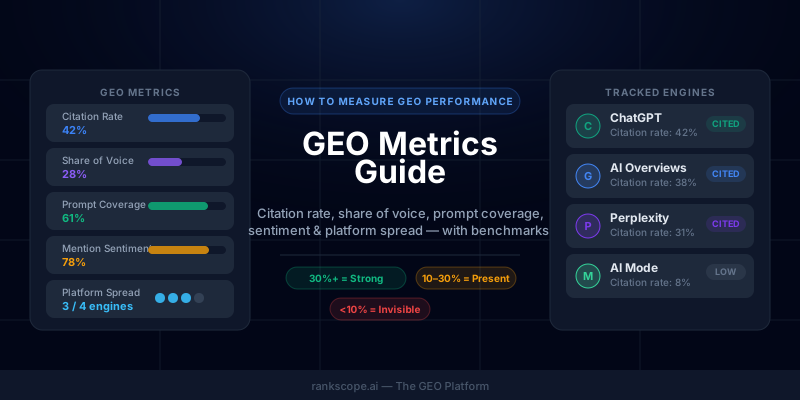
This is the GEO metrics layer — citation rate, share of voice, mention sentiment, platform coverage. None of this exists in Google Search Console or any traditional SEO tool. It requires querying AI engines directly, at scale, and recording what they say.
Without this layer, you're publishing content and hoping. With it, you have a feedback loop: publish, wait 2–4 weeks for AI engines to update their retrieval, measure citation changes, identify what moved and what didn't.
How GEO and SEO Complement Each Other
The disciplines are separate, but they're not independent. SEO creates the foundation that GEO builds on.
SEO authority helps GEO trust signals. AI engines don't weight domain authority the same way Google does, but they do draw from well-indexed, well-cited web pages. A domain with strong backlinks and broad organic presence is more likely to have its content appear in AI training data and retrieval pools. Building SEO authority doesn't automatically produce GEO citations, but it makes the content more retrievable.
SEO indexing is a prerequisite. If your page isn't indexed by Google and Bing, it's not in the pools that most AI engines retrieve from. ChatGPT's web search uses Bing. Perplexity crawls the live web. Google AI Overviews draws from Google's index. Getting indexed — which is fundamentally an SEO task — is table stakes for GEO.
GEO-optimized content tends to also be better SEO content. The content improvements GEO requires — higher factual density, clearer structure, specific data points — are also things Google rewards. A page rewritten for GEO extractability tends to see improved engagement metrics and featured snippet capture, both of which help traditional rankings. They're not in conflict; GEO forces content discipline that benefits the whole stack.
Conversely, SEO traffic validates which queries matter. Your Google Search Console data tells you which queries drive impressions and clicks. That's your starting point for a GEO prompt library — the queries that already matter for SEO are exactly the ones you should be testing in AI engines. The overlap is high.
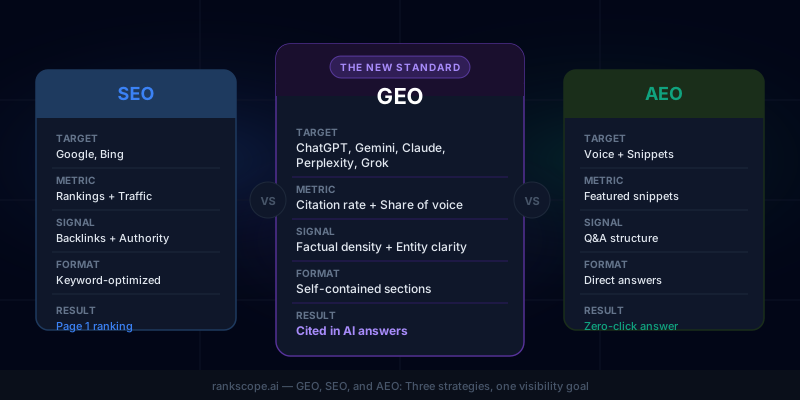
The full picture of how GEO, SEO, and AEO relate to each other — and which one to prioritize when — is in GEO vs SEO vs AEO. And for a practical guide to the specific levers — entity clarity, factual density, structured content, prompt targeting, and citation tracking — see GEO Optimization: The Complete Guide to Optimizing for AI Search.
Where to Allocate Effort
The question every SEO asks once they understand GEO: how much time should I actually spend on this?
The honest answer is that it depends on your audience and where they're doing research. But there's a reasonable default:
~70% on SEO fundamentals, ~30% on GEO-specific work.
Here's the reasoning.
SEO fundamentals — technical health, crawlability, link acquisition, keyword targeting — still drive the majority of measurable organic traffic for most sites. Letting these slip to chase GEO is a bad trade. SEO authority compounds slowly and erodes slowly; you can't quickly recover the ground you lose.
But the 30% earmarked for GEO isn't a rounding error. For B2B SaaS companies, professional services firms, and any brand where buyers are doing product research in ChatGPT, Perplexity, or Google AI Overviews, that's a significant and growing traffic channel. Ignoring it means ceding that channel to competitors who aren't ignoring it.
Within that 30%, the highest-leverage activities are:
1. Content restructuring for extractability. This doesn't require writing new content — it means editing existing pages to lead with direct answers, add specific data points, and use self-contained section structures. One afternoon of restructuring can meaningfully improve citation rates on pages you already have.
2. Citation baseline measurement. Before doing anything else on GEO, establish where you actually stand. Pick your 10–15 most important queries, run them across Perplexity, ChatGPT, Google AI Overviews and Google AI Mode, and record whether your brand appears. That baseline is what everything else is measured against. RankScope's platform automates this across all four engines.
3. Entity consistency across third-party properties. Make sure your brand is accurately described on G2, Capterra, industry roundup pages, and any publications that cover your category. If your description is wrong or absent on the sites AI models draw from, no amount of on-page optimization will fix the citation gap.
4. AI crawler access. Check your robots.txt. GPTBot, ClaudeBot, PerplexityBot, and GoogleBot-Extended need to be allowed. Blocking them is blocking AI citation — it's that direct.
What GEO Adds to Specific SEO Workflows
If you're running a full SEO program, here's where GEO plugs in:
Keyword research → Prompt library. Your keyword list becomes the foundation of your prompt library. Take your target keywords, rephrase them as natural language questions ("best [category] tool for [use case]"), and run them against AI engines. The overlap is high, and this tells you which queries your brand is already winning in AI versus where competitors are getting the citation.
Content calendar → GEO angle. Every piece you publish for SEO purposes can be structured to also qualify for AI citation. The incremental work is small: add a clear introductory statement, increase data density, write self-contained H2 sections. The blog post you'd write anyway becomes GEO-optimized with 30–60 minutes of additional editing.
Link building → Entity building. The outreach work you're doing for backlinks also contributes to entity authority when it lands mentions on relevant third-party sites. Not every link has the same GEO value — a mention in a roundup article written about your category has more citation signal than a generic directory listing.
Reporting → Two-track measurement. Your SEO reports show rankings, traffic, conversions from organic. Add a second track: citation rate and share of voice in AI engines, by platform. These are different KPIs for a different channel. Conflating them makes both harder to optimize.
How Much Does GEO Traffic Actually Matter?
The fair challenge to any GEO investment is: how much traffic is actually coming from AI-generated answers?
The honest answer in 2026: it varies wildly by category and buyer profile, and it's hard to measure precisely because AI-generated answers don't have a clean UTM attribution path.
What we do know from aggregate data:
-
Google AI Overviews appear on roughly 47% of queries that trigger them, and click-through rates from AI Overviews to cited sources are lower than from traditional blue links — but the brand impression (being named in the answer) happens regardless of whether the user clicks.
-
ChatGPT has over 100 million active weekly users in the US. For B2B software categories, a meaningful percentage of purchase research happens in chatbot conversations. Buyers ask ChatGPT "what tools should I use for X" — and whatever it says shapes their shortlist.
-
Perplexity's monthly active user base has grown to tens of millions. It cites sources directly and drives measurable referral traffic to cited pages — one of the few AI platforms where you can see the traffic effect in GSC.
The argument for GEO isn't that it replaces SEO traffic. It's that a chunk of your category's research is happening in channels your SEO tools can't see, and without measurement, you don't know if you're winning or losing those conversations.
The state of GEO in 2026 has the broader data on AI search adoption and citation patterns if you want numbers to bring to a strategy conversation. And for a dedicated look at how the zero-click acceleration changes brand visibility measurement, see our guide on zero-click search in 2026.
Common Mistakes When Adding GEO to an SEO Stack
Teams that have tried to add GEO and gotten frustrated usually made one of these mistakes.
Treating GEO as a content formatting task
The most common one. Someone reads a GEO guide, updates a few articles to have "more factual density" and "better headers," doesn't see any change in citations, and concludes GEO doesn't work.
GEO without measurement is just editorial opinion. You don't know if a content change moved your citation rate unless you measured before and after. The formatting work is real — but it only means something inside a feedback loop. Set the baseline, make the change, wait 2–4 weeks, measure again.
Measuring too early
AI engines take time to re-index content and recalibrate what they cite. Publishing a restructured article on Monday and checking AI citations on Thursday will show no change — not because the changes didn't work, but because the system hasn't updated yet. Most teams who say "we tried GEO and it didn't work" measured within 2 weeks of publishing. Wait 4 weeks minimum before drawing conclusions.
Using branded queries as the only test
Testing "does ChatGPT recommend [my brand]?" is a vanity check, not a GEO measurement. The queries that matter are unbranded — "what's the best tool for [category]?" "how do I solve [problem]?" These are the discovery prompts buyers actually use. Your branded citation rate on branded queries tells you almost nothing about GEO performance where it counts.
Only tracking one AI engine
Teams that only check ChatGPT are working with a fraction of the picture. Citation performance varies substantially across platforms. A brand that Perplexity cites consistently may get zero mentions from Google AI Overviews, because the two platforms retrieve content differently. Full GEO coverage requires tracking all four major engines: ChatGPT, Google AI Overviews, Perplexity, and Google AI Mode.
Ignoring the robots.txt
Still surprisingly common. If your site has restrictive robots.txt rules from an older SEO era — blocking unknown bots as a security/performance measure — you may be blocking GPTBot, ClaudeBot, and PerplexityBot. This is an immediate and total block on AI citation via real-time retrieval. Check it, fix it if it's blocking AI crawlers, and verify the fix is live.
Building GEO in a silo
The last mistake is organizational: having a GEO person or GEO initiative that operates separately from the SEO team. Because the disciplines overlap significantly — content, keyword strategy, technical crawlability — siloed execution produces conflicting priorities and duplicated work. GEO should be integrated into the SEO workflow, not running parallel to it.
Measuring the Combined GEO + SEO Picture
Once you've integrated GEO into your SEO stack, you need a reporting framework that covers both channels without conflating them.
SEO metrics (from GSC, Ahrefs, or equivalent):
- Keyword rankings by page and query cluster
- Organic impressions, clicks, CTR
- Domain authority and backlink growth
- Core Web Vitals and technical health scores
GEO metrics (from RankScope or equivalent):
- Citation rate per query (% of AI runs where your brand appears)
- Share of voice vs. top 3–5 competitors per AI engine
- Platform coverage (which engines are citing you, which aren't)
- Mention sentiment (positive, neutral, negative framing in AI answers)
- Citation source (which pages are being cited most)
These are separate measurement tracks. Report them separately. When you see SEO traffic flat but GEO citation rate rising, that's a sign you're gaining visibility in AI-mediated research that won't show up in GSC. When SEO traffic is growing but GEO citation rate is low, you're winning traditional search while ceding AI search to competitors.
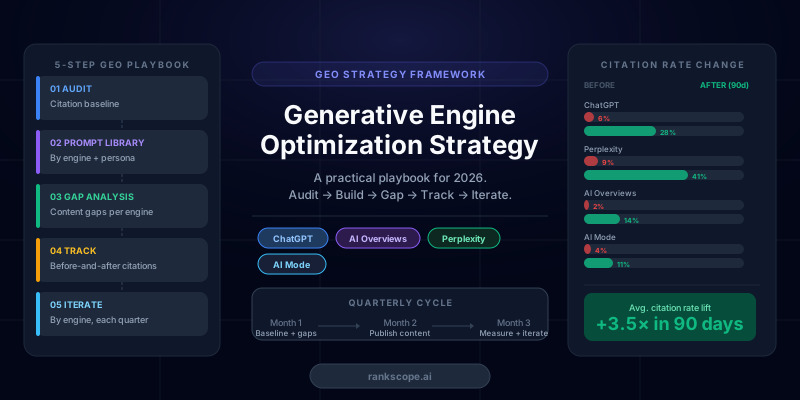
The complete guide to GEO strategy walks through the full 5-step cycle: audit, prompt library, gap analysis, track, iterate. That's the operational framework for the GEO side of the combined stack. For the hands-on implementation mechanics — specifically how to run each step, what to log, and how to read before-and-after citation data — the step-by-step guide to building a GEO strategy from scratch covers the practical details.
Practical Starting Point: Adding GEO to an Existing SEO Program
If you're running an SEO program today and want to add GEO without disrupting what's working, here's the minimum viable sequence:
Week 1–2: Baseline
- Confirm AI crawlers are allowed in robots.txt
- Pick 10–15 priority queries from your existing keyword list
- Run each query manually across ChatGPT, Google AI Overviews, Perplexity, Google AI Mode
- Record: is your brand mentioned? Which competitors are?
- This is your citation baseline
Week 3–4: Quick wins
- Restructure 3–5 existing high-traffic pages for AI extractability (lead each H2 with a direct answer, add specific data points, break up dense paragraphs)
- Check that your most important product and feature pages have complete, accurate descriptions (AI engines get brand facts wrong when they're working from sparse training data)
Week 5–8: Build the loop
- Set up systematic citation tracking across all four engines — manual at first, then with a tool as volume grows
- Add GEO metrics to your regular SEO reporting
- Identify the 2–3 queries where you're consistently losing citations to specific competitors and build content explicitly targeting those gaps
Ongoing: Integrate
- Every new piece of content should be structured for both SEO and GEO from the start
- Run quarterly citation audits the same way you run quarterly SEO audits
- Treat GEO as a channel with its own targets, not a side project
The goal isn't to have a separate GEO strategy. It's to have an SEO strategy that also covers the channel your SEO tools can't see.
The Bottom Line on GEO and SEO
SEO isn't going anywhere. Google still drives the majority of organic traffic for most sites, and that will be true for the foreseeable future. The skills, tools, and instincts you've built as an SEO practitioner are still the right foundation.
But the research process for a meaningful share of buyers has moved — at least partially — into AI-generated answers. If your brand isn't in those answers, you're invisible for that part of the buying journey. And because most teams aren't measuring GEO yet, you can't know how big that blind spot is until you start.
The smart move isn't to pivot from SEO to GEO. It's to add GEO measurement to your existing SEO stack, allocate appropriate effort, and build the feedback loop that lets you optimize both channels from evidence rather than assumption.
RankScope is built to be the measurement layer for GEO inside an SEO workflow — tracking citation rate and share of voice across all four engines, so you know exactly where your brand stands in AI-generated answers and what's moving. If you want to see your citation baseline, get started here.
Frequently Asked Questions
What does GEO stand for in SEO? GEO stands for Generative Engine Optimization. In the context of SEO, it refers to the practice of optimizing your content and digital presence to appear in AI-generated answers — not just traditional search rankings. The term was coined to distinguish optimization for generative AI search (ChatGPT, Google AI Overviews, Perplexity) from traditional Search Engine Optimization.
Is GEO replacing SEO? No. GEO and SEO target different systems and different parts of the search experience. Google's traditional blue links still drive the majority of search traffic, and SEO remains essential for capturing that traffic. GEO is an additional discipline for the growing share of research that happens inside AI-generated answers. Most teams should run both, with SEO as the foundation and GEO layered on top.
How do I know if GEO is worth investing in for my business? The clearest signal: ask whether your buyers are using AI tools for research and purchase decisions. B2B SaaS, professional services, and any category where buyers do significant research before purchasing tend to see high AI search usage. Run 10–15 of your most important queries through ChatGPT and Perplexity manually. If you see competitors being cited and your brand isn't, that's the gap GEO is designed to close.
What's the fastest way to improve GEO performance? Restructure your highest-traffic existing pages so each section leads with a direct, quotable answer. Confirm AI crawlers are allowed in your robots.txt. These two changes — no new content required — can move citation rates within 4–6 weeks. After that, systematic tracking tells you which queries need new content to close citation gaps.
Can I measure GEO without a paid tool? Yes, manually — run target queries in ChatGPT, Perplexity, and Google AI Overviews and record the results in a spreadsheet. The limitation is scale and consistency: manual checking at 50+ runs per query across 4 engines and 15 queries quickly becomes impractical. Tools like RankScope automate the sampling, track citation changes over time, and break down share of voice vs. competitors.