Zero-Click Search in 2026: What It Means for Brand Visibility
In the first four months of 2026, 68% of Google searches ended without a click. Not a visit. Not a pageview. The user typed a query, got an answer from an AI Overview or a featured result, and left. Google's job was done. Yours wasn't.
This isn't new data — researchers have been tracking the zero-click trend since SparkToro first flagged it in 2019, when 49% of searches already ended on the SERP. What's new is the velocity. The jump from 60% in 2024 to 68% in early 2026 is the fastest acceleration of this trend in a decade. And the driver is obvious: Google AI Overviews.
Before we talk about what to do about it, let's be precise about what zero-click search actually is, where it comes from, and why most brands are measuring the wrong thing in response.
What Is Zero-Click Search?
A zero-click search happens when a user finds what they need directly on the results page — without clicking through to any external website. The search engine resolved the query. No website got the visit.
The most common zero-click results in 2026:
- AI Overviews — Google's AI-generated answer summaries that appear at the top of the SERP, synthesizing content from multiple sources into a paragraph or list
- AI Mode — Google's conversational search interface, where the entire experience is AI-generated without a traditional list of blue links
- Featured snippets — Direct answer boxes pulled from a single web page, displayed prominently above organic results
- Knowledge panels — Structured entity information pulled from Google's knowledge graph (brand info, people, places, definitions)
- People Also Ask boxes — Expandable Q&A dropdowns that answer follow-up questions without requiring a click
- Local packs — Map-based results for local queries that answer the "where" question on the SERP itself
The traditional SERP — ten blue links, the user picks one — was never zero-click. Today's SERP is something different. And that's before we get to what happens off Google entirely.
AI chatbots are an entirely different zero-click surface. When someone asks ChatGPT "what's the best project management tool for remote teams," they don't get a list of links. They get a synthesized answer with brand recommendations. No results page. No click opportunity. Just an answer — and whatever brand names appeared in it are now part of the buyer's consideration set.
This is the other zero-click world running in parallel with Google. ChatGPT has over 100 million weekly active users in the US. Perplexity, which does cite sources, has grown to tens of millions of monthly users. Combined with Google AI Overviews, these platforms are handling a significant and growing share of product research queries — the exact queries where brands most want to be visible.
The Numbers Are Striking, but the Trend Is the Point
Let's put the data in sequence:
| Year | Zero-Click Rate (Google, US) | Driver |
|---|---|---|
| 2019 | 49% | Featured snippets, knowledge panels |
| 2022 | ~56% | People Also Ask expansion, zero-click UX refinements |
| 2024 | 60.45% | Featured snippets + early AI integration |
| Early 2026 | 68.01% | AI Overviews on 20%+ of queries |
The 7.5 percentage point jump from 2024 to early 2026 — in under two years — is roughly equal to the growth of the prior five years combined. AI Overviews are the inflection point.
Ahrefs' research gives us the mechanism: when an AI Overview appears on a query, click-through rates drop by an average of 34.5%. Some query types see drops as high as 61% (Seer Interactive). Meanwhile, Bain's survey found that 80% of consumers rely on zero-click AI summaries in at least 40% of their searches. Even among AI skeptics in Bain's sample, about half said most of their queries were answered on the search page without clicking.
This is the new default. Not an edge case. The default.
How AI Overviews and AI Mode Are Accelerating the Trend
Google's AI Overviews launched broadly in May 2024. By early 2026, they appear on roughly 20–21% of all Google queries — with significantly higher trigger rates for informational and question-based queries: 57.9% of question queries, 59.8% of "why" queries trigger an AI Overview.
The growth hasn't slowed. As Google improves Gemini's accuracy and reduces AI Overview errors, it's rolling them out to more query types, not fewer. Every new query type that gets an AI Overview is another pool of searches that don't produce clicks.
Google AI Mode is the next phase. AI Mode is Google's fully conversational search interface — the whole page is the AI response, with no traditional organic list. It's available for an expanding set of queries and is increasingly the default for logged-in users. Where AI Overviews trim clicks at the margin, AI Mode eliminates the traditional SERP entirely for the queries it handles.
The combined effect: the pathway from "Google query" to "website visit" is getting longer and leakier at every step. Organic traffic from Google peaked at some point in the past few years, and the trajectory is clear.
It's worth saying out loud: this is intentional on Google's part. Keeping users in the Google ecosystem — answering their questions without sending them elsewhere — increases ad revenue and user time-on-platform. Google's financial results through this period have been strong. The incentives are not going to reverse this direction.
Why Traffic Is the Wrong Metric for Zero-Click World
Here's the measurement trap that catches most brands: they're watching Google Search Console traffic and concluding that since clicks are down, visibility must be down. Sometimes that's true. Often it's incomplete.
Zero-click brand impressions don't appear in GSC. When your brand is cited in an AI Overview, the user sees your name, your product, maybe your URL — but if they don't click, GSC records nothing. Zero. That impression happened. You got visibility. Your competitor who wasn't cited got nothing. None of it shows in the data you're looking at.
The same blind spot is even worse for AI chatbots. When ChatGPT recommends your brand in a response, it doesn't generate a referral in your analytics. The buyer might go directly to your website (looking like direct traffic), might do a branded search (looking like branded organic), or might just remember your name for when they're ready to buy. GSC shows you none of this.
Bain's research captures the implication: organic web traffic has declined 15–25% because of zero-click trends. But consumer awareness and consideration of brands in AI-generated summaries has not declined — it's shifted channels. The problem isn't that brands have become less visible. The problem is that standard analytics tools can't see where visibility is happening.
This is not an argument against SEO. Good Google rankings are the prerequisite for AI Overview inclusion — 76% of AI Overview citations come from top-10 organic results. Without strong SEO, you're not getting cited. But ranking in position 3 and getting zero AI Overview citations isn't a measurement problem — it's an optimization problem that GSC traffic data won't reveal.
What Brand Visibility Actually Means in 2026
Let's define what it means to be "visible" when clicks don't happen:
1. Being named in the answer. When Google AI Overviews, ChatGPT, or Perplexity answers a category query — "what are the best CRM tools?" or "how do I automate email follow-ups?" — are you in the answer? Not cited in a footnote. Named. Your brand appears in the paragraph the user actually reads.
2. Being cited as a source. Perplexity and Google AI Overviews both surface source citations. When your page is listed as a reference, users can click through — but more importantly, appearing as a cited source builds authority and trust signal regardless of whether the click happens.
3. Being part of the competitive set. AI engines often compare brands directly. "Compare RankScope vs [competitor] for AI visibility tracking" generates a head-to-head response. If you're not in the comparison, you've been effectively disqualified from that evaluation. That happens before a buyer ever visits your website.
4. Being characterized correctly. Zero-click visibility isn't just presence — it's framing. Is the AI describing your product accurately? Is it positioning you against the right competitors? Is the sentiment neutral or subtly negative? The characterization inside an AI response shapes buyer perception at scale.
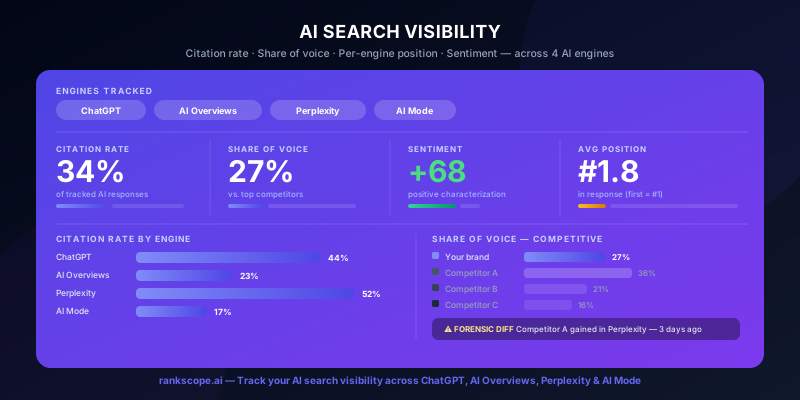
AI search visibility captures all four dimensions: citation rate, share of voice against competitors, per-engine position (first named vs. buried), and sentiment. None of these are trackable in GSC or Google Analytics.
The New Metrics: Citation Rate and Share of Voice
In a world where traffic is an incomplete signal, the metrics that matter for zero-click visibility are:
Citation Rate — Of all the times your target prompts are run in a given AI engine, what percentage of responses include your brand? A citation rate of 40% in ChatGPT means you appear in 4 out of every 10 relevant AI responses. A citation rate of 5% means you're effectively invisible.
Share of Voice in AI — Of all brand citations in your category within AI-generated responses, what percentage are yours? If ChatGPT names five brands in its answers about project management tools, and you appear in 60% of those answers while your closest competitor appears in 20%, your AI SoV is higher. This is the competitive metric that tells you who's winning the AI-generated research conversation.
Per-Engine Citation Position — Are you named first in the AI response (the most influential position) or mentioned as an afterthought at the end? Position within an AI response correlates with buyer selection in a similar way to ranking position on a SERP.
Citation Consistency — AI responses are non-deterministic. Run the same prompt 10 times; you might get 7 different brand combinations. Consistent citation (appearing in a high percentage of runs of the same prompt) indicates stable AI entity authority, not just a lucky result.
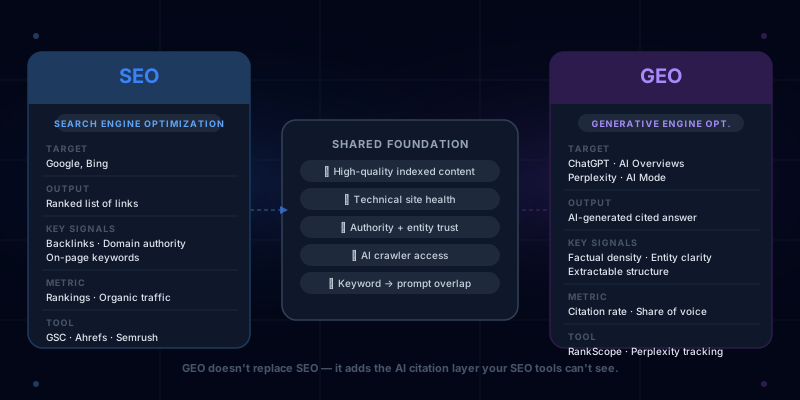
These metrics require a fundamentally different measurement infrastructure than SEO tools provide. GSC doesn't run prompts. Ahrefs doesn't track citation rate. Rank trackers don't simulate AI responses. To measure zero-click brand presence, you need a tool that actually queries AI engines at scale and measures what comes back.
How to Optimize for a Zero-Click World
Zero-click search changes the goal, but the fundamentals of what gets you into AI-generated answers are well understood. Here's what works:
1. Earn AI Overview Citations (Which Requires Strong SEO First)
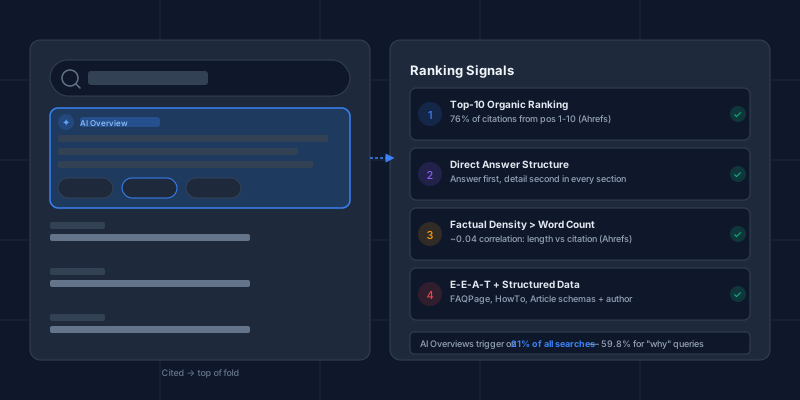
The most common misconception about AI Overviews is that you can optimize directly for them without first having strong Google rankings. You can't. 76% of AI Overview citations come from top-10 organic pages. The SEO prerequisite is non-negotiable.
But ranking alone doesn't guarantee citation. Once you have the ranking foundation, content structure determines whether Google's AI pulls your content into the answer. The key factors:
- Answer-first structure — each section opens with a direct, quotable answer, not a preamble
- Factual density — specific numbers, dates, and named entities rather than approximations
- Schema markup — FAQPage, HowTo, and Article schemas help AI systems identify extractable content
- E-E-A-T signals — named authors, cited primary sources, demonstrated first-hand knowledge
For a complete optimization checklist, see our guide to ranking in Google AI Overviews.
2. Build Entity Authority for AI Chatbots
ChatGPT and Perplexity don't pull from Google's index in the same way. ChatGPT's knowledge comes from training data (with retrieval augmentation for real-time queries). Perplexity does live crawling. Both weight entity authority — how consistently and authoritatively your brand is associated with your category across the web.
The inputs to entity authority are:
- Consistent, accurate brand information across authoritative sources (Wikipedia, Crunchbase, industry directories)
- Coverage in industry publications that AI training corpora include
- Your own site's content clarity — clear definitions of what you do, who you serve, and why you're authoritative in your category
None of this is a short-term play. Entity authority builds over months. The brands that are consistently cited by ChatGPT today are mostly the ones that started publishing authoritative category content two or three years ago.
3. Create Content That Answers the Prompts Buyers Actually Ask
Generative engine optimization centers on prompt targeting: mapping the actual questions buyers ask AI engines to specific content pieces on your site. "What is the best tool for tracking AI citations?" is a prompt. Your content should answer that prompt directly, with specific supporting evidence, in a way that an AI engine can extract and incorporate into its response.
This differs from traditional keyword targeting. You're not trying to rank in a list — you're trying to be the definitive answer to a specific question. The content that succeeds in AI engines tends to be:
- Directly answering the prompt in the first paragraph
- Backed by specific data, examples, or case studies
- Self-contained (the answer doesn't require reading a previous section)
- Factually dense enough that the AI has material to cite
4. Measure Citation Presence Systematically
You cannot manage what you cannot measure, and zero-click visibility is invisible to standard tools. Systematic measurement means:
- Running a library of target prompts across ChatGPT, AI Overviews, Perplexity, and AI Mode on a regular cadence
- Tracking citation rate, share of voice, and position per engine
- Monitoring competitor citation rates alongside your own
- Detecting when your citations change — either improving or dropping — so you can investigate why
RankScope's platform does this automatically. It runs your prompt library across all four major AI engines, uses real browser-based responses (not API outputs) to get accurate AI Overview and AI Mode data, and surfaces citation metrics in a single dashboard. When your citation rate drops, you see it before your traffic drops — because citation rate leads traffic in the funnel.
What This Means for Different Teams
For SEO teams: Zero-click search doesn't make your work less valuable — it adds a new measurement obligation. Your rankings are still the prerequisite for AI Overview inclusion. But your reporting needs a second track: citation rate in AI responses alongside rankings and organic traffic. If you're only reporting GSC data, you're missing a growing channel.
For brand teams: The buyer journey now includes AI-mediated research phases that are invisible to your analytics. A buyer might form an opinion about your brand from a ChatGPT response before they ever visit your website. Brand perception work needs to include monitoring how AI engines characterize you, not just traditional brand surveys. Brand monitoring in AI search is the new brand health signal.
For marketing leaders: Zero-click doesn't mean zero influence. The impression happens — it's just not tracked by your current tools. The brands that win in 2026 are the ones that optimize for presence in AI-generated answers, not just clicks to their website. This requires a measurement infrastructure that most teams don't yet have.
For product marketers: If AI engines are describing your product incorrectly, or positioning you against the wrong competitors, that miscategorization is reaching buyers at scale before they ever talk to a salesperson. The ability to monitor and correct AI characterizations of your brand is increasingly a product marketing function.
The Measurement Gap Is the Core Problem
Let's put a number on the visibility gap. Google Search Console shows you clicks and impressions for Google Search. It does not show you:
- How many times your brand was cited in an AI Overview (no click)
- How many times your brand appeared in a ChatGPT response (no click possible)
- How many times Perplexity cited your page (click possible, but often doesn't happen)
- Your share of voice against competitors in AI-generated category answers
- How your AI citation rate is trending week-over-week
For a brand appearing in hundreds of AI Overview responses per day and hundreds more ChatGPT responses, that's a substantial amount of brand impression data that never appears in any standard analytics tool.
RankScope exists to close this gap. It tracks citation presence across all four major AI engines, measures your brand's share of voice in AI-generated answers, alerts you when citation patterns change, and gives you the data to understand whether your GEO efforts are working — even when no click happens.
You can get accurate AI Overview and AI Mode data because RankScope runs real browser-based queries rather than using the API, which often returns different results than what actual users see in their browsers.
The Bigger Picture: Search Is Becoming a Citation Game
For 25 years, search was a ranking game. You optimized for position in a list. The metric was where you appeared. The game mechanic was clicks.
That game hasn't ended. It's been layered. On top of the ranking game — which still drives the majority of measurable web traffic — a citation game has emerged. In this game, AI engines synthesize answers from sources they find authoritative. The winning move isn't appearing in a list; it's being named in the answer. The metric isn't rank position; it's citation rate. The game mechanic isn't clicks; it's impressions that happen with or without them.
The brands that understand this — and build measurement and optimization for both games simultaneously — are the ones that will have both traffic and brand authority as the zero-click trend continues to accelerate.
Zero-click searches will exceed 70% this year. They'll probably exceed 80% in a few years. The question isn't whether to adapt to a world where most searches don't produce clicks. It's whether you'll measure what happens in those searches — and whether your brand shows up.
Frequently Asked Questions
What is zero-click search? Zero-click search is when a user finds the answer they need directly on the search results page — through an AI Overview, featured snippet, knowledge panel, or AI chatbot response — without clicking through to any website. In early 2026, 68% of Google searches end without a click.
Why is zero-click search increasing? The primary driver is Google AI Overviews, which now appear on more than 20% of all searches and reduce click-through rates by an average of 34.5% when they appear. Google and AI chatbots are designed to answer queries directly, keeping users in their ecosystem rather than routing them to external websites.
Does zero-click search hurt my SEO? Zero-click search reduces organic traffic for many query types. But strong SEO is still the prerequisite for AI Overview inclusion — 76% of AI Overview citations come from top-10 ranking pages. The shift changes what you optimize for, not whether you need SEO. You need both SEO (to earn the ranking prerequisite) and GEO (to earn the citation once you rank).
How can I track my brand in zero-click results? Google Search Console doesn't track AI Overview citations or chatbot brand mentions. You need a dedicated tool that runs your target prompts across AI engines and measures citation rate, share of voice, and position within responses. RankScope tracks citation presence across ChatGPT, Google AI Overviews, Perplexity, and Google AI Mode.
What's the difference between a featured snippet and an AI Overview? Featured snippets pull content directly from a single web page and display it verbatim or near-verbatim. AI Overviews synthesize content from multiple sources into a new response written by Google's AI. AI Overviews are longer, appear more frequently, and suppress clicks more aggressively than featured snippets did.
Is zero-click search the same on Google and ChatGPT? Structurally similar, but different mechanics. On Google, zero-click results are embedded in a SERP that still has links below them. On ChatGPT and other AI chatbots, the entire interface is zero-click — there's no list of links, just a synthesized response. Both create brand impressions without trackable clicks, but they require separate optimization and measurement approaches.