ChatGPT Competitors in 2026: 10 Best Alternatives Actually Worth Using
When ChatGPT launched in November 2022, it was a lone phenomenon — a chatbot that surprised everyone, including its creators. Three and a half years later, it sits inside a fully competitive market. Google, Microsoft, Anthropic, Meta, and a handful of pure-play startups have all shipped capable AI products with real user bases and real differentiation.
This isn't a "ChatGPT alternatives" list in the old sense — as in, here are six cheaper knockoffs. These are genuinely distinct platforms with different models, different strengths, and different audiences. Some directly compete with ChatGPT for the same users. Others have carved out territory ChatGPT doesn't dominate.
Here's where each one stands in 2026.
Quick Comparison: ChatGPT vs. Its Main Competitors
| Platform | Best For | Model | Real-Time Web | Free Tier | Starting Price |
|---|---|---|---|---|---|
| ChatGPT | General-purpose AI + reasoning | GPT-4o / o3 | ✅ With Browse | ✅ Yes | $20/mo (Plus) |
| Google Gemini | Ecosystem integration + search | Gemini 2.5 Pro | ✅ Always | ✅ Yes | Free (Advanced $20/mo) |
| Anthropic Claude | Long-form reasoning + documents | Claude 3.7 / Opus 4 | ✅ With web search | ✅ Yes | $20/mo (Pro) |
| Microsoft Copilot | Microsoft 365 users + research | GPT-4o + Bing | ✅ Always | ✅ Yes | $20/mo (Pro) |
| Perplexity AI | Real-time AI search + citations | Multiple | ✅ Always | ✅ Yes | $20/mo (Pro) |
| Grok (xAI) | Social trends + X data | Grok 3 | ✅ Real-time X | Limited | $8/mo (X Premium) |
| Meta AI | Social platform integration | Llama 4 | ✅ Yes | ✅ Free | Free |
| DeepSeek | Cost-efficient research | R1 / V3 | Limited | ✅ Yes | Free (API usage-based) |
1. Google Gemini — The Structural Challenger
Google was the only company in 2022 with the resources, data, and distribution to take OpenAI seriously as a threat. Gemini is the result — and three years in, it's the strongest direct challenger ChatGPT has.
Why it matters: Gemini 2.5 Pro has topped the LMSYS Chatbot Arena leaderboard and outperformed GPT-4o on most major benchmarks as of May 2026, particularly in reasoning, coding, and multimodal tasks. But the model performance is almost secondary to the distribution advantage.
Google has embedded Gemini into:
- Google Search — AI Overviews and Google AI Mode are both Gemini-powered
- Gmail and Google Docs — Gemini suggests, summarizes, and drafts in Google Workspace
- Android — Gemini replaced Google Assistant as the default AI on Android phones in 2024
- Google One — Gemini Advanced is bundled with the Google One AI Premium subscription
- Google Meet and Calendar — meeting summaries, scheduling assistance
That distribution means Gemini has passive reach that ChatGPT's subscription model can't match in pure volume. Hundreds of millions of people interact with Gemini-powered features without ever opening gemini.google.com.
Where ChatGPT still leads: Memory (Gemini's memory is more limited), plugin and operator ecosystem, and the sheer variety of third-party tools built around the ChatGPT API. OpenAI's model family (o3 series for reasoning, GPT-4o for general use) is also more segmented and specialized than Google's current Gemini lineup.
The bottom line: If you use Google's product suite — Search, Gmail, Workspace, Android — you're already using Gemini. For marketers specifically, Gemini's integration into Google Search means that ranking in Google AI Overviews and Google AI Mode are both Gemini retrieval questions at their core.
2. Anthropic Claude — The Reasoning Specialist
Anthropic was founded by former OpenAI researchers in 2021, including Dario and Daniela Amodei. The company's focus has always been on AI safety and reliability over raw performance claims — and that shows in the product.
Claude has earned a reputation for being:
- More honest — Claude tells you when it doesn't know something rather than confidently fabricating an answer
- Better at long documents — the 200,000-token context window (and experimental 1M token window on some models) lets Claude analyze entire books, legal documents, or codebases in a single session
- More nuanced on complex topics — where ChatGPT sometimes gives the expected "safe" answer, Claude tends to engage more carefully with ambiguity
Claude 3.7 Sonnet and Claude Opus 4 (released mid-2025) are the workhorses. On tasks like code review, legal document analysis, creative writing with specific constraints, and multi-document synthesis, they consistently match or beat GPT-4o.
Where Claude is weaker: The plugin and integration ecosystem is significantly smaller than ChatGPT's. Claude doesn't have memory across sessions by default. Web search (available in Claude.ai Pro) is there, but the interface is less polished for search-first use cases than Perplexity or even Copilot.
Enterprise adoption: Claude has seen strong adoption in enterprise settings — particularly legal tech, finance, and healthcare — where hallucination risk and document accuracy matter most. Companies including Slack, Notion, and DuckDuckGo have integrated Claude via API.
The bottom line: For anything involving long documents, careful reasoning, or outputs where you can't afford confident errors, Claude is the right choice over ChatGPT. For quick general tasks and integrations, ChatGPT's ecosystem still wins.
3. Microsoft Copilot — The Enterprise Default
Microsoft made a $13 billion bet on OpenAI starting in 2023 and used it to rewrite how hundreds of millions of people interact with computers. Copilot isn't a single product — it's the name Microsoft gave to AI across its entire stack.
- Copilot on the web (copilot.microsoft.com) — GPT-4o plus Bing search, free with generous limits
- Copilot in Windows — built into the taskbar, available with a keyboard shortcut, integrated with system functions
- Copilot in Microsoft 365 — integrated into Word, Excel, PowerPoint, Teams, Outlook, and OneNote. Enterprise subscription at $30/user/month.
- Copilot in Edge — AI sidebar in the browser, reads pages and helps you while browsing
Why it's genuinely different from ChatGPT: Copilot is designed for productivity workflows, not open-ended conversation. When you ask Copilot to compare two products, you get a formatted table with cited sources. When you ask it to summarize your meeting, it pulls from Teams automatically. The interface prioritizes structure over conversation.
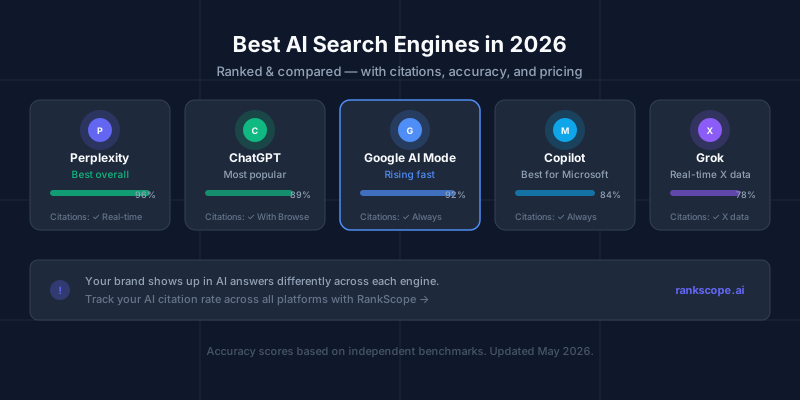
Always-on citations are a real differentiator. Unlike ChatGPT, where Browse is something you have to turn on, Copilot retrieves live web data and cites sources by default on every response. No modes to toggle, no knowledge cutoffs to navigate around.
Where it falls short: Bing's index is smaller than Google's, which occasionally shows up in source quality on niche or recent topics. The corporate product stack can feel constrained compared to ChatGPT's more open-ended capabilities.
The bottom line: If you're in a Microsoft 365 environment, Copilot is already your AI. The enterprise version (Copilot for M365) is genuinely powerful for teams — meeting summaries, email drafting, spreadsheet analysis all happen in the tools you're already using.
4. Perplexity AI — The Real-Time Search Engine
Perplexity is the most interesting company in this landscape, because it's not really trying to build a ChatGPT competitor. It's trying to build a search engine.
The product is built around one premise: every answer should have inline citations attached to specific claims, and web retrieval should be on for every single query. You never have to think about whether Perplexity has current information — it always does.
Key facts about Perplexity in 2026:
- Over 100 million queries per day as of early 2026
- $500M Series E raised at an $8B valuation (December 2024)
- Powered by multiple models (including proprietary models alongside Sonnet and GPT-4o)
- Available in 9 languages
- iOS, Android, and web apps
What makes it different from ChatGPT:
Perplexity doesn't try to be a general-purpose AI assistant. It doesn't write code or remember your previous conversations (without Spaces). What it does — retrieving current, cited information from the web — it does better than anyone else.
The Pro Search mode is particularly good: it asks clarifying questions, runs multiple sub-queries, and synthesizes a more complete answer than a single-pass retrieval. It's the difference between asking a knowledgeable colleague a question and having them actually research it before answering.
For brands: Perplexity is one of the most active AI sources for product and brand recommendations. When someone asks "what's the best tool for X," Perplexity's citation quality means it's pulling from high-authority sources. If your brand isn't on those sources, you won't appear. This is the core problem that generative engine optimization (GEO) addresses.
The bottom line: If you use AI primarily for research and want every claim sourced, switch to Perplexity. As a search engine, it beats ChatGPT. As a general AI assistant, ChatGPT is still more capable. For a full breakdown of how Perplexity stacks up against its own rivals — ChatGPT, Google AI Mode, Claude, Grok, and specialist tools — see our Perplexity competitors guide.
5. Grok (xAI) — Real-Time Social Intelligence
Grok is xAI's model, integrated into X (formerly Twitter) and available as a standalone product. The defining capability is access to the full X firehose — every post, trend, and breaking story in real time.
No other AI has this. When a news story breaks, Grok can tell you what's trending on X, summarize the reactions, identify the key voices, and put it in context — all within minutes of it happening.
Grok 3 (released early 2025) is a competitive model on general benchmarks, sitting roughly between GPT-4o and Claude Sonnet on most tasks. The gap with ChatGPT and Gemini has narrowed considerably since the original Grok, which was noticeably weaker.
Where Grok wins:
- Breaking news and social trends — X firehose access is unmatched
- Less hedged answers — Grok is more willing to give direct opinions and speculative takes
- Humor and personality — designed to be engaging, not just useful
Where Grok is behind:
- Web citations outside X are weaker than Perplexity or Copilot
- Full access requires an X Premium subscription ($8–$16/mo)
- The research and document analysis use cases are less developed
The bottom line: Grok is the right tool for anything where social context and recency matter most. For news professionals, social media managers, and anyone tracking cultural trends, it has a genuine edge. For research and analysis, the other platforms are more reliable.
6. Meta AI — The Scale Wildcard
Meta AI runs on the Llama 4 model family and is embedded across Facebook, Instagram, WhatsApp, and Messenger — which collectively reach 3.2 billion monthly active users. That is a distribution number no other AI company can touch.
Meta's AI strategy has been mostly open-source: the Llama models are freely downloadable, and the API is inexpensive. This has made Llama the foundation for hundreds of downstream AI products and research projects worldwide.
The product (meta.ai) is a capable general-purpose AI assistant with real-time web search and image generation. It's integrated into the social apps most people already check daily — so for many users, Meta AI will be the first AI product they encounter, not ChatGPT.
Where it's competitive: The free tier is genuinely good, with no meaningful artificial limits. Llama 4 is competitive with GPT-4o on most conversational benchmarks. Image generation (DALL-E equivalent) is built in.
Where it lags: The conversation quality, memory, and research capabilities are a step below ChatGPT and Claude. Meta AI doesn't have the same depth of third-party integrations. The fact that it lives inside social media apps means it's often used for casual queries rather than serious research.
The bottom line: Meta AI is going to reach more people than any other AI product simply because it's embedded in apps they already use. The model quality is solid. It just hasn't shipped the depth of features that makes power users choose it over ChatGPT or Claude.
7. DeepSeek — The Cost Disruptor
DeepSeek is a Chinese AI lab that shocked the industry in January 2025 when it released DeepSeek R1 — a reasoning model that matched GPT-o1's performance at a fraction of the training cost. The R1 release wiped billions off Nvidia's market cap overnight and forced every AI lab to revisit their efficiency assumptions.
Why it matters for the competitive landscape:
DeepSeek proved that frontier-level reasoning models don't require hundreds of millions in GPU compute. This has compressed the barrier to entry for capable AI and accelerated the overall field. It also made DeepSeek's API one of the cheapest ways to access high-quality AI reasoning.
The DeepSeek product:
- DeepSeek V3 — general-purpose model competitive with GPT-4o on benchmarks
- DeepSeek R1 — reasoning-specialist model, comparable to OpenAI's o1 series
- Free consumer app at deepseek.com
- API pricing significantly cheaper than OpenAI's equivalents
Limitations: Limited real-time web access in the consumer product. Data privacy concerns for enterprise users given Chinese jurisdiction. The consumer app can hit rate limits during high-demand periods.
The bottom line: For developers and technical users who need capable AI reasoning at low cost, DeepSeek is worth knowing. For enterprise use or anything involving sensitive data, the privacy questions are real. Most non-technical users won't choose DeepSeek over ChatGPT for day-to-day use.
The Real Competitive Dynamics: What's Actually Happening
Looking at all these platforms, a few patterns stand out.
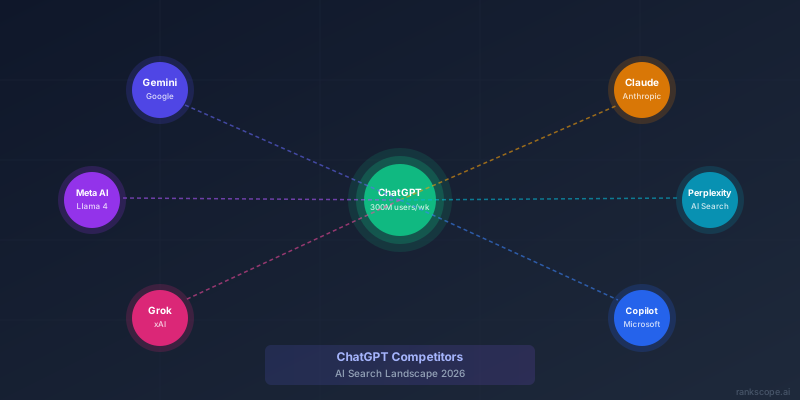
The battle has split into layers. ChatGPT is competing on multiple fronts simultaneously: against Gemini for general AI assistant users, against Perplexity for search use cases, against Claude for enterprise reasoning, and against Copilot for Microsoft ecosystem users. No single competitor threatens it everywhere — but the sum of competitive pressure is real.
Distribution beats model performance. Gemini is embedded in Search and Android. Copilot is in Windows and Microsoft 365. Meta AI is in WhatsApp and Instagram. These companies don't need to win a benchmark to win users — they need to be the first AI people encounter in their existing workflows. OpenAI is an app people have to choose to download. That's a harder acquisition model.
The specialization premium. The most durable position in this market might not be the best general model — it might be the best at something specific. Perplexity owns real-time cited search. Claude owns long-form document reasoning. Grok owns X data. These are defensible positions that don't require matching ChatGPT head-to-head on every capability.
Open source is a force multiplier. Meta releasing Llama, DeepSeek releasing R1, and Mistral's open models have all raised the floor for AI capability. Any company that competes purely on "we have a better closed model" is running a race that keeps getting harder. OpenAI's moat is more about the ecosystem, integrations, and brand than the model itself.
What This Means for Your Brand Visibility
Here's the thing most people researching AI platforms miss: from a marketing and brand perspective, this fragmentation is a problem you need to solve, not just observe.
Each of these platforms is independently deciding whether your brand gets cited when someone asks a relevant question. Someone asks ChatGPT "what are the best tools for [your category]?" and separately asks Gemini the same question. Those are two separate citation decisions, based on two different training corpora, two different retrieval systems, two different citation logics.
A brand that's well-cited in ChatGPT might be invisible in Perplexity. A brand that shows up in Gemini might not appear in Claude's answers at all. This isn't hypothetical — it's what citation tracking data consistently shows.
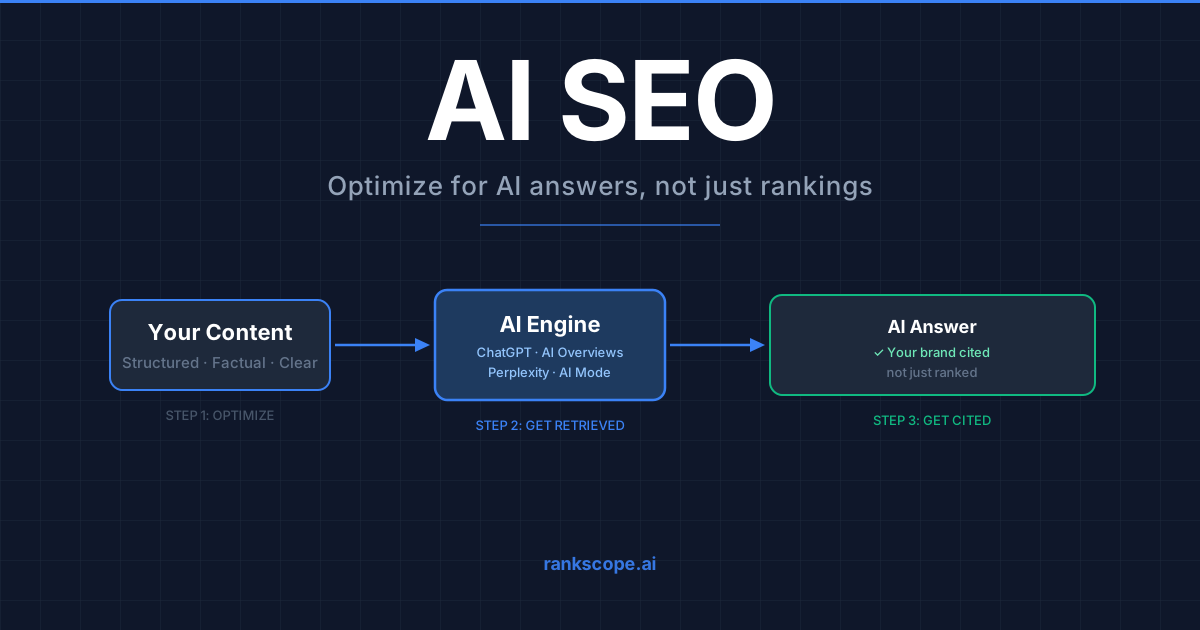
The discipline for managing this is generative engine optimization (GEO): the practice of optimizing your content, entity associations, and third-party mentions so that AI engines recognize your brand as an authoritative answer to relevant queries.
The first step is knowing where you actually stand. If you're not measuring your citation rate across AI engines, you don't have a baseline to improve from. AI visibility tools like RankScope track your brand mentions in ChatGPT, Perplexity, Google AI Overviews and Google AI Mode — so you can see which platforms are citing you and which are ignoring you, and adjust your content strategy accordingly.
For a full breakdown of how AI search works from a marketing perspective, see our guide on AI search engine optimization.
ChatGPT Still Leads — But the Lead Is Narrowing
The numbers are clear: 300 million weekly active users, the most recognized AI brand on the planet, and a head start measured in years. ChatGPT isn't going anywhere.
But "leads in awareness" and "leads in every use case" are different things. In 2026, Gemini is the better model by benchmarks. Claude is the better tool for enterprise document work. Perplexity is the better search engine. Copilot is the default choice for most knowledge workers who live in Microsoft 365.
The era where ChatGPT was the obvious, default answer to "which AI should I use?" is over. The honest answer in 2026 is: it depends what you're trying to do.
For marketers, the fragmentation of this market is the most important development. Your content strategy can no longer optimize for a single AI platform. The brands that will own AI search visibility in 2027 are the ones building their presence across all of them — not just hoping their Google rankings carry over.
The first step is knowing where you actually stand. RankScope tracks your brand citations across ChatGPT, Google AI Overviews, Perplexity, and AI Mode — so you have a real baseline, not a guess. See plans from $49/mo →
Last updated: May 2026. Model performance, pricing, and feature availability change frequently — verify directly with each provider.