Best AI Visibility Tools in 2026: Ranked & Compared
An AI visibility tool tracks how often and how prominently AI search engines mention or cite your brand, and tells you what to change when they don't. It is the measurement layer for generative engine optimization (GEO), the practice of earning citations in AI-generated answers rather than blue-link rankings.
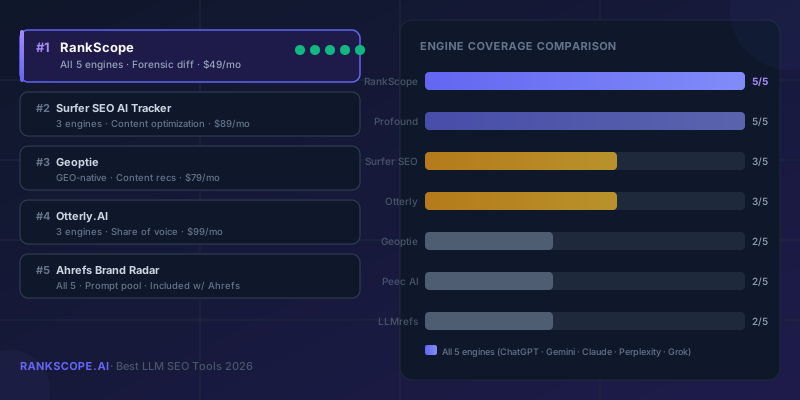
The best AI visibility tools in 2026 are RankScope for teams that need both Google AI surfaces, Peec AI for the cheapest way to start, Profound for enterprise budgets, Geoptie for content teams that want optimization bundled with tracking, and Ahrefs Brand Radar if you already pay for Ahrefs. The ten tools below are compared on engine coverage, pricing, and the job each one is actually built for.
Best AI visibility tool by use case
- RankScope — Best for teams that need both Google AI surfaces. It is the only tool here covering Google AI Overviews and Google AI Mode alongside ChatGPT and Perplexity, with forensic diff detection on every response change. From $49/mo, or $39/mo billed annually.
- Peec AI — Best for the smallest budgets. A permanent free tier covering ChatGPT and Perplexity, which is enough to answer "are we cited at all?" before committing spend.
- Profound — Best for large enterprises. The deepest dataset and the widest engine list, at enterprise pricing and with a sales cycle to match.
- Geoptie — Best for content teams. Pairs citation tracking with per-page rewrite recommendations, so measurement and the fix live in one tool.
- Ahrefs Brand Radar — Best for existing Ahrefs customers. Bundled into plans you already pay for, which makes it close to free at the margin even though coverage is narrower.
- SE Ranking AI Toolkit — Best for teams wanting SEO and AI tracking in one platform rather than two subscriptions.
Looking for tools that optimize content for AI search rather than measure it? See the companion roundup: Best LLM SEO Tools in 2026.
Quick Comparison: AI Visibility Tools at a Glance
| Tool | Engines Covered | Pricing | Free Trial | Best For |
|---|---|---|---|---|
| RankScope | ChatGPT, Google AI Overviews, Perplexity, Google AI Mode | $49–$399/mo | No | Most teams — best coverage + depth |
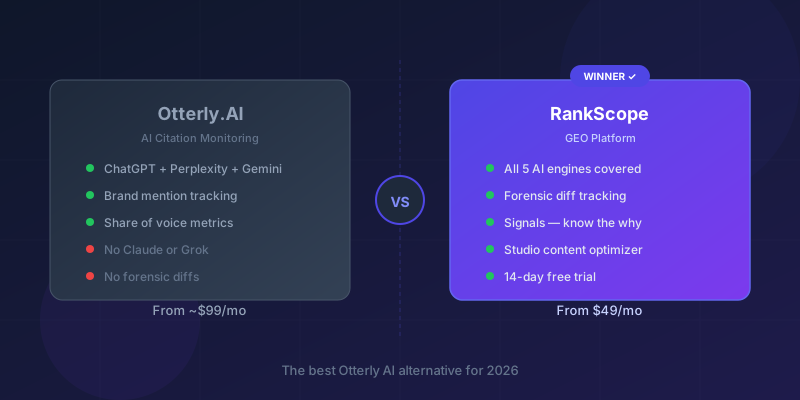
| Otterly.AI | ChatGPT, Perplexity, Gemini | From ~$99/mo | Yes | Mid-market teams, clean UX |
| Rankscale.ai | ChatGPT, Perplexity, Gemini | Custom/Enterprise | Demo required | Share of voice at scale |
| Geoptie | ChatGPT, Perplexity | From ~$79/mo | Yes | Content optimization + tracking combo |
| Profound | ChatGPT, Google AI Overviews, Perplexity, and Google AI Mode | $499/mo+ | No | Large enterprises with big budgets |
| Peec AI | ChatGPT, Perplexity | Free tier; paid from ~$29/mo | Free tier | Budget-conscious small teams |
| Ahrefs Brand Radar | ChatGPT, Perplexity, Gemini | Bundled with Ahrefs plans (~$129/mo+) | 7 days | Existing Ahrefs users |
| SE Ranking AI | ChatGPT, Perplexity | From $65/mo | 14 days | Teams wanting SEO + AI in one tool |
| Writesonic GEO | ChatGPT, Perplexity, Gemini | Bundled with Writesonic | Free tier | Content-heavy teams |
| Evertune | ChatGPT, Gemini, Claude | Custom pricing | Demo required | Brand sentiment tracking in AI |
What to Look for in an AI Visibility Tool
Five criteria separate a good AI visibility tool from a mediocre one:
- Engine coverage: Which AI surfaces the tool actually queries, and whether Google AI Overviews and Google AI Mode are counted separately.
- Tracking frequency: How often prompts are re-run — daily beats weekly, because responses change between snapshots.
- Forensic diff detection: Whether the tool tells you what changed in a response, not merely that your score moved.
- Content recommendations: Whether it connects a citation loss to a specific page and a specific fix.
- Pricing transparency: Whether you can see the price and start, or have to book a sales call first.
Each one, in detail:
Engine coverage
Most tools cover two or three surfaces. Coverage matters because citation patterns differ across engines: a brand that dominates ChatGPT answers can be absent from Google AI Overviews entirely, and optimising against the wrong one wastes the quarter.
The distinction buyers most often miss is that Google runs two separate AI surfaces. AI Overviews are the summaries that appear above organic results; AI Mode is Google's dedicated conversational search experience. They return different answers and cite different sources, so a tool that tracks one is not tracking the other.
RankScope tracks four engines — ChatGPT, Google AI Overviews, Perplexity, and Google AI Mode — covering both Google surfaces. Starter covers two of them (ChatGPT and Google AI Overviews); all four are on Professional and above.
If you're choosing a tool, check coverage first, and check how the vendor counts. "Four engines" means little until you know which four.
Tracking frequency
Weekly snapshots are the minimum. Daily tracking is better. Some tools (including RankScope) track frequently enough to catch rapid response changes — which is critical when you're actively optimizing content and need to know whether changes are having an effect.
Forensic diff detection
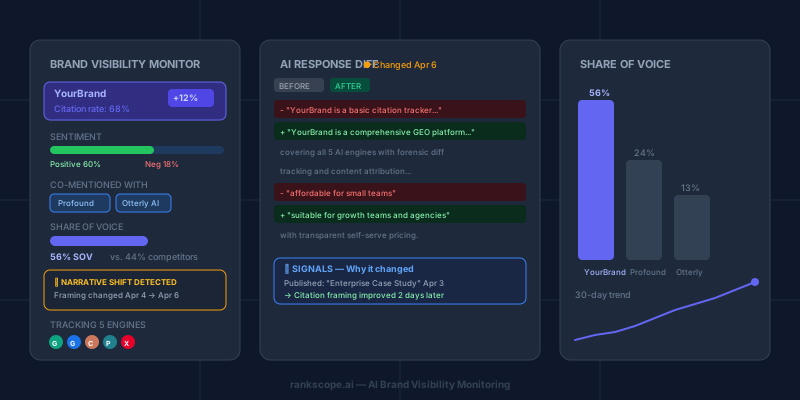
This is the feature that separates serious tools from lightweight monitors. When an AI response changes — a competitor gets added, your brand gets dropped, sentiment shifts — you need to know what changed and when. Diff detection flags these changes automatically instead of requiring manual comparison.
Content recommendations
Some tools stop at measurement. The better ones connect the dots: "your citation rate on Perplexity dropped 12% last month, here's why, here's what to fix." Not all tools offer this, and quality varies. Don't pay a premium for recommendations that amount to generic content advice.
Pricing transparency
A frustrating number of AI visibility tools hide their pricing behind sales calls. For tools in that category, expect to pay more — enterprise software with sales teams costs more to operate than self-serve SaaS. Budget accordingly.
The 10 Best AI Visibility Tools in 2026
1. RankScope
RankScope is the most comprehensive AI visibility platform available at non-enterprise pricing. It tracks all four engines it supports — ChatGPT, Google AI Overviews, Perplexity, and Google AI Mode — and provides forensic diff tracking that shows exactly how AI responses change over time, not just whether they changed.
The Signals feature is worth calling out specifically: it correlates your content changes and publishing activity with shifts in citation rates, giving you an attribution model for GEO work that most teams have never had before.
Key features:
- Full coverage of ChatGPT, Google AI Overviews, Perplexity, and Google AI Mode
- Forensic diff tracking with timestamped response history — see what changed and when
- Signals: correlate your content and SEO activity with AI citation rate changes
Pricing: $49/mo (Starter), $149/mo (Pro), $399/mo (Agency). Annual discount available.
Get started: No setup fee · Cancel anytime.
Pros:
- Broadest engine coverage of any tool in this price range
- Forensic diffs make it possible to do real optimization work, not just monitor
- Signals gives you the "why" behind citation changes
- Pricing is accessible for growth-stage companies
Cons:
- Newer product — some enterprise features (e.g., white-label reporting, SSO) are still in development
- Requires some onboarding time to get the most out of Signals
Best for: Growth teams, SEO agencies, and any company serious about tracking AI visibility across all major platforms without paying enterprise prices.
2. Otterly.AI
Otterly.AI is a solid AI citation monitoring tool with a notably clean interface. It covers ChatGPT, Perplexity, and Gemini, and does a good job presenting citation data in a format non-technical stakeholders can actually read. The dashboard is one of the more polished in the category.
Where Otterly falls short is depth. It lacks the forensic diff tracking that serious optimization work requires, and Grok and Claude coverage isn't available. For teams that mainly need to report on AI visibility to leadership rather than actively optimize for it, that tradeoff is fine.
Key features:
- Clean, presentation-ready dashboard for stakeholder reporting
- AI citation tracking across ChatGPT, Perplexity, and Gemini
- Keyword-level citation monitoring with trend views
Pricing: Around $99/mo for small teams; pricing scales with keyword volume. Check their site for current plans.
Free trial: Yes (limited).
Pros:
- Best-in-class UI — genuinely easy to use
- Good for presenting AI visibility data to non-technical audiences
- Solid keyword tracking and citation trend views
Cons:
- No Claude or Grok coverage
- Less depth in diff tracking and change attribution
- Pricing per keyword can add up for larger keyword sets
Best for: Mid-market marketing teams that prioritize clean reporting and don't need forensic-level analysis. If you're evaluating Otterly for your team, our Otterly AI alternative breakdown covers the full head-to-head comparison.
3. Rankscale.ai
Rankscale.ai is built around share of voice metrics — specifically, how often your brand appears in AI responses relative to competitors across a defined keyword set. The platform is enterprise-leaning: expect a sales process, custom contracts, and pricing that reflects that.
The share of voice focus makes it genuinely useful for competitive intelligence. If you need to answer "how does our AI visibility compare to [competitor] across these 200 queries?" — Rankscale handles that well. If you're evaluating options, see our full Rankscale alternative breakdown for a side-by-side comparison of what RankScope, Otterly, Profound, and others offer.
Key features:
- Share of voice tracking across AI engines (ChatGPT, Perplexity, Gemini)
- Competitive benchmarking and side-by-side brand comparisons
- Enterprise reporting and API access
Pricing: Custom; demo required. Enterprise-tier pricing.
Free trial: Demo-only.
Pros:
- Best competitive share of voice analysis in the category
- Good API access for teams that want to pull data into custom dashboards
- Enterprise-grade support
Cons:
- No self-serve pricing — requires a sales conversation
- Overkill (and overpriced) for most growth teams
- Narrower engine coverage than RankScope
Best for: Enterprise teams doing competitive AI visibility benchmarking at scale.
4. Geoptie
Geoptie combines GEO content optimization with AI visibility tracking — the pitch is that you can both measure and improve AI visibility from one platform. It covers ChatGPT and Perplexity primarily. If you're specifically looking for a GEO tool rather than a broader AI visibility platform, Geoptie is one of the stronger options in that narrower category.
The content optimization side is more developed than most competitors. Geoptie gives specific recommendations for how to restructure content to improve AI citation rates, with templates and scoring that help content teams act on the data. If you need more engine coverage, forensic diff tracking, or uncapped prompt monitoring, see our full Geoptie alternative guide for a side-by-side breakdown.
Key features:
- GEO content scoring and optimization recommendations
- AI citation tracking across ChatGPT and Perplexity
- Content templates optimized for AI citation
Pricing: Around $79/mo for entry-level plans.
Free trial: Yes.
Pros:
- Best-in-class content optimization guidance for GEO
- Useful for content teams that need actionable recommendations, not just monitoring
- More affordable than enterprise alternatives
Cons:
- Engine coverage is narrower (primarily ChatGPT and Perplexity)
- Tracking depth is less sophisticated than RankScope or Profound
- Smaller product team means slower feature development
Best for: Content-heavy teams that want a unified tool for GEO optimization and basic tracking.
5. Profound
Profound is the enterprise-grade option in this category. $499/mo+ gets you deep data, broad AI engine coverage, and the kind of reporting infrastructure that justifies enterprise software contracts. It covers ChatGPT, Google AI Overviews, Perplexity, and Google AI Mode.
The data quality is genuinely impressive — Profound runs high query volumes and surfaces patterns that lower-tier tools miss. For a Fortune 500 brand where missing an AI response shift can cost millions, the price is defensible. For most companies, it's not.
Key features:
- High-volume query tracking across ChatGPT, Google AI Overviews, Perplexity, and Google AI Mode
- Advanced sentiment and context analysis in AI responses
- Enterprise reporting, SSO, and team management
Pricing: $499/mo minimum; most enterprise contracts are significantly higher.
Free trial: No — requires a sales demo.
If you're evaluating Profound but can't justify the price, see our full Profound AI alternative guide — we compare all 6 best alternatives with honest pricing and feature breakdowns.
Pros:
- Among the deepest data in the category
- Strong on sentiment analysis and contextual citation tracking
- Enterprise-grade infrastructure and support
Cons:
- Pricing puts it out of reach for most companies
- No self-serve option — sales process required
- Overkill for teams that don't have high query volumes to justify the cost
Best for: Large enterprise brands with significant budget and a dedicated GEO/SEO team.
6. Peec AI
Peec AI is the most accessible entry point in the AI visibility tools category. It has a free tier — genuinely free, not just a trial — and paid plans starting around $29/mo. Coverage focuses on ChatGPT and Perplexity.
The trade-off for affordability is depth. Peec AI does citation tracking reasonably well, but lacks the diff tracking, competitive analysis, and multi-engine coverage of pricier tools. For a small team with a handful of keywords and a tight budget, it's a legitimate option.
Key features:
- Free tier with basic citation tracking
- Citation monitoring for ChatGPT and Perplexity
- Keyword-level AI mention alerts
Pricing: Free tier available; paid plans from approximately $29/mo.
Free trial: Free tier (permanent, limited).
Pros:
- Most affordable option in the category — free tier is genuinely usable
- Simple setup, low learning curve
- Good for small teams getting started with AI visibility
Cons:
- Limited engine coverage (ChatGPT and Perplexity only)
- No forensic diff tracking
- Reporting is basic; not suitable for client-facing or executive presentations
Best for: Small teams, solopreneurs, and anyone testing the waters with AI visibility before committing budget.
7. Ahrefs Brand Radar
Ahrefs added AI visibility tracking as part of their broader platform. If you're already paying for Ahrefs (plans start around $129/mo), Brand Radar gives you AI citation monitoring across ChatGPT, Perplexity, and Gemini without adding a separate tool.
The integration is genuinely useful — seeing AI citation data alongside your traditional backlink and keyword data in one place has real value. The downside is that AI visibility isn't Ahrefs' core focus, and it shows in feature depth.
Key features:
- AI citation tracking integrated with Ahrefs' existing SEO data
- Coverage of ChatGPT, Perplexity, and Gemini
- Brand mention alerts across AI and web
Pricing: Bundled with Ahrefs plans (~$129/mo for Lite, $249/mo for Standard). No standalone pricing.
Free trial: 7-day trial on Ahrefs plans.
Pros:
- No extra cost if you're already using Ahrefs
- Useful to have AI visibility and traditional SEO data in one platform
- Good brand mention tracking overall
Cons:
- AI visibility is clearly a secondary feature — depth is limited
- No Claude or Grok coverage
- Can't purchase as a standalone product
Best for: Teams already using Ahrefs who want basic AI visibility without adding another tool. For a full breakdown of what Brand Radar does and doesn't cover, see the best Ahrefs alternative for AI brand visibility.
8. SE Ranking AI Toolkit
SE Ranking is a full-service SEO platform that added an AI visibility module. Like the Ahrefs option, the value proposition is consolidation: one platform for traditional SEO rank tracking plus AI visibility monitoring.
The AI tracking covers ChatGPT and Perplexity. It's solid for what it does — keyword-level citation tracking with trend data — but it's not where SE Ranking's core investment goes. The AI module works; it won't replace a dedicated AI visibility tool for teams that prioritize GEO.
Key features:
- AI citation tracking (ChatGPT, Perplexity) alongside traditional SEO tools
- Keyword rank tracking, backlink monitoring, and AI visibility in one platform
- White-label reports for agencies
Pricing: Plans from approximately $65/mo for the base platform; AI features included on mid-tier and above.
Free trial: 14 days.
Pros:
- Strong value if you're paying for SEO tools anyway
- White-label reporting is useful for agencies
- Good traditional SEO tools alongside the AI features
Cons:
- AI visibility module is thinner than dedicated tools
- No Claude, Grok, or Gemini coverage
- Not ideal for teams where AI visibility is the primary focus
Best for: Agencies and growth teams that want traditional SEO plus basic AI visibility in one budget line. For teams outgrowing SE Ranking's AI module, see the best SE Ranking alternatives for AI visibility. If you're specifically a Semrush user wondering whether it covers AI visibility, the short answer is no — see Best Semrush Alternative for AI Search Visibility for what to add.
9. Writesonic GEO
Writesonic is primarily a content creation platform, and GEO is its attempt to extend that into optimization and tracking. The angle is create-and-measure: write content optimized for AI citation, then track whether it's working.
For pure AI visibility monitoring, Writesonic GEO isn't the right tool — the tracking capabilities are secondary to content generation. But if your bottleneck is producing GEO-optimized content at scale, the bundled approach has real efficiency benefits.
Key features:
- GEO-optimized content generation with built-in tracking
- Citation tracking across ChatGPT, Perplexity, and Gemini
- Content scoring for AI citation potential
Pricing: Bundled with Writesonic plans; check their current pricing as it changes frequently. Free tier available.
Free trial: Free tier available.
Pros:
- Tight integration between content creation and GEO tracking
- Useful for teams producing high volumes of AI-optimized content
- Writesonic's content tools are genuinely good
Cons:
- AI visibility tracking is a secondary feature; dedicated tools do it better
- Less useful if you're not also using Writesonic for content creation
- Tracking depth is limited compared to purpose-built tools
Best for: Content teams that use Writesonic for writing and want basic GEO tracking bundled in.
10. Evertune
Evertune focuses on AI brand monitoring with a particular emphasis on sentiment — not just whether your brand appears in AI responses, but how it's characterized. It covers ChatGPT, Gemini, and Claude.
If sentiment and brand perception in AI answers are your primary concern — "is ChatGPT saying positive or negative things about our company?" — Evertune has the most developed toolset for that specific question. For pure citation tracking and optimization work, other tools are stronger. If brand characterization and narrative control across AI engines is your specific goal, see our deeper guide to AI brand visibility tools.
Key features:
- Sentiment analysis for AI brand mentions (positive, negative, neutral)
- Coverage of ChatGPT, Gemini, and Claude
- Brand reputation monitoring in AI-generated content
Pricing: Custom pricing; demo required.
Free trial: Demo-only.
Pros:
- Best sentiment tracking of any tool in this category
- Useful for brands where reputation management in AI is a priority
- Good at detecting narrative shifts in how AI characterizes your brand
Cons:
- No self-serve option; requires a sales process
- Not optimized for citation rate tracking or GEO optimization work
- Grok and Perplexity coverage is limited
Best for: Brands focused on AI reputation management and sentiment monitoring — PR teams, consumer brands, public companies.
Looking for full-stack AI brand monitoring? The category now splits into two layers: AI citation trackers (this list) and traditional social/web listening tools (Brand24, Brandwatch, Sprout Social). Most brands need both. See our complete guide to AI brand monitoring tools for a side-by-side comparison of both categories.
How to Choose the Right AI Visibility Tool for Your Situation
You're a startup or early-stage company
Start with Peec AI (free) or RankScope. Verify that AI visibility tracking actually matters for your specific keywords before committing budget. Once you're confident it does, RankScope's $49/mo Starter, or $39/mo billed annually, plan is the best value available. Read how to get cited by ChatGPT to understand what you're optimizing for.
You're a growth-stage company with a dedicated marketing team
RankScope is the clear choice. It covers the 4 engines that matter (ChatGPT, Google AI Overviews, Perplexity, and Google AI Mode), gives you forensic diffs to actually optimize, and costs a fraction of enterprise alternatives. The Pro plan ($149/mo) handles most teams' needs. See RankScope's pricing for the full plan comparison.
If you're already deep in the Ahrefs or SE Ranking ecosystems and AI visibility is a secondary concern, using those tools' built-in features is reasonable — just know you're getting a lighter implementation. And if HubSpot is your primary marketing platform, see the dedicated HubSpot alternative for AI search visibility guide — the same gap exists there, and the two-tool setup is straightforward.
You're running an agency managing multiple clients
RankScope at the Agency tier ($399/mo) or SE Ranking if you need white-label reports and already use them for traditional SEO. The multi-client management features matter here; single-tenant tools designed for one brand become expensive and unwieldy at agency scale. RankScope for agencies covers the multi-client workspace and white-label capabilities in detail. For a full breakdown of how agencies package and price GEO as a managed service — including query library setup, reporting cadence, and optimization workflows — see the GEO for agencies guide.
You're at an enterprise with significant budget
Profound if you need maximum data depth. Rankscale.ai if competitive share of voice benchmarking is the priority. Evertune if brand sentiment in AI is a board-level concern. For most enterprise teams that need a balance of depth and reasonable pricing, RankScope's Pro plan still holds up well.
FAQ
What is AI visibility?
AI visibility is the measure of how often and how prominently your brand, product, or content appears in AI-generated answers across platforms like ChatGPT, Google AI Overviews, Perplexity, and Google AI Mode. Unlike traditional search rankings — where you can check your position for a keyword — AI visibility is tracked through citation rate (how often you're mentioned), share of voice (your citations as a percentage of all citations in your category), and sentiment (how you're characterized when you are mentioned). This is why AI rank tracking works so differently from traditional rank tracking — there are no position numbers, only citation presence and competitive share.
For most businesses, AI visibility matters most for high-intent informational queries: "what's the best [product category]?", "how do I [solve a problem]?", "which [tool type] is right for [use case]?" These are the queries where AI search is capturing meaningful traffic that would previously have hit Google. For SaaS companies in particular, these category queries are the highest-intent moment in the buyer funnel — see our guide to GEO for SaaS companies for the specific playbook. For ecommerce brands tracking product citations in AI shopping answers, the GEO for ecommerce guide covers the specific signals and tracking setup for product-centric businesses.
What is the best free AI visibility tool?
RankScope is the best starting point — no setup fee, cancel anytime, covers ChatGPT, Google AI Overviews, Perplexity, and Google AI Mode. Peec AI has a permanent free tier if you need something ongoing without budget, though it's limited to ChatGPT and Perplexity. Writesonic GEO also has a free tier bundled into the Writesonic free plan.
For serious AI visibility monitoring, no purely free tool gives you the query volume and diff tracking needed to optimize effectively. Budget at least $49/mo if AI visibility is a real priority.
How do AI visibility tools work?
AI visibility tools send automated queries to AI search engines and parse the responses. They look for brand mentions, citation links, and contextual framing — then aggregate that data into metrics like citation rate and share of voice.
More sophisticated tools go further. RankScope's forensic diff tracking, for example, stores the full text of AI responses and flags when they change, showing you exactly what was added, removed, or reworded. This matters for optimization: if you publish a new piece of content and your Perplexity citation rate rises 20% over the following two weeks, you want to know that.
The underlying technology varies — some tools query AI engines directly via API, others via web scraping, others via purpose-built integrations. API-based tools tend to produce more consistent results but may miss the web-retrieval augmentation that shapes many real user queries. RankScope uses real browser responses rather than API calls, which means the data reflects what your actual users see — you can see how it works for the full technical breakdown.
Is AI visibility the same as SEO?
No — they're related but distinct disciplines. Traditional SEO optimizes for position in search engine results pages. AI visibility optimizes for citations in AI-generated answers.
The ranking signals differ: SEO prioritizes backlinks, domain authority, and on-page optimization for query matching. AI visibility prioritizes content structure (direct answers, clear entities), factual density (specific data that LLMs can cite), and topical authority signals that training data and RAG retrieval reward.
The measurement differs too: SEO gives you rank positions and click-through data. AI visibility gives you citation rates, share of voice, and response sentiment.
That said, they're not zero-sum. Strong SEO — high-authority, well-structured content — tends to support AI visibility. The content that ranks well on Google often gets cited by AI. The difference is that AI visibility requires additional optimization work: structuring content for direct answers, building entity associations, and monitoring citation patterns that Google Analytics will never show you.
For a deeper breakdown, see our guide on GEO vs SEO vs AEO.
Bottom Line
AI search is now a meaningful traffic channel — and unlike traditional search, it's winner-take-few. When ChatGPT recommends a tool, it usually names two or three options. The brands that get named are the ones that invested in visibility. The rest don't exist in that answer.
The tools in this list all solve a real problem. The right choice depends on your budget, engine coverage needs, and whether you're primarily monitoring or actively optimizing:
- Best overall: RankScope (widest coverage, most actionable, accessible pricing)
- Best for budget: Peec AI (free tier) or RankScope Starter ($49/mo)
- Best for content teams: Geoptie or Writesonic GEO
- Best for enterprise: Profound or Rankscale.ai
- Best for sentiment: Evertune
If you're not sure where to start, RankScope has no setup fee and you can cancel anytime — covers the 4 engines that matter (ChatGPT, Google AI Overviews, Perplexity, Google AI Mode). Run it for two weeks against your target keywords, see where you stand, and you'll have real data to justify the next step. To see where you stand before spending anything, the free AI visibility checker needs no account.