AI Rank Tracker: How to Track Your Brand's Position in AI Search
If you've searched for "AI rank tracker" expecting something like Semrush's position tracking — a clean list showing your site at position 4 for some keyword — you're going to hit a wall. That tool doesn't exist, because that metric doesn't exist in AI search. (Traditional SEO tools like Ahrefs and Semrush don't fill this gap either — their AI features track keyword-level signals, not brand citations. For a full comparison, see the best Ahrefs alternative for AI brand visibility.)
AI engines don't return ranked lists. They write paragraphs. They name a few brands, maybe link to a couple of sources, and move on. You're either in the answer or you're not. And "being in the answer" means something completely different from "ranking on page one." This measurement challenge — what we call AI search visibility — is a distinct discipline with its own metrics and methodology.
This is what AI rank tracking actually measures, how it works, and how to build a system that gives you real data — not just a screenshot of one ChatGPT response.
Why "AI Rank Tracker" Means Something Different
Traditional rank tracking works because search engines return consistent, ordered results. You query Google for "project management software," it returns ten results in a specific order, and a rank tracker records your position. You do this daily and watch the number go up or down.
AI search doesn't work that way. When someone asks ChatGPT or Perplexity "what's the best project management software for remote teams?" the response is a synthesized narrative. It might mention Asana, Notion, and Linear. Run the same query again five minutes later and you might get ClickUp and Monday.com instead. Run it from a different session and the entire framing could shift.
There's no position 4. There's no ranked list. There is only: cited, or not cited.
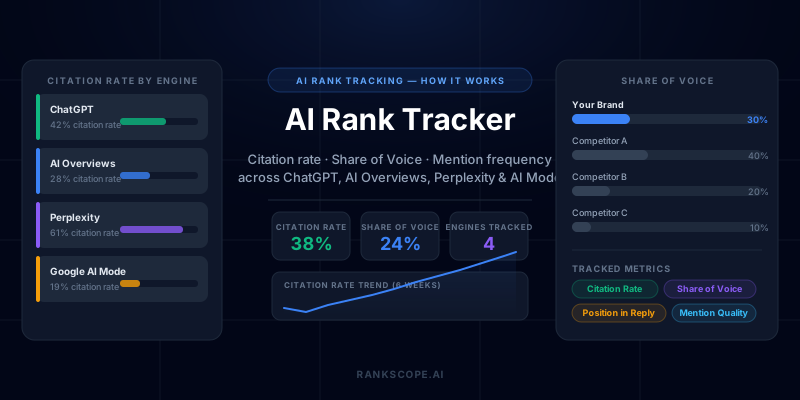
So "AI rank tracking" really means tracking these three things:
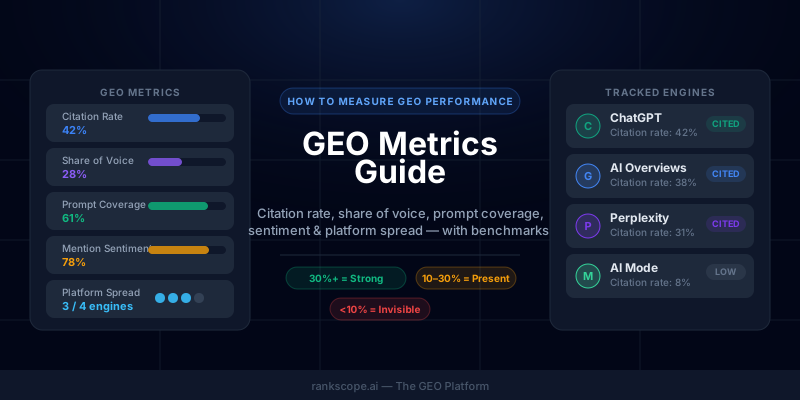
- Citation rate — In what percentage of query runs does your brand get mentioned?
- Share of Voice — Of all the brands being cited across your target queries, what fraction is yours?
- Mention quality — When you are cited, is it prominently, as a strong recommendation, or buried as an afterthought?
This is a fundamentally different discipline from traditional rank tracking. For a deeper look at why GEO metrics diverge so sharply from SEO metrics, the differences go well beyond just swapping position numbers for citation rates.
What Each AI Engine Actually Tracks
Not all AI platforms handle citations the same way. If you're going to do AI rank tracking properly, you need to understand what you're measuring per engine.
ChatGPT
ChatGPT's default mode (without web browsing) draws from its training data — a snapshot of the web that cuts off at a specific date. What it knows about your brand was baked in during training. If you launched recently or rebranded, the base model may not know you exist. The browsing-enabled version of ChatGPT does real-time retrieval, which means fresh content you've published can surface in answers.
ChatGPT citations tend to be reputation-based. Brands with strong web presence, third-party coverage, and consistent entity signals across the web get cited more reliably. This is also why getting your brand cited by ChatGPT requires a different content approach than traditional SEO — you're optimizing for model training and RAG retrieval simultaneously.
What to measure: Citation rate across non-branded prompts (category queries, comparison queries). Track both browsing-enabled and standard mode if you're measuring closely.
Google AI Overviews
Google AI Overviews pulls heavily from Google-indexed content. If Google ranks your content highly for a given topic, you're more likely to appear in the AI Overview for related queries. There's meaningful overlap with traditional SEO here — domain authority and content quality both matter — but the format is completely different.
AI Overviews are triggered on a subset of queries (not all searches), they're somewhat unstable (they appear, disappear, and change based on Google's confidence in the synthesized answer), and they heavily favour sources that answer the query directly and concisely. Long pages that bury the answer don't do as well as pages where the answer is right at the top of the section.
What to measure: Citation presence per query (binary: did your domain appear as a source?), position within the Overview panel (cited first vs cited last), and query coverage (on what % of your target queries does an Overview appear at all).
Perplexity
Perplexity does live web search on every query — it's essentially a search-augmented language model. Every answer is grounded in real-time web results. This makes it the most transparent of the four engines: sources are displayed explicitly, and you can see exactly why a brand was cited.
Perplexity citation is heavily influenced by your organic search presence. If your content ranks in the top results for a query, Perplexity is likely to pull from it. It also has strong bias toward recently published, factually dense content — Perplexity tends to favour fresh sources over old evergreen pages for timely topics.
What to measure: Source citation rate (how often your domain is pulled as a source), citation position (source 1 vs source 4), and Share of Voice vs competitors across your category queries.
Google AI Mode
Google AI Mode is a conversational search interface distinct from AI Overviews — it's a full-panel conversational experience launched in 2025. It blends traditional organic results with AI-generated summaries and allows follow-up questions within a single session.
AI Mode citation patterns are still stabilising. Early data shows it behaves somewhat like a hybrid: strong organic presence helps, but structured, directly answerable content performs best. Multi-turn query patterns matter here more than on other platforms — brands that are consistently cited across a conversation thread build stronger signals.
What to measure: Citation frequency across multi-turn query sequences, presence in the AI-generated summary panel, and source attribution.
The Three Core AI Tracking Metrics
Citation Rate
Citation rate is the foundational metric. It's the percentage of query runs where your brand is mentioned in the AI response.
How to calculate it:
Run your target prompt 30–50 times across a defined engine. Count the number of runs where your brand name appears anywhere in the response. Divide by total runs.
Citation Rate = (Runs with brand mention ÷ Total runs) × 100
If you run a prompt 40 times on Perplexity and your brand appears in 12 of those responses, your citation rate is 30%.
Why 30–50 runs? Because AI responses vary. Temperature — the controlled randomness in how language models generate text — means the same prompt produces different outputs. A single response is essentially useless as data. At 30+ runs, citation rate stabilizes and you get a reliable signal.
Benchmarks (from RankScope data):
- Below 10%: Effectively invisible for this query
- 10–30%: Present but inconsistent — you appear sometimes, but competitors are being cited more
- 30–50%: Good visibility — you're a regular feature of AI answers for this topic
- Above 50%: Strong citation presence — you're the default answer for this query on this engine
Share of Voice
Citation rate tells you your visibility in absolute terms. Share of Voice tells you your position relative to competitors.
How to calculate it:
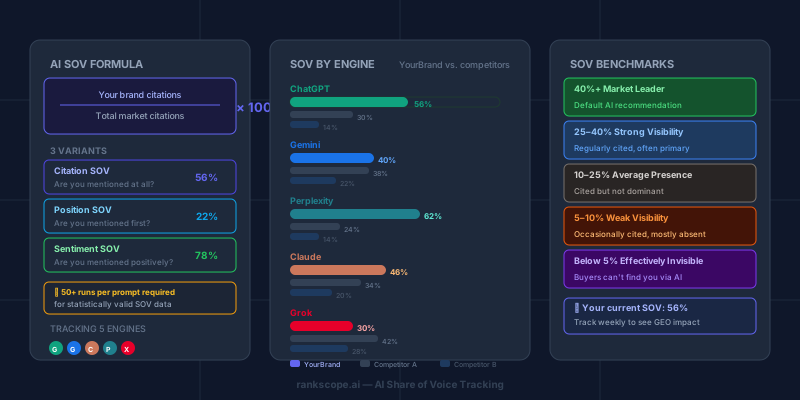
Across a defined set of prompts and runs, count the total number of brand citations (yours plus all competitors). Your Share of Voice is your citations divided by the total.
Share of Voice = (Your citations ÷ Total brand citations) × 100
If you run 50 prompts and your brand is cited 40 times, while three competitors are collectively cited 160 times, your Share of Voice is 20%.
Share of Voice is the competitive metric. A citation rate of 25% sounds decent until you see that your top competitor has a citation rate of 60% across the same queries. Share of Voice surfaces that gap immediately.
For a detailed breakdown of how to calculate and interpret Share of Voice across AI search specifically, including how it differs from the traditional marketing definition, see our complete guide to Share of Voice in AI search. And if you're newer to the concept, our share of voice in marketing guide covers how SOV works across all four channels — paid, organic, social, and AI.
Position in Response
Where you're mentioned in an AI-generated answer matters. Being cited in the first sentence of a response carries more weight — in terms of user attention and signal strength — than being listed fifth in a paragraph of alternatives.
Position tracking in AI search is less precise than traditional rank tracking, but you can categorize mentions as:
- Primary recommendation — Named first, or as the primary suggestion before others
- Mid-response mention — Named as an alternative or comparison, not the headline
- Trailing mention — Mentioned briefly at the end, often as a "also consider" note
Tracking position alongside citation rate gives you a more complete picture. A 40% citation rate where you're consistently mentioned as the primary recommendation is worth more than 40% where you're the backup option.
How to Build a Manual AI Rank Tracking System
If you're starting out with a small number of prompts, manual tracking is feasible. Here's the setup:
Step 1: Build your prompt library
Your prompts should mirror how real buyers and researchers ask about your category. Avoid branded prompts ("what does [your brand] do?") — these artificially inflate citation rate. Focus on:
- Category queries: "best [category] tools"
- Problem queries: "how do I [solve the problem your product solves]?"
- Comparison queries: "[Competitor A] vs [Competitor B] — which is better?"
- Use case queries: "[job title] looking for [specific solution]"
Aim for 15–30 prompts that cover your core use cases. For guidance on building a prompt library that generates useful tracking data, the how to track brand mentions in AI search guide walks through the methodology step by step.
Step 2: Run each prompt 30+ times per engine
Open a new incognito/private session for each run to avoid context contamination. Record: was your brand mentioned? (Y/N), what competitors were mentioned, and where in the response your brand appeared if mentioned.
Step 3: Calculate metrics per engine
For each prompt × engine combination, calculate citation rate. Then roll up to Share of Voice across your full prompt set. Do this weekly or bi-weekly to track trends.
Step 4: Log and compare
Keep a simple spreadsheet. Prompt → Engine → Date → Citation Rate → Competitors cited. After 4–6 weeks you'll have baseline data and can start measuring whether content changes are moving the numbers.
The limitation of manual tracking is obvious: 30 prompts × 4 engines × 30 runs = 3,600 individual query runs to get one reliable snapshot. That's not feasible manually. Manual works for initial exploration; automation is necessary for ongoing tracking at any meaningful scale.
When to Move to Automated AI Rank Tracking
The breakeven is roughly 10–15 prompts. Below that threshold, manual tracking is manageable. Above it, the time cost of running, logging, and analyzing thousands of responses manually exceeds the cost of a tool.
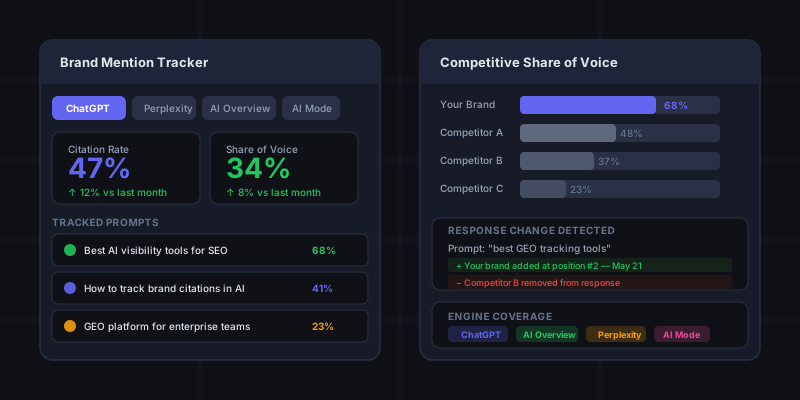
Automated AI rank tracking platforms handle the query execution, response recording, and metric calculation automatically. They run your prompt library across all four engines on a defined schedule, calculate citation rate and Share of Voice, and alert you when something changes.
The difference that matters most between automated tools isn't the volume of prompts they can handle — it's whether they give you forensic-level data on what changed. Citation rate going from 30% to 15% is a data point. Seeing the exact response text that dropped you, and identifying which competitor replaced you, is actionable intelligence.
RankScope tracks citation rate, Share of Voice, and response-level diffs across ChatGPT, Perplexity, and both of Google's AI surfaces, AI Overviews and AI Mode. When your citation rate drops, you can see the specific response that changed and exactly what's being cited instead. For brands tracking 30+ prompts across multiple engines, that forensic layer is what turns monitoring into optimization.
If you want to compare the full landscape of tools available for AI search tracking, our guide to the best AI visibility tools in 2026 covers all the major platforms with real pricing and honest pros and cons.
Interpreting AI Tracking Data: What Movement Actually Means
Tracking numbers are only useful if you know what to do with them. Here's how to read common patterns.
Citation rate drops sharply on one engine
Most likely cause: the AI engine updated its retrieval or training data, and a competitor's content outcompeted yours for that query set. Check what's now being cited instead — look at the actual response text, not just the metric.
Action: Update the relevant content page to be more directly answerable, more factually dense, and more clearly structured. Check whether your competitor published new content or earned new coverage that increased their authority.
Citation rate is strong on Perplexity, weak on ChatGPT
Common pattern for brands with good organic SEO but lower brand awareness. Perplexity is pulling from your indexed content. ChatGPT's base model doesn't have strong training data signals for your brand yet.
Action: Focus on building brand entity signals — PR coverage, third-party mentions, inclusion in industry roundups and comparisons. These signals feed training data over time. For the Perplexity side, maintain your content quality; you're doing something right.
High citation rate, low Share of Voice
You're appearing, but so is everyone else. This means a lot of brands are getting cited across your target queries — either because the queries are broad (AI names many tools for broad category searches) or because you're in a competitive category where AI engines reference multiple options.
Action: Identify which queries have the highest concentration of mentions and try to dominate those specifically. Narrow, specific queries often have lower competition than broad category queries.
Citation rate steady but position declining
You're still being mentioned, but further into the response, less prominently. Often happens when a newer, stronger piece of content from a competitor starts getting cited as the lead recommendation.
Action: Review which competitor is taking the primary position and audit the content they published. Structure and factual density usually explain primary positioning.
The Tracking Feedback Loop
AI rank tracking isn't a passive exercise — it's the input to an optimization cycle.
The loop looks like this:
- Baseline — Run your prompt library across all engines, establish citation rates and Share of Voice
- Gap analysis — Which queries have low citation rate? Which engines are you underperforming on?
- Content audit — For underperforming queries, identify which page should be ranking. Is it structured for AI extraction? Is the answer near the top of the section?
- Update — Improve the page: better answer structure, more factual density, cleaner headings
- Wait — AI engines take 2–4 weeks to re-index updated content and recalibrate citations
- Measure — Run the same prompts again. Did citation rate move?
This loop is the core of GEO (Generative Engine Optimization). Tracking without optimization is just data collection. Optimization without tracking is guesswork. The combination is what actually moves citation rate over time.
Setting Up AI Rank Tracking in RankScope
For teams that want to move past manual tracking, RankScope's platform is built specifically for this workflow.
Setup takes about 15 minutes:
- Add your brand and define your category
- Add competitors (up to 3 on Starter, 10 on Pro, unlimited on Agency)
- Configure your prompt library — either import from a list or use RankScope's suggested prompts based on your category
- Select engines — Starter covers ChatGPT + AI Overviews, Pro covers all four
- Run your first scan — results come back within a few hours
After your first scan, you'll see citation rate per prompt per engine, Share of Voice vs each competitor, and the raw response text for every run. Subsequent scans show movement from the previous run, with highlighted diffs showing exactly what changed.
Pricing starts at $49/month — no setup fee, cancel anytime.
Common AI Rank Tracking Mistakes
Tracking only one engine
ChatGPT citation rate and Perplexity citation rate for the same query can differ by 40+ percentage points. A brand that dominates ChatGPT responses can be entirely absent from Google AI Overviews. Single-engine tracking gives you an incomplete and potentially misleading picture.
Using branded prompts
"What is [your brand]?" will return a mention of your brand almost 100% of the time — it's a trivially low bar. The queries that matter are the ones buyers use when they don't already know who you are: category queries, comparison queries, problem-solution queries.
Measuring too infrequently to detect trends
Monthly tracking misses the signal. AI engines update their retrieval patterns, content gets indexed and de-indexed, competitors publish new pages — all of these can move your citation rate within days. Weekly tracking at minimum, daily if you're in a volatile category.
Treating a single snapshot as a baseline
One round of 30 runs is a starting point. Your baseline should be an average across at least 2–3 separate measurement sessions, ideally spread over a week, to account for the variation in AI responses.
Confusing presence with performance
Being cited is not the same as being cited well. Track position in response and sentiment alongside citation rate. A brand that's consistently mentioned as "an expensive option some enterprises use" is technically being cited — but that's a different signal than being cited as the leading recommendation.
Frequently Asked Questions
What is an AI rank tracker?
An AI rank tracker monitors how often your brand is cited in AI-generated answers across platforms like ChatGPT, Google AI Overviews, Perplexity, and Google AI Mode. Unlike traditional rank trackers that return a position number (1–10), AI rank trackers measure citation rate, Share of Voice, and position within the response text.
How is AI rank tracking different from traditional rank tracking?
Traditional rank tracking tells you which position your URL appears at in a list of search results. AI rank tracking tells you whether your brand is mentioned at all inside an AI-generated narrative answer — and how prominent that mention is. There are no numbered positions in AI answers, so the metrics are completely different: citation rate, Share of Voice, mention sentiment, and position-in-response.
How many times do you need to run a prompt to get reliable AI tracking data?
At minimum 30 runs per prompt per engine to get a statistically meaningful citation rate. AI engines vary their responses due to temperature (controlled randomness), context windows, and real-time retrieval differences. A single run can show your brand; the next run might not. Citation rate across 30–50 runs gives you a reliable baseline.
Which AI engines should I track my brand across?
The four AI engines that account for the vast majority of AI-assisted brand discovery in 2026 are ChatGPT, Google AI Overviews, Perplexity, and Google AI Mode. Each has different citation patterns and a different user intent profile — tracking all four gives you a complete picture.
What is Share of Voice in AI search?
Share of Voice (SoV) in AI search is your brand's citations as a percentage of all brand citations across a given set of prompts. If your brand is cited 20 times and competitors are cited 80 times across the same 100 prompt runs, your Share of Voice is 20%. It tells you your competitive position in AI-generated answers, not just whether you appear.
Bottom Line
AI rank tracking is one of those things that sounds simple ("just check if you show up in ChatGPT") and gets complicated fast the moment you try to do it rigorously. Response variability, multi-engine differences, citation quality vs citation presence — there's a lot more to it than a screenshot.
The basics are: build a real prompt library, run enough times to get statistically meaningful data, track Share of Voice not just absolute citation rate, and do it across all four major engines. That setup gives you an actual measurement system instead of a vibe check.
If you want the automated version — prompt library running on a schedule, citation rates calculated automatically, diffs showing what changed week over week — RankScope is built for exactly this. Pricing starts at $49/month with no setup fee.
And if you're earlier in the process — still figuring out what GEO is and whether this applies to your business — our complete guide to generative engine optimization is a good place to start before worrying about tracking.