Share of Voice in Marketing: The Complete Guide (Including AI Search)
Share of voice has been a marketing metric for decades. The idea is simple: in any competitive category, the total conversation has a finite size. Your brand owns some percentage of it. Your competitors split the rest. The higher your share, the more buyers encounter you at the moments that shape decisions.
The complication is that "the total conversation" now happens across four very different channels — paid search, organic search, social media, and AI-generated answers. Each needs to be measured differently, and most brands are only tracking one or two of them.
This guide covers how SOV works across all four channels, how to calculate each one, and how AI share of voice is changing the measurement in ways that make the old playbook incomplete.
What Is Share of Voice?
Share of voice (SOV) measures your brand's presence in a market relative to competitors. The core formula hasn't changed since advertisers first started using it in the 1980s:
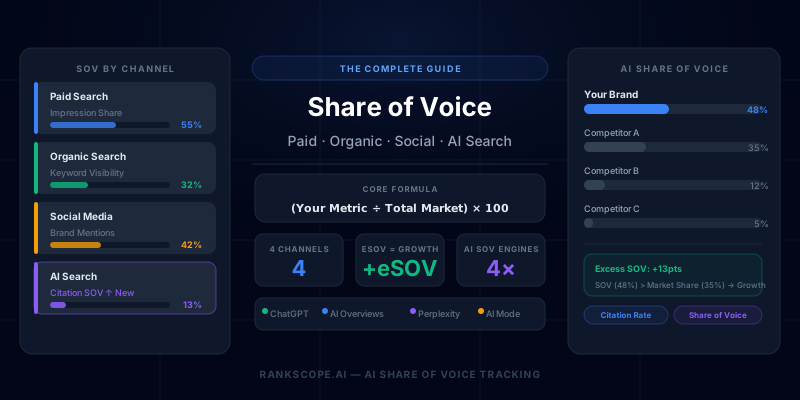
Share of Voice = (Your Brand Metric ÷ Total Market Metric) × 100
What changes is the metric you plug in:
- Paid SOV: your ad impressions ÷ total available impressions for your target keywords
- Organic SOV: your estimated search traffic ÷ total category search traffic
- Social SOV: your brand mentions ÷ total category mentions
- AI SOV: your citations in AI responses ÷ total citations across all tracked brands
The formula is always the same ratio. The channel determines what you're measuring.
Why Share of Voice Matters
There's a well-documented relationship between SOV and market share. Research from the IPA (Institute of Practitioners in Advertising) found that brands with SOV greater than their market share tend to grow, while brands with SOV below their market share tend to lose ground.
The gap between your SOV and your market share is called excess share of voice (eSOV). If your brand holds 15% market share but 22% SOV, you have +7 eSOV — historically a growth indicator. If your brand holds 15% market share but 9% SOV, you have -6 eSOV — a warning sign worth taking seriously.
eSOV is the most actionable version of the metric because it directly connects media investment to expected outcomes. You're not tracking SOV to feel good about big numbers — you're tracking it to know whether your spending is above or below the threshold needed to hold or grow your position.
Paid Search Share of Voice
Paid SOV is the oldest and most precisely measurable form. Every ad auction produces impression data, and Google Ads surfaces this as Impression Share — your impressions divided by the estimated total impressions available for your target keywords.
Formula: Impression Share = Your Impressions ÷ Total Available Impressions × 100
Google also reports Lost IS (Budget) and Lost IS (Rank) — the percentage of impressions you lost because of budget constraints vs ad rank. These are directionally useful: if you're losing 40% of impressions to budget, you know where the ceiling is.
A few things to note about paid SOV:
- It's bid-dependent. Your paid SOV fluctuates daily based on competition, bid changes, and budget pacing. A snapshot is a snapshot — trends matter more than single readings.
- It's only as broad as your keyword list. If competitors are buying keywords you haven't added to your campaigns, your denominator is wrong and your SOV looks artificially high.
- Impression Share ≠ clicks. A competitor running ads with terrible copy can have 40% impression share with a 1% CTR. Volume of exposure and quality of exposure are different things.
For most SaaS and B2B companies, paid SOV is tracked in Google Ads natively. The limitation is that it only covers your active campaigns — it doesn't tell you anything about organic or social.
Organic Search Share of Voice
Organic SOV measures how much of the total search traffic in your category flows to your site versus competitors. It's inherently an estimate, because nobody outside of Google knows the exact traffic numbers — you're working with SEO tool estimates.
Common approaches:
-
Keyword visibility score — Tools like Ahrefs, Semrush, and Moz calculate a "visibility" or "traffic" estimate for a domain across a keyword set. Your visibility ÷ total visibility across all tracked domains gives you organic SOV.
-
Traffic share for a defined keyword set — Pull a list of 50–200 keywords that represent your category. Sum the estimated traffic your domain gets from those keywords, then do the same for each competitor. Divide your total by the combined total.
-
SERP position tracking — Track rankings for target keywords across your competitive set. Weigh positions by estimated click-through rate (position 1 ≈ 28% CTR, position 5 ≈ 7%, etc.) to approximate traffic share.
The weakness of organic SOV is data reliability: SEO tools estimate traffic, and for mid-traffic sites those estimates can be well off. What matters is relative change over time for the same set of keywords, whether your share is going up or down month over month, not the absolute number.
For RankScope.ai, our priority organic SOV keywords are in the GEO, AI citation tracking, and AI search visibility clusters. You can read more about how we think about organic measurement in our GEO metrics guide.
Social Media Share of Voice
Social SOV measures the fraction of total brand conversations in your category that are about your brand. It's the most intuitive version of the concept — if 10,000 posts mention brands in your category and 2,000 of them mention you, your social SOV is 20%.
Formula: Social SOV = Your Brand Mentions ÷ Total Category Mentions × 100
In practice, social SOV is measured using brand monitoring tools (Brand24, Mention, Brandwatch, Sprout Social, Talkwalker) that scrape social platforms, forums, news sites, and review platforms for mentions. You define a keyword set that captures your category, and the tool tallies mentions by brand.
What social SOV captures:
- Direct brand mentions (@brand, brand name)
- Product/feature mentions
- Comparative mentions ("comparing X to Y")
- Earned media coverage
- Review and forum discussions
What it misses:
- Conversations on platforms the tool doesn't index
- Private conversations and DMs
- What AI systems say about your brand (more on this below)
Social SOV is most useful for tracking sentiment trends alongside volume — a spike in mentions that's 80% negative is very different from an 80% positive spike. Most social SOV tools separate these out by default.
AI Search Share of Voice — The New Frontier
Here's where the playbook changes.
In 2026, a meaningful and growing fraction of brand discovery happens inside AI-generated answers. When a B2B buyer asks ChatGPT "what are the best tools for tracking brand mentions?" or a consumer asks Google AI Overviews "which headphones are best for commuting?", they get a synthesized answer that names brands. Those brand citations shape decisions in exactly the same way a paid ad impression or a top-10 organic ranking does.
But none of the traditional SOV tools can see this.
Social monitoring tools scan indexed text. They can't read AI-generated responses, because AI engines generate answers on-the-fly and don't publish them as indexable pages. Google Ads and SEO tools only cover their respective channels. The AI search channel is completely invisible to the standard SOV toolkit.
AI SOV measures what percentage of AI-generated answers in your category mention your brand vs competitors.
The formula follows the same core structure:
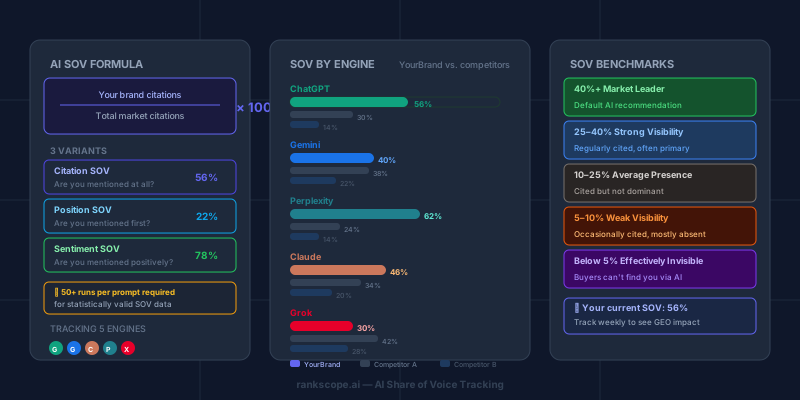
AI SOV = Your Citations in AI Responses ÷ Total Citations Across All Tracked Brands × 100
But the measurement method is fundamentally different from any other SOV channel.
Why AI SOV Requires Prompt Sampling
You cannot read AI share of voice from a dashboard or API. You have to measure it directly by querying the AI engines with the prompts your buyers actually use.
The complication: AI engines don't return the same answer every time. Temperature, retrieval variation, and prompt phrasing all affect outputs. A single run of a prompt tells you almost nothing — it's one data point from a distribution. You need to run each prompt 30–50 times across each engine to get a statistically reliable citation rate.
This is why tracking brand mentions in AI search at scale requires automation. Manually running 50 prompts × 50 runs × 4 engines every week is 10,000 queries — not something you can sustain with copy-paste.
The Four Engines That Matter
For most brands in 2026, AI SOV is measured across four engines:
- ChatGPT — the largest AI search audience; citation patterns reflect Bing-indexed content + training data
- Google AI Overviews — embedded in Google search results; citation patterns reflect Google's organic index
- Perplexity — live web search with aggressive recency weighting; faster to reflect new content
- Google AI Mode — Google's conversational search mode; close correlation with organic rankings but distinct citation behavior
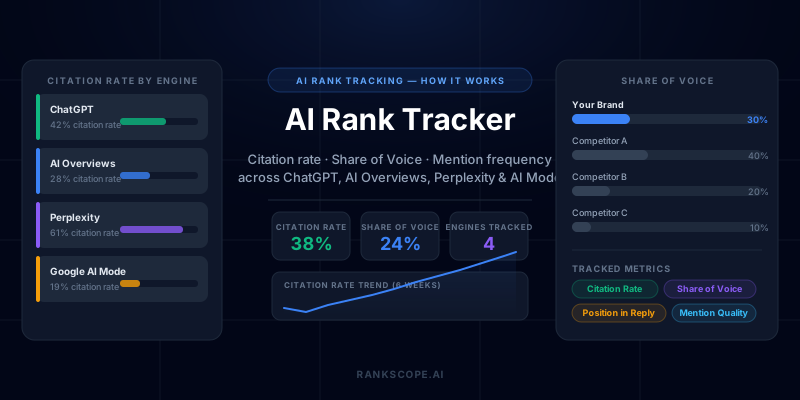
Each engine has different citation patterns. Your brand might have 40% citation rate on Perplexity and 8% on AI Overviews. That's a useful diagnostic — it tells you where you have content gaps and where your indexing is weak.
This per-engine breakdown is why AI SOV is worth measuring as its own metric rather than an average. Averaging across engines hides the information you need to act on.
AI SOV vs Citation Rate: The Difference
These two metrics are related but answer different questions:
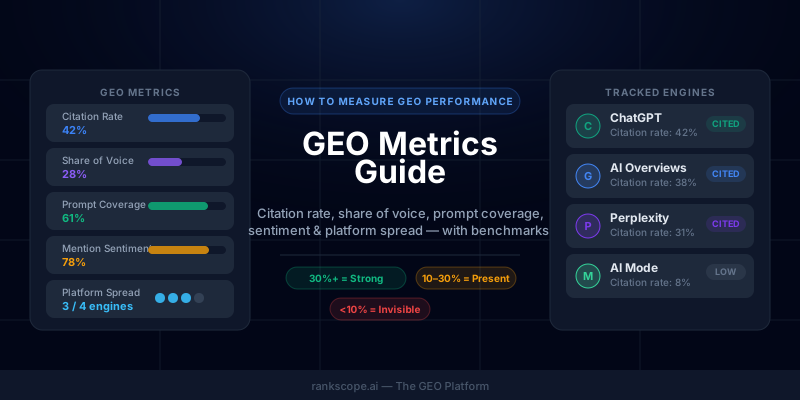
- Citation rate = how often your brand appears in responses, as a percentage of all responses run. "Your brand appeared in 32% of all runs."
- AI SOV = your citations as a percentage of all brand citations in those same runs. "Of all the brand mentions across those responses, your brand accounted for 24%."
A brand can have a high citation rate and low SOV — which means every response that mentions your brand also mentions 5 others. A brand with 40% citation rate and 8% SOV is appearing in most answers but always as an afterthought in a crowded list.
You want both numbers high. If citation rate is high but SOV is low, focus on content that positions your brand as the primary answer, not just one option among many.
For a deeper dive on calculating the exact AI SOV formula, see our guide on how to calculate share of voice in AI search.
How the Four SOV Channels Work Together
Running all four SOV measurements gives you a picture that none of them provides individually. Here's how to read the combination:
| SOV Channel | High | Low | What It Means |
|---|---|---|---|
| Paid | ✅ | — | Strong ad coverage, but check efficiency |
| Organic | — | ✅ | Content gap or authority deficit |
| Social | ✅ | — | Brand conversation happening, check sentiment |
| AI | — | ✅ | Invisible to buyers using AI search — urgent to fix |
The most common scenario we see for growth-stage B2B brands right now: reasonable paid SOV, growing organic SOV, low social SOV (because the product is new), and near-zero AI SOV because nobody has measured it or worked to improve it.
That near-zero AI SOV is the quiet threat. AI answers name only a few brands per question, so a competitor that gets established first takes a share that is expensive to win back, and you will not see it happen unless you are measuring.
How to Improve Your AI Share of Voice
Once you have a baseline AI SOV measurement, the levers for improving it are different from traditional SEO or social marketing.
Content structure. AI engines favor content that directly answers questions in structured formats — definitions, numbered steps, comparison tables, clear H2s. Content that requires context to understand is harder for AI to extract and cite. For a full breakdown, see our guide to optimizing content for AI search.
Entity and topic authority. AI engines associate brands with topics. If your brand is strongly associated with a specific topic across multiple high-authority sources, you'll get cited more reliably on prompts related to that topic. This is why GEO (Generative Engine Optimization) focuses heavily on consistent entity signals — brand name, product category, use case — across your content.
Third-party coverage. AI engines don't just cite you because your own site answers a question well. They cite you because multiple sources (your site, review platforms, comparison articles, roundups) consistently name you in relevant contexts. Earning mentions on sites that AI engines pull from is as important as your own content.
Recency. Perplexity and Google AI Overviews weight fresh content more aggressively than ChatGPT. Publishing structured content regularly keeps you in the retrieval pool for recency-sensitive queries.
Prompt coverage. Your AI SOV may be high for some prompts and zero for others. Measuring citation rate by prompt — not just in aggregate — shows you which question types you own and which you need to cover. The prompts where you're absent are your content roadmap.
Measuring AI SOV in Practice
Brands doing this well typically follow a three-stage process:
Stage 1: Build a prompt library. Write 20–50 unbranded queries that represent how buyers in your category ask about solutions. These should be open-ended ("what are the best tools for X") rather than branded ("what does [your company] do"). They should span different buyer stages — discovery, comparison, decision.
Stage 2: Establish a baseline. Run your prompt library across each AI engine, 30–50 times per prompt. Record which brands appear in each response, their position, and the framing. Calculate your AI SOV and citation rate per engine. This is your starting point.
Stage 3: Track changes. Run the same prompt library on a weekly or biweekly cadence. When you publish new content, build backlinks, or earn third-party coverage, expect a 2–4 week lag before citation data reflects it. Track trends, not snapshots.
RankScope automates all three stages — building your prompt library, running systematic sampling across all four AI engines, and tracking SOV and citation rate trends over time. The platform shows per-engine breakdowns, competitive positioning, and forensic diffs when AI responses about your brand change.
If you're starting manually, the GEO metrics guide has a step-by-step framework for building your first measurement system without tools.
Share of Voice Across the Funnel
Different SOV channels matter at different stages of the buyer journey.
Top of funnel (awareness): Social SOV and AI SOV matter most. This is where buyers first encounter brands — through word of mouth (social) or AI-generated answers to early research queries. If you're absent here, buyers build mental shortlists that don't include you.
Middle of funnel (consideration): Organic SOV and AI SOV drive this stage. Buyers researching solutions in depth are reading comparison guides, reviews, and asking AI engines for detailed comparisons. Citation SOV in "X vs Y" and "best tools for Z" queries is particularly valuable here.
Bottom of funnel (decision): Paid SOV is most controllable and directly attributable here. Retargeting, brand keyword bidding, and competitive conquesting all play. But by the time a buyer reaches this stage, their shortlist is already shaped by what they saw at the top and middle of funnel.
The implication: brands that focus exclusively on paid SOV (the most measurable) are optimizing the stage where the fewest decisions get made. The bigger leverage is owning AI and organic SOV earlier in the journey.
Common SOV Measurement Mistakes
Mixing channels without labeling them. Reporting "our SOV went from 18% to 24%" without specifying the channel is misleading — paid SOV and organic SOV respond to completely different actions and have very different baselines.
Using a single competitor as the denominator. If you calculate SOV against only your top competitor, you get a number that looks good but misses the full picture. Use the full competitive set you're actually competing against in buyer consideration.
Tracking SOV but not acting on it. SOV is a diagnostic, not an outcome. The question is always: what specific action does this SOV reading suggest? Low organic SOV → content gap analysis. Low social SOV → earned media or community strategy. Low AI SOV → content structure and entity authority work.
Ignoring AI SOV entirely. This is the most common mistake in 2026. If your SOV dashboard covers paid, organic, and social but not AI, you're flying blind on the fastest-growing buyer discovery channel. The brands building AI SOV now are staking out positions that will be hard to displace in 18–24 months.
Key Takeaways
Share of voice isn't one metric — it's a framework that applies differently across four channels. The core idea is consistent: your brand's fraction of the total market conversation. What changes is what "the total market conversation" means in each channel and how you measure it.
For marketers building a complete SOV picture in 2026:
- Paid SOV via impression share in Google Ads — native, precise, limited to active campaigns
- Organic SOV via keyword visibility tools — estimated, but useful for trend tracking
- Social SOV via brand monitoring tools — measures the human conversation
- AI SOV via systematic prompt sampling — measures the AI-generated conversation, the newest and fastest-growing channel
Excess share of voice (eSOV) remains the most predictive version of the metric. If your combined SOV exceeds your market share, the historical data suggests you're on a growth trajectory. If it's below, you're likely losing ground to brands investing more heavily.
The AI dimension is the piece most brands haven't integrated yet. Start measuring AI SOV before your competitors do — it's significantly harder to recover from a deficit than to build a lead.
Related Resources
- How to Calculate Share of Voice in AI Search — the exact formulas and methodology
- GEO Metrics: How to Measure AI Search Performance — citation rate, SOV, prompt coverage explained
- AI Rank Tracker: How to Track Your Position in AI Search — what AI rank tracking actually measures
- How to Track Brand Mentions in AI Search — manual and automated methods
- What is Generative Engine Optimization? — GEO fundamentals for marketers new to the concept