GEO for Ecommerce: How Brands Track AI Citations and Win in AI-Powered Shopping
A shopper is looking for the best standing desk under $500. They don't search Google. They open ChatGPT and type: "What's the best standing desk for under $500?"
ChatGPT returns a response. It recommends two or three brands. It explains the tradeoffs — height range, stability, build quality, warranty. The shopper shortlists those brands and starts checking their websites.
If your brand isn't in that answer, you don't exist for that shopper at the most important moment in their purchase journey. There's no second page. No sponsored placement. No retargeting. The decision was shaped before your website ever loaded.
That's the challenge Generative Engine Optimization for ecommerce is built to solve.
What Is GEO for Ecommerce?
GEO for ecommerce is the practice of optimizing your brand's content, product data, and technical infrastructure so that AI search engines cite your products when shoppers ask category and recommendation queries.
It's the ecommerce-specific application of Generative Engine Optimization (GEO): a discipline focused on earning mentions inside AI-generated answers rather than climbing traditional search rankings. For ecommerce brands, the stakes are particularly direct — AI citations translate to purchase consideration in a way that a page-three Google ranking never does.
The scope of the shift is real. Gartner estimated a 25% drop in traditional search volume by 2026 as shoppers migrate to AI-powered discovery. Early data suggests that drop is already underway: Search Engine Land reported a 20% decline in Google searches per U.S. user. Shoppers haven't stopped researching — they've moved the research into ChatGPT, Perplexity, and Gemini.
For ecommerce, this creates an asymmetric competitive dynamic. Brands that get cited early in AI answers compound their advantage. Brands that don't may not see the gap in their Google Analytics — the loss happens before the click.
How AI Engines Decide Which Products to Cite
Understanding the mechanism matters for ecommerce brands, because the GEO levers for product-centric businesses are different from those for services or SaaS. Two distinct pathways determine whether your brand appears in an AI shopping answer.
Pathway 1: Training Data
Large language models — GPT-4o, Gemini, Claude — were each trained on a large snapshot of the web. The content absorbed during training shapes the model's default understanding of which brands are legitimate, which products are well-regarded, and which solve which problems.
For ecommerce brands, the relevant training data includes: brand websites, product review content, comparison articles, Reddit discussions, editorial roundups ("best X for Y"), and press coverage. If your brand had strong representation in those sources before a model's training cutoff, it may be embedded in the model's category associations.
GPT-4o's training runs through October 2023. GPT-5-series models include data through August 2025. Claude's most recent training cut off in early 2026. You can't retroactively get into past training runs, but you can build the web presence now that feeds the next one.
Pathway 2: Real-Time RAG Retrieval
Modern AI search tools — ChatGPT with Browse, Perplexity, Google AI Overviews, Bing Copilot — pull live web content before generating responses. This is called Retrieval-Augmented Generation (RAG), and it's where ecommerce GEO work has the most immediate impact.
When a shopper asks Perplexity "best eco-friendly water bottles," Perplexity fetches live pages and synthesizes them into a response. The pages that get retrieved and cited share specific characteristics:
- Directly answerable content — the relevant answer appears clearly at the top of the section, not buried after three paragraphs of context
- Structured product information — materials, dimensions, price ranges, compatibility, certifications — specific data, not marketing claims
- Technical accessibility — AI crawlers (GPTBot, ClaudeBot, PerplexityBot) are allowed in the site's robots.txt; structured data (JSON-LD) is present
- Freshness signals — recently updated pages rank higher in RAG retrieval than stale content
For a full walkthrough of content structure for AI retrieval, the guide to optimizing content for AI search goes deeper into the formatting and structural principles.
The GEO Signals That Matter Most for Ecommerce
1. Product Data Quality and Specificity
The most important GEO signal for an ecommerce brand is the specificity and completeness of product information. AI systems use product data quality as a proxy for brand authority.
Vague product descriptions don't get cited. Specific, structured product data does.
What doesn't work:
"Our premium standing desk combines style and function for the modern workspace."
What gets cited:
"The FlexDesk Pro 2 adjusts from 27 to 47 inches, supports up to 350 lbs, includes a built-in cable management tray, has a 5-year motor warranty, and is assembled in under 20 minutes. Available in three finishes starting at $449."
AI systems are retrieving facts to build answers. The more complete your facts, the more extractable they are.
This applies beyond product description pages. Your blog content, buying guides, and comparison content should carry the same factual density. An ecommerce brand publishing "The Best Standing Desks of 2026" with specific measurements, weight capacities, and honest tradeoffs is more likely to be retrieved than one publishing "Why Ergonomic Furniture Matters."
2. Category and Brand Entity Clarity
AI engines need to unambiguously associate your brand with a specific product category. The weaker your entity signal, the less likely AI systems are to include you in category responses.
Every high-value page on your site — homepage, category pages, flagship product pages — should make three things crystal clear:
- What category is this brand in? Not "furniture" — "adjustable standing desks and ergonomic office furniture"
- What specifically is this brand known for? Not "quality products" — "standing desks with dual-motor lift systems built for all-day commercial use"
- Who is it for? Not "professionals" — "remote workers, developers, designers, and office managers outfitting permanent home and commercial workspaces"
This clarity compounds. The more consistently your site, your reviews, your press coverage, and your product listings describe you in the same category language, the stronger the entity association becomes in AI systems. See the complete GEO guide for 2026 for how entity signals work at a technical level.
3. Third-Party Review Presence
AI engines heavily weight third-party corroboration when evaluating ecommerce brands. This is more pronounced for product recommendations than for most other content types — because AI systems recognize that shoppers expect validated opinions, not just brand claims.
The key corroboration sources for ecommerce brands:
- Consumer review platforms — Amazon reviews, Google Shopping reviews, Trustpilot, G2 for B2B products — the volume and consistency of positive reviews signals real usage and legitimate category presence
- Editorial roundups — "best of" articles from Wirecutter, Good Housekeeping, Business Insider, and niche editorial publications carry significant weight. Being named in these articles is one of the strongest training data signals available for ecommerce brands
- Reddit and community discussions — organic mentions in r/BuyItForLife, r/frugal, r/homeoffice, and niche product communities. AI systems treat these as high-credibility social proof
- Comparison articles — content comparing your product to competitors (either on your site or on third-party sites) that places your brand in competitive context
The consistency of category language across these sources matters as much as the volume. When Amazon listings, editorial roundups, and Reddit mentions all describe your product using similar category terms, the entity signal is much stronger than if each source uses different language.
4. Technical AI Crawler Access
Many ecommerce sites inadvertently block AI crawlers through robots.txt configuration or JavaScript-heavy pages that bots can't render. If AI crawlers can't read your product pages, you won't appear in RAG-powered responses regardless of your content quality.
Check that your robots.txt explicitly allows:
User-agent: GPTBot
Allow: /

User-agent: ClaudeBot
Allow: /

User-agent: PerplexityBot
Allow: /

User-agent: GoogleBot-Extended
Allow: /
Beyond robots.txt, add JSON-LD structured data to your key pages. For ecommerce, the most important schemas are Product (with price, availability, rating), Organization, and FAQPage on category and buying guide pages. Schema markup helps AI systems extract structured information without having to parse prose — product name, price range, key features, and brand are all machine-readable.
5. Buying Guide and Comparison Content
One of the highest-leverage GEO investments for ecommerce brands is category-level buying guide content. When shoppers ask AI systems "what should I look for in a standing desk" or "how do I choose a protein powder," the AI retrieves authoritative buying guides and extracts the criteria from them.
If your brand publishes the buying guide that explains the category well — what specs matter, what price ranges mean, what questions to ask — you get cited both as a resource and implicitly as an authority in the category.
Effective ecommerce GEO buying guides:
- Lead each section with the direct answer, not the setup
- Include specific numbers (weight ranges, measurement specs, price tiers)
- Name tradeoffs honestly — AI systems flag overly promotional content
- Compare product attributes across the category, not just your own products
- Include FAQs at the end that mirror how shoppers phrase questions to AI tools
How Ecommerce Brands Track AI Citations
This is the question most ecommerce teams get stuck on. You can sense that AI search is changing shopping behavior. You can see competitors showing up in ChatGPT responses. But without a tracking system, you have no baseline, no trend data, and no way to know whether your GEO work is having any effect.
There are three ways ecommerce teams track AI citations — ranging from manual spot checks to automated monitoring.
Method 1: Manual Spot Checking
The simplest approach: open each major AI engine and manually run your top 20–30 category queries. Record which brands appear in each answer. Do this once a month, log the results in a spreadsheet.
This gives you signal — you'll quickly see whether you're being cited at all, and where competitors appear instead. The limitations are real: manual checking is not scalable beyond a small query set, results vary across sessions (AI responses are non-deterministic), and you can't track trends or catch answer changes automatically.
For small brands with limited resources, manual spot checking is a reasonable starting point to get a baseline before investing in tooling.
Method 2: Semi-Automated Tracking with Prompts
A step up from manual checking: build a set of standardized prompts, run them through the AI engine APIs (when available) or browser automation, and log the results in a structured format. Some ecommerce teams build lightweight scripts that run their top 50 queries on a weekly schedule and export the text responses for review.
This approach provides more data than manual checking, but requires engineering time to build and maintain, still requires manual analysis to extract citation data from raw responses, and doesn't provide share of voice or sentiment analytics.
Method 3: Dedicated GEO Tracking Platform
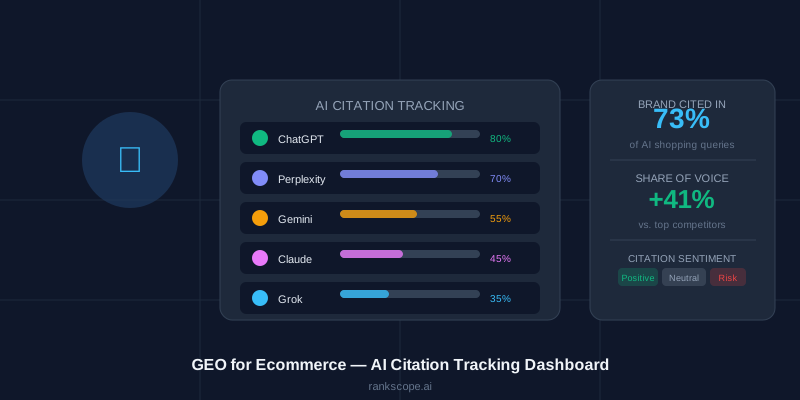
The most scalable approach is using a GEO platform purpose-built for AI citation tracking. RankScope automates the full workflow: configure your query library, set your tracking frequency, and get structured citation data — citation rate, share of voice, sentiment, and forensic diffs — without manual processing.
For ecommerce brands tracking AI citations at scale, this is the only approach that gives you actionable data without disproportionate team overhead. Understanding your AI visibility tool options is a useful starting point for evaluating what to use.
The Three Metrics Ecommerce Brands Need to Track
Most ecommerce analytics stacks are built around sessions, transactions, and ROAS. None of those metrics tell you what's happening in AI search. You need a parallel measurement layer.
Metric 1: Citation Rate
Definition: The percentage of your target queries for which your brand is named in the AI-generated answer.
How to build a query set: For an ecommerce brand, this means identifying the 20–50 queries your ideal shoppers are most likely to type into AI tools. Include:
- Category queries: "best [product type] for [use case]"
- Occasion queries: "best [product] gift under $[price]"
- Problem queries: "what [product] do I need for [situation]"
- Comparison queries: "[your brand] vs [competitor]"
What to aim for: Citation rate above 40% on your core category queries is strong. Below 15% signals a meaningful AI visibility gap. Above 70% indicates you're establishing category authority in AI search.
Metric 2: AI Share of Voice
Definition: Your brand citations as a percentage of all brand citations across your target query set.
Why it matters for ecommerce: Citation rate tells you how visible you are. Share of voice tells you how visible you are relative to the competitors who are also being cited. An ecommerce brand with a 35% citation rate sounds decent — until you see the market leader is at 75%.
How to calculate it: Share of voice in AI search = (your brand citations) / (all brand citations for your category) × 100. Track this monthly. A rising share of voice means your GEO work is compounding; a falling one means a competitor is outpacing you.
Metric 3: Citation Sentiment
Definition: Whether AI-generated mentions of your brand are positive, neutral, or carry qualifications.
Why it matters: Being mentioned is better than being ignored. But "Brand X is a popular choice, though some customers note slow shipping times" is a different signal from "Brand X is consistently rated the top pick for build quality and warranty coverage." Sentiment tracking shows whether the AI narrative around your brand is getting better or worse as you work on GEO.
RankScope's forensic diff feature is particularly useful here — it shows the exact text changes in AI responses over time, so you can see when a qualifier appears, when your brand moves from third mention to first, or when a competitor that was competing alongside you drops off.
Ecommerce GEO Checklist: What to Fix First
Based on common patterns across ecommerce brands starting GEO work, here's the priority order for the first 90 days:
Week 1 — Baseline
- Set up citation tracking for your top 30 category queries across all four AI engines RankScope tracks
- Run a manual citation check to see your current state
- Audit robots.txt for AI crawler access (GPTBot, ClaudeBot, PerplexityBot)
- Check Google Search Console for crawl issues on your top product and category pages
Week 2 — Technical fixes
- Allow all AI crawlers in robots.txt if any are blocked
- Add Product schema (JSON-LD) to your top 20 product pages — include price, availability, brand, and review aggregate
- Add FAQPage schema to any category or buying guide pages that have Q&A sections
- Verify that your most important pages are cached and crawlable (not JavaScript-only renders)
Weeks 3–4 — Content and entity
- Rewrite your homepage to make category, problem statement, and target customer explicit
- Update your top category pages to lead each section with the direct answer, not setup paragraphs
- Ensure your product descriptions include specific specs: dimensions, materials, weight, compatibility, warranty — facts AI engines can extract
- Publish or update at least one buying guide for your main category with high factual density
Weeks 5–8 — Third-party corroboration
- Request reviews on Trustpilot, Google Shopping, or Amazon from recent customers
- Check that existing review platform profiles use consistent category language
- Identify 3–5 editorial roundups in your category and evaluate whether they include your brand
- Publish at least one comparison piece that places your brand in competitive context
Weeks 9–12 — Measure and iterate
- Pull your first full citation report with trend data
- Identify the 5 queries with the largest gap between your citation rate and your top competitor's
- Map each gap to a specific content or technical fix
- Set your 6-month benchmark: citation rate and share of voice by AI engine
Ecommerce GEO vs Traditional Ecommerce SEO
A common question from ecommerce marketing teams: does GEO replace SEO, or do we need both?
The short answer is both — and they reinforce each other more than they conflict.
| Dimension | Traditional Ecommerce SEO | GEO for Ecommerce |
|---|---|---|
| Goal | Rank in Google results | Get cited in AI answers |
| Primary signal | Backlinks + page authority | Product data quality + entity clarity |
| Content format | Keywords + title tags | Direct answers + structured facts |
| Key pages | Product pages, category pages | Buying guides, comparison content |
| Measurement | Keyword rankings, organic sessions | Citation rate, AI share of voice |
| Timeline to results | 3–12 months | 4–10 weeks |
| Target platform | Google, Bing | ChatGPT, Google AI Overviews, Perplexity, Google AI Mode |
The key insight is that GEO improvements often lift SEO performance too. Writing clearer, more factually dense product content helps both Google's crawlers and AI retrieval systems. Strong entity signals and structured data are table stakes for both strategies. Building editorial backlinks improves domain authority (SEO) and increases the training data footprint that AI systems use to validate brand credibility (GEO).
The risk is optimizing for only one channel. Ecommerce brands that ignore GEO are watching purchase research migrate out of Google and into AI tools — and losing consideration to cited competitors they'll never see in their Google Analytics. Brands that abandon SEO lose the domain authority and backlink profile that gives AI systems confidence to cite them in the first place.
The Compounding Dynamic in Ecommerce AI Citations
There's a structural reason to start GEO work before it feels urgent: citations compound.
When an AI engine cites your ecommerce brand in a shopping answer, that answer gets seen. Some percentage of shoppers mention those cited brands in blog posts, social media, Reddit threads, and other content that AI systems later crawl and train on. More third-party references → stronger entity signals → more citations in the next wave of AI answers.
The reverse is also true. Ecommerce brands that establish early AI citation authority in their category build a compounding moat. A competitor who secures the "top standing desk brand" mental model in GPT-4 responses benefits from every conversation where that association reinforces itself.
For context: Shopify reported that AI-driven referrals to ecommerce stores grew 1,200% between Black Friday 2023 and Black Friday 2024. Agentic shopping tools — AI agents that autonomously research and compare products on behalf of users — are in active development at both OpenAI and Google. As shopping agents mature, the brands embedded in AI training data will be the ones recommended by default.
The question for ecommerce brands isn't whether to invest in GEO. It's whether to build that citation foundation now, or try to catch up after category leaders have already locked in their AI-search authority.
How RankScope Helps Ecommerce Brands Track GEO
RankScope is a GEO platform built to track brand citations across ChatGPT, Google AI Overviews, Perplexity, and Google AI Mode. Here's how ecommerce teams typically use it:
Query library setup: Define the 30–50 queries your buyers are most likely to run in AI tools — category queries, comparison queries, problem queries, gift queries. RankScope runs these across ChatGPT, Google AI Overviews, Perplexity, and Google AI Mode on your chosen schedule (daily, weekly, or monthly).
Citation analytics: For each query, RankScope shows which brands were cited, in what order, and with what context. You see citation rate per engine, share of voice vs. named competitors, and sentiment tracking — all in one dashboard.
Forensic diff detection: The most actionable feature for ecommerce teams: RankScope shows the exact text changes in AI responses over time. When a product category answer changes — a competitor added, your brand moved up, a qualifier inserted — you see the diff. This tells you whether your GEO work is having an effect, and when competitive dynamics in AI search are shifting.
Multi-brand tracking: For ecommerce businesses with multiple product lines or sub-brands, RankScope tracks each separately, giving you per-brand citation data across the query set.
Tracking starts at $49/month — no setup fee · cancel anytime — a meaningful step up from spreadsheets for brands serious about AI search visibility. For ecommerce brands specifically, RankScope for brands covers brand-level citation tracking, competitive share of voice, and how to use AI visibility data to inform your content and product positioning strategy.
Frequently Asked Questions
What is GEO for ecommerce?
GEO for ecommerce is the practice of optimizing product content, brand positioning, and technical infrastructure so that AI search engines like ChatGPT, Google AI Overviews, Perplexity, and Google AI Mode cite your brand and products when shoppers ask category or recommendation queries. Unlike traditional SEO that targets Google rankings, GEO targets inclusion in AI-generated shopping answers — where an increasing percentage of high-intent purchase research now happens.
How do ecommerce brands track AI citations?
Ecommerce brands track AI citations using a GEO platform like RankScope, which runs automated queries across Perplexity, ChatGPT, Google AI Overviews and Google AI Mode and analyzes responses for brand mentions. Tracking includes citation rate, share of voice vs. competitors, citation sentiment, and forensic response diffs. Manual spot checking works for a baseline but doesn't scale or provide trend data.
Why does GEO matter for ecommerce brands specifically?
Ecommerce brands face a direct revenue consequence from AI citation gaps: when a shopper asks ChatGPT "what's the best [product category]" and your brand isn't named, a competitor gets the consideration instead. With traditional search volume declining as AI tools absorb shopping research, the citation gap has a measurable cost — especially in short-cycle consumer categories where purchase decisions happen inside AI conversations.
What types of AI queries should ecommerce brands track?
Ecommerce brands should track category queries ("best [product] for [use case]"), comparison queries ("[brand A] vs [brand B]"), problem-solution queries ("what should I use for [problem]"), and gift/occasion queries ("best [product] gift for [recipient]"). Each type maps to a different stage in the purchase journey, and citation tracking across all four shows where AI search is sending buyers.
How is GEO for ecommerce different from traditional SEO?
Traditional ecommerce SEO optimizes for Google keyword rankings — title tags, meta descriptions, backlinks, page speed. GEO for ecommerce optimizes for AI citation — structured product data, brand entity clarity, factual density, and third-party review presence. The measurement is different too: citation rate and AI share of voice instead of rank positions and organic sessions. Most ecommerce teams run both in parallel.
How long does it take to improve AI citation rates for an ecommerce brand?
Technical and structural fixes — AI crawler access, schema markup, and product page restructuring — can improve RAG retrieval citations within 2–4 weeks. Training data influence takes longer: 3–6 months of consistent web presence. Most ecommerce brands see measurable citation rate improvement within 6–10 weeks of consistent GEO work.