Best SE Ranking Alternative for AI Visibility in 2026
SE Ranking has built a genuinely solid SEO platform. Agencies love it — white-label reporting, competitive pricing versus Semrush and Ahrefs, and a feature set that covers the full traditional SEO workflow without a bloated enterprise price tag. If you're managing organic search rankings for multiple clients, SE Ranking is a defensible choice.
But something changed in 2025. AI search engines — ChatGPT, Google AI Overviews, Perplexity, Google AI Mode — started handling a measurable chunk of informational queries. Brands that were invisible in AI answers started losing top-of-funnel traffic. And SEO teams started asking a question that their current tools couldn't answer: is our brand being cited in AI-generated responses?
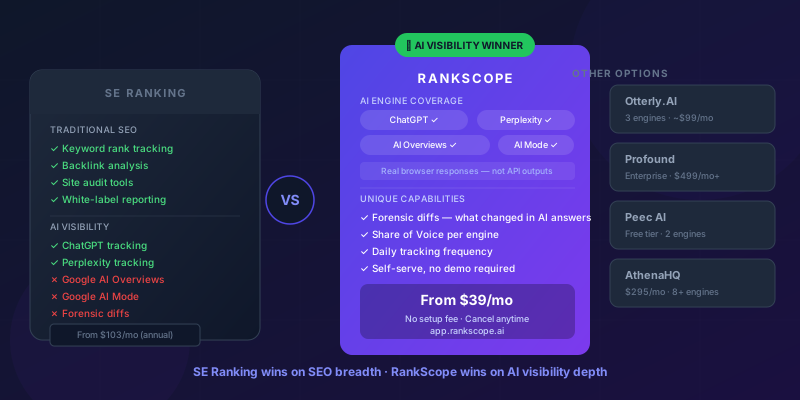
SE Ranking added an AI module to address this. It tracks ChatGPT and Perplexity citations. For teams where AI visibility is a secondary concern — something worth monitoring but not the primary focus — that's enough.
For teams where AI citation tracking is the point, it isn't.
This post breaks down what SE Ranking does well, where its AI module falls short, and the best SE Ranking alternatives for teams that need real AI visibility depth in 2026.
What SE Ranking Does Well
Before jumping to alternatives, it's worth being honest about where SE Ranking genuinely earns its keep.
Traditional SEO is where SE Ranking shines. The keyword rank tracker is accurate, covers any location and device, and handles large accounts without getting unwieldy. The backlink checker competes with tools that cost twice as much. Website audits surface real technical issues with actionable recommendations. Competitive research is robust enough that many agencies use it as a primary tool.
White-label reporting is a real differentiator. Agencies can send client-ready reports without heavy customization. This is a pain point with most competitors — SE Ranking solves it cleanly.
The AI module works for basic monitoring. For Core plan users ($103.20/month billed annually), SE Ranking includes 100 AI prompts tracked across ChatGPT and Perplexity. You can see citation trends, keyword-level visibility data, and basic competitive coverage. For teams already paying for SE Ranking's SEO features, this is a reasonable add-on.
Where SE Ranking Falls Short for AI Visibility
The limitations aren't hidden — they're just structural. SE Ranking is a traditional SEO platform that added AI monitoring. That means the AI features reflect what a traditional SEO tool would build, not what a team optimizing for AI citation actually needs.
1. Covers only 2 of the 4 major AI engines
SE Ranking's AI module tracks ChatGPT and Perplexity. That's a reasonable starting point, but it misses:
- Google AI Overviews — the AI layer shown in billions of Google searches every day. This is the highest-volume AI surface for most brands. Not tracking it means you're flying blind on the biggest channel.
- Google AI Mode — Google's full AI-first search interface, rolled out broadly in 2025. It produces different results than AI Overviews and needs to be tracked separately.
Brands can perform very differently across engines. A company cited consistently by ChatGPT might be almost invisible in Google AI Overviews. You won't know if you're only tracking two platforms.
2. No forensic diff layer
When your citation rate drops — and it will, at some point — what do you do with that information? SE Ranking will tell you the metric changed. It won't show you what actually changed in the AI responses.
Forensic diff tracking captures the exact text of AI answers over time and highlights what changed between any two dates. When your ChatGPT citation rate drops 15 percentage points in a week, a forensic diff shows you whether the AI started recommending a competitor, changed how it frames the category, or dropped your brand from the response entirely. That's the diagnostic layer that turns a metric into an action.
SE Ranking doesn't have this. Most traditional SEO platforms don't — it requires a fundamentally different data model.
3. Uses API outputs rather than real browser responses
For AI tracking to be accurate, especially for Google AI Overviews and Google AI Mode, you need to see what a real browser actually returns — not what an API returns. API responses and browser responses differ for AI-generated answers. The browser sees personalization signals, the current AI model state, and the actual rendering path. API outputs can lag or diverge.
RankScope uses real browser responses to capture AI answers. This is particularly important for Google's AI surfaces, where the browser-rendered response is what users actually see.
4. AI visibility is a secondary feature
This isn't a criticism — it's a structural reality. SE Ranking's roadmap, engineering investment, and product team focus on traditional SEO. The AI module exists because customers asked for it and the category demanded it. That's reasonable product management.
But it means the AI features get secondary prioritization. When Google AI Mode adds a new citation pattern, or Perplexity changes its answer format, a tool purpose-built for AI visibility will adapt faster. This matters in a category that's moving as quickly as AI search.
The 6 Best SE Ranking Alternatives for AI Visibility in 2026
1. RankScope — Best for Dedicated AI Citation Tracking
RankScope was built specifically for generative engine optimization — tracking brand citations across AI search engines, diagnosing why visibility changes, and optimizing content to improve citation rates. It's not a traditional SEO tool with AI features added on; it's the other direction entirely.
What it tracks: ChatGPT, Google AI Overviews, Perplexity, and Google AI Mode. All four using real browser responses — the actual AI output shown to users, not API approximations. This matters most for Google's surfaces, where browser rendering diverges meaningfully from API responses.
Forensic diffs: RankScope captures the full text of AI answers over time and shows you exactly what changed between any two dates, highlighted at the word level. When your citation rate shifts, you can see whether the AI changed its framing, added a competitor, removed your brand, or restructured the response entirely. This is the diagnostic layer that turns raw citation data into something actionable.
Share of Voice: Calculates your brand's citation rate relative to competitors across each engine. Not just "were you mentioned" but "when your category is queried, what share of AI answers include you versus the competition?" This is the metric that matters for understanding competitive AI visibility.
Pricing: Starter $49/month (2 engines, 40 prompts, 3 competitors), Pro $149/month (all 4 engines, 150 prompts, 10 competitors, GA4/GSC integration, API access), Agency $399/month (400 prompts, 25 workspaces, white-label). No setup fee, cancel anytime.
Where SE Ranking still wins: Everything outside AI visibility. If you need keyword rank tracking, backlink analysis, site audits, or white-label SEO reporting, SE Ranking is the stronger tool for that work. Most teams running serious AI brand visibility efforts use both — SE Ranking for traditional SEO, RankScope for AI search.
Who it's for: Marketing teams, agencies, and SEO professionals for whom AI citation tracking is a primary metric, not a secondary add-on. If you're running a GEO strategy alongside your traditional SEO program, RankScope is purpose-built for that work.
Get started with RankScope → — No setup fee · Cancel anytime
2. Otterly.AI — Best for Clean Reporting
Otterly built a genuinely well-designed monitoring product. The dashboard is clean, the UI is accessible to non-technical stakeholders, and the citation trend data is easy to present in executive reporting. It covers ChatGPT, Perplexity, and Gemini.
The gaps versus SE Ranking's AI module: Otterly skips Google AI Overviews and Google AI Mode, same as SE Ranking. So you're trading SE Ranking's consolidation (one tool for SEO + AI) for better UI and Gemini coverage. Whether that's the right trade depends on your workflow.
For teams where stakeholder reporting is the primary driver — proving AI visibility ROI to leadership — Otterly's UI has a genuine edge. For teams actively optimizing, the lack of forensic diffs is a limiting factor.
Pricing: Starts around $99/month. No free tier.
Best for: Teams that need clean, shareable AI visibility dashboards and can live without Google AI Overviews tracking.
3. Profound — Best for Enterprise AI Visibility
Profound is the market leader at the enterprise end. If you're managing AI visibility for a large brand with complex tracking needs — hundreds of prompts, multiple competitors, deep data export requirements — Profound has the most mature product in this space.
The catch is pricing. Profound starts at $499/month and typically requires a sales call and demo process. There's no self-serve signup. For enterprise marketing teams with budget, this is often worth it. For agencies, mid-market teams, or anyone self-serve oriented, the entry bar is too high.
Pricing: $499/month+, custom enterprise contracts, demo required.
Best for: Enterprise brands where budget isn't a constraint and depth of AI visibility data is the priority.
4. Peec AI — Best for Lightweight Entry
Peec AI is a simpler, lighter tool for teams that want to start monitoring AI citation without significant commitment. It covers ChatGPT and Perplexity, has a free tier, and is genuinely easy to get started with.
The limitations are what you'd expect from a free-tier entry product: no Google AI Overviews, no forensic diffs, limited competitive tracking. For teams that are just beginning to think about AI search visibility and want a low-friction starting point, Peec AI is a reasonable first step.
Pricing: Free tier available. Paid plans for additional capacity.
Best for: Teams exploring AI visibility tracking for the first time, or small brands with minimal prompt volume.
5. AthenaHQ — Best for High-Volume Prompt Tracking
AthenaHQ focuses on AI citation tracking at scale — large prompt libraries, detailed competitive visibility, and growing engine coverage. At $295/month for their self-serve plan, it sits between RankScope and Profound in the market.
The differentiation is prompt volume and competitive depth. If your use case involves hundreds of tracking prompts across competitive categories, AthenaHQ handles that scale well. Their G2 ratings are strong (4.9/5 Spring 2026), and the product has matured significantly in the last 12 months.
For context on how AthenaHQ compares to RankScope specifically, see the full AthenaHQ alternative breakdown.
Pricing: $295/month self-serve.
Best for: Mid-market to enterprise teams with high prompt volume and competitive tracking requirements.
6. Rankscale.ai — Best for Share of Voice Benchmarking
Rankscale focuses specifically on share of voice benchmarking across AI engines — how does your brand's citation rate compare to competitors across a defined category? The SoV metrics are detailed, and the competitive benchmarking workflows are well-designed.
The practical constraint: Rankscale requires a demo call and has no self-serve signup or transparent pricing. If you want to evaluate before committing, that's a friction point.
Pricing: Custom / demo required.
Best for: Teams where competitive AI share of voice benchmarking is the core reporting need.
Side-by-Side Comparison
| SE Ranking | RankScope | Otterly.AI | Profound | |
|---|---|---|---|---|
| Primary focus | Traditional SEO + AI add-on | AI visibility (dedicated) | AI monitoring | Enterprise AI visibility |
| AI engines | ChatGPT, Perplexity | ChatGPT, AI Overviews, Perplexity, AI Mode | ChatGPT, Perplexity, Gemini | Multiple (enterprise) |
| Real browser responses | No | Yes | No | Yes |
| Forensic diffs | No | Yes | No | Partial |
| Share of Voice | Basic | Yes (per engine) | Yes | Yes |
| Traditional SEO tools | Full suite | No | No | No |
| White-label reporting | Yes | Agency plan | No | Yes |
| Self-serve signup | Yes | Yes | Yes | Demo required |
| Starting price | $103.20/mo | $49/mo | ~$99/mo | $499/mo+ |
SE Ranking vs RankScope: The Honest Answer
These tools are solving different problems. The question isn't which is better — it's which gap you're trying to fill.
Stay with SE Ranking if: Traditional SEO is your primary workflow. You track keyword rankings, build backlinks, run site audits, and manage multiple clients through white-label reports. The AI module gives you basic citation monitoring as a bonus. For this use case, SE Ranking is a well-priced, well-built product and switching makes no sense.
Add RankScope if: AI search visibility has become a reporting requirement or a strategic priority. You need to know whether your brand appears in Google AI Overviews. You want to track how your share of voice in AI search compares to competitors. You need forensic diffs to diagnose why citations shifted. You want daily tracking frequency, not weekly.
The most common setup we see: SE Ranking handles the traditional SEO layer; RankScope handles the AI visibility layer. The two tools have almost zero functional overlap. SE Ranking's keyword rank tracker and backlink tools don't compete with RankScope's citation tracking and forensic diffs.
If budget forces a single choice and AI visibility is the primary objective, RankScope gives you 4-engine coverage with real depth at a lower starting price than SE Ranking's Core plan. If traditional SEO is the primary objective and AI is secondary, SE Ranking's bundled AI module covers the basics without adding another tool to the stack.
Why Engine Coverage Matters More Than You'd Think
One detail worth expanding: the difference between 2-engine coverage and 4-engine coverage isn't linear.
Google AI Overviews now appear on a growing share of commercial queries, not only informational ones, and Google AI Mode offers a full AI-first results experience. Citation patterns in these two Google surfaces differ from ChatGPT and Perplexity.
Brands that perform well in ChatGPT often have weak or non-existent presence in Google AI Overviews. The algorithm surfaces different sources, weights different authority signals, and often cites different competitors entirely.
Running AI visibility tracking without Google's AI surfaces is like tracking traditional SEO without Google. You can learn things from the data you have — but you're missing the biggest channel.
If you want to understand how Google AI Overviews specifically works and how to rank in it, the full guide is here: How to Rank in Google AI Overviews.
What to Prioritize When Evaluating Alternatives
If you're actively evaluating tools to replace or supplement SE Ranking's AI tracking, these are the questions that separate serious options from lightweight ones:
1. Does it track Google AI Overviews and Google AI Mode? These are the highest-traffic AI surfaces for most brands. If a tool skips them, you're missing the most important channel.
2. Real browser responses or API outputs? This matters specifically for Google's AI surfaces, where API outputs and browser responses diverge. Real browser tracking gives you what users actually see.
3. Does it have forensic diffs? Citation metrics tell you something changed. Diffs tell you what changed and what to do about it. Without diffs, you're monitoring without diagnosis.
4. How does it calculate Share of Voice? Citation presence (were you mentioned?) is a binary metric. Share of Voice (what percentage of relevant AI queries mention you?) is the metric that actually matters for business decisions. Make sure the tool calculates SoV by engine, not just a blended average.
5. Is tracking daily or weekly? AI responses change frequently. Weekly tracking can miss citation drops and recoveries entirely. Daily tracking at minimum — more frequent for competitive categories.
For a deeper look at which tools pass or fail these criteria, the best AI visibility tools comparison covers the full market with detailed breakdowns. If you're also comparing other traditional SEO platforms on their AI visibility gaps, the Semrush alternative for AI visibility, Ahrefs alternative for AI brand visibility, and Moz alternative for AI search visibility posts all follow the same framework — the pattern is consistent: traditional SEO platforms don't track AI citations well, and dedicated tools are the right solution.
Quick Summary
SE Ranking is a strong SEO platform. Its AI module handles the basics — ChatGPT and Perplexity citation monitoring — but it's not built for teams where AI visibility is a primary metric. The missing engine coverage (Google AI Overviews and AI Mode), the lack of forensic diffs, and the API-based rather than browser-based tracking all reflect that it's a secondary feature, not a core product investment.
For dedicated AI citation tracking, RankScope is purpose-built for exactly that use case: 4-engine coverage, real browser responses, forensic diffs, daily tracking, Share of Voice across engines. Starting at $49/month with no setup fee, it fits alongside SE Ranking for teams running a serious GEO program alongside their traditional SEO work.
The two tools don't compete. They cover different ground. That's the honest answer.
Get started with RankScope → — No setup fee · Cancel anytime
Frequently Asked Questions
Is SE Ranking free? SE Ranking offers a free plan with no credit card required. Paid plans start at $103.20/month (billed annually) on the Core plan, or $129/month billed monthly.
Does SE Ranking track AI Overviews? No. SE Ranking's AI module tracks ChatGPT and Perplexity. It does not currently track Google AI Overviews or Google AI Mode.
Can I use SE Ranking and RankScope together? Yes — most teams that do this find the tools complementary. SE Ranking handles keyword rankings, backlinks, and site audits. RankScope handles AI citation tracking across all 4 engines. The overlap in functionality is minimal.
What's the cheapest SE Ranking alternative for AI tracking? RankScope's Starter plan at $49/month is the lowest entry point among the dedicated AI visibility tools, covering 2 engines (ChatGPT and Google AI Overviews) with 40 prompts. Peec AI has a free tier for very basic monitoring. SE Ranking's AI module is included in its paid plans starting at $103.20/month — more expensive, and more limited in engine coverage.
How long does it take to set up RankScope? Under 30 minutes. You add your brand, configure tracking prompts (or use the prompt suggestions), connect competitors, and you'll have initial citation data within 24 hours. No demo required, no sales call, no onboarding fee.