What is AI Search? How the New Search Engines Work (2026)
Ask Google something and you get ten links. Ask ChatGPT the same thing and you get an answer — two or three paragraphs, a few brand names, and a clear recommendation.
That's the shift. AI search doesn't return a list for you to sort through. It does the synthesizing for you and hands you the conclusion. For users, it's a significant upgrade in convenience. For brands, it changes everything about what it means to be "visible" online.
AI search is a search experience where an AI system reads multiple sources, synthesizes the information, and delivers a direct conversational answer to your query. Instead of ranking ten pages, the engine picks one or two to cite. Instead of sending you elsewhere, it gives you what you came for.
This guide explains exactly how it works, what makes it different from traditional search, the four engines that matter most in 2026, and why being cited — not ranked — is the new competitive advantage.
How Traditional Search Works (Quick Recap)
Traditional search engines like Google work roughly like this:
- Crawl — Bots spider the web and collect pages
- Index — Pages are catalogued, scored by 200+ ranking factors
- Rank — When a query is submitted, the most relevant and authoritative pages surface at the top
- Return — A list of links, ranked by relevance, is shown to the user
Your job as a website owner was to climb that list. Earn backlinks. Write content Google's algorithm preferred. Get to page one.
The assumption built into this model: users will click. They'll visit your site, read your content, and decide for themselves.
AI search breaks that assumption at the last step.
How AI Search Works
AI search adds two layers on top of traditional retrieval: large language models (LLMs) and real-time synthesis.
Here's the simplified process:
- Query received — The user asks a question in natural language
- Retrieval — The system pulls relevant sources (sometimes from the live web via RAG, sometimes from training data)
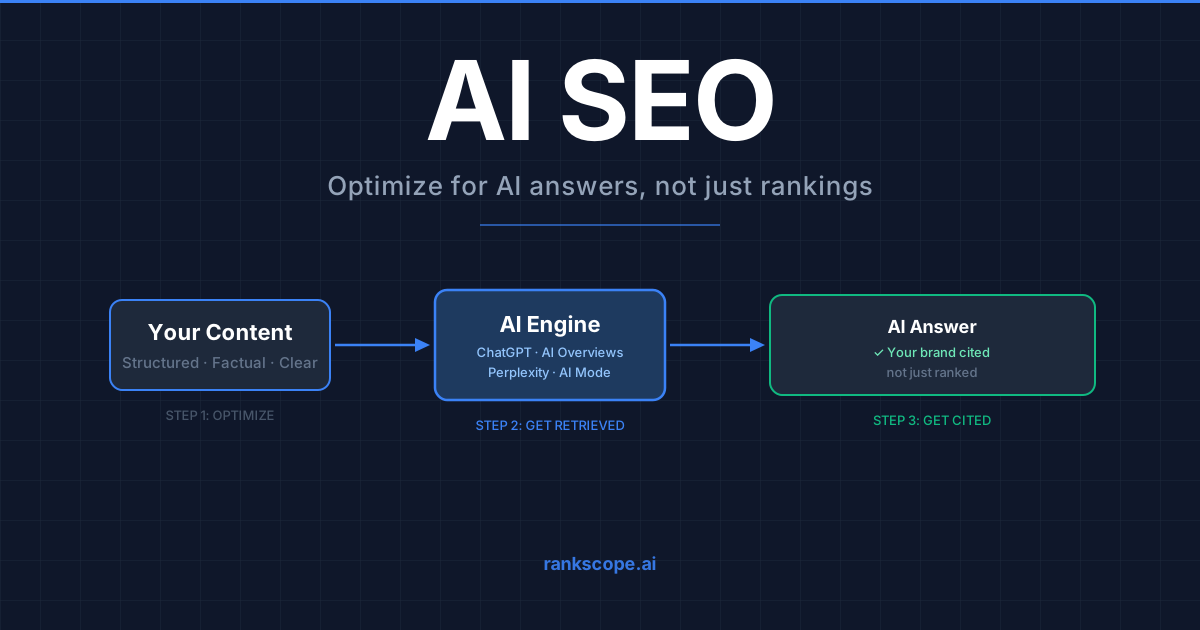
- Synthesis — The LLM reads those sources and generates a direct answer
- Citation — A small number of sources (typically 2–5) are cited as the basis for the answer
- Delivery — The user gets a complete answer, not a list of pages
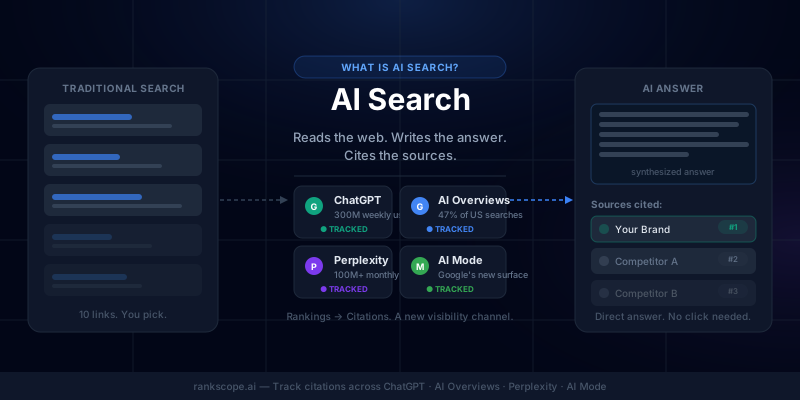
The critical difference: instead of returning links to ten pages, the engine uses those pages to write you an answer — and only a handful of sources make the cut.
What is RAG?
Most modern AI search engines use a technique called Retrieval-Augmented Generation (RAG). When a query comes in, the system first retrieves fresh web content relevant to the question, then feeds that content to the LLM to generate a grounded, cited answer.
RAG is what makes AI search results current rather than stuck at a training cutoff date. It's also what gives brands a real-time lever: if you publish content that retrieval systems can find and extract clearly, your citation rate improves.
AI Search vs. Traditional Search: The Key Differences
| Dimension | Traditional Search (Google) | AI Search (ChatGPT, Perplexity, etc.) |
|---|---|---|
| Output | Ranked list of 10 links | Synthesized direct answer |
| User behavior | Click, visit, read, decide | Read answer, rarely click |
| Brands cited | Top 10 pages visible | 2–4 brands cited in the answer |
| Ranking signal | Backlinks, authority, page speed | Content structure, factual density, entity clarity |
| Measurement | Rankings, organic traffic | Citation rate, share of voice |
| Geographic factor | Local search factors baked in | Engine-by-engine variation |
| Freshness | Indexed content | Real-time via RAG (most engines) |
The most important row: brands cited. Google shows ten results and everyone on page one gets some exposure. AI search synthesizes those ten results and names two or three. If you're not in those two or three, you don't exist to the user — even if you're ranking organically.
This is why companies that have spent years building page-one Google positions are finding that they're invisible in AI search. The visibility channels are separate. A high Google ranking helps, but it doesn't guarantee an AI citation.
For a deeper dive into how these disciplines fit together, GEO vs SEO vs AEO unpacks the overlaps and distinctions in detail.
The 4 AI Search Engines That Matter Most in 2026
RankScope tracks four AI search platforms because they collectively represent the vast majority of AI search volume and the most commercially significant citation opportunities.
1. ChatGPT
Platform: OpenAI
Weekly active users: 300 million+ (as of early 2026)
How it searches: When Browse mode is active, ChatGPT uses Bing's index for real-time retrieval. Without Browse, it relies on training data (cutoff: early 2025 for GPT-4o).
ChatGPT is the largest single AI platform by usage. It's not purpose-built for search — it's a general assistant — but an increasing share of queries are research and comparison questions that have real commercial intent.
What makes ChatGPT citation-worthy: specific, factual content that directly answers a question. ChatGPT's synthesis tends to favor sources that state things clearly and attribute claims to a named entity (your brand).
For more on how to optimize for ChatGPT specifically, see our guide on how to rank in ChatGPT.
2. Google AI Overviews
Platform: Google
Reach: ~47% of US Google searches now include an AI Overview (2026)
How it searches: Uses Google's own index with Gemini-powered synthesis
Google AI Overviews appear at the very top of search results — above the organic rankings. They're triggered by most informational and comparison queries. The engine synthesizes a multi-source answer and cites 3–5 pages from Google's index.
The counterintuitive finding: ranking in the organic results below an AI Overview doesn't mean your content is cited in the Overview. Google's AI surface and its traditional ranking algorithm don't always agree on who the authoritative source is.
AI Overviews are the single biggest reach multiplier for brand visibility — they're shown to everyone using Google, not just people who've switched to a new tool. For tactics on how to earn a place in them, our AI Overviews SEO guide covers the mechanics in detail.
3. Perplexity
Platform: Perplexity AI
Monthly visits: 100 million+ (early 2026)
How it searches: Real-time web retrieval on every query, inline citations always displayed
Perplexity is the only major platform built exclusively for search. Every response includes inline citations. Retrieval is real-time. The platform is popular with researchers, professionals, and technical users — a high-intent audience.
What makes Perplexity different: it's more transparent about its sources than any other engine. Users can see exactly where every claim came from. That means your content needs to be extractable at the sentence and paragraph level — a direct answer at the top of each section, with named claims that the system can lift and cite with confidence.
For platform-specific tactics, our Perplexity SEO guide goes deep on what earns citations there.
4. Google AI Mode
Platform: Google
Status: Rolling out in the US through 2026
How it searches: Full conversational search experience, powered by Gemini, with multi-turn dialogue
Google AI Mode is Google's answer to Perplexity and ChatGPT — a fully conversational search interface where users can ask follow-up questions, get multi-source synthesis, and dig deeper without ever visiting a separate site.
The significance: AI Mode sits on top of Google's trillion-URL index. If you're already indexed and ranking, you're in the retrieval pool. The question is whether your content structure is clear enough for Gemini to cite you in the synthesized answer.
AI Mode is the newest of the four and its citation patterns are still emerging — but given Google's distribution and the fact that it's being surfaced directly on google.com, it will be one of the most important citation surfaces by late 2026.
Why Citations Matter More Than Rankings in AI Search
In traditional SEO, the goal was clear: rank on page one. Rankings drove traffic. Traffic drove conversions.
AI search changes the relationship between visibility and traffic. When an AI engine synthesizes an answer, most users don't click through to the cited sources — they read the answer and move on. The click-through rate from AI Overviews, for example, is a fraction of what it is from traditional organic results.
So if clicks are lower, why does being cited still matter?
Brand awareness and trust. When ChatGPT names your brand as a solution to someone's problem, that's a brand impression at the highest possible intent moment — the user is actively researching, comparing, or deciding. Being named there shapes their consideration set, even without a click.
Share of voice. AI search answers typically cite 2–4 brands. If your competitors are being cited and you're not, those are consideration moments you're missing entirely. Share of voice in AI search is the new competitive metric.
Attribution patterns are shifting. As more people use AI search for research, the "dark funnel" — people who heard about you before they ever searched for you directly — is growing. Being consistently cited builds brand recall that shows up later as direct traffic and branded searches.
The zero-click future. This is the direction search is heading. More queries will be answered without a page visit. The brands that have built citation authority now will be positioned to capture that attention even as click rates decline. To understand the mechanics of how to build that, generative engine optimization is the discipline to learn.
How AI Search Engines Decide What to Cite
This is the question that matters for brands: what makes one source get cited over another?
The short answer: retrievability and clarity.
AI engines are running a selection process when they synthesize an answer. They've retrieved several candidate pages. Now they need to decide which ones most directly and clearly answer the query. The signals they use are different from traditional ranking factors.
Content structure
Can the AI extract a clean answer from your page, or does it have to wade through context, caveats, and marketing copy to find the useful part? The pages that get cited lead with direct answers. First paragraph answers the question. Subsections start with the key claim, then expand. Tables compare things explicitly.
Factual density
AI systems favor content that makes specific, verifiable claims over content that's vague or hedged. Numbers, percentages, named examples, and concrete details are extraction-friendly. "AI search is growing rapidly" is hard to cite. "AI search usage grew 47% year-over-year through Q1 2026" is easy to cite.
Entity clarity
If your brand, product, and category are clearly and consistently named — and associated with specific attributes — AI systems can build an internal model of what you are and surface you for relevant queries. Entity clarity is why brand consistency across your site, your mentions, and your structured data matters for AI search visibility.
Source authority
AI systems still lean toward sources that have accumulated authority — third-party mentions, citations from credible sites, established domain presence. This is where traditional SEO work still pays dividends for AI search: the authority you've built in Google's eyes influences whether retrieval systems consider you a credible source.
For a full breakdown of what the actual optimization tactics look like in practice, how to optimize content for AI search covers the playbook in detail.
The AI Search Landscape Beyond the Big 4
ChatGPT, Google AI Overviews, Perplexity, and Google AI Mode account for most commercially relevant AI search volume — but they're not the only platforms worth knowing about.
Microsoft Copilot (formerly Bing Chat) is integrated into Windows and Microsoft 365. It's significant for B2B brands where users are researching in a Microsoft environment. Always-on citations, Bing-powered retrieval.
Claude (Anthropic) with web search enabled is growing among technical users and researchers. It's the engine of choice for people who want detailed, nuanced analysis. Its citation patterns skew toward depth and specificity.
Grok (xAI) integrates real-time X (formerly Twitter) data. For brands with strong social presence or in trending categories, Grok's real-time retrieval can surface you quickly.
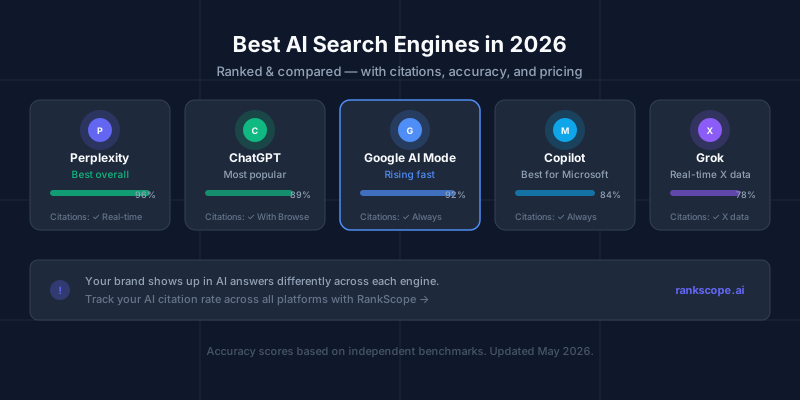
For a ranked comparison of all the major platforms, our guide to the best AI search engines in 2026 covers each one with accuracy ratings and use-case recommendations.
What This Means for Your Brand
Here's the practical implication: your Google Analytics and Search Console data don't tell you whether AI search engines are recommending your brand.
You could be ranking on page one of Google for your category — and simultaneously, every time a potential customer asks ChatGPT or Perplexity to recommend a solution, a competitor's name is appearing in the answer.
That gap is now large enough to matter commercially. Especially for B2B, research-heavy categories (software tools, financial products, healthcare information), the share of buying journeys that now include an AI research step is significant and growing.
The first step is establishing a baseline. Run a set of prompts — the queries your customers actually ask when researching your category — across ChatGPT, AI Overviews, Perplexity, and AI Mode. See where you're being cited and where you're not. That's your citation baseline.
From there, tracking brand mentions in AI search becomes a regular practice — as standard as checking your organic rankings.
Why AI Search Visibility Requires a Different Measurement Layer
Traditional rank tracking tools aren't built for this. A rank tracker tells you your position in a list of links — a metric that has no equivalent in AI-generated answers.
What you need instead:
- Citation rate — For a given prompt, what percentage of the time does your brand appear in the AI answer?
- Share of voice — Of all AI answers on your category queries, what fraction mention your brand vs. competitors?
- Citation position — When you are mentioned, are you the first brand cited, or buried fourth?
- Per-engine breakdown — Your citation rate on ChatGPT is often very different from your rate on Perplexity or AI Overviews
This is what RankScope is built to track. It runs your target prompts through all four major AI engines using real browser responses — not API outputs, which often differ from what actual users see. The result is an accurate, current picture of your brand's AI search visibility, updated continuously.
For brands that have been optimizing for Google for years, the mental shift here is: AI visibility is not a Google ranking problem. It's a new measurement problem. You need a new instrument for a new channel.
The Relationship Between AI Search and GEO
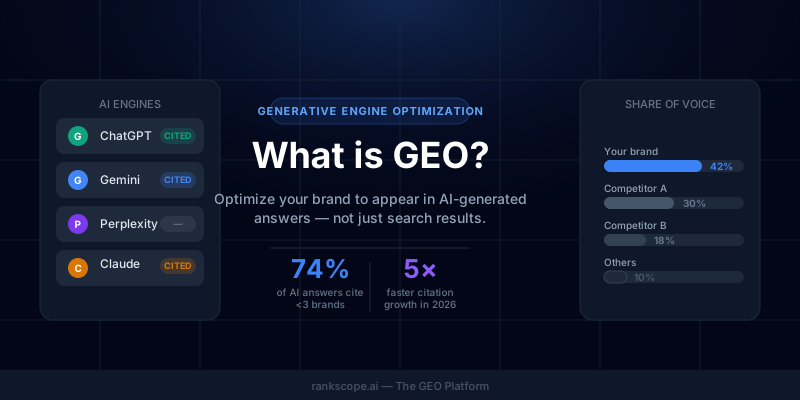
The discipline that's emerged to address AI search visibility is called Generative Engine Optimization (GEO) — optimizing your brand to be cited in AI-generated answers, not just ranked in traditional search.
What is Generative Engine Optimization? is the foundational explainer. The short version: GEO is to AI search what SEO is to Google. You're optimizing for a different output (citations, not rankings), using different signals (structure and factual clarity, not backlinks), and measuring differently (citation rate and share of voice, not position and traffic).
The relationship between AI search, GEO, traditional SEO, and Answer Engine Optimization (AEO) is nuanced — our GEO vs SEO vs AEO breakdown maps how they fit together and where they diverge.
Frequently Asked Questions
Is AI search replacing Google?
Not replacing — reshaping. Google is still processing 8.5 billion queries per day, and most users haven't switched away from it. But the behavior pattern is changing: more people use AI tools for research and comparison questions, and Google itself has embedded AI Overviews into its own results. Traditional web browsing and AI synthesis are converging.
Do AI search engines use the same content as Google?
Partially. Google AI Overviews uses Google's own index. ChatGPT with Browse uses Bing's index. Perplexity uses its own web retrieval. All three can access your content if it's publicly available and crawlable — but their selection criteria for what to cite differ from Google's ranking algorithm. Being indexed isn't the same as being cited.
Does being cited in AI search drive traffic?
Less than traditional organic results. Click-through rates from AI Overviews and conversational AI answers are significantly lower than from traditional organic rankings. But citations still matter for brand awareness, share of voice, and influence on purchase decisions — especially in high-consideration categories where the AI answer shapes what brands the user even considers.
How fast is AI search growing?
Rapidly. In 2025, Perplexity crossed 100 million monthly users. ChatGPT reached 300 million weekly active users. Google AI Overviews reached ~47% of US searches. The overall AI search category is growing faster than any other segment of the search market. Brands that establish citation authority early will have a compounding advantage as the audience grows.
Summary
AI search is a fundamentally different channel from traditional search — not a feature, not a trend to watch, but a distinct medium with its own retrieval mechanisms, citation patterns, and measurement requirements.
The four engines that define commercial AI search in 2026 — ChatGPT, Google AI Overviews, Perplexity, and Google AI Mode — each work differently, cite from different sources, and respond to different optimization signals. A strategy that treats them as interchangeable will miss most of the available opportunity.
The practical starting point: establish your citation baseline. Find out where you're showing up and where you're not — across all four engines, for the prompts your customers actually ask. That's the data that tells you where to focus.
RankScope is the measurement layer built specifically for this. It tracks your citations in ChatGPT, Perplexity, Google AI Overviews and Google AI Mode — giving you the share-of-voice and citation data that traditional SEO tools weren't built to capture. Ready to see where you stand? Get started today.