Perplexity SEO: How to Rank in Perplexity AI (2026 Guide)
When someone asks Perplexity a question and your brand doesn't appear in the answer, you've lost that moment. There's no second-page organic listing to fall back on. Perplexity delivers one synthesized answer with three to five sources cited inline — and everyone else is invisible.
That's the challenge this guide addresses. Perplexity is now the fourth-largest AI platform globally with 30 million monthly users and 40% month-on-month search growth (Backlinko, January 2026). It's no longer a niche tool for researchers. It's where a meaningful slice of your potential customers go to answer purchase and evaluation questions right now.
Getting cited in Perplexity is a specific skill — related to, but distinct from, traditional SEO. It falls under Generative Engine Optimization (GEO), the discipline of optimising content to be cited by AI answer engines. This guide covers the full picture: how Perplexity works technically, what drives citations, how to structure and update your content, and how to measure your Perplexity visibility over time. If you want context on how Perplexity stacks up against ChatGPT, Google AI Mode, and other rivals, see our Perplexity competitors guide.
How Perplexity Actually Works (What the Algorithm Does)
Most "Perplexity SEO" guides treat it like a black box. It isn't. Understanding the mechanics determines every optimisation decision.
Retrieval-Augmented Generation (RAG)
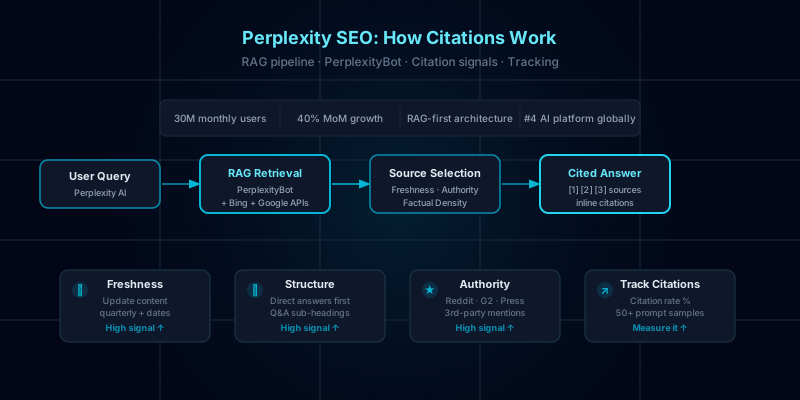
Perplexity is built on Retrieval-Augmented Generation. Unlike a traditional chatbot that answers from static training data, Perplexity retrieves live web content at the moment of each query and uses that content to generate its answer. The process runs roughly like this:
- A user submits a query
- Perplexity identifies the best web sources to answer it — pulling from its own index via PerplexityBot and from Bing and Google API data
- It retrieves the content of those pages
- It synthesises a cited answer, numbering each source inline
This matters enormously for optimisation. Because Perplexity retrieves live content at query time, freshness is a first-class signal in a way it simply isn't for ChatGPT's training data layer or for traditional Google rankings. A page updated yesterday can beat a page that ranked on Google for three years if Perplexity's retrieval engine scores it as more directly relevant and recent.
PerplexityBot: Perplexity's Own Crawler
Perplexity operates its own crawler called PerplexityBot. This is separate from and additional to its use of Bing and Google APIs. PerplexityBot crawls your site to keep Perplexity's own index fresh and to enable real-time retrieval for active queries.
If you've blocked PerplexityBot in your robots.txt, your pages are ineligible for direct Perplexity citation regardless of how well they rank on Google. This is the single highest-impact technical fix for sites with zero Perplexity presence.
The correct robots.txt entry:
User-agent: PerplexityBot
Allow: /
Check your robots.txt now. If PerplexityBot is listed under Disallow, or if there's a blanket User-agent: * Disallow: / rule without an explicit exception, you're invisible. The GEO checklist has the full crawlers template for all five major AI engines.
What Models Power Perplexity?
Perplexity doesn't use a single language model — it runs multiple underneath, including OpenAI's GPT-5 series, Anthropic's Claude 4 Sonnet and Opus, Google's Gemini Pro, xAI's Grok, and Perplexity's own Sonar models (built on Llama-family checkpoints). Users can switch between them. This means Perplexity's citation behaviour can vary slightly by model, but the retrieval pipeline — and therefore the optimisation levers — is shared across all of them.
How Perplexity Selects Sources
Perplexity doesn't publish a ranking algorithm, but research and testing point to these primary selection factors:
- Topical authority: Pages from domains that consistently publish high-quality content on a specific topic outperform isolated one-off pages from generalist sites
- Content freshness: More recently updated content gets weighted higher, especially for queries about current tools, products, or events
- Factual density: Pages with specific numbers, named entities, and cited data outperform vague, hedged prose
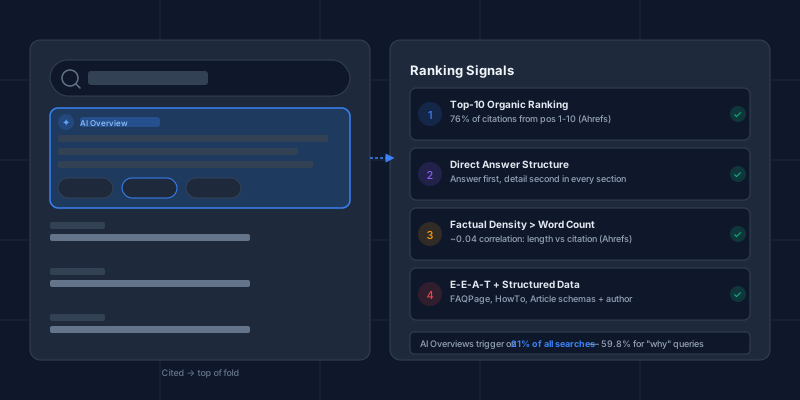
- Direct-answer structure: Pages where the answer to the query appears in the first sentence of a section, not buried after three paragraphs of context
- Domain credibility signals: Backlink profile, E-E-A-T indicators, and how the domain is discussed on independent third-party sites
- Crawl accessibility: Pages must be accessible to PerplexityBot — paywalls, JavaScript-heavy rendering, and robots.txt blocks all reduce retrieval probability
The big difference from Google: Perplexity does not weight click-through rates, dwell time, or behavioural engagement signals. It has no concept of "impressions" or "user satisfaction feedback." What it has is the content itself and the signals baked into it at indexing time.
Step 1: Fix the Technical Foundation
Before content matters, Perplexity needs to be able to access and index your site. Run through this checklist first:
Allow AI crawlers: Open your robots.txt and explicitly allow PerplexityBot. While you're there, allow the full set of AI crawlers — GPTBot, ClaudeBot, GoogleBot-Extended, and anthropic-ai. Blocking any of these reduces citation potential across multiple AI engines simultaneously. This aligns with the broader GEO content optimization foundation.
Ensure crawlability: Check that your key pages load without JavaScript being required for content rendering. Perplexity's crawler is not a full browser — it reads HTML. If your content only appears after a JS framework renders it client-side, it may not be picked up accurately.
Submit to Bing: Since Perplexity uses Bing API data alongside its own index, Bing indexing helps. Submit your sitemap via Bing Webmaster Tools and enable IndexNow for faster freshness signalling.
Fast page load: Perplexity's retrieval at query time has a time budget. Slow-loading pages can be deprioritised in favour of faster ones that return the same information. Aim for under 2.5 seconds LCP. Google's PageSpeed Insights is a free benchmark tool.
Absolute canonical URLs: Every page should carry an absolute canonical pointing to itself. This prevents Perplexity from attributing your content to a different URL or duplicate variant.
Step 2: Establish Topical Authority
Perplexity prefers sources that demonstrate deep expertise on a specific subject, not single pages from broad generalist sites. A domain with 15 interlinked posts on AI search optimisation will consistently outperform a single well-written post on an unrelated site.
This is the same principle as Google E-E-A-T applied specifically to AI retrieval. The signals Perplexity uses to assess topical authority include:
- Content cluster depth: How many pages does your domain have on this topic cluster?
- Internal link structure: Are those pages connected to each other, signalling a coherent content architecture?
- Mention patterns on third-party sites: Does your domain appear as a cited source on other authoritative sites in the same space?
- Consistency of entity associations: Is your brand consistently described the same way across your own site and independent sources?
For a practical example: if you run an AI search visibility platform, publishing and interlinking content on how to rank in ChatGPT, how to rank in Google AI Overviews, GEO strategy, citation tracking, and Perplexity SEO creates a content cluster that signals topical authority across the whole AI search domain — not just one piece of it.
This is why publishing a single optimised page for "perplexity seo" and stopping there will underperform versus building a connected cluster of AI search content. Perplexity's retrieval model is topic-aware, not just page-aware.
Step 3: Prioritise Content Freshness
Freshness is where Perplexity diverges most sharply from Google and ChatGPT.
Google has freshness signals, but they're outweighed by authority and backlinks for most queries. ChatGPT's training data layer is static — no amount of updating your content today changes what GPT-4o learned from web scrapes in 2023. But Perplexity retrieves live content at query time, and its scoring algorithm actively rewards recently updated pages.
What freshness means in practice:
Add visible last-updated dates. Perplexity's crawler picks up structured date signals in HTML and schema markup. A dateModified field in your Article schema, combined with a visible "Last updated: May 2026" in your page body, sends a clear freshness signal.
Update key pages quarterly. Don't just add a sentence — meaningfully refresh the data and examples. Perplexity can distinguish between a token update (one line changed, date bumped) and a genuine content refresh. Add new statistics, update tool comparisons, revise recommendations based on how the market has changed.
Publish new data when you have it. Original research, updated statistics, and proprietary benchmark data make you the freshest source on that specific claim. If your platform generates data about AI citation patterns, publishing that data creates content that Perplexity cannot get from anywhere else.
Timestamp your claims. Write "as of Q2 2026" when citing statistics or tool capabilities. This signals to Perplexity's retrieval system that the data is current, not stale.
Step 4: Structure Every Section for Extraction
Perplexity extracts passages from your content, not pages. It reads your page, identifies the passage most directly relevant to the query, and includes that passage (or a synthesis of it) in its answer. The rest of your content may never be processed for a given query.
This has a concrete implication: every section must be independently valuable and extractable. A user who reads only one paragraph from your page should come away with a complete, accurate answer.
The structure that maximises extraction probability:
Lead with the answer. The first sentence of every H2 section should directly answer the implied question. Don't warm up with context — state the answer, then support it.
Use Q&A sub-headings. H3 headings phrased as questions ("Does Perplexity use Google's index?") followed by immediate direct answers perform better than topic-label headings ("Perplexity Index Sources") followed by explanatory paragraphs. Perplexity's retrieval model recognises the Q&A pattern and prioritises it for conversational queries.
Include specific numbers. "Perplexity has 30 million monthly users growing at 40% month-on-month" is infinitely more citable than "Perplexity is growing fast." Specificity signals reliability. Vague claims get filtered out.
Keep sections self-contained. Avoid opening a section with "As we discussed above..." or "This connects to the previous point..." Each section should make sense without the surrounding context. This is the single most common structural failure in content that doesn't get cited by AI engines.
Limit section length. Sections over 400 words become harder for Perplexity to extract cleanly. Long sections with multiple sub-points work better when broken into discrete H3 sub-sections, each with its own direct opening.
For a deeper look at the content patterns that work across all AI engines, the AI search content optimization guide covers the full structural playbook with examples.
Step 5: Build Third-Party Corroboration
Perplexity's retrieval system treats your own website as one data point. Before surfacing your brand as the answer to a query, it cross-references what independent sources say about you. This is similar to how Google processes E-E-A-T but applied in real time against Perplexity's retrieval corpus.
The sources Perplexity weights heavily for corroboration:
Reddit. Perplexity cites Reddit threads regularly — especially for "best tool for X" and "is Y worth it?" queries. Getting your brand discussed positively in relevant subreddits (organically, through genuine product quality) is a high-impact signal. Communities like r/SEO, r/artificial, and r/marketing are the right audiences if your product fits.
Review platforms. G2, Trustpilot, Capterra, and Product Hunt reviews appear in Perplexity answers for commercial queries. If you're a SaaS product and have no G2 profile, Perplexity may never surface you for "best [category] tool" queries regardless of your content quality.
Industry publications and blogs. Mentions on authoritative sites in your niche (not paid placements — genuine editorial coverage) are weighted as corroboration signals. A single mention on a respected industry publication does more than ten self-published posts.
Comparison posts on third-party sites. When a third-party site publishes "X vs Y" or "Best tools for Z" and includes your brand, Perplexity picks that up. This is one of the reasons building relationships with affiliate sites and content publishers in your space pays off beyond just referral traffic.
Wikipedia and authoritative reference sources. If your product category or concept has a Wikipedia article that links to your site (or mentions your brand), it's a powerful corroboration signal. Perplexity treats Wikipedia as a highly trusted source.
The practical action: audit your third-party footprint. Where does your brand appear beyond your own domain? What does the coverage say? Is it accurate? Are there obvious gaps (no G2 profile, no Reddit presence, no mention in any industry roundup)?
LLM visibility — the measure of how prominently your brand surfaces across AI engines — is built as much from third-party corroboration as from your own content. You need both.
Step 6: Handle Perplexity's Specific Search Modes
Perplexity offers several search modes that change how content is retrieved and displayed. Understanding which modes affect your category changes your optimisation priorities.
Default (All): The standard mode. Pulls from Perplexity's live index and API data from Bing and Google. Most users stay here for most queries. Standard content optimisation applies.
Academic mode: Prioritises peer-reviewed sources, journal articles, and research papers. If you publish original research or cite academic sources heavily, you may appear here. For most commercial brands, this mode is less relevant but worth knowing about.
Writing mode: Focuses on content creation help — less relevant for brand citation optimisation.
Video mode: Perplexity surfaces YouTube videos as citations here. If you produce video content, transcribed and summarised video content on your site can increase visibility across both default and video modes. A YouTube video explaining "how Perplexity SEO works" can appear in Perplexity answers — and if your brand produced it, that's a citation.
Perplexity Deep Research: The premium research mode that synthesises multiple long-form sources. For this mode, depth matters more than brevity. Comprehensive, well-cited content performs better than short-form answers.
The implication: your content strategy should target default mode first (biggest audience), but publishing research-grade content and transcribed video can give you additional surface area in the other modes.
The Comparison: Perplexity vs. ChatGPT vs. Google AI Overviews
Knowing how Perplexity differs from other AI engines prevents you from applying the wrong playbook to the wrong platform.
| Signal | Perplexity | ChatGPT Search | Google AI Overviews |
|---|---|---|---|
| Retrieval architecture | Own crawler (PerplexityBot) + Bing + Google APIs | Bing index | Google index |
| Freshness weighting | High — live retrieval favours recent updates | Medium — dependent on Bing crawl cycle | Low — Google rankings take precedence |
| Source display | Numbered citations visible in every answer | Source bubbles visible below answer | Inline attribution in dropdown |
| Training data reliance | Low — heavy RAG weighting | High (training) + retrieval hybrid | Lower — primarily live retrieval |
| Reddit/social weighting | High | Medium | Low |
| Key technical action | Allow PerplexityBot | Submit sitemap to Bing | Rank in Google top 10 |
The single most practically important distinction: ChatGPT Search is Bing-first, Perplexity is its own index plus APIs. Submitting to Bing Webmaster Tools helps both, but Perplexity's retrieval goes beyond Bing. Allowing PerplexityBot ensures direct crawl coverage that Bing submission alone doesn't provide.
For ranking in Google AI Overviews, the prerequisite is already ranking in Google's top 10 for the target query. For Perplexity, you can bypass that entirely — a fresh, factually dense page from a new domain can get cited in Perplexity before it ever cracks Google's top 50, as long as PerplexityBot can crawl it and it answers the query better than what's currently indexed.
How to Track Perplexity Citations
Perplexity does not provide publishers with citation analytics. There's no "Perplexity Search Console." This means the only way to know your Perplexity citation rate is to measure it yourself.
The Manual Method
Define your 20–50 most important target queries — the specific questions your potential customers would ask Perplexity. Run each query. Record whether your brand appears in the answer and as a numbered citation. Do this weekly or bi-weekly. Track trends over time in a spreadsheet.
The challenge: Perplexity's responses vary by session, by model selected, and by freshness at the exact moment of retrieval. A single run of a query tells you almost nothing. You need at least 10–20 runs per query across different sessions to get a statistically meaningful citation rate.
Manual sampling also doesn't scale. Running 50 queries across 10 sessions each is 500 individual checks per week.
The Automated Method
RankScope tracks your brand's citation rate across Perplexity alongside ChatGPT, Google AI Overviews, and Google AI Mode. It runs your target prompt set on a defined cadence, records citation rates per engine, and shows you share of voice trends over time.
For teams running any serious Perplexity SEO effort, automated tracking is the only practical path to understanding what's working. Without systematic citation data, you're optimising blind — you don't know which content changes moved your citation rate, and you can't demonstrate ROI.
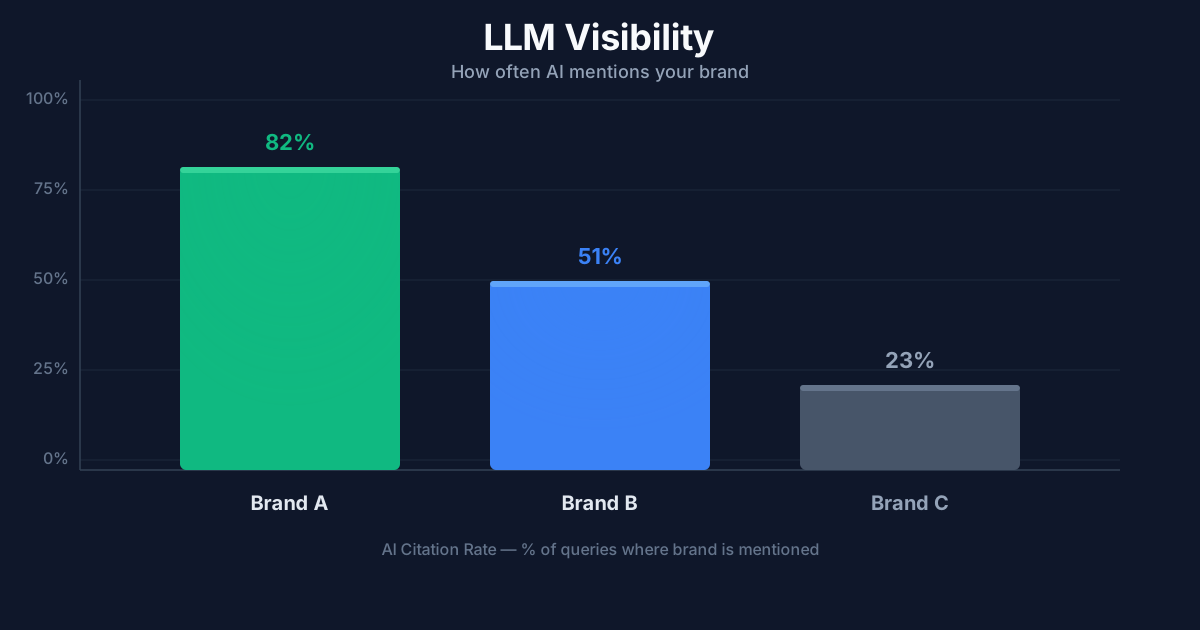
The metric to track is citation rate: the percentage of your target queries for which Perplexity includes your brand in the answer, measured consistently over time. A 5% citation rate on 50 queries means Perplexity cites you in roughly 3 out of 50 target answers. A 30% rate means you're dominant in that topic area.
Common Mistakes That Kill Perplexity Citations
These are the patterns that consistently appear in sites with zero Perplexity presence:
Blocking PerplexityBot. The most common issue. Check your robots.txt — if there's a blanket Disallow or an explicit PerplexityBot block, you're not getting cited regardless of content quality.
No third-party presence. If your brand only appears on your own site, Perplexity has no corroboration signal. Perplexity doesn't trust lone-wolf self-promotion — it looks for a consistent presence across independent sources before surfacing a brand as a recommendation.
Stale content. A blog post from 2023 with no visible update date competes poorly against a page dated Q2 2026, even if the older content is technically more comprehensive. Add dates, refresh data, update examples.
Buried answers. If the answer to the query appears in paragraph five after four paragraphs of background context, Perplexity may extract the background instead of the answer. Lead with the answer — always.
Overly promotional copy. Perplexity avoids citing content that reads like advertising rather than information. Marketing-heavy copy gets filtered in favour of neutral, informative content. Keep promotional framing minimal in the body of any page you want cited.
Thin pages with no specific data. "Perplexity is a great AI search engine" teaches Perplexity nothing it doesn't already know. "Perplexity has 30 million monthly users growing 40% month-on-month, uses RAG architecture with its own PerplexityBot crawler, and uses a mix of OpenAI, Anthropic, Google, and xAI models" gives it something to extract.
Putting It All Together: A Prioritised Action Plan
If you're starting from scratch, here's where to focus your effort in order of impact:
Week 1 — Technical:
- Check and fix robots.txt (allow PerplexityBot and all AI crawlers)
- Submit sitemap to Bing Webmaster Tools, enable IndexNow
- Add
dateModifiedto Article schema on all key pages
Week 2–4 — Content structure:
- Audit your top 10 pages for direct-answer structure — does the first sentence of each H2 directly answer the section's implied question?
- Add Q&A sub-sections to any page targeting question-based queries
- Ensure all sections contain at least one specific statistic or named entity
Month 2 — Authority and corroboration:
- Create or update your G2, Capterra, and Product Hunt profiles
- Find 3–5 subreddits where your product category is discussed; contribute genuinely
- Identify 5 comparison posts or industry roundups where your brand should appear but doesn't; reach out
Ongoing:
- Update key pages quarterly with fresh data
- Set up Perplexity citation tracking (RankScope or manual sampling sheet)
- Monitor citation rate monthly; correlate changes to content updates
The effort required to build Perplexity visibility is the same effort that builds LLM visibility broadly. The signals are overlapping. Optimise for Perplexity and you're also improving your citation rate in ChatGPT, Google AI Overviews, and Google AI Mode simultaneously — because the underlying quality signals are shared across all AI search engines.
What Perplexity SEO Is Really About
Strip away the technical detail and Perplexity SEO comes down to one thing: being the most trustworthy, most current, most directly useful source on your topic at the exact moment someone asks a question.
Traditional SEO rewards historical authority. Perplexity rewards present relevance. That's a shift that actually works in favour of newer, leaner teams — if you produce fresher and more accurate content than the established players in your space, Perplexity will cite you over them.
The brands that will dominate Perplexity citations in 2026 and beyond are the ones building deep topic clusters, refreshing content systematically, and tracking their citation rates the way traditional marketers track keyword rankings. The ones who'll fall behind are the ones treating Perplexity like a mystery box — hoping for citations without measuring or optimising for them.
The starting point is simple: allow PerplexityBot, write a direct answer at the top of every section, and start tracking.