What is LLM Visibility? (And How to Measure It)
Ask ChatGPT to recommend the best project management tool for remote teams. It'll name three or four options — with specific reasons, confident framing, and no citation links. One brand will appear first, described as the go-to choice. Another might be framed as "good for smaller teams." One that's arguably just as capable may not show up at all.
That gap — between the brand that gets named first and the brand that gets skipped entirely — is LLM visibility.
LLM visibility is how present, prominent, and positively your brand appears in large language model outputs. It's not about ranking on a results page. It's about whether AI engines include you in their synthesized answers, where in the answer you appear, and how you're described when you do.
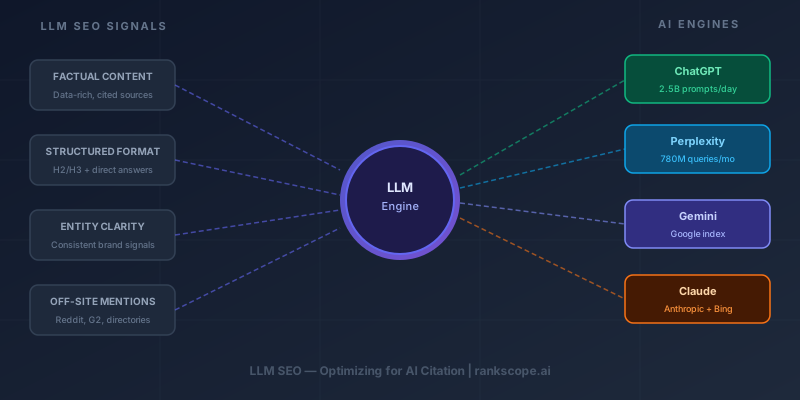
As AI-powered search engines handle a growing share of discovery — ChatGPT processing over 2.5 billion prompts daily, Perplexity handling 780 million queries per month, Google AI Overviews appearing in the majority of informational searches — LLM visibility is becoming as commercially important as traditional search visibility. For many categories, it already is.
This post defines what LLM visibility is, how it differs from SEO, what drives it, how to improve it through LLM optimization, and how to actually measure it.
What Exactly Is LLM Visibility?
LLM visibility is the degree to which your brand appears, and appears favorably, in responses generated by large language models.
It's useful to contrast this with traditional search visibility, which most marketers already understand:
- Search visibility = your rankings and impressions in Google's results pages. Measured by position, clicks, and impressions in Google Search Console.
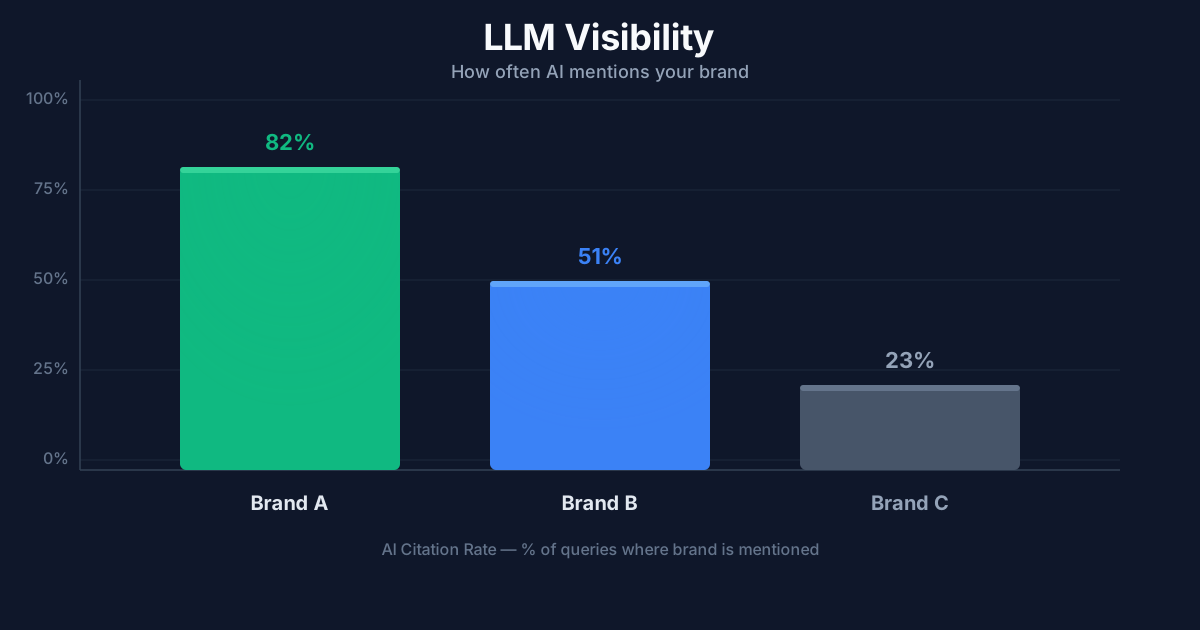
- LLM visibility = how often and how prominently your brand appears when AI engines generate responses to relevant queries. Measured by citation rate, share of voice, and mention prominence.
The two disciplines share some signals (authoritative content, technical accessibility, third-party mentions) but they're measuring fundamentally different things. You can have strong Google rankings and near-zero LLM visibility — and vice versa.
LLM visibility has three distinct dimensions:
1. Presence — Does your brand appear at all? For a given set of queries relevant to your category, what percentage of AI-generated responses mention your brand at least once? This is your citation rate, and it's the baseline metric.
2. Prominence — When you appear, where do you appear? Being the first brand named in an answer is meaningfully different from being fifth on a list. Being described as "the recommended option for most teams" is different from "also worth considering." Prominence captures where you land in the answer's hierarchy.
3. Framing — How is your brand described? AI engines don't just cite you — they characterize you. "The leading platform for enterprise GEO" carries more weight than "a newer tool that some teams use." Framing is controlled by the model, not your title tag, and it's shaped by how you and others describe your brand across the web.
All three dimensions matter. A brand with 80% citation rate but consistently last-place prominence and weak framing is in a worse position than a brand with 60% citation rate that appears first and gets described as the category leader.
Why LLM Visibility Is Different from SEO
Traditional SEO has a clear output: a ranked list of pages. Users scan positions 1 through 10, click what looks useful, and ignore the rest. The game is about ranking position, and the metrics (impressions, CTR, position) reflect that.
LLM visibility operates on completely different logic.
There are no positions. AI engines don't return a ranked list — they synthesize a response. Your brand either gets included in that synthesis or it doesn't. There's no position 1 to 10; there's cited or not cited, mentioned first or mentioned last, described accurately or described vaguely.
There's often no click. When ChatGPT names your brand in an answer, users frequently don't click anywhere. The recommendation itself is the conversion signal. This changes the economics entirely — brand mentions in AI responses drive direct navigation, not referral traffic. Standard analytics tools won't capture this.
Brand framing is controlled by the model. In traditional SEO, you control your title tag, meta description, and the snippet Google shows. In LLM responses, the model paraphrases and characterizes your brand based on its training data and what it retrieves. You influence this indirectly — through consistent messaging across your own pages and third-party coverage — but you don't control it directly.
Consistency varies across sessions and platforms. Run the same query through ChatGPT five times and you'll get five slightly different answers. Run it through ChatGPT, Perplexity, Google AI Overviews, and Google AI Mode and you'll likely get four meaningfully different brand sets. Each platform has different retrieval mechanisms, different training data weights, and different tendencies. Strong LLM visibility requires attention to all of them — not just optimizing for one.
The content bar is higher. Google rewards pages that match keyword intent. LLMs reward pages that contain specific, extractable facts that directly answer questions. Vague, promotional content that performs adequately in traditional search often gets skipped entirely by AI engines in favor of pages that give concrete answers.
What Drives LLM Visibility?
LLM visibility comes down to four factors. The brands that appear consistently across AI engines are typically strong on most of them.
1. Training Data Representation
Every large language model was trained on a massive dataset of web content. During training, the model built associations — learning what brands exist, what categories they belong to, and how they're typically described. If your brand appeared frequently and consistently in that training data, the model has a strong internal representation of who you are.
This matters because AI engines don't rely purely on live retrieval. When ChatGPT answers a question about your category from memory (without browsing the web), it draws on what it learned during training. A brand that was mentioned in thousands of blog posts, reviews, news articles, and community discussions before the model's training cutoff has a significant advantage over a brand that launched after it.
The limitation: you can't change what's already in a model's weights. Training data is a long-term signal, built over years of consistent brand presence. It's worth understanding, but it's not where short-term LLM optimization work pays off.
2. Live Retrieval (RAG)
Retrieval-Augmented Generation is how most modern AI search engines work at query time. When someone asks Perplexity or ChatGPT (with Browse enabled) a question, the system fetches live web pages and synthesizes an answer from what it finds. This is the pathway you can most directly influence right now.
Each platform retrieves from different sources:
- ChatGPT draws from Microsoft Bing's index for Browse mode
- Perplexity runs its own aggressive crawler (PerplexityBot), strongly weighted toward freshness and relevance — see the Perplexity SEO guide for the full Perplexity-specific optimisation playbook
- Google AI Overviews uses Google's own search index
- Google AI Mode similarly draws from Google's index with additional synthesis
If your pages rank on the first page for relevant queries in the underlying search index, they're far more likely to get retrieved and cited. Bing Webmaster Tools, Google Search Console, and technical crawlability all feed into this. LLM SEO and traditional SEO share more signal here than people realize.
3. Content Extractability
Retrieval is necessary but not sufficient. AI engines fetch multiple pages and then decide what to quote, paraphrase, and cite in the final answer. The pages that get cited are almost always the ones that make extraction easy.
Extractable content has specific characteristics:
- Each section opens with a direct answer, not a preamble
- Claims are specific and factual: numbers, named examples, comparisons
- Sections are self-contained — a reader (or model) can understand one section without reading the rest
- Headers are descriptive statements, not clever wordplay
- FAQ sections provide explicit Q&A structure that maps directly to common queries
Pages that spend three paragraphs setting up context before answering rarely get cited. Pages that open with "LLM visibility is X, measured by Y, and driven by Z" and back it up with specific data almost always do. This is the most controllable variable in LLM visibility.
4. Third-Party Authority
AI engines don't just retrieve from your own site. They weight content from sources they already trust — major publications, industry review platforms, analyst reports, and community forums. A mention in TechCrunch, a G2 review, a Reddit thread, or an analyst report from Gartner carries significantly more weight in shaping your LLM representation than an additional page on your own blog.
This is why brand visibility programs — getting covered by journalists, earning reviews on G2 and Capterra, building presence in industry Slack groups and forums — have real LLM visibility value. The goal isn't just referral traffic; it's building third-party signal that AI engines can retrieve and trust.
What Is LLM Optimization (LLMO)?
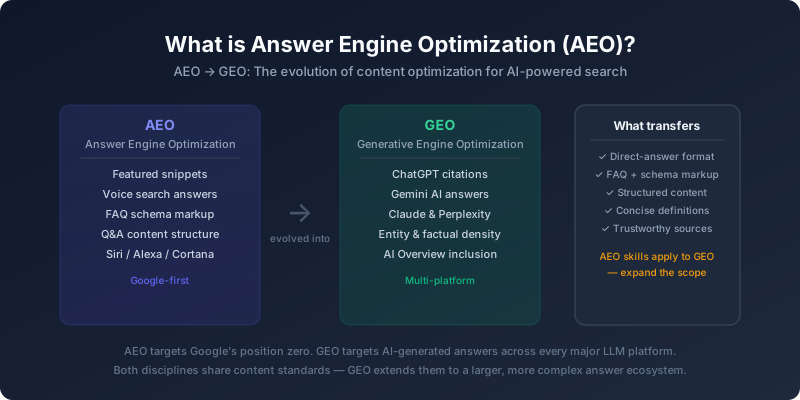
LLM optimization is the practice of deliberately improving your LLM visibility. It's sometimes called LLMO to distinguish it from traditional SEO, though the two disciplines overlap considerably in practice. If you've seen the term LLM SEO, that refers to the same concept — optimizing content and brand presence so AI engines cite you.
The core tactics:
Write for extraction. Open every section with a direct answer. If someone asked "what is [topic]?" in a search bar, your first sentence should answer it. Avoid "In this section, we'll explore..." openers. AI engines skip those and look for the actual answer.
Add specific data. Numbers, statistics, and named examples are what AI engines cite. "Conversion rates are often higher" is not citable. "B2B SaaS companies see 3–5x higher conversion rates from branded AI citations than from organic search" is. Specificity is extractability.
Build consistent entity signals. Your brand name, your category, and your key differentiators should appear together consistently — across your homepage, product pages, and landing pages, and across third-party mentions. If your brand is described differently in different places, AI engines get a blurred picture. Clarity and repetition build entity authority.
Earn coverage on cited sources. Identify which domains AI engines cite most often when answering questions in your category. Those are your outreach targets. Getting mentioned on a site that ChatGPT retrieves regularly is worth more for LLM visibility than a backlink from a domain that doesn't appear in AI responses.
Add an llms.txt file. Modeled on robots.txt, an llms.txt file at your domain root signals to AI engines which pages are most relevant and citable. It's an emerging standard and not yet universally respected, but it costs nothing to implement and signals intentionality about AI accessibility.
Keep AI crawlers unblocked. Check your robots.txt to ensure GPTBot, OAI-SearchBot, PerplexityBot, and Google's AdsBot-Google are allowed. Blocking these means live retrieval can't include your content regardless of its quality.
How to Measure LLM Visibility
Most marketing teams have no idea what their LLM visibility looks like — because their existing tools simply don't measure it.
Google Search Console shows Google search data. Ahrefs and Semrush show rankings and backlinks. GA4 shows website traffic. None of these capture what ChatGPT says when someone asks about your product category. If ChatGPT names your competitor first in 10,000 answers today, your dashboard won't tell you.
Measuring LLM visibility requires tracking five distinct metrics:
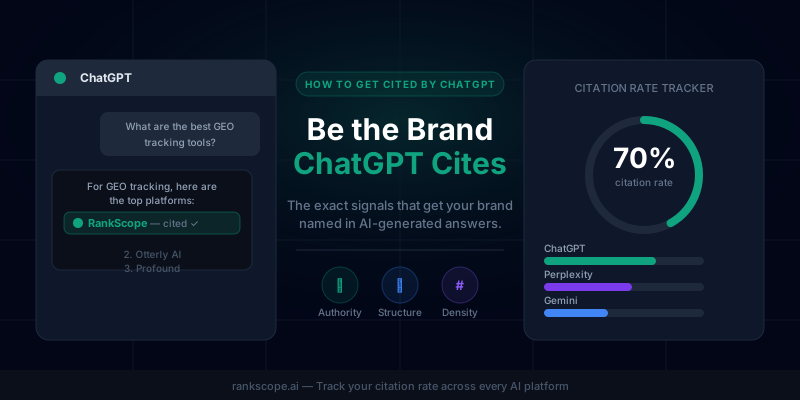
Citation rate — The percentage of your tracked prompts where your brand is mentioned at least once. If you track 50 category queries and your brand appears in 32 of the ChatGPT responses, your citation rate on ChatGPT is 64%. This is your headline metric.
Share of voice — Your citation count relative to competitor citations across the same prompt set. If your brand appears in 32 out of 50 responses and your top competitor appears in 41, you have a 32/41 share of voice ratio. This contextualizes your citation rate — a 64% citation rate looks different if the category leader has 90%.
Mention prominence — Where in the response your brand appears. First mention, last mention, or recommended? Some tracking approaches score this numerically (1st mention = score of 5, last mention = score of 1). Prominence shapes whether the citation drives brand consideration or just awareness.
Engine coverage — Which AI platforms cite you? Your ChatGPT citation rate and your Google AI Overviews citation rate may differ significantly. A brand with strong training data representation often performs well on ChatGPT but poorly on Perplexity, which weights freshness differently. Understanding engine-specific gaps helps prioritize optimization work.
Sentiment and framing — How is your brand described? "The leading platform for enterprise GEO" vs. "a newer option still gaining traction" represent very different LLM visibility positions even if citation rate is the same. Systematic framing analysis requires either manual review or NLP-based classification at scale.
Platforms like RankScope are built to track these metrics — running your prompts across ChatGPT, Google AI Overviews, Perplexity, and Google AI Mode and surfacing citation rate, share of voice, and competitive benchmarks in one dashboard. Because RankScope uses real browser responses rather than API outputs, the data reflects what users actually see.
Getting Started with LLM Visibility
The fastest way to understand your current LLM visibility is to measure it manually before setting up any automated tracking. Three steps:
Step 1: Run your top 10 category queries manually. Open ChatGPT, Perplexity, and Google AI Overviews. Ask the questions your ideal customers are asking — "best [category] tools," "how to [solve problem you solve]," "[your category] for [your use case]." Note where you appear, where you don't, and who consistently appears first.
Step 2: Audit your top pages for extractability. Look at your five most important pages. Does each section open with a direct answer? Is there specific data — numbers, comparisons, named examples — on every page? Are your headers descriptive statements rather than vague labels? If the answer to any of these is no, that's where LLMO work starts.
Step 3: Identify your third-party citation targets. Look at the AI responses from step 1. Which third-party sources (publications, review sites, forums) are cited when AI engines mention your competitors? Those are your outreach priorities. A placement on one of those domains will do more for your LLM visibility than a dozen new blog posts.
For a one-off baseline you can run right now, our free AI visibility checker tests 5 prompts across all four engines without an account. For a systematic baseline across all four major AI engines — and ongoing tracking as your citation rate changes — get started with RankScope. It runs your tracked prompts automatically and surfaces your citation rate and share of voice across all four engines: ChatGPT, Perplexity, Google AI Overviews and Google AI Mode. For a full breakdown of how to build a monitoring workflow and what to track week-over-week, see our guide to LLM monitoring. For a comparison of all the platforms available for this kind of tracking, see our LLM SEO tools guide.
Frequently Asked Questions
What is LLM visibility? LLM visibility is how often and how prominently your brand appears in responses generated by large language models like ChatGPT, Perplexity, Google AI Overviews, and Google AI Mode. It's measured by citation rate (how often you appear), share of voice (your citations vs competitors), and mention prominence (whether you're first-mentioned or recommended).
What is the difference between LLM visibility and SEO? Traditional SEO measures your rankings and visibility in search engine results pages. LLM visibility measures how often your brand is cited in AI-generated answers. There are no rankings in AI responses — you either get cited or you don't, and the framing of that citation matters as much as the mention itself.
What is LLM optimization (LLMO)? LLM optimization (LLMO) is the practice of improving your brand's visibility in large language model outputs. Key tactics include writing content in direct-answer format, adding factual density with specific data, building consistent entity associations, and earning coverage on sources AI engines already trust.
How do I measure my LLM visibility? LLM visibility requires dedicated tracking tools — standard SEO tools like Google Search Console don't capture AI citations. You need to track citation rate, share of voice, and engine coverage across ChatGPT, Google AI Overviews, Perplexity, and Google AI Mode. Tools like RankScope automate this measurement.