What is LLM SEO? How to Optimize for Large Language Models
Search has split in two. There's Google, where you rank for keywords. And there's everywhere else — ChatGPT, Perplexity, Claude, Gemini — where AI engines synthesize answers and name specific brands directly to users.
LLM SEO is how you show up in the second category.
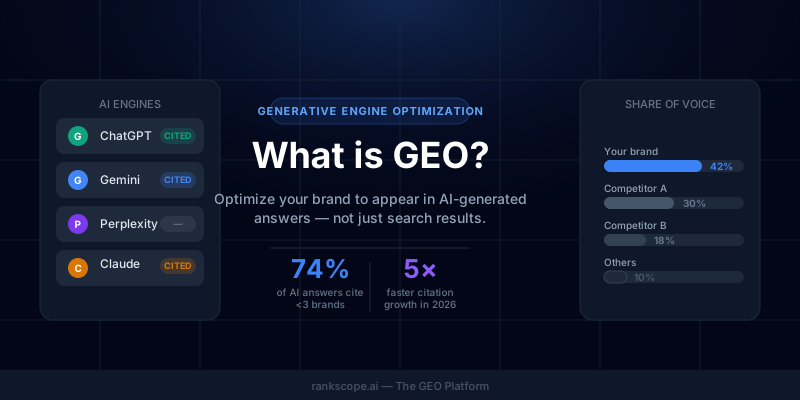
LLM SEO (large language model search engine optimization) is the practice of optimizing your content and brand presence so that AI-powered search engines cite you when answering questions relevant to your business. Instead of ranking on a results page, you're being included in a synthesized answer — or you're not there at all.
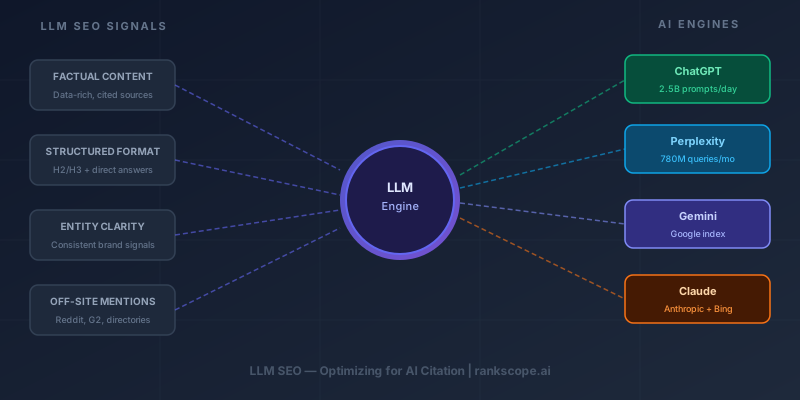
ChatGPT now processes over 2.5 billion prompts daily across more than 900 million weekly active users. Perplexity handles 780 million queries per month. When someone asks those tools about your product category, a shortlist of brands gets named. The goal of LLM SEO is making sure your brand is on it. How well you appear in those answers is your LLM visibility — the measure of how often and how prominently AI engines cite your brand.
What Does "LLM SEO" Actually Mean?
LLM stands for large language model — the AI technology powering ChatGPT, Claude, Gemini, Grok, and Perplexity. These models are trained on vast amounts of text data, and they're what generates the answers when someone types a question into an AI search tool.
LLM SEO optimizes for those models specifically. You'll also see it called:
- LLMO — large language model optimization
- GEO — Generative Engine Optimization, the broader strategic term
- AEO — Answer Engine Optimization (more specific to featured snippets)
- AI SEO — a catch-all term; see what is AI search engine optimization for a full breakdown
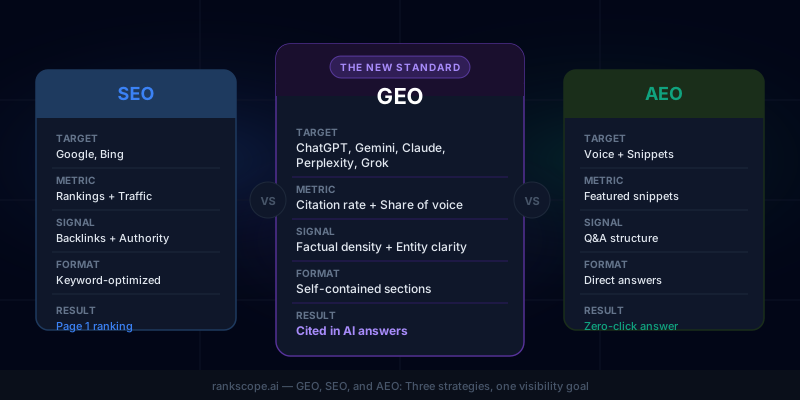
These terms are largely interchangeable in practice. LLM SEO tends to emphasize how models process content. GEO tends to emphasize the full strategy for AI citation visibility. If you want to get into the terminology details, GEO vs SEO vs AEO covers the distinctions clearly.
How LLMs Actually Find and Use Your Content
To do LLM SEO well, you need to understand how these models encounter your content in the first place. There are two distinct pathways — and they require different tactics.
Pathway 1: Training Data
Large language models are trained on massive internet datasets (Common Crawl being the largest). During training, the model reads billions of pages and builds associations: it learns what your brand does, how it's described, and what category it belongs to.
If your brand appears frequently and consistently across the web before a model's training cutoff, the model will "know" about you without any live search. This is why Wikipedia mentions, industry publication features, and high-authority backlinks still matter for LLM SEO — they all feed training datasets.
The catch: training data has a cutoff date. You can't update what a model already learned. This pathway builds slowly over years of consistent brand presence.
Pathway 2: Real-Time Retrieval (RAG)
Retrieval-Augmented Generation (RAG) is how most modern AI search engines work at query time. When someone asks Perplexity or ChatGPT a question, the model doesn't just pull from its training data — it fetches live web pages, reads them, and synthesizes an answer from what it finds.
This is the pathway LLM SEO can influence right now. If your page ranks in Google or Bing (which feed ChatGPT's retrieval), if Perplexity's crawler can access it, if the content directly answers the question — your page can be cited in real time.
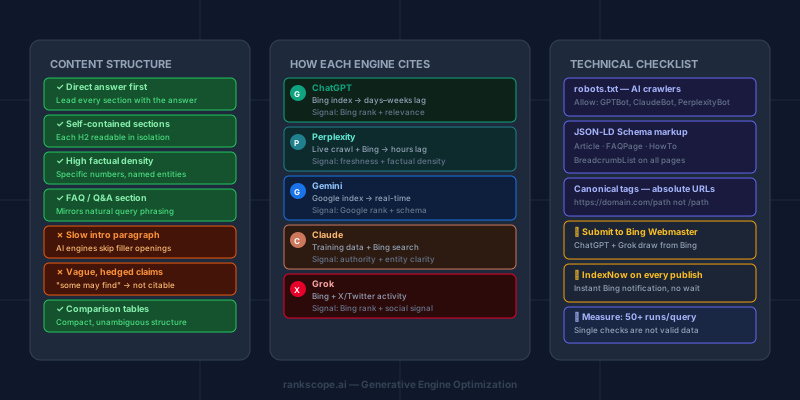
Each AI engine retrieves differently:
- ChatGPT draws from Microsoft Bing's index
- Perplexity runs its own aggressive crawler, weighted toward freshness
- Gemini uses Google's search index
- Claude uses Anthropic's training data plus Bing-sourced real-time search
- Grok layers in X/Twitter activity alongside Bing
LLM SEO vs Traditional SEO: What's Different
Both disciplines share a foundation — quality content, technical health, authority, and trust all still matter. But LLM SEO has a different optimization target, different signals, and different metrics.
| Traditional SEO | LLM SEO | |
|---|---|---|
| Goal | Rank in Google's blue links | Get cited in AI-generated answers |
| Primary signal | Backlinks + keyword relevance | Entity clarity + factual density |
| Content structure | Keyword placement, heading tags | Self-contained sections, direct answers first |
| Success metric | Ranking position, organic traffic | Citation rate, share of voice |
| Platform | Google, Bing | ChatGPT, Perplexity, Claude, Gemini, Grok |
| Update cycle | Rankings shift weekly | Citations shift with model updates and RAG freshness |
The most important difference: ranking #1 on Google does not automatically mean ChatGPT cites you. Their retrieval systems are separate. A page can rank well in Google and never appear in an AI answer, and a page that ranks lower in Google can be the one AI engines cite consistently — because it's better structured for extraction.
The 6 Core LLM SEO Tactics
These are the highest-leverage changes you can make to improve citation rate across AI platforms. For the full optimization playbook, see our guide on how to optimize content for AI search.
1. Lead Every Section With a Direct Answer
AI engines extract the first complete, self-contained sentence of a section far more often than buried conclusions. Structure your content like this:
Wrong: Here's some background on the topic, and after all these considerations, what it really means is…
Right: [Direct answer in one sentence.] Here's why that matters…
Every H2 section should be answerable on its own, without requiring the surrounding context. If an LLM extracts your section and reads it in isolation, the answer should still be complete.
2. Build Entity Associations
LLMs associate brands with categories through consistent entity signals across the web. If every major reference to your brand — your website, third-party reviews, directory listings, press mentions — uses the same description, the model builds a strong association between your brand name and your category.
Inconsistent descriptions are confusing to models. "RankScope is an AI citation tracker" and "RankScope is an SEO analytics platform" send different signals. Pick one clear description and use it everywhere.
3. Increase Factual Density
Vague, hedged prose doesn't get cited. Specific, factual, data-rich content does. LLMs are trained on factual data and weighted toward content they can confidently cite — which means content with named entities, specific numbers, and verifiable claims consistently outperforms generic prose.
- Include specific statistics (with sources)
- Name specific platforms, tools, or methodologies
- Cite studies or original research when possible
- Avoid filler language and hedging
4. Build Third-Party Mentions
Roughly 85% of LLM citations for broad category queries come from third-party sources, not your own website. Forums (Reddit, Quora), review platforms (G2, Capterra), industry directories, and publications — these are what AI models weight heavily when retrieving answers.
Brand mentions in third-party content correlate at 3:1 over backlinks for AI Overview placement. This isn't the same as traditional link-building. It's about off-site presence: being mentioned, described, and recommended in the places AI models crawl and trust.
5. Allow AI Crawlers
If your robots.txt blocks AI crawlers, you won't be cited — regardless of content quality. Make sure your site explicitly allows:
User-agent: GPTBot
Allow: /

User-agent: ClaudeBot
Allow: /

User-agent: PerplexityBot
Allow: /

User-agent: GoogleBot-Extended
Allow: /
This is the fastest technical fix available. One file change, immediate impact on crawlability.
6. Keep Content Fresh
65% of AI bot crawl activity targets content published within the past year. Pages updated within the last two months earn 28% more citations than static pages. This doesn't mean rewriting everything constantly — it means revisiting high-priority pages quarterly to update statistics, add new sections, and refresh examples.
What LLM SEO Doesn't Mean
A few common misconceptions worth clearing up.
It's not about stuffing "LLM" into your content. LLMs don't reward keyword density. They reward contextual relevance, factual clarity, and structural extractability.
It's not a replacement for traditional SEO. Google remains the dominant search channel for most industries. LLM SEO adds a layer — it doesn't replace the foundation. Traditional search authority (indexed pages, backlinks, technical health) also helps AI systems trust you as a source.
It's not a one-time fix. LLM SEO requires ongoing measurement. Citation rates change as models update, competitors publish new content, and retrieval algorithms shift. Brands that treat it as a one-time audit and move on will lose ground to brands monitoring and adjusting continuously.
LLM SEO and GEO: Same Thing, Different Frame
The term "GEO" — Generative Engine Optimization — is increasingly standard in the industry. It covers the same ground as LLM SEO but frames it from the user's perspective (optimizing for generative search experiences) rather than the technical layer (optimizing for LLMs specifically).
Both terms are in wide use. Some practitioners prefer LLM SEO when discussing technical optimization signals (how models process content). Others prefer GEO when discussing strategy (how to build AI citation authority over time). If you're building a GEO program, you're doing LLM SEO — and vice versa.
The GEO vs SEO vs AEO breakdown is worth reading if you want to understand where these disciplines overlap and where they diverge.
How to Measure LLM SEO Performance
The fundamental metric in LLM SEO is citation rate: how often your brand appears in AI-generated answers when someone asks a question relevant to your category.
Supporting metrics include:
- Share of voice — your citations vs. competitors for a set of target queries
- Citation sentiment — whether AI answers describe your brand positively, neutrally, or negatively
- Platform coverage — which AI engines cite you, and which don't
- Citation source breakdown — are you being cited from your own site, or from third-party mentions?
- Position in answer — are you the first brand named, or mentioned as a footnote?
The challenge: you can't get this data from Google Analytics or traditional rank trackers. AI citation tracking requires sampling AI responses systematically — running the same queries across multiple AI engines, multiple times, and aggregating the results.
RankScope was built specifically for this. It tracks citation rate, share of voice, and sentiment across ChatGPT, Google AI Overviews, Perplexity, and Google AI Mode — giving you the data to know where you stand and what to fix, rather than guessing.
LLM SEO in Practice: What to Do First
If you're starting a LLM SEO program from scratch, here's the order that makes sense:
- Audit your robots.txt — confirm all major AI crawlers are allowed
- Run a citation baseline — sample 20–30 queries across your target category across each AI engine
- Fix the highest-traffic pages first — restructure them to lead sections with direct answers
- Write a clear, consistent brand description — use it across every property (your site, directories, third-party profiles)
- Identify citation gaps — where are competitors getting cited that you're not?
- Build third-party presence — directory listings, forum answers, review profiles
- Measure monthly — citation rate needs time to move; track trends, not single data points
For a complete step-by-step framework, the GEO checklist covers 60 actionable items across every stage of the process. And if you're evaluating which tools to use for tracking and optimization, our LLM SEO tools comparison covers every major platform with real pricing and honest pros/cons.
Frequently Asked Questions
What is LLM in SEO?
In SEO, "LLM" refers to large language models — the AI technology behind ChatGPT, Claude, Gemini, Perplexity, and Grok. LLM SEO is the discipline of optimizing content so these models cite your brand in their responses.
What is the difference between traditional SEO and LLM SEO?
Traditional SEO optimizes for Google rankings through keyword relevance and backlinks. LLM SEO optimizes for AI citation through factual density, entity clarity, direct-answer formatting, and off-site brand mentions. Both matter for most businesses — they target different discovery channels and require different tactics.
Is LLM SEO dead?
No — LLM SEO is accelerating. AI search traffic grew 600% between January 2025 and early 2026. As more users turn to AI tools for product research, brand discovery, and recommendations, LLM visibility becomes more valuable, not less. The brands building citation authority now are compounding an advantage that latecomers will struggle to close.
How long does LLM SEO take to work?
The technical fixes (robots.txt, content restructuring) can affect crawlability and citation rate within weeks. Off-site presence building and entity association take longer — typically 3–6 months to show measurable movement in citation rate. Like traditional SEO, LLM SEO rewards consistent effort over time.
Do I need a different strategy for each AI engine?
Yes, in practice. ChatGPT retrieves from Bing; Perplexity weights freshness heavily; Gemini uses Google's index; Claude uses a mix of training data and Bing; Grok adds X/Twitter signals. A platform-by-platform approach — auditing where you appear and don't appear for each engine — is more effective than generic optimization. Our guide on how to optimize content for AI search covers engine-specific tactics.
Ready to see where you actually stand? RankScope tracks your citation rate across ChatGPT, Google AI Overviews, Perplexity, and AI Mode — engine by engine, prompt by prompt. See plans from $49/mo →