What is AI Search Engine Optimization? (AI SEO Explained)
If you've noticed that more of your customers are getting answers directly from ChatGPT, Perplexity, or Google AI Overviews instead of clicking through to websites — you're not imagining it. AI-generated answers are now the first thing millions of people see when they search for a product, service, or solution. The click to your website often never happens at all. If you're new to this shift and want a foundational understanding of what AI search is and how the new search engines work, start there before diving into the optimization tactics here.
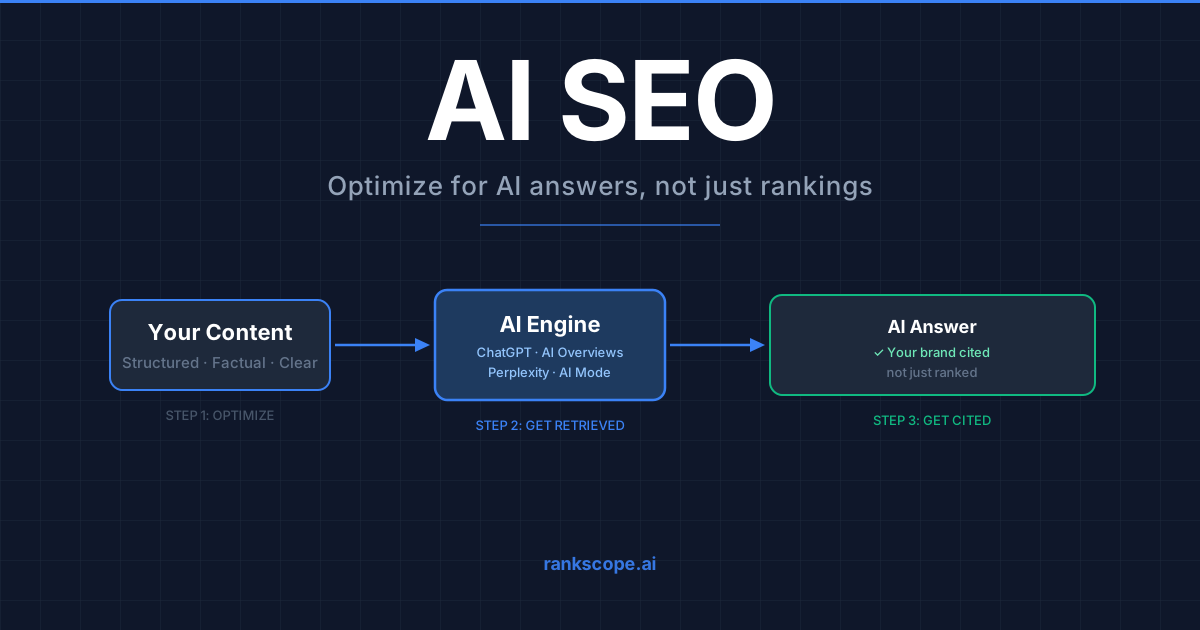
AI search engine optimization (AI SEO) is the practice of making your brand show up in those AI-generated answers, not just in the traditional ten blue links. Where traditional SEO is about earning a position on a search results page, AI SEO is about being cited, named, or recommended inside a synthesized AI response.
You may have heard different names for this: GEO (generative engine optimization), LLM SEO (large language model SEO), or AEO (answer engine optimization). They're all pointing at the same underlying problem — the search interface is changing, and the optimization playbook has to change with it. This guide uses "AI SEO" because it's the term most people search when they first encounter this concept.
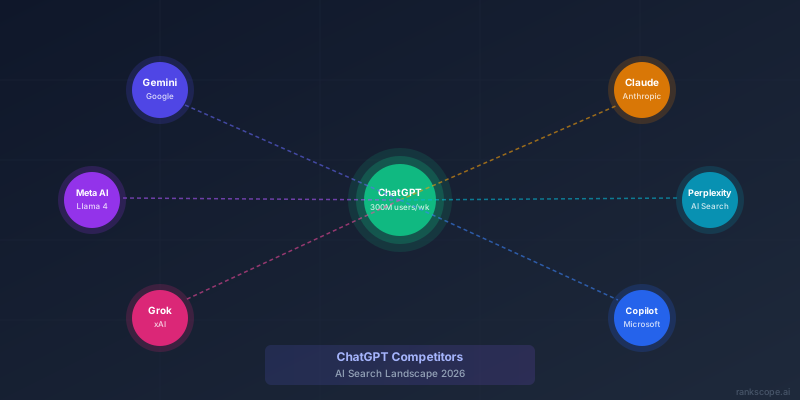
Whether you're a marketer trying to understand why competitors are getting mentioned in ChatGPT and you're not, or a founder looking to build AI visibility from scratch, this post covers what AI SEO is, how it works, what signals matter, how to measure it, and what to do about it. If you want a breakdown of how each AI platform differs — ChatGPT vs. Gemini vs. Claude vs. Perplexity — see our ChatGPT competitors guide.
What Does AI SEO Actually Mean?
AI search engine optimization is the practice of optimizing your content and brand presence so that AI language models cite, mention, or recommend your brand when answering questions in your category.
That definition has a few moving parts worth unpacking.
"Optimizing your content" means structuring pages so AI systems can extract clear, accurate, citable information — not just keywords for a crawler to index.
"Brand presence" goes beyond your own website. AI systems draw from the entire web: review sites, industry publications, forums, directories, and third-party coverage all factor into whether your brand gets cited.
"When answering questions in your category" is the key context. AI SEO isn't about showing up when someone types your brand name directly. It's about appearing when someone asks a broader question like "what's the best tool for tracking AI citations?" or "how do I improve my visibility in AI Overviews?" — questions where you'd want your brand in the answer.
How this differs from traditional SEO
Traditional SEO = rank in Google's index so people find your page in search results.
AI SEO = get cited in AI-generated responses so people encounter your brand inside the answer itself.
The mechanisms are different. Google ranks pages based on relevance signals and authority — links, content quality, technical factors. AI engines synthesize information from multiple sources and generate a response. They're not returning a ranked list of URLs; they're writing an answer. The signals that get you into that answer are not the same signals that get you ranked on page one.
The measurement is different. Traditional SEO is measured through rankings, impressions, and clicks — all visible in Google Search Console. AI SEO is measured through citation rate and share of voice across AI platforms — metrics that don't exist in any standard analytics tool.
The content requirements are different. Keyword-optimized content may rank well in Google but get ignored by AI engines if it doesn't provide clear, extractable, factually dense answers. AI systems extract passages, not pages — and they strongly prefer content that answers questions directly in the first sentence of each section.
How AI Engines Find Your Content
Understanding how AI systems actually encounter your content is essential for knowing what to optimize. There are two distinct pathways.
Pathway 1: Training data
Large language models like GPT-4, Claude, and Gemini were trained on enormous datasets of web content before their knowledge cutoff dates. During training, these models read billions of pages and built associations — they learned which brands exist, what they do, how authoritative sources describe them, and which companies are considered leaders in which categories.
If your brand had strong web presence before a model's training cutoff — through your own content, press coverage, Wikipedia mentions, industry publication features, and consistent brand signals across the web — the model may cite you from memory, without any live web retrieval happening at all.
Training data influence builds slowly, over years of consistent brand presence. You can't update what a model already learned. But it shapes your baseline visibility with models that rely heavily on their training knowledge rather than live retrieval.
Pathway 2: Live retrieval (RAG)
Most modern AI search engines don't just rely on training data. They also perform live web retrieval at query time — a process called Retrieval-Augmented Generation (RAG). When someone asks Google AI Overviews or Perplexity a question, the system searches the web in real time, pulls relevant pages, and synthesizes an answer from what it finds.
This is where the overlap with traditional SEO matters most, and where AI SEO work pays off quickly.
For RAG-based citations, AI engines retrieve pages that are already ranking well in search indexes. Google AI Overviews draws from Google's own index — if you're not on page one for a relevant query, you're unlikely to be retrieved. Perplexity runs its own aggressive crawler, weighted toward fresh content and clean markup. ChatGPT's Browse feature draws from Bing's index.
But ranking on page one isn't sufficient by itself. Once a page is retrieved, the AI system decides whether to actually cite it — based on how extractable and trustworthy the content is, not just whether it ranked. A page in position 3 with vague, preamble-heavy content may be retrieved and ignored. A page in position 7 with direct answers and factual density may be cited instead.
This is why AI SEO is a separate discipline even for teams with strong traditional SEO. Ranking and citation are correlated, but not the same thing. You need both: visibility in the index, and content worth citing once it's retrieved.
How each major AI engine retrieves content:
- Google AI Overviews — Google's own index; top-10 rankings are a significant retrieval advantage
- Perplexity — runs its own crawler; rewards freshness, clean markup, and factual specificity
- ChatGPT (with Browse) — draws from Microsoft Bing's index
- Google AI Mode — Google's conversational AI interface; similar retrieval behavior to AI Overviews
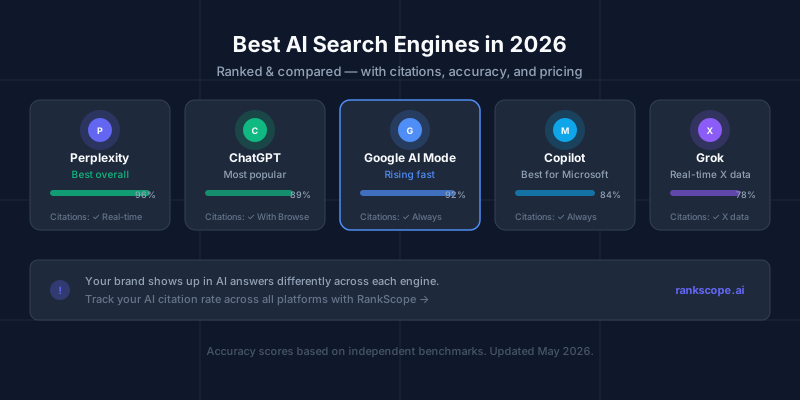
For a deeper look at how each platform works, what makes them different, and which to use when, see our comparison of the best AI search engines in 2026.
What Signals Matter for AI SEO?
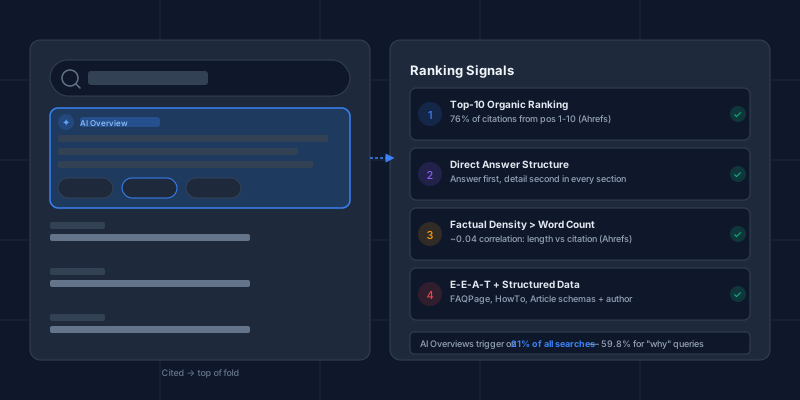
AI systems evaluate content differently than Google's ranking algorithm does. Backlinks matter far less. Exact-match keywords matter far less. What matters instead is whether your content is extractable, trustworthy, and factually useful. Four signals account for the majority of AI citation outcomes.
1. Factual density
Factual density is the ratio of specific, verifiable claims to vague generalities in your content. AI engines strongly prefer content with concrete data: percentages, timeframes, named examples, cited sources, and precise statements.
"Most companies struggle with AI visibility" is weak — it's a vague claim with nothing for an AI to extract and verify. "74% of ChatGPT responses in product categories name three or fewer brands" is factually dense — a specific, extractable, citable claim.
Original research is the highest-leverage content format for AI SEO. If your product or team generates data, publish it with specific numbers. If you're citing third-party research, include the specific figures and source names. Every time you replace a vague generality with a verifiable claim, you make your content more citation-worthy.
2. Entity clarity
AI models think in entities — named things with defined attributes and relationships. "RankScope" is an entity. "AI citation tracking" is an entity. "Generative Engine Optimization" is an entity.
For your brand to be cited confidently, AI engines need a clear, unambiguous picture of what your brand is, what category it belongs to, and what problems it solves. If your content is inconsistent about your category — or if third-party sources describe you differently — AI engines won't cite you confidently even when they know you exist.
Entity clarity requires consistency: the same category language on your website, in your schema markup (schema.org), in your press coverage, in your product listings, and across third-party directories. The more consistently your brand is described the same way across independent sources, the more confidently AI engines associate you with the right queries.
3. Third-party mentions
AI engines don't just crawl your website. They retrieve from the entire web — and they weight some sources more heavily than others. Sites that AI engines already cite frequently for a given topic carry significant trust weight.
Getting mentioned on authoritative industry publications, listed in software review directories (G2, Capterra, Product Hunt), discussed in active communities (Reddit, Hacker News), and covered in niche newsletters — these third-party mentions have more AI SEO impact than publishing additional content on your own blog.
The reason: AI systems are trained on and retrieve from diverse web sources. A brand appearing consistently across many independent sources looks more authoritative than a brand appearing only on its own domain. Third-party coverage is the signal that you exist in the broader world, not just on your own site.
4. Direct-answer structure
AI engines don't read full articles. They extract passages. And they strongly prefer passages that answer the question in the first sentence — no preamble, no "in this section we'll explore," just the answer followed by supporting detail.
The format that gets cited most consistently: heading as question or topic → direct answer in first sentence → supporting data → brief elaboration. Each section should be self-contained, making sense even if an AI system extracts only that one passage and ignores the rest of the page.
The order of information within each section matters more for AI SEO than for traditional SEO. A section that buries its answer in paragraph three is functionally invisible to AI citation, even if the answer is accurate and well-written.
AI SEO vs Traditional SEO: What's the Same, What's Different
AI SEO doesn't replace traditional SEO — they operate on the same content and often reinforce each other. But they have different goals, different signals, and different metrics. Understanding where they overlap and where they diverge helps you prioritize correctly.
| Aspect | Traditional SEO | AI SEO |
|---|---|---|
| Goal | Rank in search results | Get cited in AI-generated answers |
| Key signal | Backlinks + on-page relevance | Factual density + entity clarity |
| Primary metric | Rankings, CTR, organic traffic | Citation rate, share of voice |
| Platforms | Google, Bing | ChatGPT, AI Overviews, Perplexity, AI Mode |
| Content format | Keyword-optimized pages | Direct-answer, structured, citation-ready |
| Measurement tool | Google Search Console, Ahrefs | Dedicated AI citation tracking |
Where they overlap
If you're doing good traditional SEO — quality content, clear structure, authoritative sources, fast-loading pages, clean HTML — you're already part of the way to strong AI visibility. High-quality content helps both disciplines. Page-one rankings in Google directly support retrieval by Google AI Overviews. Technical SEO hygiene (crawlability, structured data, canonical tags) helps AI crawlers index your content correctly.
The authoritative sources you've built for traditional SEO — editorial coverage, industry citations, trust signals — also feed AI training data and influence retrieval weighting.
Where AI SEO adds new requirements
AI SEO adds specific requirements on top of a solid traditional SEO foundation:
- Direct answers at the top of every section — traditional SEO doesn't require this; AI citation consistently rewards it
- Factual density over keyword density — swapping vague claims for specific data improves AI visibility even when keyword placement doesn't change
- Third-party presence beyond backlinks — review directories, community mentions, and niche publication features matter for AI citation in ways they don't for Google rankings
- Entity consistency across the web — AI engines need consistent brand signals across all sources, not just your own domain
- llms.txt — an emerging standard that signals to AI crawlers which content on your site is most relevant and citable
Teams seeing the strongest AI SEO results are treating it as a layer on top of their existing SEO work, not a replacement for it. For a full breakdown of how these disciplines interact, see GEO vs SEO vs AEO.
How to Measure AI SEO
This is where most teams get stuck. You've published content, improved your structure, built some third-party mentions — but how do you know if it's working? Traditional tools (Google Search Console, Ahrefs, SEMrush) don't measure AI citations. They measure rankings and clicks, which reflect traditional search behavior, not AI citation outcomes.
AI SEO requires its own measurement framework.
Citation rate is the core metric: what percentage of your tracked prompts include a mention of your brand? If you're tracking 50 prompts relevant to your category and your brand appears in 17 of the AI-generated answers, your citation rate is 34%. This is the primary signal that your AI SEO work is having an effect.
Share of voice puts your citation rate in competitive context. If you appear in 34% of relevant prompts and your top competitor appears in 61%, you have a clear gap to close. Share of voice is more actionable than absolute citation rate because it tells you where you stand relative to the brands you're actually competing with.
Mention frequency and position tells you more than just whether you appear. Are you mentioned first, or buried at the end? First-mentioned brands in AI responses get more user attention — position within the response matters, not just presence.
Engine coverage breaks your citation data down by platform: are you being cited on Perplexity but missing from Google AI Overviews? Are you appearing in ChatGPT but not in Google AI Mode? Different engines retrieve differently, and gaps in coverage point to specific optimization opportunities.
Tools like RankScope are built specifically for this — tracking citation rate and share of voice across ChatGPT, Google AI Overviews, Perplexity, and Google AI Mode. The key differentiator from manual tracking or API-based tools: RankScope extracts real browser responses, which reflects what your actual users see, not sanitized API outputs that may differ from real-world behavior. For marketing and content teams doing this collaboratively, RankScope for marketing teams provides team-level tracking and shared dashboards so everyone working on AI SEO can see the same data.
Without systematic measurement, AI SEO is guesswork. You can't tell whether your content improvements are working, which engines are responding, or where competitors are outpacing you. Measurement comes first.
5 Tactics to Improve Your AI SEO Right Now
Once you understand the signals, improving AI SEO is methodical. These five tactics cover the highest-leverage moves available to most teams.
1. Audit your current AI citations
Before you optimize, establish a baseline. Open ChatGPT, Perplexity, and Google AI Overviews and run 10–20 prompts representing the questions your target customers ask — questions like "what's the best tool for X?" or "how do I solve Y problem?" Note whether your brand appears, what it says when it does, and which competitors are cited when you're not.
This manual audit takes less than an hour and reveals where you actually stand. You'll likely find consistent appearances in some engines and complete absence from others — which tells you exactly where to focus first.
2. Rewrite key pages for direct answers
Go through your most important pages — homepage, product page, key landing pages, top blog posts — and revise the structure so every section leads with a direct, citable answer. Not "In this section, we'll discuss how our platform helps teams track AI citations" but "RankScope tracks AI citation rate and share of voice across all four engines: ChatGPT, Perplexity, Google AI Overviews and Google AI Mode."
The test: could an AI engine extract the first sentence of each section as a standalone, accurate statement about your brand or topic? If yes, you've written for AI citation. If no, rewrite the opening.
3. Add factual density
Go through your existing content and replace vague claims with specific data. "Helps you track AI visibility" becomes "tracks citation rate across 4 major AI engines with daily refresh." "Customers see results" becomes "customers typically establish a citation baseline within 72 hours of setup."
If you have product data, usage statistics, customer outcomes, or original research — publish it with specific numbers. Numbers are to AI SEO what keywords were to early traditional SEO: the extractable signal that makes content citable.
4. Build third-party presence
Identify which sites and publications AI engines are already citing when answering questions in your category. Run your audit prompts and check which sources appear as citations in Perplexity and ChatGPT responses — those are the sources that carry weight.
Getting coverage on those sources has more AI SEO impact than publishing additional content on your own blog. Actively pursue: software review listings on G2 and Capterra, editorial features in industry publications, mentions in relevant communities (subreddits, Slack groups, Hacker News), and presence in curated tool directories. Third-party mentions are the signal AI engines use to validate that your brand exists in the broader web, not just on your own domain.
5. Create llms.txt
llms.txt is an emerging standard — a plain-text file at the root of your domain (yoursite.com/llms.txt) that tells AI crawlers which pages on your site are most relevant, what your brand does, and how to interpret your content hierarchy.
It's analogous to robots.txt for traditional search crawlers, but purpose-built for AI systems. Creating llms.txt takes under an hour and costs nothing — it's one of the fastest AI SEO implementations available right now, and early adoption gives you a signal advantage while many competitors haven't done it yet.
The Bottom Line
AI search engine optimization isn't a replacement for traditional SEO — it's a new layer on top. The good news: most of what makes content good for AI visibility also makes it better for humans. Direct answers, factual specificity, and clear entity associations are just good writing. If you're already doing serious traditional SEO work, you're starting from a stronger position than you think.
The difference is intention. Writing for AI citation means leading every section with the answer, building factual density into every claim, and thinking about your content as a collection of extractable passages rather than a single document to be read top-to-bottom.
The brands that will be consistently cited in AI answers three years from now are building these habits today, while the competitive landscape is still forming. The brands still treating AI SEO as a future problem will find the citations have already been allocated.
If you want to see where you actually stand across the four major AI engines — and track how that changes as you publish — RankScope gives you the baseline and the measurement layer to see what's working.