Is Moz Good for AI Search Visibility? (+ The Best Moz Alternative in 2026)
Here's something you don't see in most "Moz alternative" posts: Moz is a decent tool for what it does. Domain authority tracking, local SEO, keyword research, link building — Moz has been doing these things since 2004 and has iterated them to a reasonable standard. If you need a traditional SEO platform that won't break the bank, Moz Pro is a legitimate option.
But "what it does" is the key phrase. And what Moz does has a hard boundary that matters more in 2026 than it did even two years ago.
Moz does not track anything that happens inside an AI-generated answer.
Not what ChatGPT says about your brand when someone asks for product recommendations. Not whether your company is cited in Google AI Overviews, which now appear on 15-20% of all US Google searches. Not how you compare to competitors in Perplexity's AI search results. Not what Google AI Mode — the full AI-first search interface that Google has been rolling out aggressively — generates when someone searches your category.
For most of Moz's history, that gap didn't exist. Traditional Google results were the game, and Moz played it well. But AI search is now a separate channel, with separate citation logic, separate ranking factors, and separate winners — and Moz has no measurement infrastructure for any of it.
That's the gap this post is about.
Is Moz Good for AI Search Visibility?
Moz is not built for AI search visibility. It tracks traditional search metrics — domain authority, keyword rankings, backlink profiles, and organic traffic estimates. None of those metrics tell you whether your brand is being cited in ChatGPT, Google AI Overviews, Perplexity, or Google AI Mode.
Here's what Moz measures vs what AI search visibility requires:
| What Moz Measures | What AI Search Visibility Requires |
|---|---|
| Domain authority (DA) | Brand entity clarity |
| Keyword rankings in Google | Citation rate in AI responses |
| Backlink count and quality | Structured, extractable content |
| Organic traffic estimates | Prompt coverage (queries that trigger AI citations) |
| On-page SEO health | AI crawlability (GPTBot, ClaudeBot, PerplexityBot access) |
| SERP position tracking | Share of Voice in AI-generated answers |
Moz's "Search Visibility" metric — often what people mean when they search for "moz search visibility" — measures the percentage of organic clicks your site captures across tracked keywords. It's a useful SEO metric. It has nothing to do with whether AI engines cite you.
If you're asking whether Moz tracks how often ChatGPT or Google AI Overviews mentions your brand: it doesn't. That's a fundamentally different data layer requiring direct AI engine querying, not SERP scraping.
What Moz Does Well (Honestly)
Before getting to alternatives, here's a clear-eyed read on what Moz Pro actually delivers — because understanding its strengths clarifies what "alternative" actually means in this context.
Domain Authority and link metrics. Moz invented Domain Authority (DA) as a metric, and while it's imperfect and Moz doesn't hide that, it's still widely used as a proxy for link profile strength. The Link Explorer tool gives you referring domain counts, anchor text distribution, new and lost link alerts, and link gap analysis against competitors. For teams tracking link building progress over time, this is functional and readable.
Keyword research. Moz's Keyword Explorer surfaces monthly volume estimates, keyword difficulty, organic CTR potential, and priority scoring that combines all three into a single prioritization signal. The interface is straightforward, and the tool is good enough for most keyword planning workflows even if it's not as deep as Semrush's database.
On-page optimization. The Moz On-Page Grader analyzes individual URLs against a target keyword — checking title tags, headers, content length, keyword usage, and page authority relative to competitors ranking for the same term. It's useful for quick audits, particularly for in-house teams that want checklist-style guidance without a dedicated SEO consultant.
Local SEO. Moz Local is genuinely strong for local businesses. Citation tracking, NAP consistency, Google Business Profile sync, duplicate listing detection, and local ranking monitoring across major directories. If local visibility is a significant part of your SEO program, Moz Local is worth pricing seriously.
Site audit. Moz Pro's site crawler covers technical issues — broken links, redirect chains, missing meta tags, crawlability problems — with clear severity scoring. Not as comprehensive as more expensive tools, but solid for sites under ~100K pages.
What it isn't: a real-time ranking tracker at Semrush's scale, a backlink database at Ahrefs' depth, or a content research tool at either platform's breadth. Moz is a practical, affordable traditional SEO toolkit. It has tradeoffs even within the traditional SEO space. But for the specific question of AI search visibility, the gap isn't about tradeoffs — it's a complete absence. There's nothing to compare.
What Moz Cannot Do for AI Visibility
This deserves to be explicit, because some Moz users assume the platform will eventually surface AI data alongside keyword rankings. As of mid-2026, that's not the case. Here's what's missing and why each piece matters:
1. Citation tracking in ChatGPT, Perplexity, and AI Mode
Moz tracks Google keyword rankings. When someone types a query into ChatGPT, Perplexity, or Google AI Mode and gets an AI-generated answer that cites companies, tools, or people — Moz sees none of that. You can have an excellent DA score and rank in the top three for a competitive keyword in traditional Google, and still be completely absent from every AI-generated answer in your category. That disconnect is increasingly common, and Moz gives you no way to detect it.
2. Google AI Overviews citation tracking
This is the most significant gap for most Moz users, because Google AI Overviews affects Google traffic directly. When your tracked keyword triggers an AI Overview, Moz might show you it triggered one — but it has no visibility into whether your brand is cited inside it. "Your keyword has an AI Overview" and "your brand is cited in that AI Overview" are entirely different signals. Only one of them tells you whether you're winning in that channel.
3. Share of Voice in AI answers
Share of voice in AI search means: across all AI-generated responses to queries in your category, what percentage mention your brand? This is the AI-era equivalent of market share in organic rankings. Moz has no way to calculate this because it doesn't read or store AI response content.
4. Forensic response tracking
When your AI visibility changes — citation rate drops, a competitor starts appearing where you used to — you need to know what changed in the actual AI response text. Forensic diff tracking captures word-level changes in AI answers over time, so you can see whether the AI restructured a response, added a competitor, changed how it describes your category, or quietly dropped your brand from a cluster it used to include you in.
This diagnostic layer doesn't exist anywhere in traditional SEO tooling, including Moz.
5. Moz DA is not an AI ranking signal
It's worth saying clearly: Domain Authority is a metric designed to predict Google's traditional ranking algorithm. AI search engines — ChatGPT, Perplexity, Google's AI surfaces — use different signals. A site with a DA of 15 that publishes deeply factual, well-structured content on a specific topic can outperform a DA-80 domain in AI citations for that same topic. If you're optimizing for AI visibility, understanding generative engine optimization means measuring entity relevance, content density, and citation patterns — not domain authority.
This is why AI visibility is a separate measurement problem, not an extension of the metrics Moz already surfaces.
The 6 Best Moz Alternatives for AI Search Visibility
1. RankScope — Best Dedicated AI Visibility Layer
RankScope was purpose-built for generative engine optimization — tracking and improving how AI search engines represent your brand in generated answers. It covers all four major AI engines: ChatGPT, Google AI Overviews, Perplexity, and Google AI Mode.
The distinction from Moz and from lighter alternatives is that RankScope isn't just counting mentions. It tracks the full text of AI responses over time, calculates Share of Voice against specific competitors, surfaces forensic diffs when AI answers change, and does all of this through real browser sessions — not API calls that may diverge from what actual users see.
Engine coverage: ChatGPT, Google AI Overviews, Perplexity, and Google AI Mode. Google AI Overviews and Google AI Mode are specifically where Moz leaves a blind spot — and they're also where the most search traffic is at stake for most brands. Google AI Overviews alone now appears on a significant portion of commercial and informational queries in the US.
Real browser responses. This matters specifically for Google's AI surfaces. API calls and real browser sessions can return different AI Overviews content because Google personalizes, A/B tests, and updates these responses continuously. RankScope uses actual browser sessions, which means the data reflects what real users see — not a potentially outdated or simplified API response. This is why the forensic diffs are meaningful rather than noisy.
Forensic diffs. When your citation rate drops or a competitor's share of voice spikes, RankScope shows you the exact text change in AI responses — highlighted word by word, filterable by engine and date. You can see precisely when a competitor was added to a ChatGPT response, when the AI changed how it describes your product category, or when your brand was removed from a cluster it previously appeared in. That's the diagnostic capability that turns citation data into something actionable.
Share of Voice per engine. For any configured set of tracking prompts, RankScope calculates what percentage of AI responses mention your brand versus each competitor, broken out by engine. This is the competitive AI search metric — the one that tells you if you're gaining or losing ground in AI-generated results relative to your competitive set.
Pricing:
- Starter: $49/month — 2 engines (ChatGPT + AI Overviews), 40 prompts, 3 competitors, 5 manual scans
- Pro: $149/month — all 4 engines, 150 prompts, 10 competitors, 30 manual scans, GA4/GSC/Looker integration, API access
- Agency: $399/month — all 4 engines, 400 prompts, unlimited competitors, 25 client workspaces, white-label reporting
No setup fee. No sales call required. No annual lock-in.
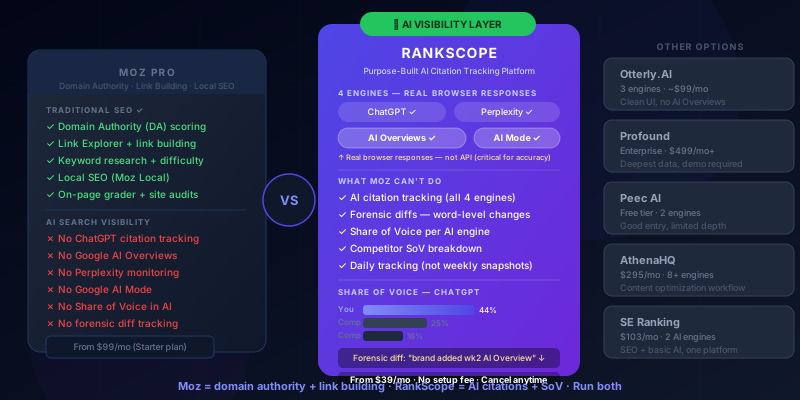
What Moz still wins on: Everything RankScope doesn't do. Domain authority tracking, local SEO (Moz Local is genuinely strong here), keyword research, link building workflow, on-page graders, traditional rank tracking. These tools have zero functional overlap. The right frame is: Moz handles your traditional search measurement and optimization; RankScope handles AI search. They're parallel layers, not competing products.
Get started with RankScope → — No setup fee · Cancel anytime
2. Otterly.AI — Best for Reporting-Focused Teams
Otterly has built a genuinely clean AI visibility product. The interface is arguably the most polished in this space — easy to set up, easy to read, and easy to show stakeholders who don't want to dig into data. Citation trend charts, mention rate tracking, and automated weekly summaries make it useful for teams where the primary need is stakeholder visibility rather than deep technical diagnosis.
Engine coverage is ChatGPT, Perplexity, and Gemini — three engines, with no Google AI Overviews or Google AI Mode. For teams where Google's AI surfaces are primary tracking needs, this is a significant gap. For teams primarily reporting on ChatGPT and Perplexity presence, it's a usable and well-designed option.
Where it fits: Teams where clean executive reporting is the priority and Google's AI surfaces aren't in scope. Marketing managers who need to show AI visibility trend lines in monthly reviews without deep technical analysis.
Pricing: Starts around $99/month.
3. Profound — Best for Enterprise Requirements
Profound is the most mature enterprise option in this space. Large brand teams with complex tracking requirements — hundreds of custom prompts, multi-market coverage, advanced data exports, API integrations into internal BI systems — will find Profound's product architecture the most capable of the dedicated AI visibility tools.
The tradeoff is access and pricing. Profound starts at $499/month and requires a sales demo and procurement conversation before you can evaluate it in depth. There's no self-serve trial. For enterprise procurement contexts, this is standard process. For teams at the growth stage evaluating options without a large procurement budget, it's a significant barrier.
Where it fits: Large brands and enterprise marketing teams with complex multi-market AI visibility programs and existing enterprise software procurement processes.
Pricing: $499/month and up. Enterprise pricing on request.
4. Peec AI — Best Free Entry Point
Peec AI offers the only meaningful free tier in the AI visibility space. It covers ChatGPT and Perplexity with basic citation tracking and a clean dashboard. For teams that want to audit their AI presence before committing to a paid tool — or for very small brands where budget is the binding constraint — Peec AI is a reasonable starting point.
The free tier has meaningful limits: fewer prompts, no Google AI Overviews or AI Mode coverage, no forensic diffs, no competitive Share of Voice. It's useful for validating whether AI citation tracking is worth investing in before committing budget. Once you're actively running an AI visibility program, you'll likely outgrow it.
Where it fits: Early-stage evaluation, very small brands, or teams that need a zero-cost starting point before making a paid commitment.
Pricing: Free tier available. Paid plans from approximately $49/month.
5. AthenaHQ — Best for Content Optimization Workflow
AthenaHQ combines AI citation tracking with a content optimization workflow — it tracks brand visibility across multiple AI engines and surfaces content recommendations for improving how AI models describe and cite you. If you want both measurement and content guidance in one platform, AthenaHQ is worth evaluating.
Engine coverage includes 8+ AI platforms including Claude, Copilot, and Grok alongside the major four. The broader coverage can be useful for brands where secondary AI platforms are relevant to their audience. The tradeoff is pricing: AthenaHQ self-serve starts at $295/month — about 7.5x the cost of RankScope Starter for teams that need basic dedicated tracking.
Where it fits: Teams with content optimization as a primary use case alongside tracking, or teams where secondary AI platforms (Claude, Copilot, Grok) are significant channels.
Pricing: Starts at $295/month (self-serve).
6. SE Ranking — Best for Budget-Conscious Teams Already Running Traditional SEO
SE Ranking is a traditional SEO platform that has added basic AI visibility features — ChatGPT and Perplexity citation monitoring — to its core product. It's priced below Semrush and Ahrefs, and for teams looking to consolidate some AI monitoring into their existing SEO tool rather than add a new platform, the AI module is a starting point.
The limitations are similar to Ahrefs Brand Radar: no Google AI Overviews tracking, no Google AI Mode, no forensic diffs, API-based rather than browser-based data collection. It's a feature addition to a traditional SEO tool, not a dedicated AI visibility platform.
Where it fits: Budget-conscious teams already on SE Ranking who want basic AI presence data alongside their traditional SEO work without adding a new tool or budget line.
Pricing: Starts at $103.20/month (annual) with AI module included.
Moz vs RankScope: The One-Line Summary
| Capability | Moz Pro | RankScope |
|---|---|---|
| Domain Authority tracking | ✅ Full | ❌ N/A |
| Keyword rankings (Google) | ✅ Full | ❌ N/A |
| Link building + backlink analysis | ✅ Full | ❌ N/A |
| Local SEO (Moz Local) | ✅ Full | ❌ N/A |
| ChatGPT citation tracking | ❌ None | ✅ Full |
| Google AI Overviews citations | ❌ None | ✅ Full |
| Perplexity citation tracking | ❌ None | ✅ Full |
| Google AI Mode citations | ❌ None | ✅ Full |
| Share of Voice per AI engine | ❌ None | ✅ Full |
| Forensic diff tracking | ❌ None | ✅ Full |
| Real browser responses (not API) | ❌ N/A | ✅ Yes |
The table tells the story. There's no overlap because they're measuring different things. This is why the right answer to "what's the best Moz alternative for AI visibility" is: not a replacement, but an addition.
Why the "Big Three" All Have the Same AI Gap
Moz, Semrush, and Ahrefs are the three platforms that dominate traditional SEO tooling. If you've been doing SEO for more than a few years, you've used at least one of them. They're excellent at what they were built to do.
None of them were built for AI citation tracking. And none of them have meaningfully closed that gap in 2025 or 2026.
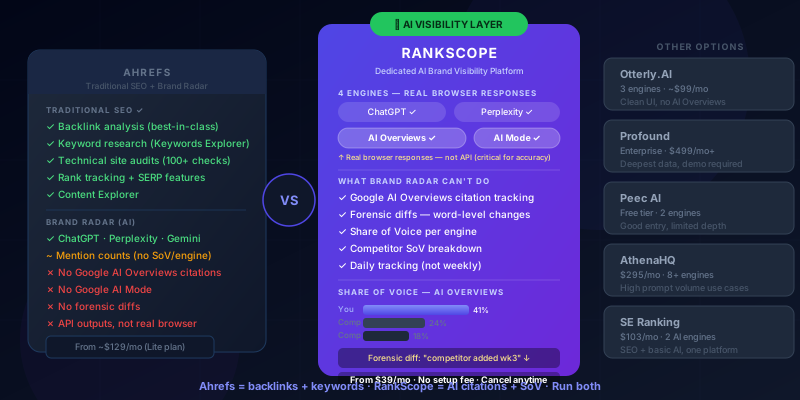
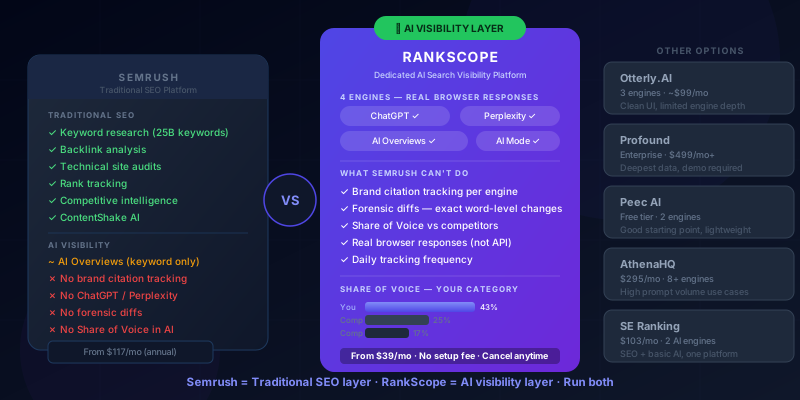
Semrush has an AI Overviews signal — it can flag whether a keyword triggers an AI Overview, but not whether your brand is inside it. Ahrefs has Brand Radar — ChatGPT, Perplexity, and Gemini mention monitoring, but no Google AI Overviews, no AI Mode, no forensic diffs. Moz has nothing at all in this space.
This isn't a criticism of any of them. Building accurate AI citation tracking — especially for Google's AI surfaces, which require real browser infrastructure to track correctly — is a fundamentally different engineering problem than crawling traditional search results. It makes sense that dedicated tools built specifically for this problem are ahead of features bolted onto platforms with different core architectures.
If you're evaluating where to direct attention in 2026, the practical recommendation is the same across all three: keep whichever traditional SEO tool fits your workflow, and add a dedicated AI visibility layer for the channel that your existing tooling doesn't see. The Semrush alternative for AI visibility and Ahrefs alternative for AI brand visibility posts cover the same decision framework from those starting points.
For teams using Moz as their primary SEO platform, RankScope Starter at $49/month is a low-risk way to add genuine AI visibility coverage alongside it. The tools don't compete; they complete each other. See the full RankScope platform overview for what the tracking dashboard looks like in practice.
How to Evaluate Any Moz Alternative for AI Visibility
If you're comparing options beyond what's covered above, these are the questions that actually matter:
Does it track Google AI Overviews at citation level? Many tools claim AI visibility coverage but only track ChatGPT and Perplexity. Google AI Overviews affects more search traffic for most brands than any other AI surface. A tool that doesn't track AI Overviews at the citation level — meaning, whether your brand is specifically mentioned inside the AI-generated answer — is missing the most impactful channel.
Real browser responses or API calls? This is a technical question with practical consequences. API calls to Google don't return the same AI Overviews content that real browsers see. Personalization, A/B testing, and continuous updates mean browser-rendered responses are more accurate — and essential for forensic tracking over time.
Does it have forensic diffs? Any tool can show you whether your citation rate is going up or down. Forensic diffs show you why. When you're trying to figure out which content changes actually moved the needle in an AI response, or which competitor's content displaced you, word-level diff tracking is the diagnostic capability you need. Without it, you're looking at metrics with no path to action.
Engine-level Share of Voice against your competitive set? Brand mentions are a count. Share of Voice is a competitive percentage. The difference is whether you know you're mentioned in 65% of AI responses — or whether you're in 65% and a competitor is in 85%. For strategic decisions, you need the competitive context.
Prompt customization depth? Pre-built AI visibility tools often come with generic query sets. The most useful tracking uses prompts that map to your actual sales funnel — the questions your buyers ask AI engines when they're evaluating vendors in your category. Configuring these properly is what turns citation data into something connected to revenue.
For a broader view of the AI visibility tooling landscape, the best AI visibility tools for 2026 covers all the major options in detail. For teams building an AI visibility program from scratch, the GEO tools comparison covers optimization-specific capabilities alongside tracking.
The Two-Layer Stack
The cleanest way to think about this decision is that traditional SEO tools and AI visibility tools answer different questions about the same brand.
Moz tells you:
- What's your domain authority and link profile strength?
- Which keywords are you ranking for in traditional Google results?
- Are your local citations consistent across the web?
- What technical issues are affecting your crawlability?
- How are your backlinks growing over time?
RankScope tells you:
- Is your brand cited when someone asks ChatGPT to recommend tools in your category?
- What percentage of Google AI Overviews in your space include your brand?
- When your AI citation rate changed last month, what specifically changed in the AI responses?
- Are you gaining or losing Share of Voice in Perplexity versus a specific competitor?
- Which content changes are actually improving how AI engines describe you?
These are parallel measurement systems for parallel search channels. In 2026, your brand exists in both. Measuring only one means you're making decisions with half the picture.
Moz's pricing starts at $99/month. Adding RankScope Starter at $49/month means you're covering both traditional and AI search visibility for $138/month combined — less than most Semrush plans alone. Check out the RankScope pricing page for the full tier breakdown. For agencies running GEO programs for clients or B2B SaaS teams where AI search visibility is increasingly part of the buyer journey, that's a straightforward investment.
The traditional search layer is covered. The AI layer is what most Moz users are currently missing.
Get started with RankScope → — No setup fee · Cancel anytime
Frequently Asked Questions
What is the best Moz alternative for AI search visibility? RankScope is the best Moz alternative specifically for AI search visibility. It tracks brand citations across all four engines: ChatGPT, Perplexity, Google AI Overviews and Google AI Mode using real browser responses — not API outputs — includes forensic diffs to show exactly what changed in AI responses over time, and calculates Share of Voice against competitors per engine. It starts at $49/month with no setup fee. Moz has no AI citation tracking whatsoever, so this is an addition to Moz rather than a replacement for it.
Does Moz have any AI search features? As of mid-2026, Moz has no AI citation tracking features. Moz Pro covers keyword rankings, link analysis, site audits, and local SEO — all focused on traditional Google search. There's no feature for monitoring brand mentions in ChatGPT, Google AI Overviews, Perplexity, or Google AI Mode. This isn't a minor gap; it's a complete absence of the infrastructure needed for AI visibility tracking.
Should I cancel Moz if I start using RankScope? That depends on whether you use Moz's traditional SEO features. If you actively use keyword research, link building, local SEO, or site audit workflows in Moz, there's no reason to cancel — the tools have zero overlap. If you signed up for Moz specifically to track search visibility and found its AI gap is your primary problem, then switching budget to a dedicated AI visibility tool makes more sense. Most users add RankScope alongside their existing tools rather than replacing them.
Is Moz DA useful for AI search optimization? Not directly. Domain Authority is a Moz-proprietary metric designed to correlate with traditional Google organic rankings based on link profile strength. AI search engines use different signals — content relevance, factual density, entity clarity, source credibility in the context of a specific query. A site with high DA but thin AI-optimized content can underperform a low-DA site with deeply authoritative content in AI citations. Understanding what makes content visible in AI search requires thinking in different terms than traditional link-based authority metrics.
What's cheaper — Moz or its alternatives?
Moz Pro starts at $99/month (Starter plan). Among AI visibility tools, Peec AI has a free tier, and RankScope Starter is $49/month. RankScope is actually cheaper than Moz's entry plan. For traditional SEO comparison, Mangools ($29/month) and SE Ranking ($103/month) offer different value propositions at different price points. The relevant comparison for this decision is: what does each tool actually measure, and does that match what you need?
How is RankScope different from just using ChatGPT to check what it says about you? Manual ChatGPT checks are snapshots. RankScope provides systematic, daily tracking across 4 engines, multiple prompts, and your full competitive set — with historical data showing how citations change over time, Share of Voice calculations across your competitive landscape, and forensic diffs when responses change. Manual checks tell you what's happening right now; RankScope tells you how you're trending, why things changed, and where you stand relative to competitors. That's the gap between awareness and an actual measurement program.