Otterly AI Alternative in 2026: Why Teams Are Switching to RankScope
Otterly.AI built a genuinely useful product. It was one of the first AI monitoring tools that non-technical marketers could actually use — clean dashboard, reasonable pricing, enough data to show leadership that AI search visibility was worth caring about. For 2024 and early 2025, that was enough.
But the category has moved. AI search now runs across five major engines. Teams doing serious generative engine optimization need to know not just whether they're being cited, but why citations changed and what to fix. That's the gap where Otterly starts to feel limited — and where teams start looking for alternatives.
This post covers what Otterly does well, where it falls short, and the six best Otterly AI alternatives in 2026. We'll be direct about the tradeoffs.
What Otterly.AI Does Well
Before we get into alternatives, let's be honest about where Otterly actually earns its keep. If you're shopping for a replacement, knowing what you're giving up matters.
Clean, accessible interface. Otterly's dashboard is one of the most polished in the category. Stakeholders who've never tracked AI visibility before can look at the numbers and immediately understand what they mean. That's not nothing — many tools in this space are built for SEO nerds, not marketing directors.
Solid mid-market positioning. The pricing sits in a usable range for mid-size teams, and the onboarding isn't painful. You can be up and tracking within an hour.
Competitive benchmarking. Otterly lets you see where your brand appears relative to named competitors across tracked queries. This is a genuinely useful feature for framing AI visibility as a competitive issue rather than a technical one. If tracking how AI characterizes your brand (not just cites it) is important to you, see our guide on AI brand visibility tools for tools built specifically for that depth.
Established brand signal. Otterly has Wikipedia recognition, Semrush marketplace integration, and legitimate industry coverage. For teams doing vendor due diligence, there's a real paper trail.
Why Teams Look for an Otterly Alternative
Four specific limitations come up consistently from teams evaluating replacements.
1. Missing key engines
Otterly tracks ChatGPT, Perplexity, and Gemini. It does not track Google AI Overviews or Google AI Mode. By 2026, Google's AI surfaces are significant — Google AI Overviews now appear on the majority of informational searches, and Google AI Mode is rolling out as the default interface for millions of users. If you're not tracking those surfaces, you're working from an incomplete picture.
The issue isn't just the missing data — it's the false confidence. A brand might look strong in ChatGPT and Gemini but be completely absent in Google AI Overviews. You won't know that from Otterly's dashboard.
2. No forensic diff capability
This is the one that matters most for teams actively trying to improve their AI visibility. When your citation rate drops 20% between Monday and Friday, Otterly tells you the number changed. It doesn't show you why.
What actually happened? Did a competitor's content start appearing in those response slots? Did the AI engine shift how it answers that type of query? Did a specific piece of your content stop being referenced? Without a diff layer showing the actual AI response text before and after — with changes highlighted — you're diagnosing a problem without being able to see the patient.
3. Monitoring without optimization
Otterly is a monitoring tool. It tracks what's happening but doesn't connect those metrics back to content recommendations. There's no GEO quality scoring for your existing content, no action plan based on what cited content looks like, no optimization workflow. The gap between "your citation rate dropped" and "here's what to fix" is where most real value gets created.
If your goal is to get cited by ChatGPT — not just to know whether you are — monitoring alone isn't enough.
4. Pricing ceiling
Otterly's entry pricing (~$99/month) is reasonable. But as your team scales tracked keywords and brands, the cost-to-capability ratio gets harder to justify compared to tools that offer more depth at similar or lower price points. Teams at the growth stage — 20+ keywords, multiple brands, regular reporting cycles — tend to run into this ceiling around month four or five.
Quick Comparison: Otterly AI vs. Alternatives
| Tool | AI Engines | Forensic Diffs | Content Optimization | Starting Price | Free Trial |
|---|---|---|---|---|---|
| RankScope | 4 (ChatGPT, Google AI Overviews, Perplexity, Google AI Mode) | ✅ Yes | ✅ Studio + GEO scores | $49/mo | No setup fee |
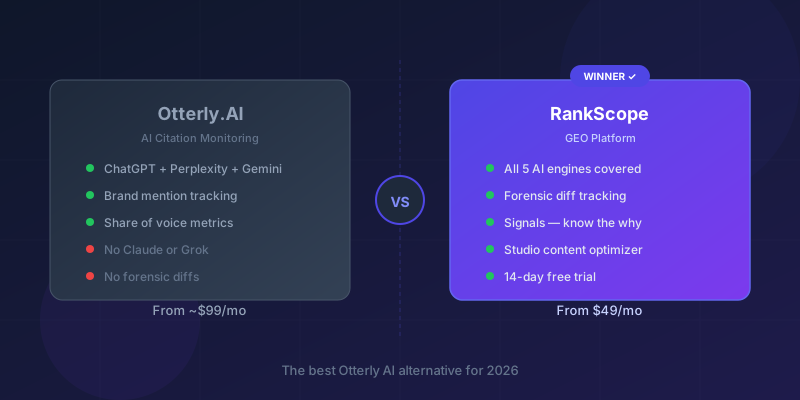
| Otterly.AI | 3 (no Claude/Grok) | ❌ No | ❌ No | ~$99/mo | Yes |
| Rankscale.ai | 3 | ❌ No | ❌ No | Custom | Demo only |
| Geoptie | 2 | ❌ No | ✅ GEO scoring | ~$79/mo | Yes |
| Profound | 4 | ❌ No | Limited | $499/mo | No |
| Peec AI | 2 | ❌ No | ❌ No | Freemium | Yes |
| SE Ranking AI | 3 | ❌ No | Limited | ~$65/mo | 14 days |
The 6 Best Otterly AI Alternatives in 2026
1. RankScope — Best Overall Otterly Alternative
RankScope is the most complete replacement for Otterly in 2026. It covers ChatGPT, Google AI Overviews, Perplexity, and Google AI Mode, adds forensic diff tracking, and includes a content optimization layer — making it the only tool in this category that spans the full GEO workflow from monitoring to optimization.
Where RankScope beats Otterly directly:
- Engine coverage: ChatGPT, Google AI Overviews, Perplexity, and Google AI Mode vs. Otterly's ChatGPT, Perplexity, and Gemini. Google AI Overviews and Google AI Mode coverage is critical in 2026 — Google's AI surfaces now dominate informational search.
- Forensic Diffs: Shows you the exact text of AI responses on any two dates with changes highlighted. When your citation rate shifts, you can see precisely what changed in the response — which brands appeared, which disappeared, what language shifted. Otterly shows you the metric; RankScope shows you the mechanism.
- Signals: A diagnostic layer that identifies why your visibility metrics changed. Competitor appearing where you used to? Model behavior shift for that query type? Content decay? Signals surfaces the cause so you can act.
- Studio: Content optimization with GEO quality scores for your tracked queries. Action Plans generate specific content recommendations based on what cited content looks like in your category. Otterly stops at "here's your citation rate." Studio tells you what to do about it.
Pricing: $49/mo Starter · $149/mo Pro · $399/mo Agency · No setup fee · cancel anytime
Best for: Any team that outgrew monitoring-only tools and needs to understand why their AI visibility is changing. The Starter plan is a genuine step-up from Otterly for less money. Professional works well for agencies and multi-brand operations.
2. Rankscale.ai — Best for Share of Voice Metrics
Rankscale is built around competitive share of voice — your brand's percentage of relevant AI responses versus named competitors. If that's the primary metric your leadership cares about, Rankscale goes deeper on it than most tools.
Key features:
- Share of voice calculations across competitor sets at the category and keyword level
- Branded vs. unbranded query tracking
- Trend data showing how your market position shifts over time
Where it falls short vs. Otterly: Rankscale requires a demo call and custom pricing — there's no self-serve. Engine coverage is limited to 3 engines, similar to Otterly. It's more of a lateral move than an upgrade for most teams.
Pricing: Custom enterprise pricing; demo required
Best for: Larger teams and enterprises where competitive market share measurement is the primary use case, not content optimization
If you’re specifically evaluating Rankscale vs. other options, our Rankscale alternative guide has a full feature-by-feature breakdown.
3. Geoptie — Best for Content Optimization
Geoptie sits at the intersection of monitoring and optimization, similar to RankScope's Studio feature but as the core product. If improving your content for AI citation is the primary goal rather than breadth of tracking, Geoptie is worth evaluating.
Key features:
- GEO content scoring against tracked AI queries — identifies structural and factual gaps in your content
- Topic gap analysis showing where competitors are cited and you aren't
- Free GEO audit tool that attracts links and provides an easy entry point
Where it falls short vs. Otterly: Geoptie only covers ChatGPT and Perplexity — fewer engines than Otterly. It's stronger on content optimization but weaker on monitoring breadth.
Pricing: From ~$79/month; scales with query volume
Best for: Content teams that want a combined GEO audit and monitoring workflow. Pairs well with a systematic approach using our GEO checklist as a baseline. For a detailed comparison of Geoptie vs. RankScope — including prompt limits, forensic diffs, and pricing — see our Geoptie alternative guide.
4. Profound — Best for Enterprise
Profound is the high-end option: $499/month minimum, aimed at large brands with serious measurement requirements. The data depth is real, the engine coverage is broad (ChatGPT, Google AI Overviews, Perplexity, and Google AI Mode), and the attribution reporting is enterprise-grade. But the price and complexity are not appropriate for most teams evaluating Otterly alternatives.
Key features:
- Deep AI response analysis with high query volume
- Enterprise-grade attribution and reporting
- Dedicated onboarding and custom query frameworks
Where it falls short vs. Otterly: It's dramatically more expensive and doesn't include Grok coverage. For teams moving from Otterly, Profound is a significant cost jump without proportional feature gains unless you specifically need enterprise-scale query volume and attribution depth.
Pricing: $499/month and up
Best for: Large enterprise brands with a dedicated AI/SEO team and the budget to match. If you're comparing Profound to Otterly, you're probably evaluating it for different reasons than cost.
Visit Profound → | See the best Profound AI alternatives →
5. Peec AI — Best Budget Entry Point
Peec AI is the lightest option on this list — it tracks ChatGPT and Perplexity with a clean UI and a free tier that's genuinely usable for small teams. If you're currently on Otterly and looking to reduce spend while maintaining basic monitoring, Peec is worth a look.
Key features:
- Free tier with limited query volume
- Clean citation rate and share of voice metrics
- Simple onboarding — up and running in minutes
Where it falls short vs. Otterly: Peec covers fewer engines than Otterly (2 vs. 3), lacks competitive benchmarking depth, and has limited query volume on free/lower tiers. It's a step down from Otterly on capability, not a step up.
Pricing: Freemium; paid plans scale with volume
Best for: Very small teams that want basic ChatGPT/Perplexity monitoring without the Otterly price tag. Not a fit for teams trying to get more from their AI visibility tool.
6. SE Ranking AI Toolkit — Best for Existing SE Ranking Users
SE Ranking added AI visibility tracking as part of their broader SEO platform, covering ChatGPT, Gemini, and Perplexity with brand mention monitoring baked into their existing toolset.
Key features:
- AI visibility monitoring bundled with traditional SEO (keywords, backlinks, site audit)
- Brand mention tracking across 3 AI engines
- Familiar SE Ranking interface for teams already using the platform
Where it falls short vs. Otterly: The AI visibility features are supplementary to SE Ranking's core product, not purpose-built. For teams whose primary job is GEO and AI tracking — not traditional SEO — this bundled approach means you're paying for a lot you don't use to get the piece you do.
Pricing: From ~$65/month for plans including AI visibility features
Best for: Teams already on SE Ranking who want to add AI visibility without another tool subscription. If you're specifically evaluating SE Ranking's AI module and need dedicated alternatives, the full SE Ranking alternative comparison covers this in detail.
RankScope vs. Otterly.AI: Head-to-Head
If you're specifically deciding between RankScope and Otterly, here's the detailed breakdown.
Engine Coverage
Otterly: ChatGPT, Perplexity, Gemini (3 engines)
RankScope: ChatGPT, Google AI Overviews, Perplexity, Google AI Mode (4 engines)
This gap matters more than it sounds. Google AI Overviews now appear on the majority of informational searches in the US, and Google AI Mode is rolling out as the default search experience. Brands that look healthy in ChatGPT and Gemini but aren't tracking Google's AI surfaces may be missing a significant share of AI-driven traffic and citations.
Data Depth: What You See When Metrics Move
Otterly: Citation rate, share of voice, trend lines. Good dashboard. No explanation of causation.
RankScope: Same metrics plus forensic diffs, Signals, and the ability to drill into why specific queries changed. When your citation rate for "best [your category] tool" drops 18% in a week, RankScope shows you the actual AI responses from before and after — with changes highlighted — and Signals tells you what likely triggered it.
This is the difference between a monitoring tool and a diagnostic tool. Otterly tells you something changed. RankScope tells you what changed and points you toward what to do about it.
Content Optimization
Otterly: None. It's a monitoring product.
RankScope: Studio provides GEO quality scores for your content against tracked queries and generates specific improvement recommendations. For teams actively working to improve their citations — not just track them — this closes the loop. Understanding GEO vs. SEO vs. AEO dynamics matters here: AI citation optimization requires a different content approach than traditional ranking, and Studio is built around those specific signals.
Pricing
Otterly: ~$99/month base; scales up
RankScope: $49/month Starter · $149/month Pro · $399/month Agency · No setup fee · cancel anytime
RankScope's Starter plan at $49/mo offers more capability (broader engine coverage, forensic diffs) than Otterly's base plan. For teams where Otterly is already at the right price point, the Pro plan is comparable in cost but broader in scope.
Who Should Choose Otterly?
Otterly is the right call if: your team just needs a clean dashboard to report AI visibility numbers to leadership, you don't need Google AI Overviews or Google AI Mode coverage, you have no interest in content optimization workflow, and the current price works for your budget. It's a solid monitoring tool. It just isn't a diagnostic or optimization tool.
Who Should Choose RankScope?
RankScope is the right call if: you need Google AI Overviews and Google AI Mode coverage (the two largest AI search surfaces in 2026), you want to understand why your citation metrics change (not just that they changed), you're doing active content optimization work for AI visibility, or you want a lower entry price with more capability. The platform is built for teams that have moved past basic tracking and need a full GEO workflow.
How to Switch from Otterly to RankScope
Switching tools between AI monitoring platforms is straightforward. Here's what the transition looks like:
1. Export your Otterly baseline data. Before you cancel, download your historical citation rate and share of voice data. You'll want a benchmark to compare against once you're set up in RankScope.
2. Get started with RankScope. Set up the same tracked queries you were running in Otterly. No setup fee — you can cancel anytime.
3. Add Google AI Overviews and Google AI Mode to your tracked set. These are the two surfaces Otterly wasn't covering. Run your priority queries across all 4 engines for the first two weeks — you'll often find the Google AI surfaces reveal visibility gaps you didn't know existed.
4. Set up Studio for your priority content. Identify the 3–5 pages on your site most important for AI citation. Run them through Studio to get baseline GEO quality scores before you start optimizing.
5. Review Signals on week 2. By your second week, you'll have enough data for Signals to start identifying patterns. This is where the "why" starts to emerge.
Frequently Asked Questions
What is the best Otterly AI alternative?
RankScope is the best Otterly AI alternative in 2026. It covers ChatGPT, Google AI Overviews, Perplexity, and Google AI Mode — compared to Otterly's 3 engines — includes forensic diff tracking to show exactly what changed in AI responses day-over-day, and costs less — starting at $49/month with no setup fee. Otterly starts around $99/month.
Is there a free Otterly AI alternative?
Yes. RankScope has no setup fee and you can cancel anytime — the most flexible starting option in the category. Geoptie and Peec AI also offer free tiers, though with narrower engine coverage and limited query volume.
Otterly AI vs RankScope — what's the difference?
The main differences are engine coverage and diagnostic depth. Otterly.AI tracks ChatGPT, Perplexity, and Gemini. RankScope tracks ChatGPT, Google AI Overviews, Perplexity, and Google AI Mode. Beyond coverage, RankScope adds forensic diffs (showing exactly what changed in AI responses between any two dates), a Signals layer that explains why your citation metrics shifted, and Studio for content optimization with GEO quality scores.
How much does Otterly AI cost?
Otterly.AI pricing starts at approximately $99/month for their base plan, with higher tiers for larger query volumes and team seats. RankScope starts at $49/month — lower entry cost with broader engine coverage and additional diagnostic features.
Does Otterly AI track Google AI Overviews?
No. As of 2026, Otterly.AI tracks ChatGPT, Perplexity, and Gemini. It does not track Google AI Overviews or Google AI Mode. RankScope covers both Google AI surfaces plus ChatGPT and Perplexity. This matters because Google AI Overviews now appear on the majority of informational searches — a major citation surface that Otterly misses.
The Bottom Line
Otterly.AI is a legitimate tool that got a lot of teams started with AI visibility monitoring. Clean product, reasonable onboarding, solid for stakeholder reporting.
The issue isn't that Otterly is bad — it's that the bar has moved. Teams doing serious GEO work in 2026 need full engine coverage, forensic diagnostics, and a path from monitoring data to content optimization. Otterly covers the first layer. It stops before the second and third.
Of the alternatives on this list, RankScope is the most complete replacement: same category, broader engine coverage, deeper diagnostics, and a lower starting price. Getting started takes about 20 minutes to set up. Whether you're actively switching from Otterly or just evaluating your options, it's the obvious place to start.
If you're earlier in your thinking and still learning the landscape, our comparison of the best AI visibility tools covers the full category, not just Otterly alternatives. For a broader look that includes traditional social listening alongside AI search monitoring, see our AI brand monitoring tools comparison.
Ready to see what your AI visibility looks like across all 4 engines? Get started with RankScope →