13 AI SEO Tools Compared (2026): Content, Rankings and AI Search Optimization
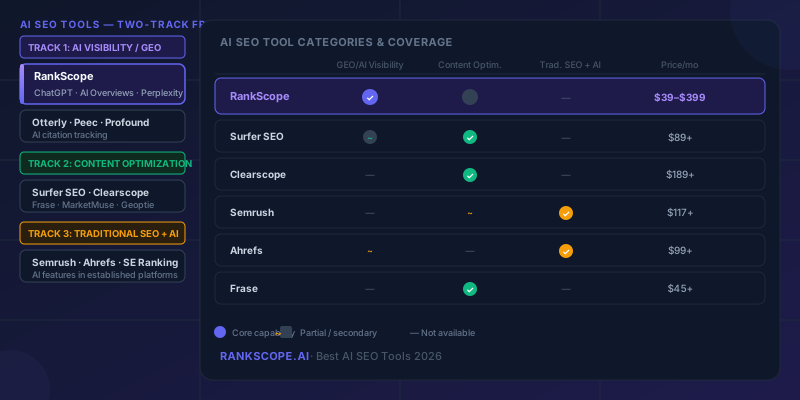
AI SEO tools are software that use AI to do search optimization work, and in 2026 the phrase covers three different products. Content optimizers such as Surfer SEO, Clearscope and Frase help you write pages that rank. All-in-one SEO suites such as Semrush, Ahrefs and SE Ranking handle keywords, links and audits, and have now added AI visibility tracking. AI search optimization platforms such as RankScope, Otterly.AI and Profound exist to measure and improve how ChatGPT, Google AI Overviews, Perplexity and Google AI Mode mention and cite your brand.
Which one you need depends on the problem. Producing content, ranking in Google, and getting named inside an AI answer are three jobs. Most teams end up paying for two of them.
Below are 13 tools across those three groups, with prices and engine coverage taken from each vendor's own pricing page on 29 September 2026. We also explain why that date matters so much, because the previous version of this page got nearly all of it wrong.
The Short Answer
| If you need to... | Start with | Why |
|---|---|---|
| Track whether AI engines name your brand, on your own buyer questions | An AI search optimization platform (RankScope, Otterly.AI, Geoptie) | Custom prompts, daily runs, per-engine results |
| Write and optimize pages faster | A content optimizer (Surfer SEO, Frase, Clearscope) | All three now add some AI tracking too |
| Do keyword research, backlinks and audits in one place | An SEO suite (Semrush, Ahrefs, SE Ranking) | AI visibility is now included or sold as an add-on |
| Run AI visibility for many clients | RankScope Agency, Otterly.AI Premium, or AthenaHQ | Workspaces, white-label, higher prompt limits |
| Enterprise coverage of nine or more engines | Profound or AthenaHQ | Widest engine lists we found |
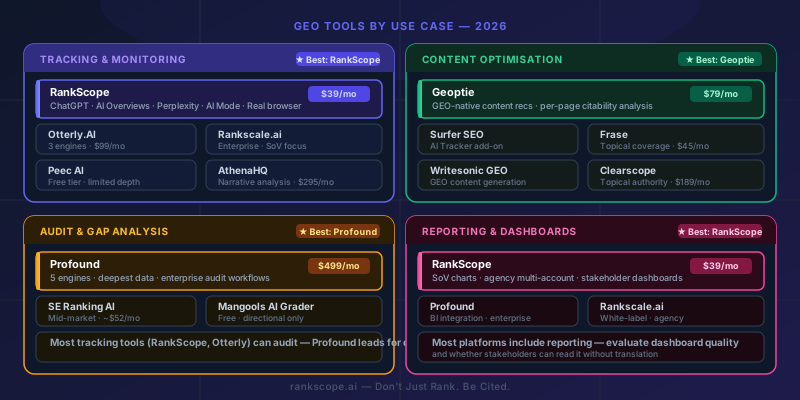
We Re-Checked Every Price on This Page. Almost All of Them Were Wrong.
This page first went up in May 2026. On 29 September we opened the pricing page of every competitor it listed and compared it line by line with what we had published.
Every one of the 12 competitor entries had at least one claim that no longer matched.
| Tool | What this page said | What the vendor's page said on 29 Sep 2026 |
|---|---|---|
| Otterly.AI | From $99/mo; no Google AI Overviews | Lite at $29/mo; Google AI Overviews included on every plan |
| Peec AI | Permanent free tier; ChatGPT and Perplexity only | Advertises "Start for free"; also tracks Gemini |
| Profound | From $499/mo | No listed price beyond a free 7-day trial; enterprise by demo |
| AthenaHQ | Custom pricing only | A free tier, and Starter at $295/mo |
| Surfer SEO | From $89/mo; no Google AI Mode | From $49/mo billed yearly; AI Tracker includes Google AI Mode |
| Clearscope | From $189/mo; no AI visibility tracking | Essentials at $129/mo; tracks ChatGPT and Gemini |
| Frase | From $45/mo; no AI visibility tracking | $49/mo month to month; tracks ChatGPT and Google AI |
| MarketMuse | Standard from $149/mo | No public paid prices; free plan at 10 queries a month |
| Geoptie | From $79/mo | Starter listed at $41/mo |
| Semrush | Pro $117, Guru $208, Business $416 | Plans renamed; the SEO plan is $139/mo, or $117.33/mo billed annually |
| Ahrefs | Lite $99; Brand Radar included at no extra cost | Lite $129; Brand Radar AI is an add-on from $199/mo |
| SE Ranking | From $52/mo | Core at $129/mo, or $103.20/mo billed annually |
Some of these were probably right in May and went stale. Others, like the claim that Otterly.AI did not cover Google AI Overviews, we cannot reconstruct either way. It does not matter much to a reader. The page was wrong for anyone who read it in September.
It was not the only problem.
The old page stated that "15 to 20% of Google searches now show AI Overviews." We went looking for the source and could not find one that says that. Google has published that AI Overviews reach "over 1.5 billion users per month" (Alphabet, April 2025), which is a different claim. We deleted the percentage rather than swap in a different number we also could not source.
Its five FAQ answers existed only in the page's structured data, with no matching visible text, which is exactly the pattern Google ignores. And when we checked, no other page on our site linked to it at all. It was an orphan, while Search Console recorded 17,440 impressions for it over 90 days and exactly one click.
We are telling you this for a practical reason. Every comparison page in this category is decaying at the same speed ours was. The tools ship AI features monthly and reprice quarterly. If a roundup does not say when its prices were checked, assume they were not.
Three Kinds of AI SEO Tool
The old version of this page split the market into two tracks: tools that use AI to do SEO, and tools that track AI search. That split has mostly collapsed.
By September 2026, Semrush lists AI visibility across ChatGPT, Perplexity and Gemini on its paid plans. Surfer's AI Tracker covers five engines. Frase and Clearscope both track brand mentions in ChatGPT. SE Ranking sells an AI search add-on covering AI Overviews, AI Mode, Perplexity and ChatGPT. Almost everyone tracks something now.
So the useful distinction is no longer whether a tool tracks AI answers. It is what the tool was built to do first.
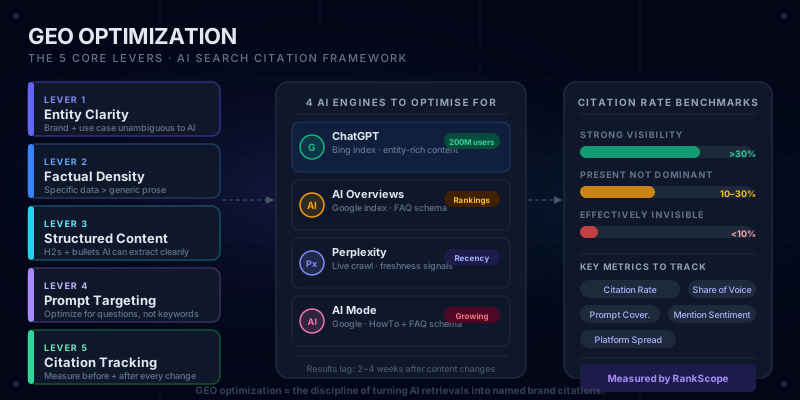
AI search optimization platforms were built for AI answers. Their core object is a prompt, a real question a buyer would type, run against each engine on a schedule. You get citation rate, share of voice against named competitors, the sources the engine used, and a history of how each answer changed. An "AI search optimization platform" and an "AI search optimization tool" are the same thing under two names.
Content optimizers were built to help you write a page that ranks. They grade drafts against the top results, suggest terms and structure, and now bolt on a prompt tracker so you can see whether the page gets cited.
All-in-one SEO suites were built around keywords, links and site audits. Their AI visibility features sit next to rank tracking and tend to lean on the suite's own prompt database rather than questions you write yourself, though that is changing.
A tool can straddle two groups. Geoptie sells both tracking and content guidance. Surfer now has a standalone "AI Search Analytics" plan. We have put each tool where its pricing page puts its weight.
What Google's AI Overview Says About AI SEO Tools
We pulled the live Google results for two of the phrasings this page targets on 29 September 2026, US English, desktop.
"ai seo tools" returned an AI Overview that cited 12 URLs from 11 domains and named five tools: Semrush ("best all-in-one"), Surfer SEO, SEO.AI, Mangools and Frase. It then listed three features to look for, the first of which was "AI search visibility: tracking whether AI search engines cite or mention your brand rather than just monitoring blue-link positions."
None of the eight organic results below it were among the 12 cited URLs. Not one. The top organic result was a press release, the second a Reddit thread.
"ai search optimization tools" returned an Overview that cited 7 URLs and grouped tools into all-in-one platforms (Semrush One, Ahrefs, SE Ranking), content tools (Surfer, Frase, Writesonic) and AI visibility trackers (Wellows, OnCited, SEO.ai). Three of its cited URLs also appeared among the organic results on the same page.
Three things are worth taking from this, with the caveat that it is one reading of each query.
First, the AI Overview on the broad term is written for a marketer choosing a general SEO stack, and it leads with suites and content tools. The dedicated AI visibility platforms mostly appear when the question is phrased around tracking.
Second, ranking and being cited were close to unrelated on the first query. If your plan for "AI SEO" is to rank a listicle on page one and wait to be quoted, that page gave no evidence it works.
Third, do not treat any of this as stable. GetMentions ran 2,398 queries through four engines once a day for a week in June 2026 and found that the median day-over-day churn in cited sources was 82% on ChatGPT, 92% on Gemini, 78% on Google AI Mode and 43% on Perplexity (GetMentions, July 2026). Run the same two queries tomorrow and you would probably get different citation sets. That churn is the whole reason the tracking category exists.
Group 1: AI Search Optimization Platforms
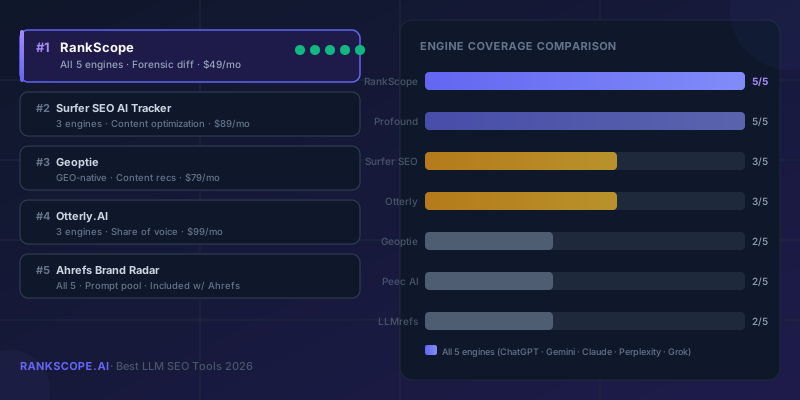
These six were built to track and improve how AI engines mention your brand. For a longer list focused only on this group, see our guide to the best LLM SEO tools.
1. RankScope
Pricing: Starter $49/mo, or $39/mo billed annually. Professional $149/mo, or $124/mo billed annually. Agency $399/mo, or $332/mo billed annually. Enterprise is custom. Engines: ChatGPT, Google AI Overviews, Perplexity and Google AI Mode. Starter covers ChatGPT and Google AI Overviews; Professional and Agency cover all four. Best for: Teams that want to track their own buyer questions across both of Google's AI surfaces.
This is our product, so weigh what follows accordingly.
RankScope runs the prompts you define every day on each engine and records the answer as it appears in a real browser, not through an API. API responses often differ from what a user actually sees, which is why we made that choice. Each prompt gets a citation result, share of voice against the competitors you name, sentiment scoring, and a diff view that shows how the answer changed between two dates.
Plan limits are simple. Starter is 40 monitored prompts, 3 competitors and one brand workspace. Professional is 150 prompts, 10 competitors and 3 workspaces, and adds Google Search Console and GA4 integration, read access to the REST API, and autonomous agents. Agency is 400 prompts, unlimited competitors, 25 client workspaces and white-label client dashboards. Every plan scans daily and has unlimited seats.
Where it falls short: Gemini, Claude and Microsoft Copilot are not on the list of engines we track, and several competitors below cover them. Starter's two engines leave out Perplexity and Google AI Mode. It does no keyword research, backlink analysis or site crawling, so it replaces none of your SEO suite. There is no free trial; the free AI Visibility Checker runs a one-off check with no account and no credit card required.
2. Otterly.AI
Pricing: Lite $29/mo (15 prompts), Standard $189/mo (100 prompts), Premium $489/mo (400 prompts). Annual billing takes 15% off. Free trial. Engines: ChatGPT, Google AI Overviews, Perplexity and Microsoft Copilot on every plan. Google AI Mode, Gemini and Claude are paid add-ons. Best for: A cheap first look, or teams that specifically need Copilot.
Otterly's $29 Lite plan is the lowest entry price in this group, though 15 prompts is a small sample for anything beyond a first look. Standard adds API and MCP access. The thing to price carefully is Google AI Mode: it is an add-on here, and if both Google surfaces matter to you, the add-on changes the comparison.
3. Geoptie
Pricing: Starter $41/mo (15 prompts), Professional $83/mo (100 prompts), Enterprise $333/mo (400 prompts), as listed. Engines: Any 4 of 7, chosen per brand: ChatGPT, Claude, Perplexity, Gemini, Microsoft Copilot, Google AI Mode, Google AI Overviews. Best for: Teams that want tracking and content guidance in one tool, and want to pick their own engines.
Geoptie's pick-four-of-seven model is unusual and useful: a team whose buyers live in Copilot can track Copilot without paying for engines it does not care about. On listed price per prompt it is the cheapest tool in this group. It also sells content recommendations aimed at citation, which puts it half in Group 2.
4. Profound
Pricing: A free 7-day trial (50 prompts a day on ChatGPT, Gemini and Google AI Overviews). Enterprise pricing through a demo. Engines on Enterprise: ChatGPT, Perplexity, Google AI Mode, Gemini, Microsoft Copilot, DeepSeek, Claude, Google AI Overviews and Exa Search. Best for: Large brands that need the widest engine list and have a budget set through procurement.
Profound's nine engines are the broadest set we found on a vendor pricing page. The trade-off is that you cannot see the price before you talk to sales. The previous version of this page said "from $499/mo"; the pricing page no longer shows any paid figure, so we have removed it.
5. AthenaHQ
Pricing: A free plan (300 credits). Starter $295/mo (3,600 credits). Enterprise custom. Engines: The free plan covers ChatGPT, Perplexity, AI Overviews, Gemini and Copilot. Starter adds AI Mode, Claude, Grok, DeepSeek, Meta AI and Mistral. Best for: Teams that want a very wide engine list at a published price.
AthenaHQ meters usage in credits rather than prompts, so its numbers do not compare directly with anyone else's. Ask how many credits one prompt costs per engine per run before you do the arithmetic. At $295 the Starter plan lists eleven engines, far more than most tools here. We compare it head to head in our AthenaHQ alternative breakdown.
6. Peec AI
Pricing: Starter, Pro, Advanced and Enterprise tiers. We could not read prices from its pricing page on 29 September; its homepage and ads say "Start for free". Engines: Advertises ChatGPT, Perplexity and Gemini, and has a Google AI Mode tracker page. Best for: Teams comfortable signing up to find out.
We are not going to guess Peec's prices. Our old page called its free option a "permanent free tier", and we cannot confirm from its pricing page whether "Start for free" means a trial or a standing plan. Check before you plan around it.
Group 2: Content Optimizers With AI Tracking
These were built to help you write. All four now touch AI search in some way, and three of them track it.
7. Surfer SEO
Pricing (billed yearly): Discovery $49/mo, AI Search Analytics $82/mo, Standard $99/mo, Pro $182/mo, Peace of Mind $299/mo. AI Tracker engines: ChatGPT, Perplexity, Google AI Mode, Google AI Overviews and Google Gemini. Best for: Content teams that want the draft, the optimization and the tracking in one workflow.
Surfer made the biggest move of any tool on this list. Its AI Tracker now covers five engines, and it sells a standalone AI Search Analytics plan. The prompt limits are where the plans differ: Standard tracks 25 AI prompts refreshed weekly, AI Search Analytics and Pro track 50 refreshed daily, and Peace of Mind tracks 100 daily. Discovery has no AI tracking.
Weekly refresh is worth noticing. With day-to-day citation churn running at the levels above, a weekly reading is a sample of a moving target, not a trend.
8. Frase
Pricing: Starter $49/mo month to month, or $39/mo billed annually. Professional $129/mo, or $103/mo billed annually. Scale $299/mo, or $239/mo billed annually. Free 7-day trial, no card. AI tracking: ChatGPT and Google AI on Starter and Professional; Scale adds Perplexity, Claude and Gemini. Best for: Smaller teams that want briefs, optimization and basic AI tracking at the lowest content-tool price.
Frase has always been strong on question-and-answer structure, and that happens to be the shape AI answers extract most easily. Its free tools page also turned up as a cited source in one of the two AI Overviews we pulled.
9. Clearscope
Pricing: Essentials $129/mo, Business $399/mo, Enterprise custom. AI tracking: Tracks queries across ChatGPT and Gemini. Best for: Larger content teams with several writers who need consistent briefs.
Clearscope's strength is still the grading workflow: writers who are not SEO specialists can follow it. The AI tracking covers two engines, and neither of Google's AI surfaces is among them, which matters if Google is where your buyers search.
10. MarketMuse
Pricing: A free plan (10 queries a month, 1 user). Paid tiers named Optimize, Research and Strategy, with prices through a demo. AI tracking: None listed on its pricing page. Best for: Planning topic coverage across a large content library.
MarketMuse works at the level of the whole site rather than the single page, scoring where you have enough coverage to compete. It is the only tool in this group with no AI visibility tracking on its pricing page. That is not a flaw if all you need is the planning layer.
Group 3: All-in-One SEO Suites
11. Semrush
Pricing (monthly billing): SEO $139/mo, Starter $199/mo, Pro+ $299/mo, Advanced $549/mo. Billed annually they are $117.33, $165.17, $248.17 and $455.67. There is also a free tier. AI visibility: Included on paid plans. The pricing page names Google Search, ChatGPT, Perplexity and Gemini, "& more". Best for: Teams that want one subscription for classic SEO and a first layer of AI tracking.
Semrush is the tool Google's own AI Overview called the best all-in-one on the day we checked. It has the widest classic SEO feature set here, and AI visibility is no longer an extra purchase. If you already pay for it, turn the AI features on before you buy anything else. Our Semrush alternative for AI visibility post covers when a dedicated tracker is still worth adding alongside it.
12. Ahrefs
Pricing (monthly billing): Starter $29/mo, Lite $129/mo, Standard $249/mo, Advanced $449/mo, Enterprise $1,499/mo. A free tier exists. AI visibility: Brand Radar AI, an add-on from $199/mo, with custom prompt packages from $50 to $250/mo. Best for: Teams where backlinks and authority research come first.
Ahrefs still has the backlink data most SEOs reach for. Brand Radar draws on a large database of prompts that Ahrefs collects, and you can now pay to track your own prompts as well. Our old page said Brand Radar was included at no extra cost. On the current pricing page it is a paid add-on, which moves Ahrefs from "free AI tracking with your SEO plan" to "a $199/mo decision".
13. SE Ranking
Pricing: Core $129/mo, or $103.20/mo billed annually. Growth $279/mo, or $223.20/mo billed annually. Enterprise custom. AI visibility: An AI Search add-on at $89/mo ($71.20/mo billed annually), with an AI Results Tracker covering AI Overviews, AI Mode, Perplexity and ChatGPT. Best for: Agencies and mid-market teams that want classic SEO plus both Google AI surfaces at a lower price than the two suites above.
SE Ranking's add-on is the only suite option we found that names both Google AI Overviews and Google AI Mode on its pricing page. Core plus the add-on comes to $218/mo on monthly billing.
All 13 Side by Side
Prices are the lowest paid plan listed on 29 September 2026, on monthly billing unless marked. "AI engines" is what the vendor's pricing page names, at any plan level, including add-ons.
| Tool | Group | Lowest paid price | AI engines named | Both Google AI surfaces? |
|---|---|---|---|---|
| RankScope | AI search optimization | $49/mo | ChatGPT, AI Overviews, Perplexity, AI Mode | Professional and up |
| Otterly.AI | AI search optimization | $29/mo | ChatGPT, AI Overviews, Perplexity, Copilot; AI Mode, Gemini, Claude as add-ons | With add-on |
| Geoptie | AI search optimization | $41/mo (as listed) | Any 4 of 7 | If you choose both |
| Profound | AI search optimization | Demo only | 9 on Enterprise | Yes, on Enterprise |
| AthenaHQ | AI search optimization | $295/mo | Up to 11 | Yes, on Starter |
| Peec AI | AI search optimization | Not readable | ChatGPT, Perplexity, Gemini, AI Mode | Unclear |
| Surfer SEO | Content | $49/mo (billed yearly) | ChatGPT, Perplexity, AI Mode, AI Overviews, Gemini | Yes, on AI plans |
| Frase | Content | $49/mo | ChatGPT, Google AI; more on Scale | Unclear |
| Clearscope | Content | $129/mo | ChatGPT, Gemini | No |
| MarketMuse | Content | Demo only | None listed | No |
| Semrush | SEO suite | $139/mo | Google, ChatGPT, Perplexity, Gemini, "& more" | Not stated |
| Ahrefs | SEO suite | $29/mo; AI add-on from $199/mo | Not named on pricing page | Not stated |
| SE Ranking | SEO suite | $129/mo; AI add-on $89/mo | AI Overviews, AI Mode, Perplexity, ChatGPT | With add-on |
A Worked Example: What 50 Tracked Prompts Actually Costs
Price-per-plan comparisons hide the thing you are actually buying, which is a number of questions checked on a number of engines, on some schedule. So here is one concrete need priced across the tools that publish enough to do it.
The need: 50 buyer questions, checked daily, on ChatGPT and Google AI Overviews at minimum.
| Option | Plan that covers it | Monthly cost | Prompts | What else you get |
|---|---|---|---|---|
| RankScope | Professional | $149 | 150 | All four of our engines; 10 competitors |
| Otterly.AI | Standard | $189 | 100 | Four engines plus API/MCP |
| Geoptie | Professional | $83 (as listed) | 100 | Any 4 of 7 engines |
| Surfer SEO | AI Search Analytics | $82 billed yearly | 50 | Five engines, daily |
| Semrush | Paid plan with AI visibility | From $139 | Check your plan | The full SEO suite |
RankScope Starter at $49/mo does not make this table, because its 40 prompts fall short of 50. That is the honest answer, and it is the kind of detail a "from $X" comparison hides.
Two things fall out of the arithmetic.
On listed price alone, Surfer and Geoptie are the cheapest routes to 50 daily prompts. If price per prompt is the deciding factor, they win.
But the unit is not the same across rows. A prompt on Surfer is priced with an annual commitment; a prompt on Semrush comes bundled with a keyword and backlink suite you may already own; a prompt on RankScope includes the history of how each answer changed. You are comparing baskets, not prompts. Decide which of the extras you would actually use before the cheapest number decides for you.
Our View: Start With What You Already Pay For
Here is an opinion that could be wrong.
For most teams that already pay for Semrush, SE Ranking or Surfer, the AI tracking inside that subscription is good enough to start. Turn it on, load 20 to 30 real buyer questions, and live with it for a month.
A year ago this would have been bad advice, because the suites tracked almost nothing. Now they track the main engines and cost you nothing extra, or a modest add-on. The cheapest way to learn whether AI visibility is a problem for your brand is to use a tool you have already paid for.
You will outgrow it at one of four points, and each is specific enough to recognise:
- You need to track the exact questions your buyers ask, not a vendor's prompt database.
- You need Google AI Overviews and Google AI Mode as separate surfaces. They return different answers and cite different sources for the same question.
- You need to see what an answer said before and after it changed, not only that a score moved.
- You need share of voice against specific named competitors, per engine.
That is the point where a dedicated AI search optimization platform starts to pay for itself. It is also where we would like you to look at RankScope. If none of the four applies to you, keep your money.
Where we might be wrong: suite AI trackers that lean on their own prompt databases may track questions nobody in your market asks. A month of confident-looking data about irrelevant prompts is worse than no data. Read the prompt list before trusting the chart.
What We Would Not Buy an AI SEO Tool For
Google's AI Overview for "ai seo tools" recommended SEO.AI for "fully automated, 24/7 autopilot content creation that researches, structures, and publishes... articles directly to your site." Autopilot publishing is the fastest-growing idea in this category, and we are wary of it for a reason we learned on our own blog.
When we audited our own 71 blog posts in September 2026, every one of them used the em-dash, at about 14 per 1,000 words, and 58 of the 71 leaned on the same stock "not only this, but that" contrast. Those are two of the most reliable signatures of machine-generated prose, and readers notice them. We had published all 71 without spotting it.
Speed was never the problem. The problem was that nobody read the output closely enough to notice the machine's fingerprints, or to catch a wrong price. That is how this very page came to carry 12 stale competitor entries. AI writing tools are useful drafting help. A tool that publishes without a human reading the result will publish the errors too, at the same speed as everything else.
How to Choose in Five Steps
1. Run ten prompts by hand first. Before buying anything, type ten real buyer questions into ChatGPT and Google, and note who gets named. It takes under an hour and tells you whether you have a visibility problem at all. Our free AI Visibility Checker does the same across real engines with no account.
2. Decide which surfaces matter. If your buyers search on Google, treat AI Overviews and AI Mode as two surfaces. If they work inside Microsoft 365, Copilot may matter more than Perplexity. Pick tools by the engines they cover, not by the length of their engine list.
3. Check what you already own. Semrush, SE Ranking, Surfer, Frase and Clearscope subscribers all have some AI tracking available now. Use it.
4. Price the need, not the plan. Work out prompts times engines times frequency, then price that across two or three tools, as in the worked example above.
5. Set a baseline before you change anything. A tracker is only useful once there is a before to compare the after against. For what to do once you have the baseline, see AI visibility optimization, which covers what actually moves citation rate and a targeting method we built and then retired.
For more on the tracking-only group, our best AI visibility tools roundup and generative engine optimization tools guide go deeper.
Frequently Asked Questions
What are AI SEO tools?
AI SEO tools are software that use AI to do search optimization work. In 2026 the term covers three kinds of product: content optimizers such as Surfer SEO, Frase and Clearscope; all-in-one SEO suites such as Semrush, Ahrefs and SE Ranking, which have added AI visibility tracking; and AI search optimization platforms such as RankScope, Otterly.AI and Profound, which track how ChatGPT, Google AI Overviews, Perplexity and Google AI Mode mention and cite your brand.
What is an AI search optimization platform?
An AI search optimization platform runs the questions your buyers ask against AI engines on a schedule and records whether your brand is named or cited, how often compared with competitors, which sources the engine used, and how the answer changes over time. AI search optimization tools, AI visibility tools and GEO tools are other names for the same category.
What are the best AI search optimization tools?
It depends on the engines you need and your budget. As listed on 29 September 2026: Otterly.AI has the lowest entry price at $29/mo; Geoptie lets you choose any 4 of 7 engines from $41/mo; RankScope tracks ChatGPT, Google AI Overviews, Perplexity and Google AI Mode from $49/mo, or $39/mo billed annually; AthenaHQ lists up to 11 engines at $295/mo; Profound covers 9 engines on enterprise contracts. If you already pay for Semrush, SE Ranking or Surfer, try their built-in AI tracking first.
Do I need a separate AI visibility tool if I already use Semrush or Ahrefs?
Not necessarily. Semrush includes AI visibility on its paid plans, and Ahrefs sells Brand Radar AI as an add-on from $199/mo. Start there. A dedicated platform is worth adding when you need to track your own buyer questions, treat Google AI Overviews and Google AI Mode as separate surfaces, see how an answer changed over time, or compare share of voice against named competitors per engine.
How much do AI SEO tools cost?
On the vendors' own pricing pages on 29 September 2026, paid plans started at $29/mo (Otterly.AI Lite and Ahrefs Starter), with content optimizers from about $49/mo, SEO suites from $129/mo to $139/mo on monthly billing, and enterprise AI visibility platforms priced through a demo. Prices in this category change often, so check the date on any comparison you rely on.
Can AI SEO tools write and publish content on their own?
Some can, and Google's AI Overview for this query recommended one that does. We would not let any tool publish without a human reading the result. When we audited our own 71 blog posts, every one carried the em-dash at about 14 per 1,000 words, a common signature of machine-written text, and our own comparison page had drifted out of date on all 12 competitor entries. Automated publishing repeats those errors at the same speed as everything else.
Is ranking on Google enough to be cited in AI Overviews?
Not reliably. On 29 September 2026, the AI Overview for "ai seo tools" cited 12 URLs and none of them were among the eight organic results on the same page. For "ai search optimization tools", 3 of the 7 cited URLs also ranked organically. Those are single readings, and citation sets change daily, but ranking and being cited are clearly separate outcomes to measure.
Want to see where your brand stands before buying anything? The free AI Visibility Checker runs real prompts against real engines, no credit card required. When you are ready to track it daily, start with RankScope. No setup fee, cancel anytime.