AI Visibility Optimization: What Actually Moves Citation Rate (2026)
AI visibility optimization is the practice of changing your content, structure and entity signals so that AI search engines name and cite your brand when someone asks a question in your category. It is a different job from AI visibility tracking, which measures where you stand, and a different job from SEO, which targets a ranked list of links.
That last distinction is the one most guides skate over. A blue link and a citation inside a generated answer are selected by different processes. You can hold position 3 on a query and never appear in the answer sitting above it.
We spent a few weeks measuring this on our own category rather than reasoning about it. Part of what we found held up and part of it did not, including a targeting method we built, used, and then retired. Both halves are below, because the failed half is the more useful one.
What You Are Actually Optimizing
An AI answer makes three decisions about your page, and they fail independently.
Retrieval. Does your page enter the candidate set for this question at all? This is the part that overlaps most with classic SEO: crawlability, indexing, topical relevance.
Selection. Of everything retrieved, does the answer actually draw on yours? AI answers are winner-take-most. A typical response names two or three brands out of dozens available. Being retrieved and not selected looks identical, from the outside, to being invisible.
Characterization. When your brand is named, what does the model say about it? This is the one teams find last, usually by accident. Getting named alongside "best for enterprise budgets" when you sell to five-person teams is a visibility win and a pipeline loss.
Most optimization advice addresses retrieval and stops. Selection is where the competition actually happens.
We Tried to Predict Which Queries Were Winnable. It Did Not Hold Up.
Here is the part most posts like this leave out.
We thought we had found a shortcut. Every AI Overview cites sources, and those sources have measurable authority. So take the weakest domain in the citation set, not the strongest, and treat it as the entry price for that result. If the least-authoritative site cited has 800 referring domains and you have 30, do not bother. If it cites someone with 12, the door is open.
We ran it across 19 AI Overview results in our category in September 2026, pulling every citation set and looking up domain-level referring domains for each cited source. The spread was enormous:
| Query type | Weakest cited source |
|---|---|
| Narrow product terms | 1 to 12 referring domains |
| Mid-tail tool comparisons | 45 to 110 |
| Category head terms | 291 to 356 |
| Definitional head terms | 857, or nothing but institutional sources |
Nine of nineteen looked open, ten looked closed, and we started using it to decide what to write. Then we looked harder at our own method and stopped.
Why we retired it
The minimum of a set is the least stable number you can compute from it. One domain leaving changes it completely. And AI citation sets are not stable. Published measurements put monthly churn at 82% on ChatGPT and 92% on Gemini, with 28-day persistence around 10%, and roughly three quarters of cited URLs appearing once and never again.
So we had built a filter on the most volatile statistic available, in a system that turns over almost entirely every month, from a single observation per query. Re-run those 19 measurements in a month and a good share land in different buckets. The line we drew between "45 to 110, winnable" and "291 to 356, hopeless" was mostly drawing through noise.
The broader research agrees. Across the published correlation studies, domain authority explains only low single-digit percentages of the variation in whether AI engines cite a brand, and backlinks rank last among citation signals while branded mentions rank first. Link equity looks like a credibility threshold, not a competitive ranking factor.
What we had actually done to ourselves
The filter was doing more than reordering our work. It was killing targets. We dropped a 2,400/mo term, skipped two more at 2,400/mo, and cancelled an entire planned batch, each on one measurement of a number we now think is mostly noise. We were declining real demand on the strength of a snapshot.
What survives
Two things, both smaller than what we thought we had.
The extremes are real. An answer citing nothing but Forbes, Coursera, Wikipedia and Google's own documentation is genuinely different from one citing a site with a single referring domain. If every source in an answer is an institution, a small site is not getting in on writing quality. But that described 2 or 3 of our 19 results, not 10.
Intent mismatch is cheap and reliable. One term we measured had strong volume and a $49 cost per click, and its AI Overview turned out to be about agency retainers priced from $2,000 to $30,000 per month. That is the wrong buyer for a self-serve product no matter how winnable the result is. Checking who an answer is actually written for costs one look and does not depend on any unstable metric.
The honest conclusion
Nobody can currently predict which queries will produce a citation, and the methods that claim to, including ours, are weaker than they look. In a system with 80%-plus monthly churn, a one-shot measurement is a snapshot of something that has already changed.
Which points somewhere unglamorous: publish more, across a wider spread of intents, and measure what actually happened rather than trying to forecast it. The value of a prediction is what it saves you from doing. When the prediction is this noisy, the saving is negative, because you skip things that would have worked and never learn that you did.
One practical note for anyone running this check anyway, because it is a real trap: strip the
www. prefix before looking up any domain. Most backlink APIs treat www.example.com as a
subdomain rather than the site. We measured the same domain at 1 referring domain via its www
host and 302 via its apex. Getting that backwards makes a hopeless result look like an easy one.
What Moves Citation Rate Once a Query Is Open
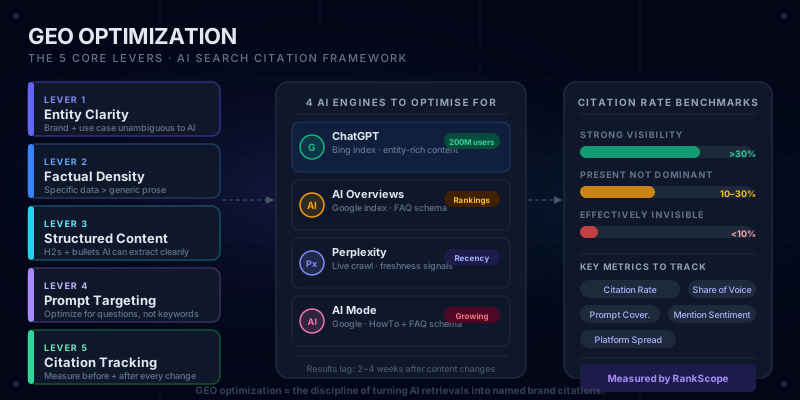
Assume you have picked a winnable query. These are the levers, in rough order of how much they change outcomes.
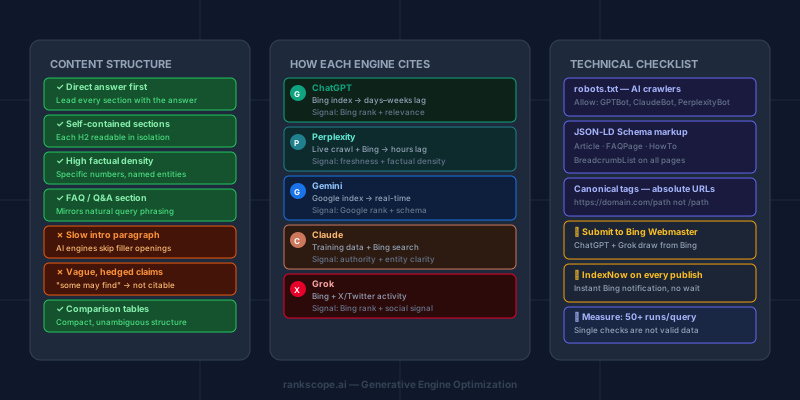
1. Answer the question in the first sentence
AI engines extract passages. A section that spends three sentences setting up context before reaching its point offers nothing extractable, and the engine moves on to a source that gets there faster.
This applies at every level: the page opening, each H2, and each FAQ answer. Lead with the claim, then support it. We have a fuller walkthrough of the structural side in how to optimize content for AI search.
Of everything in this list, this is the change we have seen produce results fastest, because it requires no new authority and can be applied to pages that are already being crawled.
2. Make every section stand alone
Retrieval works on passages, not whole documents. A section that opens with "as we saw above" or "building on this" loses its meaning the moment it is lifted out of the page, and a passage that does not make sense alone is a passage that does not get quoted.
Write each H2 as though it might be the only part of the page anyone ever reads. That means repeating a little context rather than referring backwards.
3. Raise factual density
Specific, checkable statements get cited. Hedged generalities do not.
"Most teams see improvement over time" is unusable to a model trying to answer a question. "Nine of nineteen results in this category were winnable at 30 referring domains" is a fact it can reproduce and attribute. Named entities, real numbers, dates and direct comparisons all raise density. Words like "various", "numerous" and "significant" lower it.
A useful test: if you deleted every qualifier from a paragraph and nothing factual remained, that paragraph will never be cited.
4. Get your entity description consistent
A model has to know what you are before it can recommend you for anything. That means describing the category you occupy and the job you do the same way everywhere: your homepage, your pricing page, your documentation, and the third-party sources the model already trusts.
Inconsistency is expensive here. If your own site calls you three different things, none of those descriptions reinforces the others, and the model has no stable entity to attach a recommendation to.
5. Target prompts, not keywords
Buyers type full questions into AI engines, and those questions carry qualifiers no keyword tool will show you: team size, industry, budget, integrations, compliance requirements.
"Best AI visibility tool" and "best AI visibility tool for an agency running 20 client brands" get different answers with different citations. The second is less contested and converts better.
This is also the strongest argument against consolidating pages that look duplicative. When we checked two of our own pages that appeared to compete on the same head term, they shared zero queries out of 171 across 90 days. Four pages in another cluster overlapped on 4.8% of 475 queries, and every one of those overlaps sat below position 20 with no clicks attached. Pages that look redundant on keywords are frequently separate assets on prompts.
Structured Data, and What It Will Not Do
Schema markup helps engines parse your page. It does not create authority and it does not make a claim true.
Two rules worth stating because both are commonly broken:
FAQ schema requires visible on-page questions and answers. Emitting FAQPage markup for questions that do not appear in the rendered page is ignored. The wording has to match too. We audited our own site and found 37 questions out of 408 where the schema and the visible copy had drifted apart, usually by a word or two: schema asking "How do I track AI visibility?" against prose asking "How can I track AI visibility?". Close is not a match.
The structural fix is to render both from a single source rather than maintaining two copies. If the schema and the page are separate hand-edited blocks, they will drift, and nobody notices because one of them is invisible.
Structured data is where stale claims survive audits. Because it never appears on screen, an outdated price or a discontinued feature can sit in your markup long after the visible copy was corrected. We found our own FAQ schema telling Google we retrieved AI answers through official APIs, which contradicted both the visible page and how the product actually works. Audit your markup with the same care as body copy.
Measuring Whether Any of It Worked
The common mistake is judging query-level work with sitewide numbers.
Impressions and average position aggregate populations that behave nothing alike: branded and non-branded queries, human and automated traffic, blue-link placements and AI citation slots. An average across all of those describes none of them.
We ran into this hard on our own data. Across 90 days, our branded queries at positions 1 to 3 took 58 clicks from 744 impressions, a 7.8% click-through rate, which is unremarkable and healthy. Non-branded queries at the same positions took 3 clicks from 888 impressions. Three clicks is too few to put a meaningful percentage on, which is rather the point: whatever the true rate is, it is not a rate that builds a business. A subset of longer, question-shaped queries produced zero clicks across 718 impressions in the top three. Every one of those results had an AI Overview sitting above the organic links.
We cannot prove from Search Console alone whether those clicks were absorbed by the AI answer or whether the queries were never human to begin with. Both explanations fit. What is certain is that ranking, on those queries, bought us nothing, and any decision made from the blended average would have been made on a number describing nobody.
So track these instead:
- Citation rate per prompt. Of the buyer questions you care about, what share of answers name you?
- Share of voice against named competitors on those same prompts. See how to calculate share of voice in AI search for the arithmetic.
- Which URLs the engine cited. This is frequently not the page you optimized, and it tells you where the authority actually sits.
- Before and after on one specific change, on a fixed prompt set. A diff between two dated runs is evidence. A moving sitewide average is not.
Run the same prompt set on a schedule. Answers shift as models update and competitors publish, so one snapshot tells you where you are and only a series tells you whether you are moving.
A Worked Example
Say you sell project management software to construction firms and you want to be cited for "best project management software for contractors".
Step 1, check the floor. Pull the AI Overview. Suppose it cites four sources and the weakest has 140 referring domains. You have 90. That is close enough to attempt.
Step 2, read what the answer is actually doing. In our category, nearly every AI Overview follows the same shape: a one-sentence definition, a categorised list of named products with a clause of description each, and a closing offer to narrow things down. If the answer lists products by category, a page organised by use case will be easier to quote than a ranked listicle.
Step 3, check the intent matches your buyer. This kills more targets than authority does. One term we measured had strong volume and a $49 cost per click, and its AI Overview turned out to be about agency retainers priced from $2,000 to $30,000 per month. Winning it would have delivered the wrong reader entirely.
Step 4, write to the shape. Open with a direct answer naming the category and the job. Give each contender its own self-contained section. Put specifics in: integrations, pricing, which trade each suits.
Step 5, set a baseline before you publish, then re-run the prompt set weekly. Without the before, you cannot attribute the after.
Common Mistakes
Optimizing gated queries. The expensive one. Ten of the nineteen results we measured were unwinnable at our authority, and publishing into them costs exactly as much effort as publishing into the nine that were open.
Treating Google as one surface. Google AI Overviews and Google AI Mode return different answers and cite different sources for the same question. A brand cited in one is regularly absent from the other. Together with ChatGPT and Perplexity, that is four surfaces to check, not three.
Rewriting a page that was already being cited. If a page is the one an engine draws on, restructuring it can cost you the citation. Diff before and after, and be ready to revert.
Assuming a citation is permanent. Citation sets turn over. We lost a citation we had held for months on one of our own target terms, and the only reason we knew was that we were re-running the prompt on a schedule. A launch-day check tells you nothing about September.
Trusting page-level link metrics. They are always optimistic, and they will tell you a gated query is open. Use domain-level numbers.
Where Tooling Fits
Manual work takes you a long way here. The ceiling is measurement. Running 30 to 50 buyer prompts across four engines by hand, re-running them weekly, and diffing the results stops being sustainable somewhere in the second month.
RankScope tracks brand visibility across ChatGPT, Google AI Overviews, Perplexity and Google AI Mode, capturing each response as it appears in a real browser rather than through an API. API responses are frequently sanitised or stripped of citations, so they do not match what your customer actually sees. Plans start at $49/mo ($39/mo billed annually) for 40 monitored prompts across ChatGPT and Google AI Overviews, and every plan includes diff detection, Share of Voice trending against named competitors, and Action Plans.
If you want to see where you stand before committing to anything, the free AI Visibility Checker runs real prompts against real engines with no account and no credit card.
Frequently Asked Questions
What is AI visibility optimization?
AI visibility optimization is the practice of changing your content, structure and entity signals so that AI search engines name and cite your brand when users ask questions in your category. It is the work of improving visibility, as distinct from AI visibility tracking, which measures it.
Is AI visibility optimization just SEO with a new name?
No. A blue-link ranking and a citation inside a generated answer are produced by different selection processes. A page can rank well organically and never be drawn on by the AI answer above it, and the reverse happens too. The foundations overlap, including crawlability, clear structure and credible sourcing, but the target outcome is different.
How do I know if a query is worth targeting?
Less reliably than most guides suggest. We built a method for this, measuring the weakest-authority domain in each AI Overview's citation set across 19 results, and then retired it: the minimum of a set is the least stable number you can compute, and AI citation sets churn more than 80% a month, so one reading is mostly noise. Two checks still earn their keep. If every source in an answer is an institution, a small site is not getting in. And if the answer is written for a different buyer than yours, volume does not matter. Beyond that, publish across a spread of intents and measure what happened.
How long does AI visibility optimization take to show results?
Content and structure changes on pages that are already crawled can surface within days, because AI answers regenerate as sources are re-indexed rather than waiting on ranking cycles. Entity and authority work runs on a scale of months. The variable that decides it is whether the query was winnable at your authority level to begin with.
Which AI engines should I optimize for?
ChatGPT and Google AI Overviews cover the majority of AI search interactions. Add Perplexity for research-heavy categories and Google AI Mode for complex B2B buying journeys. Treat Google AI Overviews and Google AI Mode as separate surfaces, because they return different answers and cite different sources.
Does schema markup improve AI visibility?
It helps engines parse your content, but it does not create authority or make claims true. FAQ schema in particular is ignored unless the same questions appear visibly on the page, and the wording in the markup has to match the wording in the prose.
Why do my pages rank without getting any clicks?
On AI-answered queries this is common. In 90 days of our own data, question-shaped queries at positions 1 to 3 returned zero clicks across 718 impressions, with an AI Overview sitting above the organic results every time. Either the answer satisfied the user or the query was never human. In both cases the position was not worth what the report implied, which is why citation rate is the more useful metric.