Generative Engine Optimization Tools: The Complete Comparison (2026)
Generative engine optimization (GEO) tools help brands track, measure, and improve how they appear in AI-generated answers from ChatGPT, Google AI Overviews, Perplexity, and Google AI Mode. They fall into four jobs: tracking what gets cited, optimizing content to earn citations, auditing for gaps, and reporting results to stakeholders.
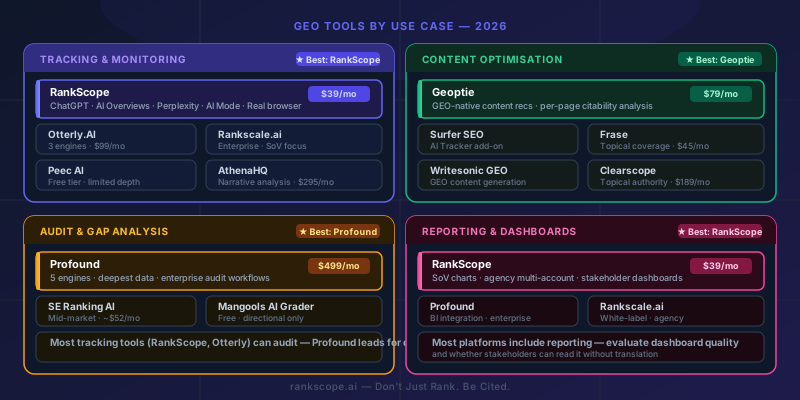
Which GEO tool you need depends on the job, not the ranking. RankScope is the tracking platform for teams that need both Google AI surfaces; Geoptie pairs tracking with content rewriting; Profound serves enterprise audit work; free graders answer "am I cited at all?" before you spend anything. Most roundups skip this and hand you a ranked list, which is useful for shortlisting and useless for deciding.
Top GEO tools by use case
- Free checks and a first baseline: Start with a free grader to establish whether you're cited at all. Our free AI visibility checker runs real prompts across all four engines with no account and no credit card; Mangools and HubSpot publish free graders of their own.
- Small budgets and first paid tracking: RankScope Starter at $49/mo, or $39/mo billed annually, covers ChatGPT and Google AI Overviews with 40 monitored prompts. Peec AI's free tier is the cheapest way to see ChatGPT and Perplexity data.
- Established SEO suites: Ahrefs Brand Radar and SE Ranking's AI toolkit bolt AI tracking onto rank tracking you already pay for. Weaker coverage, near-zero marginal cost.
- Content scaling and gap filling: Geoptie and Writesonic GEO connect a missing citation to a drafted fix, which suits teams whose bottleneck is production rather than measurement.
- Enterprise and deep analytics: Profound and AthenaHQ offer the widest engine lists and conversation-level analysis, at enterprise pricing with a sales cycle attached.
Core features to look for
- Multi-engine tracking: Coverage across the surfaces your buyers actually use, counting Google AI Overviews and Google AI Mode as the two separate surfaces they are.
- Citation intelligence: Which third-party sources an engine cites when it answers about your category, not merely whether your name appeared.
- Share of voice: Your citation share against named competitors, trended over time.
- Change detection: What specifically changed in a response between scans, so a drop is diagnosable instead of just visible.
New to the discipline? Start with what generative engine optimization is, then come back for the tool comparison below.
Why Tool Category Matters More Than Rankings
The "best GEO tool" question is only answerable once you know what you're trying to measure or fix.
A brand manager who needs to track weekly citation movement across four AI engines has very different needs from a content strategist who wants to know why a competitor keeps appearing in ChatGPT answers and their brand doesn't. The first person needs a monitoring platform with reliable historical data. The second needs content gap analysis and prompt-level diagnostics.
Running the wrong tool for your use case doesn't just waste money — it gives you the wrong data. A content optimization tool will tell you your page needs more subheadings. A tracking tool will tell you your citation rate dropped 12 points this month across Perplexity. Those are not the same insight, and you can't substitute one for the other.
The categories here aren't strict silos. Most established GEO platforms touch all four to varying degrees. But each tool has a center of gravity. That's what this guide maps.
Category 1: GEO Tracking and Monitoring Tools
Tracking tools answer the most fundamental GEO question: Is your brand being cited, and is that changing over time?
They query AI engines directly — using your actual prompt library (the questions your buyers ask), across statistically sufficient sample sizes — and record which brands appear, in what context, and with what sentiment. Done well, this produces citation rate, share of voice, per-engine breakdown, and trend data. Done poorly (manual checks, single-run queries, branded-only prompts), it produces data that looks real but isn't.
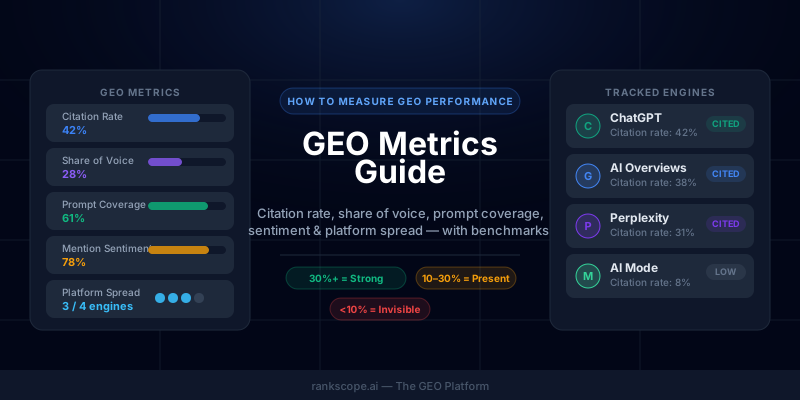
GEO metrics like citation rate and share of voice are the core outputs you're trying to get from tracking tools. If a platform doesn't produce these specifically, it's doing something adjacent to GEO tracking — not GEO tracking itself.
RankScope
Best for: Teams that need accurate, real browser-based tracking across all four major AI engines.
RankScope is the dedicated GEO tracking platform, built specifically to measure brand citation across ChatGPT, Perplexity, and both of Google's AI surfaces, AI Overviews and AI Mode. It runs your prompt library automatically, samples at scale, and surfaces citation rate, share of voice, mention sentiment, and per-engine performance in a single dashboard.
The detail that matters most for accuracy: RankScope uses real browser responses rather than API outputs. Google AI Overviews and AI Mode don't expose an API — the only way to get accurate data from them is to render responses the way a user would. Platforms that skip this step systematically miss a huge portion of the AI search landscape.
Forensic diff detection is the standout feature for monitoring — RankScope surfaces exactly when and how AI responses change, which brand was added or removed, and what context shifted. That's the kind of signal that tells you a content change worked, or that a competitor just earned a new citation you weren't tracking.
Pricing: Starter $49/mo · Pro $149/mo · Agency $399/mo (20% off annual). No setup fee, cancel anytime.
Best use cases: Citation rate tracking, share of voice monitoring, competitive intelligence, before/after content testing, weekly reporting dashboards.
Limitations: RankScope is a tracking and monitoring platform first. It surfaces what's happening and where — the content optimization work that acts on that data sits in your existing content tools.
Start tracking your AI citations →
Otterly.AI
Best for: Teams that want AI citation monitoring with a simpler setup and lighter UI.
Otterly.AI tracks brand mentions across ChatGPT, Perplexity, and Google AI Overviews. It's well-regarded for its clean onboarding experience and prompt management — useful for smaller teams that don't need enterprise-grade data depth.
Pricing: Plans start around $99/mo.
Limitations: Fewer engines tracked than RankScope (notably missing Google AI Mode), and the share of voice data is less granular for competitive benchmarking.
Rankscale.ai
Best for: Enterprise and agency teams that need share of voice benchmarking at scale with custom reporting.
Rankscale.ai focuses heavily on the competitive angle — tracking how brands stack up against each other across AI responses rather than just measuring individual citation rates. The platform is built for teams managing multiple brands or accounts simultaneously.
Pricing: Enterprise pricing, requires a sales demo.
Limitations: No self-serve pricing or sign-up. Minimum commitment is high, which makes it impractical for SMB teams or individual practitioners.
Peec AI
Best for: Small teams or individuals who want to start GEO tracking without a financial commitment.
Peec AI offers a permanent free tier covering ChatGPT and Perplexity — useful for establishing a citation baseline before committing to a paid platform. The free plan has meaningful limitations (fewer prompts, less historical data), but it's a legitimate starting point.
Pricing: Free tier available. Paid plans from approximately $49/mo.
Limitations: Engine coverage on the free tier is limited. Not built for the kind of statistical sampling depth you need for accurate citation rate measurement at scale.
AthenaHQ
Best for: Enterprise teams prioritizing depth of AI response analysis and brand narrative tracking.
AthenaHQ goes beyond basic citation tracking into the content of what AI systems say about brands — tracking narrative framing, competitor positioning within responses, and how AI platforms characterize brand attributes. It's built for larger brands where how you're described matters as much as whether you appear.
Pricing: Starting around $295/mo. Enterprise plans require a demo.
Limitations: Overkill for teams that just need citation rate and share of voice numbers. The pricing reflects the added analytical depth.
Category 2: GEO Content Optimization Tools
Content optimization tools answer a different question: What do I need to change in my content to get cited more often?
This is where the overlap with traditional SEO content tools gets significant. Platforms like Surfer SEO, Frase, and Clearscope were built to optimize for Google — but they've added AI visibility features as the market shifted. Some of these additions are meaningful. Others are badge-level ("we have an AI feature now").
The honest framing: most content optimization tools will tell you structural and topical signals that correlate with AI citation. Very few will tell you the specific prompt-level context that's causing an AI engine to favor your competitor. For that level of diagnostics, you need tracking data combined with content analysis.
Understanding the signals that make content get cited in AI search is worth reading alongside this section — it will help you evaluate whether a content tool's recommendations actually map to citation behavior.
Geoptie
Best for: Teams that want GEO-native content recommendations alongside citation tracking.
Geoptie is the most GEO-focused content optimization tool in this category. Unlike Surfer or Frase, which adapted from SEO, Geoptie was built with AI citation as the primary optimization target. It analyzes your page against citation patterns in AI responses and gives specific structural recommendations for improving citability.
Pricing: Plans from $79/mo.
Best use cases: Per-page content recommendations, identifying why specific pages aren't getting cited, pre-publication GEO checks.
Limitations: The tracking component is lighter than dedicated monitoring tools like RankScope. Strong for content teams running active optimization sprints; less useful as a standalone monitoring dashboard.
Surfer SEO (AI Tracker)
Best for: Content teams that already use Surfer for SEO and want AI visibility integrated into the same workflow.
Surfer's AI Tracker adds mention rate, average position, and visibility score for AI search into the Surfer dashboard. If you're already paying for Surfer and producing content there, the incremental cost of adding AI tracking is low.
Pricing: AI Tracker available as an add-on to existing Surfer plans.
Limitations: The AI visibility data is based on Surfer's proprietary methodology and doesn't surface the granular per-engine, per-prompt citation breakdown that dedicated GEO tools provide. Fine for high-level directional data; not a replacement for dedicated tracking if AI visibility is a priority metric.
Frase
Best for: Content optimization teams that want to improve topical coverage and factual density for both traditional SEO and AI citability.
Frase analyzes SERP competition and identifies content gaps in your pages. The correlation between comprehensive topical coverage and AI citation rate is real — AI engines favor content that answers questions completely. Frase is good at finding where your content falls short on topical depth.
Pricing: Plans from $45/mo.
Limitations: No dedicated AI citation tracking. Frase optimizes the inputs (content structure and topical coverage) but doesn't measure whether those inputs translate into actual citations.
Writesonic GEO
Best for: Teams that want content generation with GEO-oriented output baked in, not just post-hoc optimization.
Writesonic has positioned itself in the GEO content creation space — producing long-form content structured with AI citability signals (direct answers, factual density, structured headers). It's a content generation tool with GEO awareness, not a content audit tool.
Pricing: Plans from $20/mo (limited credits). Business plans from $99/mo.
Limitations: Content generation quality still requires human review and editing. The GEO structuring features help, but they don't replace the research and positioning judgment that makes content worth citing in the first place.
Clearscope
Best for: Enterprise content teams that prioritize topical authority and content grading at scale.
Clearscope has added AI visibility features to its content grading system. For large content operations — 50+ pieces per month — the ability to grade content for topical completeness at scale is genuinely useful, and the AI visibility angle aligns with the same signals (comprehensive, direct-answer content) that correlate with citation rates.
Pricing: Plans from $189/mo. Enterprise packages available.
Limitations: Pricing puts it out of range for smaller teams. Like Frase, it optimizes inputs without directly measuring citation output.
Category 3: GEO Audit Tools
Audit tools serve a specific moment: you need a systematic diagnostic of your current AI visibility across a defined scope — a website, a product category, a keyword set — before making a major content investment.
This is distinct from ongoing monitoring. Monitoring is a continuous stream of data. An audit is a point-in-time snapshot with a diagnostic lens — where are the gaps, how big are they, what's causing them.
Most full-platform GEO tools can be used for auditing (run your prompt library against your brand, check citation rates, compare against competitors). But a few tools have audit-specific workflows that make them particularly useful for this use case.
A solid GEO strategy typically starts with an audit — establishing a citation baseline before you invest in content changes. A free AI visibility checker is the quickest way to get that first number. That baseline is what lets you measure whether those changes worked.
Profound
Best for: Enterprise teams that need the deepest data across the broadest range of AI engines for pre-launch or quarterly audits.
Profound is built for scale. It covers more AI engines than most competitors (including Claude and Grok alongside ChatGPT, Perplexity, and Google), which matters when you're running a comprehensive audit for a brand with global reach and broad product categories.
The audit capabilities go deep: citation context extraction, competitive share of voice breakdowns, narrative analysis, prompt category mapping. For a major brand doing a pre-rebrand or post-product-launch AI visibility audit, Profound gives you more raw data than any other platform.
Pricing: Starting at $499/mo. Enterprise plans require a sales call.
Limitations: The cost is prohibitive for most teams unless AI visibility is a dedicated budget line. Self-serve onboarding is limited — most customers go through a sales process.
SE Ranking AI Toolkit
Best for: Marketing teams already on SE Ranking that want to add AI citation auditing to their existing SEO workflow.
SE Ranking's AI Toolkit bridges traditional SEO and GEO auditing. It tracks brand mentions in AI Overviews, surfaces which pages are generating citations, and flags where competitors are gaining AI coverage you're not.
For teams that already live in SE Ranking for keyword research and rank tracking, adding the AI Toolkit is a low-friction way to add GEO audit capability without adopting an entirely new platform.
Pricing: AI Toolkit is an add-on to SE Ranking plans (plans from $52/mo). AI Toolkit pricing varies by plan tier.
Limitations: SE Ranking's AI coverage isn't as deep as RankScope's four-engine real browser tracking or Profound's enterprise depth. Fine for periodic audits within a broader SEO workflow; not a replacement for dedicated GEO monitoring.
Mangools AI Search Grader
Best for: Teams that need a quick, free GEO audit snapshot before committing to a paid platform.
Mangools has released a free AI Search Grader that evaluates brand visibility across AI search engines and gives a structured report on citation patterns and content gaps. It's a lighter tool — useful for getting a quick baseline read before making a platform decision, or for one-off audits.
Pricing: Free.
Limitations: The depth doesn't compare to paid platforms. Use it as a directional input, not a definitive audit.
Category 4: GEO Reporting Tools
Reporting tools answer the question that gets asked in every quarterly business review: How is our AI visibility performing, and what is it worth?
This is the category that traditional SEO professionals will find most familiar — connecting activity (we published X, we changed Y) to outcomes (citation rate moved Z points, competitor share of voice dropped). The challenge with GEO reporting is that the output metrics are unfamiliar to most stakeholders. Citation rate and share of voice aren't in any traditional marketing dashboard, which means whoever owns GEO has to translate the data into terms a CMO or VP will act on.
Most dedicated GEO platforms include reporting as part of their core offering — this section focuses on the features that distinguish platforms for reporting-specific use cases.
RankScope (Reporting Use Case)
RankScope's dashboard is built with stakeholder reporting in mind. The share of voice visualization shows competitive position at a glance — the kind of chart that lands clearly in a board slide or a client call. Historical trend lines make the before/after story of a content investment legible.
For agencies running GEO for multiple clients, the Agency plan ($399/mo) supports multi-account management with client-facing reporting. See the full platform →
Rankscale.ai (Reporting Use Case)
Rankscale.ai has strong white-label and custom reporting features for agency use cases. If you're managing 10+ brands and need to deliver standardized AI visibility reports at scale, Rankscale's reporting stack is worth evaluating. The trade-off is sales-process-gated access and higher minimums.
Profound (Reporting Use Case)
Profound's enterprise positioning comes with enterprise reporting features — custom dashboards, scheduled data exports, and integration options for teams that want GEO data inside their BI tools. For a company that runs quarterly AI visibility reports as a formal business process, Profound's reporting infrastructure is the most mature in the market.
How to Choose: A Decision Framework
The right tool depends on where you are in your GEO maturity:
If you're just starting GEO: Begin with a tracking platform to establish your citation baseline before investing in content changes. RankScope's Starter plan ($49/mo) gives you the core data — citation rate by engine, share of voice, competitor comparison — that tells you what you're working with. Without a baseline, you're optimizing blind.
If you have a baseline and want to improve citation rates: Add a content optimization tool to your tracking platform. Geoptie is the strongest GEO-native option. If you're already in Surfer or Frase, use their AI visibility features first before paying for a separate content tool.
If you're preparing for a major launch or rebrand: Run a Profound audit for maximum data depth before making content investments. The cost is meaningful, but the diagnostic value before a high-stakes launch justifies it.
If you're reporting GEO to senior stakeholders or clients: Make sure your tracking platform has shareable dashboards and trend visualization. RankScope and Profound both clear this bar for most reporting scenarios. For agencies specifically, check whether multi-account reporting fits your workflow.
If you're on a tight budget: Peec AI's free tier for basic tracking and Mangools' free AI Search Grader for audits give you a starting point. Neither is a permanent solution — they don't have the statistical rigor for reliable citation rate measurement at scale — but they're better than no GEO data at all.
Tool Comparison by Category
| Tool | Tracking | Content Optimization | Audit | Reporting | Starting Price |
|---|---|---|---|---|---|
| RankScope | ★★★★★ | — | ★★★ | ★★★★ | $49/mo |
| Otterly.AI | ★★★★ | — | ★★★ | ★★★ | ~$99/mo |
| Geoptie | ★★★ | ★★★★★ | ★★★ | ★★ | $79/mo |
| Profound | ★★★★★ | — | ★★★★★ | ★★★★★ | $499/mo |
| AthenaHQ | ★★★★ | — | ★★★★ | ★★★★ | ~$295/mo |
| Peec AI | ★★ | — | ★★ | ★★ | Free |
| Rankscale.ai | ★★★★ | — | ★★★ | ★★★★ | Enterprise |
| SE Ranking AI | ★★★ | ★★★ | ★★★ | ★★★ | ~$52/mo+ |
| Surfer SEO | ★★ | ★★★★ | ★★★ | ★★★ | $89/mo+ |
| Frase | — | ★★★★ | ★★★ | ★★ | $45/mo |
| Mangools | — | — | ★★ | ★ | Free |
What's Missing from Most GEO Tool Comparisons
Three things consistently get underdiscussed in GEO tool roundups:
Engine coverage matters more than feature lists. A tool that tracks ChatGPT but not Google AI Overviews is missing a major source of AI-generated brand citations. Google AI Overviews are displayed for hundreds of millions of searches per day. If your GEO tracking platform doesn't cover them accurately — using real browser responses, not just API approximations — your data has a significant blind spot.
Sample size drives accuracy. Citation rate measurement is statistically noisy. A single-query run can show 100% citation or 0% depending on the session. Accurate citation rate requires 50+ runs per prompt, per engine. Tools that claim to give you "real-time" citation data from single-run checks are giving you noise, not signal.
The content side and the tracking side solve different problems. The best-resourced GEO teams use both: a dedicated tracking platform to measure citation baselines and monitor weekly movement, and a content optimization tool to act on what the tracking data reveals. Expecting a single tool to do both jobs equally well usually means it does neither particularly well.
For a comprehensive look at every major GEO tool ranked and compared in a single list, that post covers all nine platforms with detailed pros, cons, and pricing. If you're specifically evaluating platforms that operate at the intersection of LLM optimization and tracking, our LLM SEO tools guide goes deeper on that category with 15 platforms compared. This comparison approaches the same landscape through a use-case lens — the posts complement each other.
Common Questions About GEO Tools
How often should I run GEO tracking?
Weekly is the right cadence for most teams. GEO metrics don't move daily the way keyword rankings do — AI engines recalibrate their citation patterns on a slower cycle. Weekly tracking gives you enough data points to spot trends without burning through API budget on meaningless noise.
Can I use my existing SEO tool for GEO tracking?
Traditional SEO platforms like Semrush, Ahrefs, and Moz don't track AI citations. They measure Google keyword rankings and backlinks — data that doesn't include whether ChatGPT or Perplexity is mentioning your brand. The AI features some of these platforms have added are oriented toward traditional search, not AI citation measurement. You need a dedicated GEO tool for GEO tracking. Here's why GEO and SEO tools serve different needs.
How much should I budget for GEO tools?
A realistic GEO tool budget for most mid-market teams: $49–$149/mo for tracking (RankScope Starter or Pro), plus your existing content tool if it has AI visibility features. Enterprise teams running multi-account or brand-level reporting should budget $300–$500/mo for the tracking layer alone. If you're just starting out, the free tools (Peec AI, Mangools AI Search Grader) are a legitimate starting point to validate the use case before committing budget.
Do I need a GEO tool if my citations are already good?
Yes — tracking is how you know they're still good. Citation rates move based on competitor content changes, AI engine updates, and your own content evolution. A brand with strong AI visibility that stops measuring will eventually lose ground without knowing why. The brands that consistently maintain high citation rates measure continuously, not just when they suspect a problem.
Getting Started with GEO Measurement
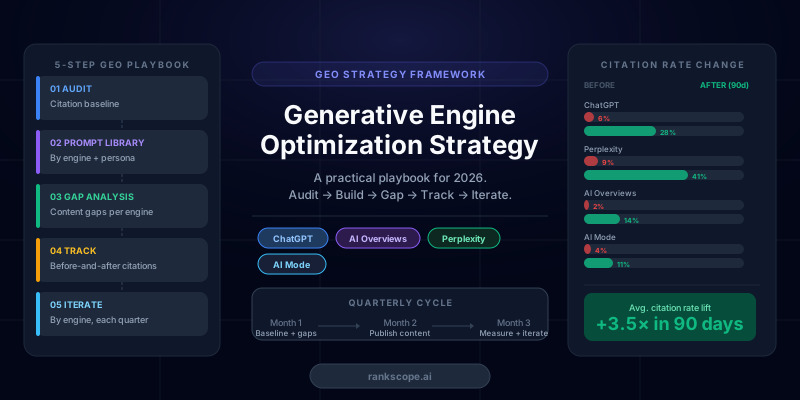
The single highest-leverage action for any brand starting GEO is establishing a citation baseline — a systematic measurement of where you stand across AI engines today, before you make any content changes.
Without a baseline, content optimization work is unmeasurable. You can publish a new structured guide, rewrite three landing pages, and add FAQ schema — and have no way to know whether any of it moved your citation rate.
RankScope's platform automates this baseline measurement on ChatGPT, Perplexity and Google's two AI surfaces — running your prompt library, sampling at scale, and giving you a citation rate and share of voice number you can actually track over time.
If you're evaluating where to start, the AI search visibility guide walks through exactly what the measurement looks like and what benchmarks to expect.
If you're also considering whether to hire a GEO agency or consultant rather than running tools yourself, see our overview of generative engine optimization companies — it covers the full landscape of who does GEO work and how to decide what combination of tools, agencies, and consultants makes sense.